
Audio reading of this section (English)
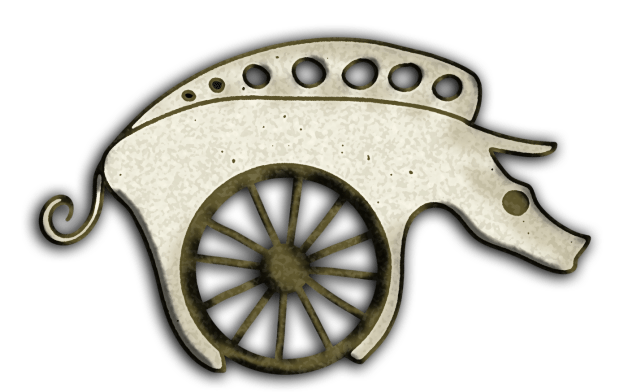
More research has been done on the domestic life of Senogalatîs in the past few decades. A refreshing thought as often the focus ends up on “elites” and what they did as opposed to how people lived day to day. By the time the various peoples of the Senogalatîs emerged, most people farmed. Agriculture and work related to it was the main “job” people had. So we apologize to those that thought the Senogalatîs were like Asterix and Obelix. Hunting for wild boar accounted for very little (virtually none) of the Senogalatîs diet! Though they were more than likely the first in Europe to invent the salted ham. They were at least the first Europeans documented making them. On the matter of pork and the Senogalatîs, Marcus Terentius Varro says in his commentary, ‘On Agriculture’ (2.4.10) the following:
“The Gauls are reputed to put up not only the largest quantity but the best quality of pork: evidence of its quality being that even now hams, sausage, bacon and shoulders are imported every year from Gaul to Rome…”
Marcus Terentius Varro, ‘On Agriculture’ 2.4.10
The main sources of meat were hogs, however. Cattle, sheep, and goats filled out much of the rest. Local fish would have been available to those near waterways, and occasionally a fowl or two. Wild beasts like deer and boars are very rarely found in archaeological sites. Occasionally horse as a meat source is, however, though it doesn’t appear very often and as such doesn’t seem to be a regular part of their diet. By about the fourth century AAC (second century BCE) we start to see a standardisation in the raising and culling of pigs and cattle, owing to the fast growing population and proto-urbanisation that was going on at the time.
More on the livestock of the Senogalatîs:
- Pigs and Cattle in Gaul: The Role of Gallic Societies in the Evolution of Husbandry Practices, by Delphine Frémondeau, Pauline Nuviala, and Colin Duval
- Standardized pork production at the Celtic village of Levroux Les Arènes (France, 2nd c. BC): Evidence from kill-off patterns and birth seasonality inferred from enamel δ18O analysis, by Delphine Frémondeau, Marie-Pierre Horard-Herbin, Olivier Buchsenschutz, Joël Ughetto-Monfrin, and Marie Balasse
For agriculture, grains were the most common food source. Wheat, barley, and spelt were the most common grains, but einkorn, oats, rye, and panic were known to the Senogalatîs as well. With these they made flatbreads, porridges, and used it in soups and stews. They could leaven bread using beer barm, but the loaves we know of today weren’t really known to them. At the least, as far as we know! Beyond this, legumes were the most commonly cultivated crops. Peas, lentils, broad beans, chickpeas, and vetch have been detected in finds. Also, they are known to have drunk milk from cows and to have made cheese and butter. The consumption of butter in particular was considered particularly strange to Mediterranean folks, especially the Romans who may have used it in poultices but didn’t think of eating it. Regarding the harvesting methods related to grains, Pliny the Elder had this to say in ‘Natural History’ (18.72):
“The mode of getting in the harvest varies considerably. In the vast domains of the provinces of Gaul a large hollow frame, armed with teeth and supported on two wheels, is driven through the standing grain, the beasts being yoked behind it; the result being that the ears are torn off and fall within the frame. In other countries the stalks are cut with the sickle in the middle, and the ears are separated by the aid of paddle-forks. In some places, again, the corn is torn up by the roots; and it is asserted by those who adopt this plan, that it is as good as a light turning up for the ground, whereas, in reality, they deprive it of its juices. There are differences in other respects also: in places where they thatch their houses with straw, they keep the longest stalks for that purpose; and where hay is scarce, they employ the straw for litter. The straw of panic is never used for thatching, and that of millet is mostly burnt; barley-straw, however, is always preserved, as being the most agreeable of all as a food for oxen. In the Gaulish provinces panic and millet are gathered, ear by ear, with the aid of a comb carried in the hand.”
Pliny the Elder ‘Natural History’ 18.72
Apples, pears, plums, and sloes are known to have grown where the Senogalatîs lived. Strawberries, raspberries and blackberries would have been found, as well as grapes. Along with such fruits and berries, various types of nuts and seeds would have also been consumed such as hazelnuts, acorns, and mast – though the last was more often eaten by pigs. A particularly interesting piece of farming technology is an ox powered harvester that garnered the admiration of contemporaries and later generations alike. It is mentioned in Pliny the Elder’s ‘Natural History’ (18.296):
“On their great estates the Gauls make use of a very large container with toothed sides and which is propelled by means of two wheels across a field of corn by a beast pushing in the contrary direction; the ears (of corn) cut off by this means fall into the container.”
Pliny the Elder’s ‘Natural History’ 18.296
In the same book, Pliny notes another agricultural innovation was the fertilisation of the soil with marl and/or limestone. (17.4)
“There is another method, which has been invented both in Gaul and Britain, of enriching earth by the [use of] marl [loose spoil of clay and lime]. This soil is looked upon as containing a greater amount of fertilising properties, and acts as a fat in relation to the earth […] The Aedui and the Pictones have rendered their lands remarkably fertile by the aid of limestone, which is also found to be particularly beneficial to the olive and the vine.”
Pliny the Elder’s ‘Natural History’ 17.4
More on the agriculture of the Senogalatîs:
- Contribution à l’histoire de la boulangerie romaine : étude de « pains/galettes » découverts en Gaule, by Andreas G. Heiss, Véronique Matterne, Nicolas Monteix, Margaux Tillier and Camille Noûs
- Harvesting by the Gauls: The Forerunner of the Combine Harvester, by Leslie G. Matthews
- Cheese Production in Gaul during the Iron Age and Roman period: State of Knowledge and Analysis of its place in the Ancient World, by Alain Ferdière and Jean-Marc Séguier
 Bessus Nouiogalation