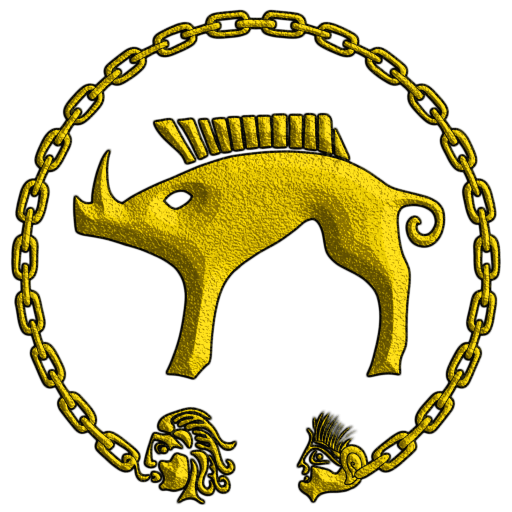
The symbol of Bessus Nouiogalation (BNG) has a few Gaulish elements displayed within it. At the center is a turcos (a boar). The turcos (boar) holds a position of prominence in Gaulish works and displays and is very much associated with them. For us, that means it was important to include it. It is indeed just as common in contemporary works related to the Gauls. The turcos represents galâ (bravery, strength, force, fire, animating vigor.) which may explain the widespread prominence and depictions of them from Gaul and beyond.
“Indigenous deities like Ogmios appear to be heroes par excellence, comparable to Herakles whose heroic deeds were already known in pre-Roman Gaul. In this view, it should not surprise us that Parthenios of Nikaia considered Hercules to be the ancestor of all Gauls, and that Ogmios could be seen as the god from whom all life originates.”
Ogmios holds a special position in BNG as ancestor of the Gauls. As Galatîs, we too include Him among our diverse ancestors. And so we attempt to reforge this connection in our contemporary environment. For this reason, surrounding the turcos are two heads linked by a golden chain. The head on the left is based on a head found on Gaulish coins that we used in the symbol to represent Ogmios. You can see His tongue being connected to the chain. On the right, you see another stylized head. It is representing a follower of Ogmios, with the chain attached to their ear. This allegory of chains connecting the tongue of Ogmios to the ears of His followers is based on a historical account from Lucian of Samosata. (Full account here.) For the relevant parts:
“Our Heracles is known among the Gauls under the local name of Ogmios… [That’s our Ogmios, Lucian!]
This ancient Heracles drags after him a vast crowd of men, all of whom are fastened by the ears with thin chains composed of gold and amber, and looking more like beautiful necklaces than anything else. From this flimsy bondage they make no attempt to escape, though escape must be easy. There is not the slightest show of resistance: instead of planting their heels in the ground and dragging back, they follow with joyful alacrity, singing their captor’s [Hard to say that of the willing, but okay…] praises the while; and from the eagerness with which they hurry after him to prevent the chains from tightening, one would say that release is the last thing they desire.”
So what we glean here is this: His followers follow Him willingly. They could escape at any time due to the weak bonds but choose not to do so. They follow Him willingly and gladly. This valuable account depicts an important insight into Ogmios and the nature of the followers. Thus we are fortunate to have such a piece of lore preserved.
Like these followers, we Galatîs could choose to break from the bonds of Bessus Nouiogalation (Custom of the New Gauls) if we so chose. These aren’t the chains of force or violence. Sadly far too common in the history and present of our world today. Nor is He guileful or deceitful. His eloquence, His îanolabâ (right speech) is His strength, and so He is followed. Equally so, we try to follow the customs of the Senogalatîs (Ancient Galatîs) in our own time. Freely and willingly. We do our best to make Bessus Nouiogalation available freely and openly to those called to or who desire to be Galatîs.
Ogmios’s chains bind only the willing who follow Him gladly. However, there are people around the world who do not have such gentle chains. Who are not bound to a Dêuos like Ogmios, but to cruel and barbaric people. As such, if you’d like to help people who have suffered such anuîrolaniâ (injustice), we’d ask you to consider making a datus (donation) here, to the organization ‘Not For Sale’. Which combats human trafficking and provides resources to survivors.
The Iextis — that is language — is a big part of Bessus Nouiogalation. It informs how we learn and develop custom greatly, as it seeks to develop along the lines of Galatibessus, which centres Gaulish worldview in development. This is why the language is so important, and is privileged over English in our articles and server. After all, English gets plenty of privileges as is.
Without a doubt, learning Gaulish is difficult due to conflicting reconstructions of the tongue, and uncertainties amongst what we do know. As Bessus Nouiogalation means “Custom of the New Galatîs” or “Neo Gaulish Custom”, it is of prime importance that we provide an outlet to help folks who want to put a little more Gaulish in their lives. Whether or not they undergo an in depth study of the language.
The words and phrases provided will be a combination of attested Gaulish. Supplied mostly by Xavier Delamarre’s works ‘Dictionnaire de la Langue Gauloise’ and ‘Les Noms Gaulois’. Along with input from Ranko Matasovic’s ‘Etymological Dictionary of Proto-Celtic’. With reconstructions informed also mainly by Iuomâros Cunouellauni’s Iextis Galation, and buttressed with Olivier Piquerron’s Yextis Keltika (along with the English translation thereof by Tegos Skribbatous). Other sources will be neologisms of attested and reconstructed words that we make ourselves, and pieces of other sources. The idea for this document is based off a previous document with a similar aim written for Toutâ Galation by Selguiros Caranticnos.
While referencing these works it is important to understand that the use of this tanuâ (tongue) is not to academic ends, but instead a key part of Gaulish revival. By using the language we not only remember and honour the Galatîs of the past, but solidify the Nouiogalatis identity of the present and with our greatest hope — the future.
For those not in BNG, especially fellow Galatîs, this document intends to help revive the use of at least a form of Gaulish. We cannot promise complete accuracy, but we’ve given it our best. Hopefully this document provides you with some useful Gaulish or at least Neo-Gaulish words that allow you to bring some of the language into your own life. Also, to understand some of the Gaulish phrases you may see or hear. Peruse at your leisure. All are welcomed and encouraged to participate.
Atelabâmos Iextis Galation! (We speak the Gaulish language again!)
Sounds
Vowels
Vowel are pretty simple. Five vowels each with two sounds. A short and long version.
It should be mentioned that regarding vowels, these are approximations. It is certain that there would have been different accents. As such, think of the vowel pronunciations as more of a guideline than a given. This allows one to see what we figure the sounds would have been. However vowel pronunciation tends to be a marker of accent and it’s okay to be different.
Why the circumflex? The accent marking our long vowels here â, ê, î, ô, and û is called a circumflex. While at first the choice to use these to mark our long vowels as opposed to the usual macron like in: ā, ē, ī, ō, and ū seems a strange one. The reason why it is done here is actually to honour one of the first widespread Gaulish language reconstructions — Labarion, which used the circumflex to mark long vowels. While in Gaulsh writings and inscriptions no such marks exist, we want to honour a dialect that contributed much to the revival of Gaulish usage in the community.
Semi-Vowels
There are two semi-vowels. The letters iand u. Other than their vowel sounds in the above table, they also have consonant sounds.
(For English speakers, the ‘i’makes a ‘y’sound. For Romance language speakers, when used as a consonant, the ‘i’ makes an English ‘y’. For other Germanic language speakers, the ‘u’ is an English ‘w’.)
A general rule for knowing when a semi-vowel is acting as a vowel, and when it is acting as a consonant is this: If there is a vowel after i or u, they are consonants. Example: Iextis, and Uediâ. The first i in iextis is a consonant, as is the u in uediâ.
Why use i and u as semi-vowels when other reconstructions use letters like j, y, and w? This is for two reasons. The first being that those three letters did not exist in Gaulish. The second is that if w or y was used, it would unfairly centre English. Just as one doesn’t change the spelling of say Latin or Greek to suit another language, neither will we.
Diphthongs
Diphthongs are vowel clusters. There are a few of these in Gaulish:
It is worth noting that these do not apply if they are at the conjunction of two words being put together to make one word (E.g. Areuiros, it’s are- then uiros).
Consonants
With the consonants, they’re also quite simple to pronounce. There are a few slight variations that we’ll visit:
For English and Romance language speakers, it’s important to note that the ‘c’ is always “hard”. Always a ‘k’ sound, never an ‘s’ or ‘ç’. The ‘g’ always like (for English speakers) “get”, as it is in Latin (for those who speak Romance languages). Also, for both groups, ‘x’ is like Scottish loch or Welsh bach. It’s called a voiceless velar fricative. For Germanic language and French speakers, the ‘r’ is rolled like in Spanish.
When a consonant doubles (E.g. aballon) pronounce both (abal-lon).
Now… for the fun part!
We have gone over some basics of pronunciation, and now are ready to get into words and phrases. In this document, we aren’t really going to go over grammar as the goal of it is to get you speaking some Gaulish. Stay tuned for more about that in later installments.
There will be a few attested phrases in here, and attested words will be given preference. Neologisms will of course be necessary for words for things that didn’t exist in the time of our ancestors (E.g. Bituuegâ for ‘Internet’). Plus, we’ve made plenty such words by combining whole attested words and using prefixes, suffixes, and infixes. Along with participles and substantives.
Last thing, do not expect a literal one for one exact translation here between Gaulish and any other language. We’ll use Gaulish to convey an idea, but it doesn’t mean each word can be broken down to mean the exact same words in your usual language.
Bisiomos cintus. (We will start.)
[Example there. Cintus means “first” but we’ve worked it to mean “start”.]
For speaking to multiple people, take the word “te” which means “you” in the accusative case (when speaking directly to someone)and replace it with “suos” (the plural form). For ease of use, this pronoun is being separated. But normally, following a verb or preposition, the pronoun would be attached to the word. E.g. uerte instead uer te, or Labâiumite instead of Labâiumi te.
Vocabulary
Greetings and Partings
Subutâ! (“Hello!” or “Goodbye!”)
Rocenon! (“Hello!” but for someone you know well.)
Slanon te! (“Health to you!” as either a toast, or as a more formal greeting.)
Suauelon! (“Bye!” lit. “Good wind!”)
Atepissiumi te! (“I will see you again!”)
Ðironâ nessâtu te. (“Ðironâ approach you.” This can be a morning or evening greeting/blessing.)
Alaunâ nessâtu te. (“Alaunâ approach you.” This is a morning greeting/blessing.)
Suuarin! (“Good morning!”)
Diion dagon! (“Good day!” This can be a usual greeting as well. Perhaps also to send someone off…)
Dercon Grannî uer te. (“Eye of Grannos upon you.” An afternoon greeting/blessing.)
Suarenoxten! (Good evening!)
Noxten dagan! (Good night!)
Text Related Expressions
These expressions are similar to what one sees in text messages and online chats.
Suariumi ueroxos! [suo] (“I laugh on high!” [lol])
Brissumi exsuartû! [bexs] (“I burst from laughing!” [rofl, lmao])
In mon dercû… [imd] (In my eye… [imo])
Incors boccâ iton! [icbi] (“Shut your mouth!” [stfu])
Gniumi. [gm] (“I know.” [ik])
Ne gniumi. [ngm] (“I don’t know.” [idk])
Ne carâiumi. [ncm] (“I don’t care.” [idc])
Sindos. [sin] (“This.”)
Simple Phrases
Lubiumi te! (“I love you!”)
Iâiumi uercon. (“I’m going to work.”)
Biie iaccos disergiosc. (“Be you healthy and removed from sickness/pain.”)
Etic Sucellê boîtu ordon clitân! (“And Sucellos strike hammer to post!” [Don’t let the door hit your behind on the way out!])
Immi rios exuergû. (“I’m free from work.”)
Delge curmi imon… (“Hold my beer…”)
Gentian dagan! (“Happy Birthday!”)
Cobon dagon! (“Good luck!”)
Suuercon! (“Good work!”)
Dêuoi cantite. (“Dêuoi with you.”)
Sagiumi mon uerouos! (“I try my best!”)
Uores mê! (“Help me!”)
Bratun (/Braton) te! (“Thank you!”) [For plural, substitute “te” for “suis” or “suos”.]

 Bessus Nouiogalation