
Audio reading of this section (English)
The Senogalatîs were certainly known for their presence in battle. It is the Senogalatîs in battle that form the majority of accounts about them. Leaving very little written records themselves, our sources about the Senogalatîs are generally from the accounts of Mediterranean peoples such as the Greeks and Romans. Often as enemies in battle. Due to this, such sources should be scrutinised closely. Much like today, such accounts are generally one sided and are prone to exaggeration. This is not to say the Senogalatîs did not do things worth frowning upon, but their wrongs are more likely to be embellished and the wrongs of those writing of their own people are more likely to be diminished.
As they were involved in many different battles and wars, it would be an unwieldy commentary to talk of each of them. Mostly, we will focus on equipment, tactics, and approaches to battle. Expect a few accounts of battles to be here, however. Since we’re dealing with the subject of war, reader discretion is advised.
Early on in their warfare, swords were the more common weapon. This suggests (as swords were quite expensive for millennia) that most battles were fought among specific groups of well off warrior types. This lends support to the idea that warfare in this very early time of the Senogalatîs (the end of the Isarnoberios – Hallstatt era) was conducted as relatively small-scale affairs. It would be some time before they would see massive, large-scale battles.
This is an example of a sword wielded by a Senogalatis. It dates roughly to the 4th or 5th century AAC, the 3rd or 2nd century BCE.
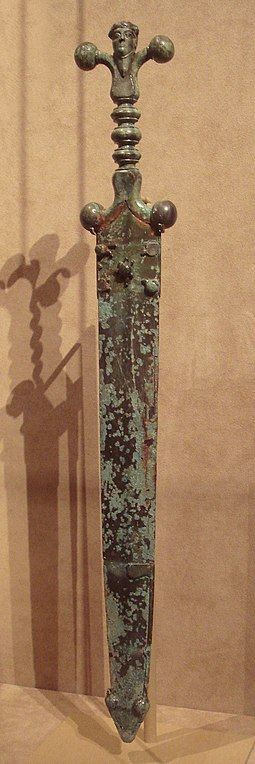
This cladios (sword) dates from the early 6th century AAC, or mid 1st century BCE. Showing again, an anthropomorphic design on the hilt.

Cladioi (swords) certainly didn’t fall out of use as the years went on. Into the Laticos (or LaTène) period, warfare simply included more people. Including those who probably couldn’t afford something so expensive as a sword. This is the time gaisoi (spears) start to take precedence as a weapon of foot soldiers. While swords reamined the province of a wealthier warrior class. Another Senogalaticos (Ancient Gaulish) word lanciâ gives birth to the word ‘lance’. Of course, in Gaulsh that c would have been “hard”, not “soft”.
Spearheads used by the Senogalatîs. [Photo from mauiceltic.com]

There were other weapons of course. They simply didn’t have metal components and so would not have survived by the time archaeologists would have been able to dig them up. For example, we know they had archers as is evidenced in Julius Caesar’s ‘Di Bello Gallico’ (7.31) when speaking of Uercingetorix (Vercingetorix) recruiting armies to defend Senogaliâ (Ancient Gaul) against the Roman invasion:
“…At the same time, that his diminished forces should be recruited, he levies a fixed quota of soldiers from each state, and defines the number and day before which he should wish them brought to the camp, and orders all the archers, of whom there was a very great number in Gaul, to be collected and sent to him…”
Julius Caesar’s ‘Di Bello Gallico’ 7.31
Iron and bronze arrowheads have been found in a few tombs, further correlating that they had bows and arrows (as many other peoples across the world did), and late in their time did use them in battle. Without a doubt, they were used in hunting. In the defence of the dunâ (fortified towns), it is known that they also utilised slings. One Senogalatis apparently fired one successfully in a battle against Julius Caesar’s men, noted in ‘Di Bello Gallico’ (5.35):
“…L. Cotta, the lieutenant, when encouraging all the cohorts and companies, is wounded full in the mouth by a sling.”
Julius Caesar’s ‘Di Bello Gallico’ 5.35
Clubs, axes and knives are also known. The former is depicted on iconography of a number of Dêuoi (beings worshipped by the Senogalatîs) but their use in battle is unknown, and probably extremely rare if it happened at all. The latter two as tools, with again no proof that the Senogalatîs used them as weapons of war. For defence, it varied by what one could likely afford (or loot). This affected both the type of armour, if any, and the quality of it. The body could be covered by thick woollen clothes, or in rare cases chainmail (possibly an invention of the Senogalatîs). In a few cases we have warriors who went to battle in the nude. This was accounted for with the Gaisatoi (Gaesatae). However, this notion of naked Senogalatis warriors became a hugely common misconception. In almost all cases, the Senogalatîs were at the least clothed going into battle. Though sometimes without a tunic.
According to the Histories by Polybius of Megalopolis, (2.31):
“When the men who were armed with the javelin advanced in front of the legions, in accordance with the regular method of Roman warfare, and hurled their javelins in rapid and effective volleys, the inner ranks of the Celts found their jerkins and leather breeches of great service…”
Polybius of Megalopolis, 2.31
As such, we have a record of them wearing clothes of leather and jerkins. It was common that cloaks were worn (in general, not just in battle) and they often had ovular shields that covered much of their bodies.
Diodorus Siculus, in his ‘Library of History’ describes the Senogalatîs in clothing and armour as such (5.30):
“The clothing they wear is striking — shirts which have been dyed and embroidered in varied colours, and breeches, which they call in their tongue bracae; and they wear striped coats, fastened by a fibula on the shoulder, heavy for winter wear and light for summer, in which are set checks, close together and of varied hues. For armour they use long shields, as high as a man, which are wrought in a manner peculiar to them, some of them even having the figures of animals embossed on them in bronze, and these are skillfully worked with an eye not only to beauty but also to protection. On their heads they put bronze helmets which have large embossed figures standing out from them and give an appearance of great size to those who wear them; for in some cases horns are attached to the helmet so as to form a single piece, in other cases images of the fore-parts of birds or four-footed animals. Their trumpets are of peculiar nature and such as barbarians use, for when they are blown upon they give forth a harsh sound, appropriate to the tumult of war. Some of them have iron chain-mail, but others are satisfied with the armour which Nature has given them and go into battle naked. In place of the short sword they carry long broad-swords which are hung on chains of iron or bronze and are worn along the right flank. And some of them gather up their shirts with belts plated with gold or silver. The spears they brandish, which they call lanciae, have iron heads a cubit in length and even more, and a little under two palms in breadth; for their swords are not shorter than the javelins of other peoples, and the heads of their javelins are larger than the swords of others. Some of these javelins come from the forge straight, others twist in and out in spiral shapes for their entire length, the purpose being that the thrust may not only cut the flesh, but mangle it as well, and that the withdrawal of the spear may lacerate the wound.”
Diodorus Siculus, ‘Library of History’ 5.30
A couple of misconceptions are here. Nudity was not a common occurrence in battle among the Senogalatîs, which we have already discussed. The second has to do with helmets. While indeed very elabourate helmets have been found that belonged to them, these were more for ceremonial purposes. (According to Jean-Louis Brunaux in ‘Guerre et Religion en Gaule’ p.56)
A “Coolus” type helmet (left). [Musée du Cinquantenaire, Brussels] An “Agen” type helmet (centre). [St-Germain-en-Laye] A helmet from Manching in Bavaria (right). [Celtic Museum Manching] All representatives of the kinds of helmets the Senogalatîs actually wore in battle. [Musée du Cinquantenaire, Brussels]

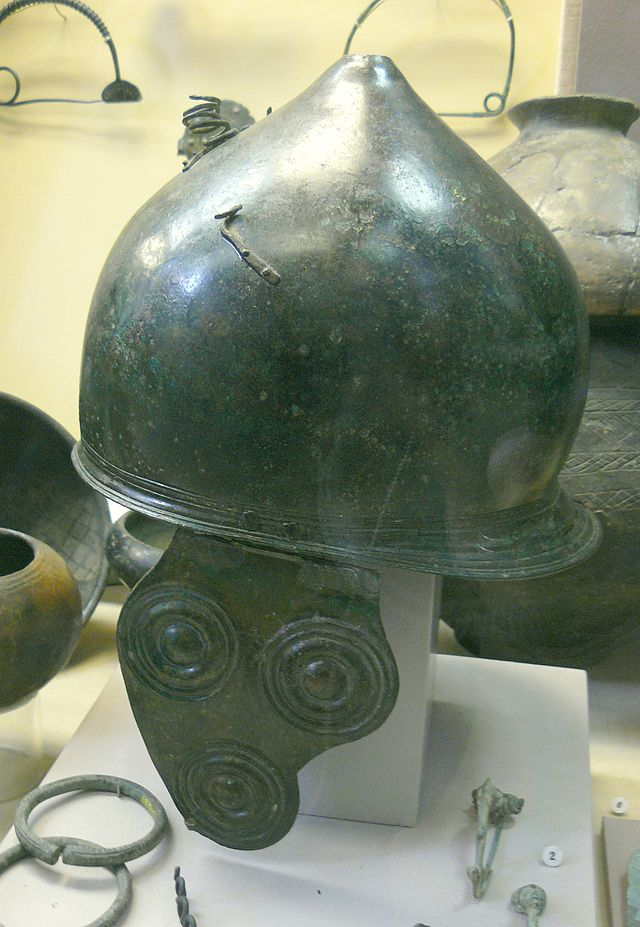
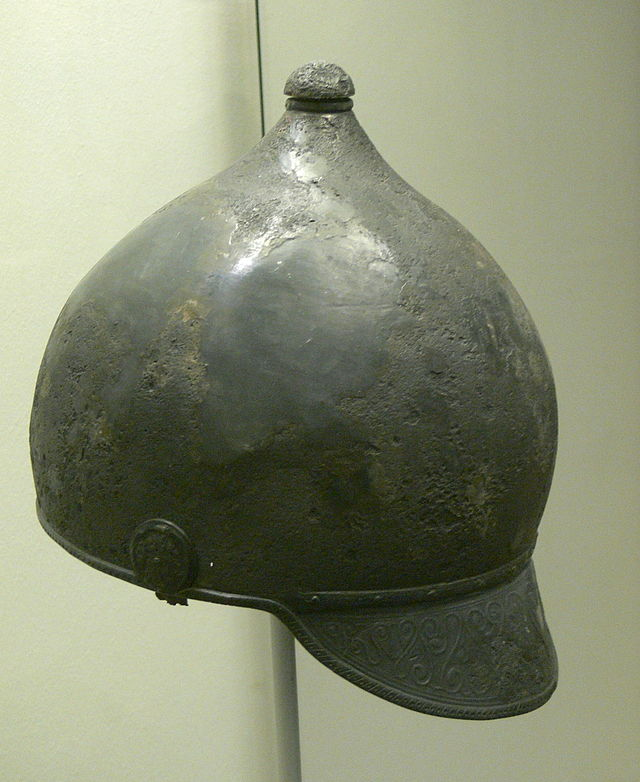
In summation, we can imagine the typical Senogalatis warriors. Often with a spear, but sometimes a sword. With a bronze or iron helmet if they wore one. The large cloaks of linens or wool, woollen pants that are sometimes supported with leather. Straps of leather for a little extra protection, but mainly relying on their large ovular shields.
Armour and garb typical of the Senogalatîs, a design based on accounts. [Museum Kelten-Keller]

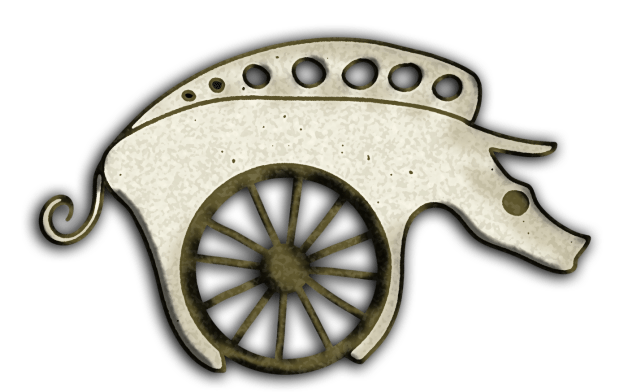
We have spoken of what the cingetos – warrior – looked like. Now we will talk about a couple of other items related to battle. The first will be that of the standard. We don’t have very many of these as per finds, but there is a gorgeous one dating to the 4th-5th century AAC (1st century BCE) that is a brass boar. Boars feature prominently in Senogalatis art. Through this artefact, we can see that they utilised standards.
The brass boar standard from Soulac-sur-Mer. [Hallein Keltenmuseum]

Another enigmatic item, used for what essentially amounted to psychological warfare was a large and beautiful instrument, the carnux (carnyx). This was also presumably used in rituals, but certainly had use for war. The characteristically unique sound from this large wind instrument was frightening to those not familiar with its sound, and rousing to those who did know it. The height of this instrument, and that it was played with the instrument in an upright position meant that it could be heard over the din of battle.
The famous Tintignac Carnyx, found in Corrèze, France. [Wikimedia Commons]

Here is a link to a song played on a replica of the Tintignac Carnux (carnyx) by John Kenny Read of the European Music Archaeology Project:
Pulse – Tintignac Carnyx
Typically speaking, warfare to the Senogalatîs was smaller in scale compared to the great wars of peoples to their south. These were usually done in the form of raids – one side doing the raiding, the other defending against it. Thus they favoured loose formations that allowed warriors to individually show off their abilities and demonstrate their courage in battle. In some cases, this meant single combat. A warrior chosen from each side to determine the outcome of the battle. There is no copy of course of the codes which bound the different Senogalatis nations to such terms. We then do not know how often they were held to or broken, but there does appear to be some idea of how battle is supposed to be done. Though we of course do not know for certain the specifics.
For a taste of the way the Senogalatîs engaged in battle among their own, Diodorus Siculus in his ‘Library of History’ offers this (5.29):
“In their journeyings and when they go into battle the Gauls use chariots drawn by two horses, which carry the charioteer and the warrior; and when they encounter cavalry in the fighting they first hurl their javelins at the enemy and then step down from their chariots and join battle with their swords. Certain of them despise death to such a degree that they enter the perils of battle without protective armour and with no more than a girdle about their loins. They bring along to war also their free men to serve them, choosing them out from among the poor, and these attendants they use in battle as charioteers and as shield-bearers.
Diodorus Siculus, ‘Library of History’ 5.29
It is also their custom, when they are formed for battle, to step out in front of the line and to challenge the most valiant men from among their opponents to single combat, brandishing their weapons in front of them to terrify their adversaries. And when any man accepts the challenge to battle, they then break forth into a song in praise of the valiant deeds of their ancestors and in boast of their own high achievements, reviling all the while and belittling their opponent, and trying, in a word, by such talk to strip him of his bold spirit before the combat. When their enemies fall they cut off their heads and fasten them about the necks of their horses; and turning over to their attendants the arms of their opponents, all covered with blood, they carry them off as booty, singing a tribute over them and striking up a song of victory, and these first-fruits of battle they fasten by nails upon their houses, just as men do, in certain kinds of hunting, with the heads of wild beasts they have mastered.
The heads of their most distinguished enemies they embalm in cedar oil and carefully preserve in a chest, and these they exhibit to strangers, gravely maintaining that in exchange for this head some one of their ancestors, or their father, or the man himself, refused the offer of a great sum of money. And some men among them, we are told, boast that they have not accepted an equal weight of gold for the head they show, displaying a barbarous sort of greatness of soul; for not to sell that which constitutes a witness and proof of one’s valour is a noble thing, but to continue to fight against one of our own race, after he is dead, is to descend to the level of beasts.”
It would appear, in reference to the final line that the removal of the enemy’s head, that it was not a continuation of the fight, but of cultural importance. Whatever judgement one may pass on them for this practice (it is certainly and obviously not done today) it pales in comparison to the many more objectionable practices of many others throughout history. It should also be mentioned that large scale battles among nations weren’t unheard of. But were – at least potentially – inferred by both their preferred method of battle coupled with a lack of mention in sources regarding large scale battles among Senogalatis nations, the exception rather than the rule.
Another account which speaks of another battle tactic of the trimarcisiâ. A move that allowed for constant rotation during conflict on horseback. In Pausanias’ ‘Description of Greece’ (10.19.11):
“I believe that the Galatai in adopting these methods copied the Persian regiment of the Ten Thousand, who were called the Immortals. There was, however, this difference: the Persians used to wait until the battle was over before replacing casualties, while the Galatai kept reinforcing the horsemen to their full number during the height of the action. This organization is called in their native speech trimarcisia, for I would have you know that marca is the Celtic name for a horse.”
Pausanias’ ‘Description of Greece’ 10.19.11
Typically speaking, the Senogalatîs liked to lead charges into enemy lines. Formations were generally loose, allowing each combatant to demonstrate their prowess, courage, and spirit. We find in this a different attitude to warfare, as opposed to a deliberate lack of sophistication. The objective of warfare was generally to seize portable treasures and for glory, as opposed to a motive of conquest. That did happen at times, but doesn’t appear to be the norm. Overpowering another nation was generally to take valuables and potentially exact tribute. This is generally how nations acquired power. Larger nations like the Aruernoi (Arverni), the Aiduoi (Aedui), Eluetoi (Helvetii), and the Bituriges built power this way by a system of client nations who received protection from other large nations in exchange for tribute. This being a quite common method of smaller nations surviving in the presence of larger ones. It was technically possible to change what nation a smaller nation was a client under. Both parties had strict, long embedded obligations to each other. Forms of this exist on a global scale even today – though the stakes reflect the scale. In part, this contributed to the fluctuations in primacy different nations had among the Senogalatîs. Attracting, or taking clients added to the power and influence of the larger nation. The client nation would be protected against encroachment from other nations. As notions of conquest seen in the Mediterranean and Middle East at the time were mostly (but not completely) foreign to them. Especially as the lands they were from were less and less able to support them. Remembering that they had next to nothing like the level of technology that we have today. All in all, the Senogalatîs were an imposing presence on the field of battle. When they weren’t the active fighting force, they were mercenaries that were highly sought for their courage and skill. Even at the risks they sometimes presented, it was never enough to discourage their use.
 Bessus Nouiogalation