
Audio reading of this section (English)
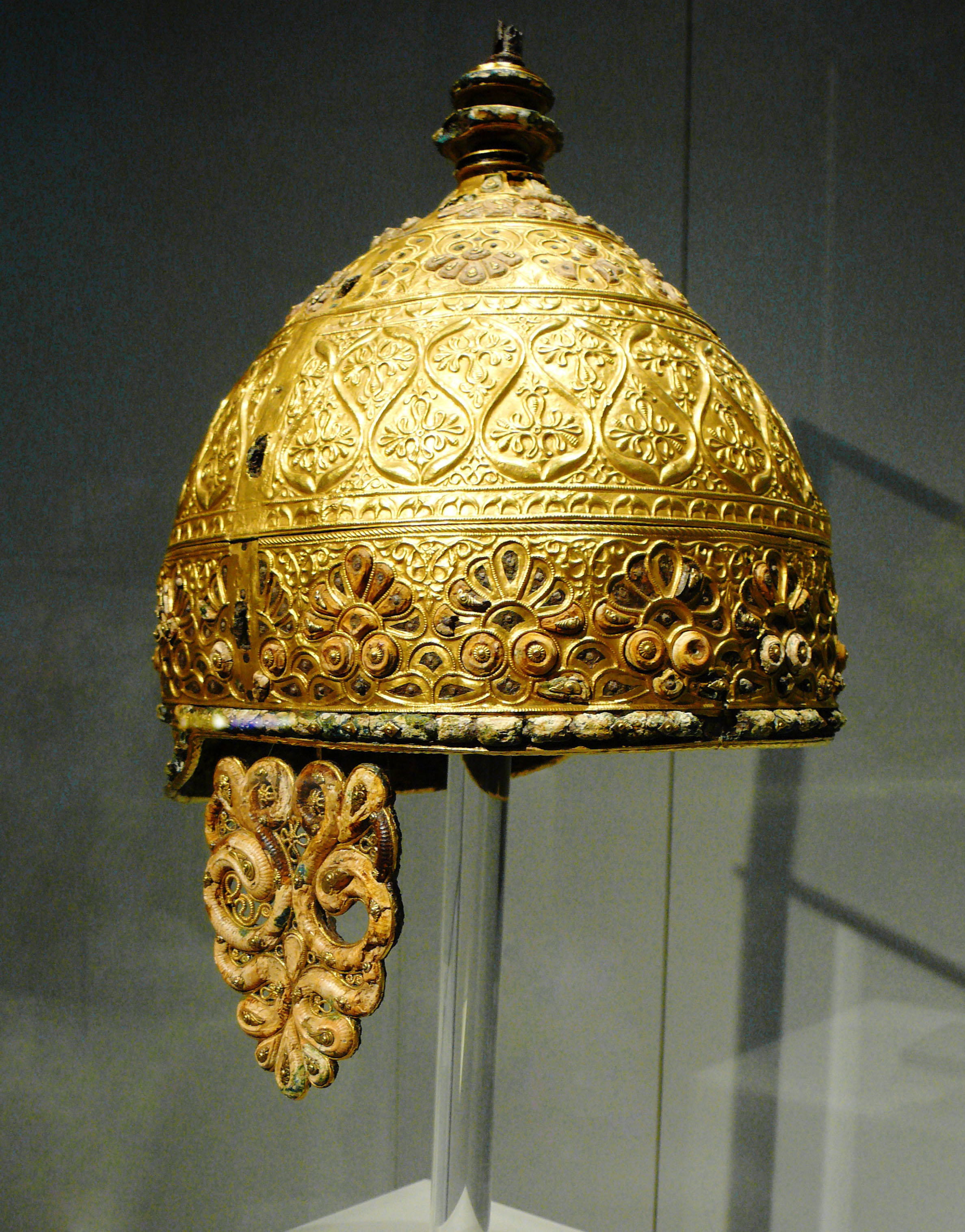
The most defining archaeological feature of both the Senogalatîs and the Laticos (LaTène) period is their distinct styles of artwork. Marked often by the swirled, curved, and vegetal patterns common to their designs. One fine example is the Agris Helmet, which is gold plated and has exquisite detail. The vegetal and curved patterns on it being some of the trademarks of the age.
The gold plated Agris helmet, exemplary of Senogalatis art. [Wikimedia Commons]
The Mšecké Žehrovice Head exemplifies the rise in depictions of the human head in the art of the Senogalatîs. They were a favourite motif, and the aforementioned head has striking, wide eyes as well as the commonly sported moustache of the time period. At the base, the ever present torcos (torc) around his neck.
The Mšecké Žehrovice Head. [Wikimedia Commons]

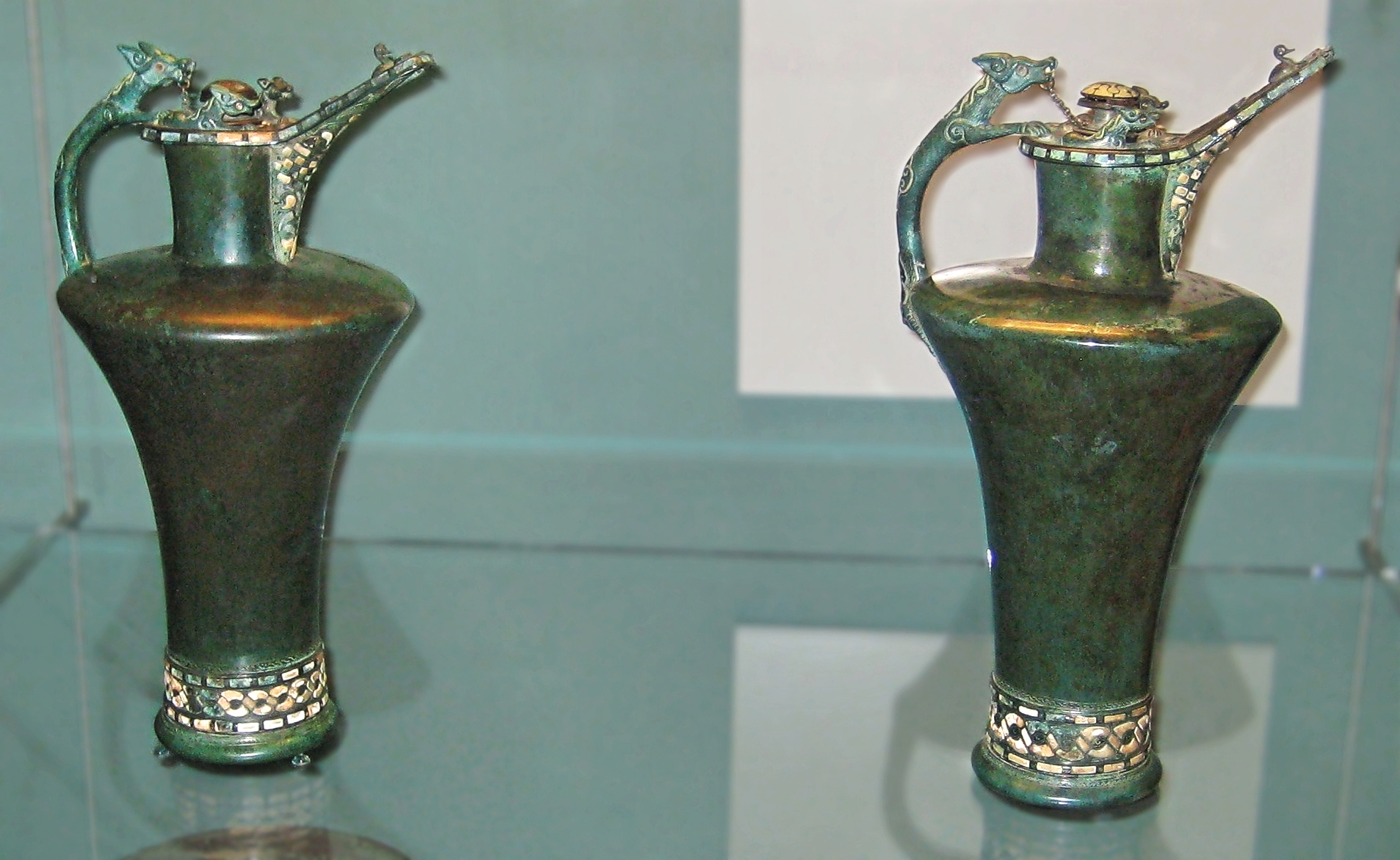
The Senogalatîs were well in touch with the world around them and their art shows influence from many cultures contemporary to them: Greek, Etruscan, Roman, further out still Thracian and Scythian. Along with that, drawing upon their rich Isarnoberios (Hallstatt) heritage. However, even with all of these influences they were not dependent on any of them and it took little time for their own distinct artworks to develop regardless of influence. It is rare that they ever simply copied anything, save for perhaps at the beginning. After all, why copy what you’re already importing? They were curious enough to learn, but creative enough to develop their own styles based on whatever they may have learned and what they already knew.
The Basse Yutz Flagons. An example of the Seongalatîs employing Etruscan shape of the vessel, and Mediterranean motifs in a uniquely Galaticos (Gaulish) fashion. Thus, their ability to learn and utilise styles and techniques from other peoples to make their own original works. [British Museum]
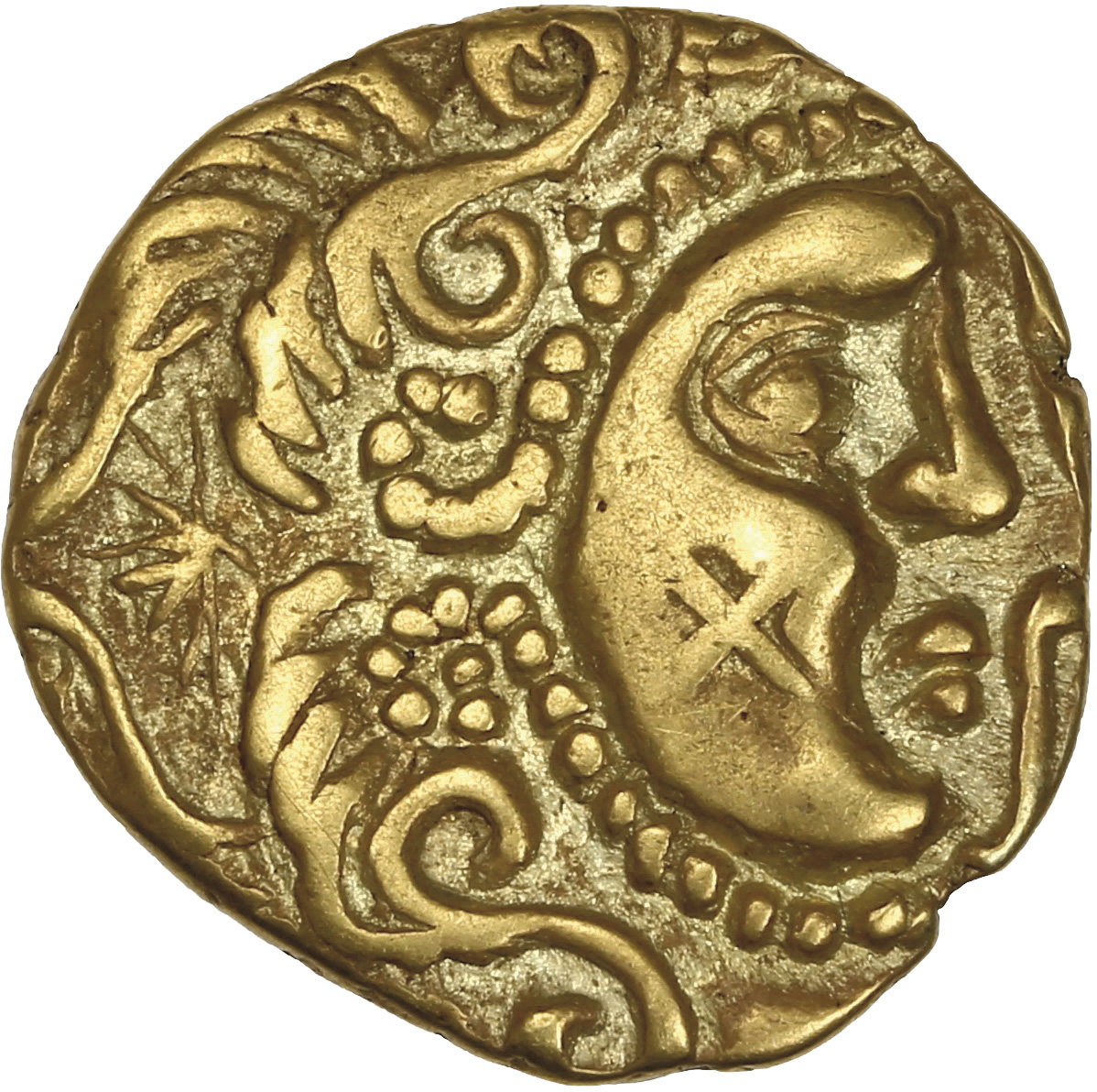
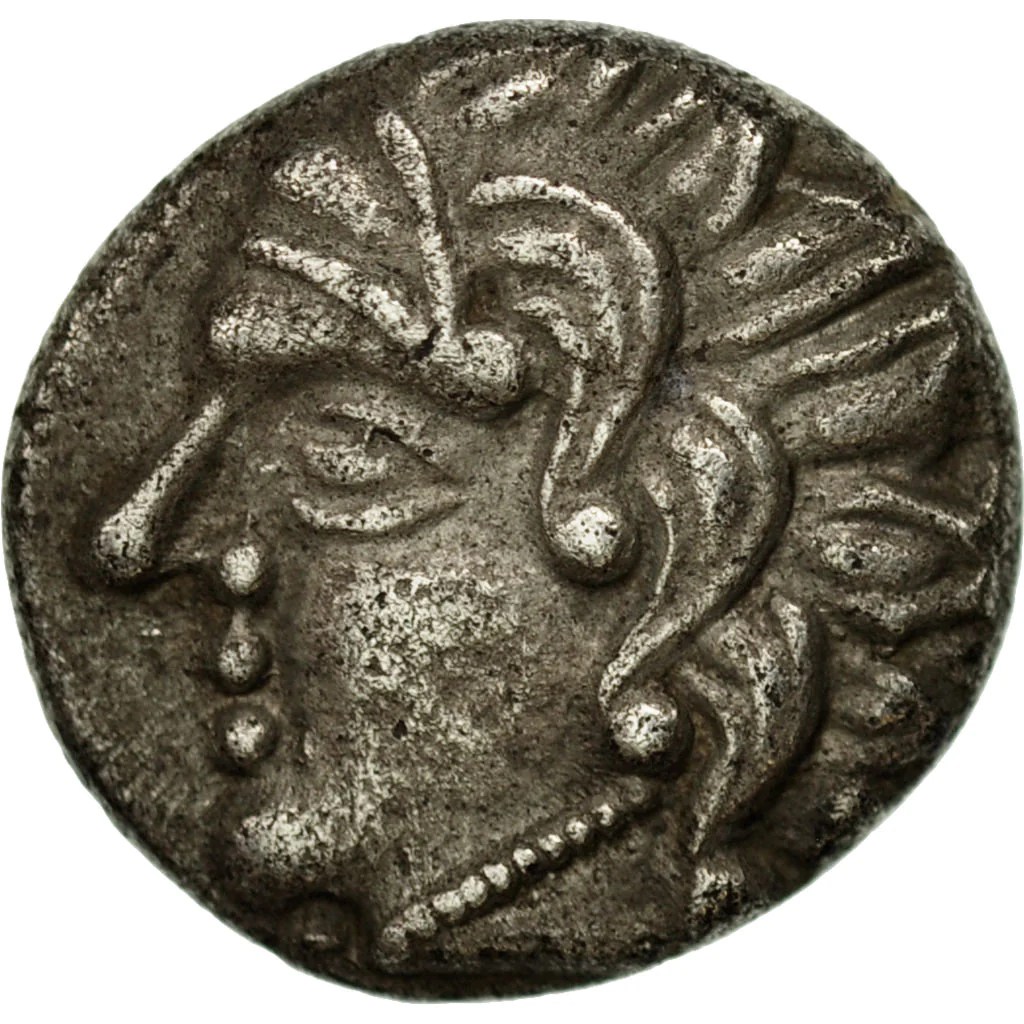
One of the things the Senogalatîs were quite well known for artistically was their metalwork. Their coins for example convey a diverse array of motifs, though the horse is undoubtedly among the most popular of them. This could have to do with the utilisation of the horse and horse powered vehicles in the transport of goods. However, stylised heads as well as depictions of leaders and heroes were also quite commonly found on coins. Like many things about the Senogalatîs, similar ideas often yield diverse results in practice and expression.
Clockwise from top left: A coin from the Ambianoi (Ambiani) [Wikimedia Commons], the Parisioi (Parisii) [Cabinet des Médailles], Carnutes [wildwinds.com]

[In this short video by the Ambiani Project, you can see how coins were made back then.]
Another enigmatic piece of metalwork the Senogalatîs were known for was that of the torcos (torc, torque). For certain, they were not the only ones to wear them at the time, nor the only in history, but it is likely the most easily recognised and well known pieces of jewellery associated with them. Torcoi (torcs, torques) appear to have originated in the Aisson Cassês (Bronze Age) and are present in Celtic, Scythian, and Thracian finds, later on in Nordic ones. Torcoi appear to symbolise wealth, power, and are often depicted on the necks or in the hands of Dêuoi (the beings the Senogalatîs worshipped, and those that Nouiogalatîs do today). Due to this consistent recurrence of torcs in their depictions and in finds where people wore them, we can safely assume that they were of great importance. As they were made of precious metals like gold, we know that they were quite valuable. They typically are made by bending one piece of metal that is tightly twisted and at the ends they have various shapes – discs, balls, animal heads, trumpet-like bell endings, etc.
Clockwise from the top left: bronze torc from Somme-Suippe, gold torc from Vix, silver torc from Trichtingen, gold torc from Marche, the golden Tayac torc. [All courtesy of Wikimedia Commons.]


For further reading on the artistic ornamentation of the Senogalatîs:
- Celtic Regionalities: Personal Ornaments from Southern Gaul, by Michel Feugére
Another style of art in which the Senogalatîs excelled was fibre arts. It is known that they practised a technique known as tablet weaving, which was invented by their immediate ancestors the Isarnoberios (in academia, the Hallstatt) peoples. While not the inventors, the Senogalatîs proliferated chequered and tartan patterns in their weavings. In Pliny the Elder’s ‘Natural History’ there are interesting quotes regarding the Senogalatîs and their textile works:
“The thick, fleecy wool has been esteemed for the manufacture of carpets from the very earliest times; it is quite clear, from what we read in Homer, that they were in use in his time. The Gauls embroider them in a different manner from that which is practised by the Parthians. Wool is compressed also for making a felt, which, if soaked in vinegar, is capable of resisting even iron; and, what is still more, after having gone through the last process, wool will even resist fire; the refuse, too, when taken out of the vat of the scourer, is used for making mattresses, an invention, I fancy, of the Gauls. At all events, it is by Gallic names that we distinguish the different sort of mattresses at the present day […]”
Pliny the Elder’s ‘Natural History, 8.73
“Babylon was very famous for making embroidery in different colours, and hence materials of this kind have obtained the name of “Babylonian.” The method of weaving cloth with more than two threads was invented at Alexandria; these cloths are called polymita; it was in Gaul that they were first used to create a chequered pattern.” – 8.74
Pliny the Elder’s ‘Natural History, 8.74
“We know, too, that from plants are extracted admirable colours for dyeing; and, not to mention the berries of Galatia, Africa, and Lusitania, which furnish the coccus, a dye reserved for the military costume of our generals, the people of Gaul beyond the Alps produce the Tyrian colours, the conchyliated, and all the other hues, by the agency of plants alone.” – 22.3
Pliny the Elder’s ‘Natural History, 22.3
For a little more on the fiber arts of the Senogalatîs, check out:
“Scutulis Dividere Gallia”: Weaving on Tablets in Western Europe, by Carolyn Priest-Dorman
Continue to Chapter Seven: Biuos Tegicos Senogalation (Domestic Life of the Senogalatîs)
 Bessus Nouiogalation