
Continuing from where we broke down parts of the Coligny Calendar, we now step into how the calendar keeps time. We’ll explain this in a simple way, so that the layers of days, months, and cycles become easier to understand.
Basic Structure of the Coligny Calendar
The Coligny Calendar is lunisolar, meaning it tracks both the Moon and the Sun. A year is made up of twelve lunar months, and sometimes thirteen when an intercalary month is added to keep alignment with the solar year.
Each month has 29 or 30 days, roughly matching the lunar cycle.
In our reckoning, the year begins with Samonios, which falls in the spring or early summer.
Time Units
- Day
- Starts at sunset.
- Moon phases mark important points in the month: first quarter, full moon, last quarter new moon.
- Month
- Months are either 30 days (Matis / MAT) or 29 days (Anmatis / ANM).
- The first quarter moon marks the start of each month, making it easy to spot and fitting the binary fortnight division: each month has a “light” and “dark” half.
- The full moon typically falls around the 7th to 9th day of each month, while the new moon appears around the 22nd to 24th day.
- Equos alternates between 29 and 30 days in this pattern — 30, 29, 29, 29, 30 — to preserve lunisolar harmony.
- Year
- Normally 12 months.
- Every few years, an extra intercalary month is added to keep the calendar in sync with the Sun.
- Five-Year Subcycle
- The calendar is grouped into blocks of 5 years.
- Each subcycle has a pattern of intercalary months and day adjustments.
- 19-Year Cycle (Metonic-like)
- The Coligny Calendar also tracks a longer 19-year cycle, similar to the Metonic cycle of Greek astronomy.
- This cycle keeps the calendar in sync over decades.
- We have 4 Five-Year Subcycles, each has five years within, besides the last one, which has four.
The lunar months track the Moon closely. The intercalary months keep the calendar aligned with the solar year, so seasons don’t drift. Days are counted from sunset to sunset, and months are often adjusted slightly (29 vs 30 days) to match the Moon. The five-year subcycles provide a repeating structure to predict when intercalations happen. Over 19 years, the calendar resets in a sense, maintaining alignment between Moon cycles and solar years.
- Days → building blocks
- Months → small bundles of days
- Year → bundle of months
- 5-year subcycle → bundle of years
- 19-year cycle → bundle of subcycles, keeping everything aligned
Months and Intercalary Months
The calendar usually has 12 months, with intercalary months inserted in a 5-year cycle to maintain alignment with the solar year.
| Coligny Month | Gregorian Approx. | Days | Notes |
| Samonios | May–June | 30 | First month |
| Dumannios | June–July | 29 | – |
| Riuros | July–August | 30 | – |
| Anagantios | August–September | 29 | – |
| Ogronios | September–October | 30 | – |
| Cutios | October–November | 30 | – |
| Giamonios | November–December | 29 | “Winter” month |
| Simiuisonna | December–January | 30 | – |
| Equos | January–February | 30-29 | Alternates to maintain lunisolar alignment |
| Elembiuos | February–March | 29 | – |
| Edrinios | March–April | 30 | – |
| Cantlos | April–May | 29 | – |
Intercalary Months
- Quimonio (29 Days): inserted at the start of Year 1 of the 5-year cycle.
- Rantaranos (30 days): inserted before Giamonios in Year 3.
- The other years remain 12-month years.
- This 5-year cycle repeats three times, creating a grand 19-year cycle, with one day dropped from Equos every 61 years to maintain alignment.
Here is the pattern using everything mentioned.
Grand Years — subyear / intercalary summary
- Grand Year 1 — Subyear 1 — Quimonios present (29) — Equos = 30
- Grand Year 1 — Subyear 2 — no intercalary — Equos = 29
- Grand Year 1 — Subyear 3 — Rantaranos present (30) — Equos = 29
- Grand Year 1 — Subyear 4 — no intercalary — Equos = 29
- Grand Year 1 — Subyear 5 — no intercalary — Equos = 30
- Grand Year 2 — Subyear 6 — Quimonios present (29) — Equos = 30
- Grand Year 2 — Subyear 7 — no intercalary — Equos = 29
- Grand Year 2 — Subyear 8 — Rantaranos present (30) — Equos = 29
- Grand Year 2 — Subyear 9 — no intercalary — Equos = 29
- Grand Year 2 — Subyear 10 — no intercalary — Equos = 30
- Grand Year 3 — Subyear 11 — Quimonios present (29) — Equos = 30
- Grand Year 3 — Subyear 12 — no intercalary — Equos = 29
- Grand Year 3 — Subyear 13 — Rantaranos present (30) — Equos = 29
- Grand Year 3 — Subyear 14 — no intercalary — Equos = 29
- Grand Year 3 — Subyear 15 — no intercalary — Equos = 30
- Grand Year 4 — Subyear 16 (note: Year 1 of subcycle 4 is omitted; therefore grand 16 corresponds to subyear 2) — no Quimonios — Equos = 29
- Grand Year 4 — Subyear 17 — Rantaranos present (30) — Equos = 29
- Grand Year 4 — Subyear 18 — no intercalary — Equos = 29
- Grand Year 4 — Subyear 19 — no intercalary — Equos = 30
It would not be fitting, in the spirit of the Bessus Nouiogalation (Custom of the New Galatîs), to speak of time without using the words of our ancestors.
In Gaulish, a day is called a diios, the bright course from one sunset to the next. A month, or miððos, follows the Moon’s journey through its phases, marking the waxing and waning light. The year, known as a sonnocingos, is the great march of the Sun — its passage through the turning of the seasons.
Beyond this, the Coligny Calendar teaches us of greater measures of time. Five sonnocingoi form what we call the Grand Year, or Sonnocingos Mòros — the great sun-course in which the cycles of the Moon and Sun are brought back into balance. Four of these Grand Years complete the Great Cycle, the Cingos Decamnoe, the nineteen-year turning where the heavens and earth once again align in perfect rhythm.
Through these measures — diios, miððos, sonnocingos, Sonnocingos Mòros, and Cingos Decamnoe — the Coligny Calendar becomes more than a tool of time. It becomes a mirror of cosmic order, a reminder that all things move in harmony: the heavens above, the earth below, and the spirit within.
| English Term | Gaulish Term | Meaning |
|---|---|---|
| Day | Diios | A single day (sunset to sunset) |
| Month | Miððos | One lunar cycle |
| Year | Sonnocingos | One solar year (“sun-course”) |
| 5-Year Grand Year | Sonnocingos Mòros | The great sun-course, five-year cycle |
| 19-Year Cycle | Cingos Decamnoe | The nineteen-year cycle |
Current Alignment
Using all we know, we will be following Helen McKay’s reconstruction. She began the 19-year cycle on 26 April 2015 (Year 1 of Grand Year 1) (Our year 0), with 30 April 2020 marking the start of Grand Year 2, Year 6.
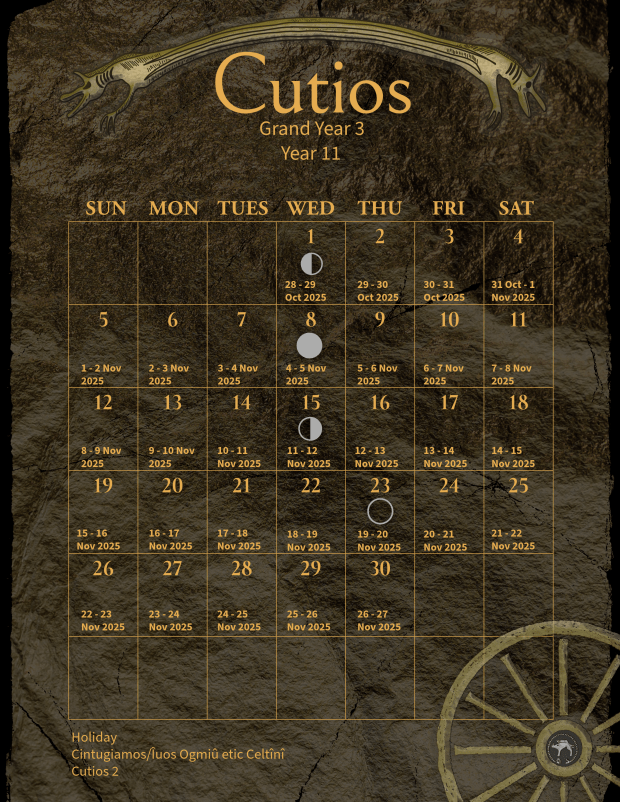
That means as of now, we are in Grand Year 3, Year 11 of the Cingos Decamnoe. Below is the rest of this current year according to the Coligny reckoning: We try to update this every year.
| Coligny Month | Gregorian Approx. | Days | Notes |
|---|---|---|---|
| Cutios | Oct 29–30, 2025 → Nov 26–27, 2025 | 30 | — |
| Giamonios | Nov 27–28, 2025 → Dec 26–27, 2025 | 29 | “Winter” month |
| Simiuisonna | Dec 26–27, 2025 → Jan 24–25, 2026 | 30 | — |
| Equos | Jan 25–26, 2026 → Feb 23–24, 2026 | 30 | Alternates; this year 30 days |
| Elembiuos | Feb 24–25, 2026 → Mar 24–25, 2026 | 29 | — |
| Edrinios | Mar 25–26, 2026 → Apr 23–24, 2026 | 30 | — |
| Cantlos | Apr 24–25, 2026 → May 22–23, 2026 | 29 | Final month of the year |
Current Month
 Bessus Nouiogalation