
Audio reading of this section (English)
We will speak here of things invented (at least perhaps in Europe) by, independently or initially, or at the least items of import that were popularised by the Senogalatîs. As there are cases where while they didn’t invent something, its widespread use in Europe was attributed to them. This is of course not to diminish the importance of inventions by other peoples or their impact in their own areas or on the world. Simply to highlight the influence the Senogalatîs had in their region of the world as well. As often it is influences on the Senogalatîs that are noted – seldomly their contributions to other peoples or their own ingenuity. One such instance is with that of soap. The Senogalatîs were not the first peoples to use soap (which was invented in Sumeria millennia before), but in Europe it appears they were the first known to do so. It is not known whether they invented it independently or if peoples between the Senogalatîs and the Near East simply did not use it. Pliny the Elder states in ‘Natural History’ (28.51)
“Soap, too, is very useful for this purpose, an invention of the Gauls for giving a reddish tint to the hair. This substance is prepared from tallow and ashes, the best ashes for the purpose being those of the beech and yoke-elm.”
Pliny the Elder ‘Natural History’ 28.51
Aretaeus also mentions it in his second book of ‘De Curatione Diuturnorum’ (2.7):
“There are many other medicines [missing text] of the Celts, which are men called “Gauls,” those alkaline substances made into balls, with which they cleanse their clothes, called “soap,” with which it is a very excellent thing to cleanse the body in the bath.”
Aretaeus ‘De Curatione Diuturnorum’ 2.7
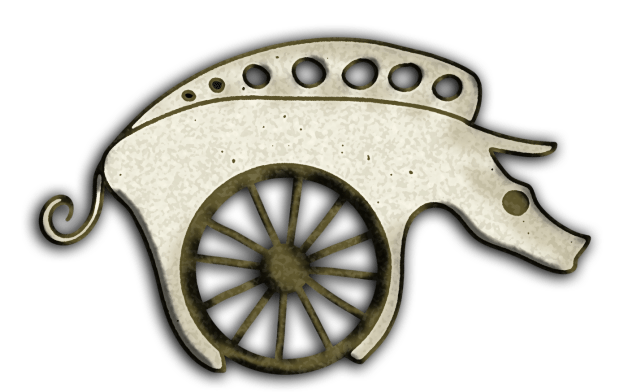
As was alluded to briefly in the section on livestock and agriculture, the Senogalatîs invented a unique device for harvesting grains. In Palladius Rutilius Taurus Aemilianus’s ‘Opus agriculturae’:
“They obviate much hand-labour and in a day an ox can get in the whole harvest. The vehicle (used) is mounted on two small wheels. Two flat sheets (of metal) are mounted on the vehicle towards the exterior, the smaller of the two being in the front of it. On these sheets are fixed recurred teeth. Two short shafts are attached to the front of the vehicle. An ox is harnessed with its head towards the vehicle. It must be a quiet animal so that it does not push too heavily. As it propels the machine across the field the ears of corn are gripped by the teeth, cut off, and fall into the vehicle, while the straw falls outside and the operator who is behind raises or lowers the machine. Thus by constantly going backwards and forwards across the field the whole crop is garnered. This is a good practice where the fields are level and where the straw is of no importance.”
Palladius Rutilius Taurus Aemilianus’s ‘Opus agriculturae’
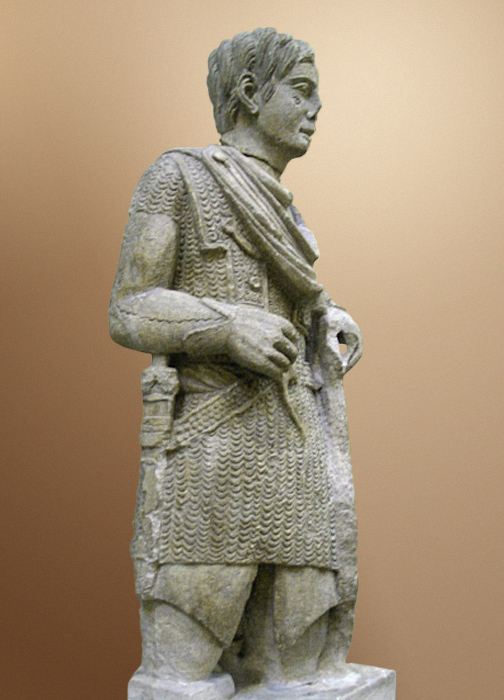
Another invention attributed to the Senogalatîs is that of chainmail. However, it is contested that it could have been the Etruscans. Regardless of this, their use of this ubiquitous armour was certainly associated with the Senogalatîs. This is mentioned by Marcus Terentius Varro in ‘De Lingua Latina’ (Book 5, paragraph 116) “… afterwards the Gallic corselet of iron was included under this name, an iron shirt made on links…” and Diodorus Siculus in his ‘Library of History’ (Section 5.30) “Some of them have iron chain-mail, but others are satisfied with the armour which Nature has given them…”, both noting its usage among the Senogalatîs. Chainmail remained popular for centuries after the Senogalatîs were gone.
The Vachères Warrior, depicted in chainmail. [Wikimedia Commons]
The Senogalatîs were also the first coopers in Europe, the first to make barrels on the continent. Like soap, another interesting case of something being invented farther afield that wasn’t used by anyone between the Senogalatîs and them. In this case, the first recorded barrels were from Egypt. The Senogalatîs were, according to Pliny the Elder, the first to use them in Europe. He says in ‘Natural History’ (27.21)
“The various methods of keeping and storing wines in the cellar are very different. In the vicinity of the Alps, they put their wines in wooden vessels hooped around…”
Pliny the Elder, ‘Natural History’ 27.21
Through the Senogalatîs who lived in these Alpine areas (perhaps the Eluetios – Helvetii), the barrel spread throughout Europe. In fact, that same book details a few more inventions of the Senogalatîs. Details on these inventions are a little more sparse but we shall go over them nonetheless. One that we still use to this day being that of the mattress. ‘Natural History’ (19.2)
“[Mattresses] are an invention for which we are indebted to the Gauls: the ancient usage of Italy is still kept in remembrance in the word stramentum, the name given by us to beds stuffed with straw.”
Pliny the Elder, ‘Natural History’ 19.2
Yet another invention that Pliny attributes to our ancestors is that of a type of straining screen that back then was made of horsehair. ‘Natural History’ (18.28):
“The Gauls were the first to employ the bolter [straining screen] that is made of horse-hair.”
Pliny the Elder,‘Natural History’ 18.28
 Bessus Nouiogalation