
Audio reading of this section (English)
While the Sinâdus (Corded Ware) culture lasted for quite some time, they were overlapped by roughly 2220 SA (by our calendar), or around 2800 BCE. For around 500 years, another culture asserted itself. As opposed to coming from the east, it came from the west. From Iberia people known in Nouiogalaticos as the Cloccogandnatîs, brought their Cloccogandnon (“the bell beakers” – in academia “Bell Beaker”) culture in a vast east and northward spread that covered (not all of, but certainly the southern part of Scandinavia) Europe from what is now the eastern border of Poland and everything west of it. Even into parts of Northwestern Africa.
The spread of Cloccogandnon (Bell Beaker) culture was quite impressive. [Wikimedia Commons]

It would be unwise to assume that the entire area this culture covered spoke Proto-Indo-European languages, many didn’t. But some likely did. Proto-Indo-European speakers were certainly affected by it. The main thing this culture was known for were their bell shaped vessels, or beakers.
Vessels like this are emblematic of the Cloccogandnon (Bell Beaker) culture. [Wikimedia Commons]
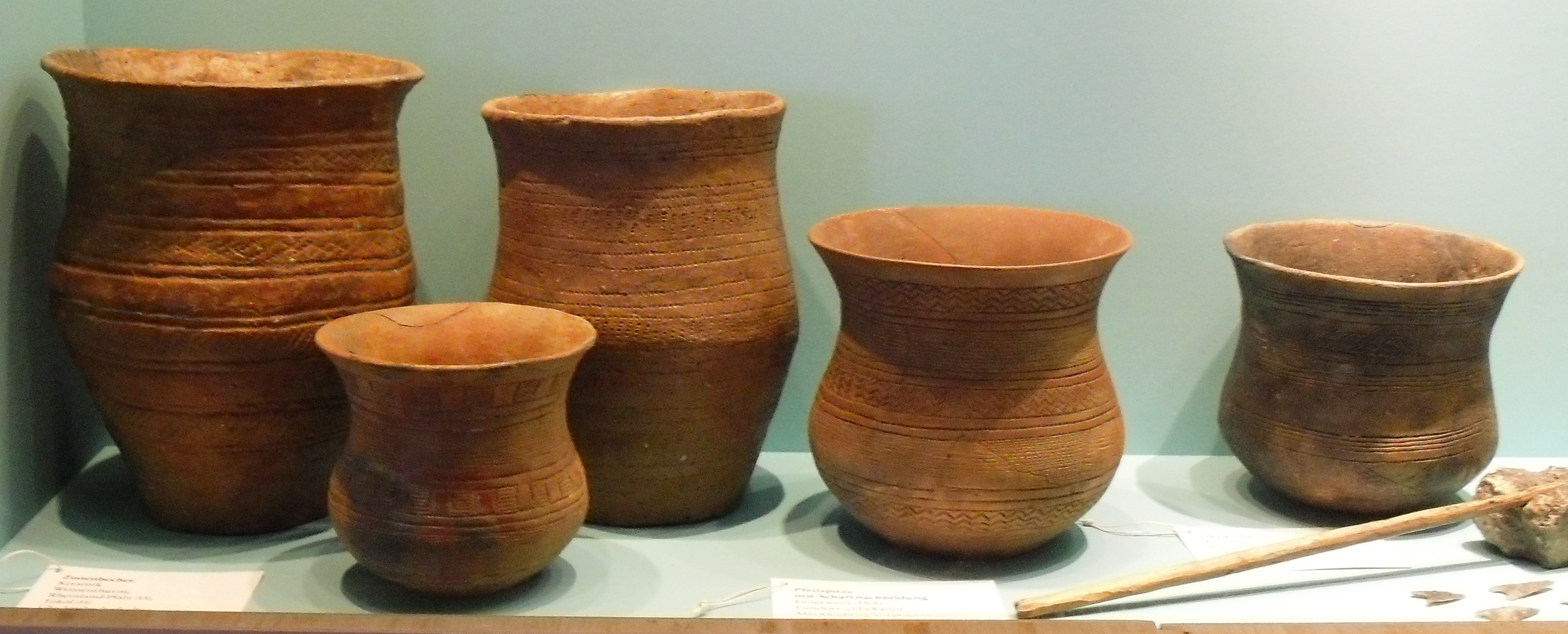
They were experts in working copper, knew how to work gold, and they were already working with bronze in small amounts. Though the age is called the Bronze Age, much of the mastery of working with it in Western and Central Europe hadn’t quite taken off.
More reading on the Cloccogandnon (Bell Beaker) culture:
- Corded Ware and Bell Beaker burial mounds in Central Europe, by Jan Turek
- Bell Beaker metal and metallurgy in Western Europe, by Matthieu Labaune
Continue to Chapter Two, Part Four: Cassiberios (Únětice) Culture
 Bessus Nouiogalation