
Audio reading of this section (English)
We call these peoples in Nouiogalaticos Sinâdioi people for what we call the Sinâdus (“cord pot” – in academia, the Corded Ware) culture. They were mainly known for the “corded” patterns on their pottery. Overlapping with their predecessors, their time was from roughly 2320-1770 SA (according to our calendar) or about 2900-2350 BCE. At this point, these descendants of the Cauologioi (Yamnaya) peoples had mixed with the indigenous farmers.
Extent of the Sinâdus (Corded Ware) Culture. They covered much of Northern and Central Europe.
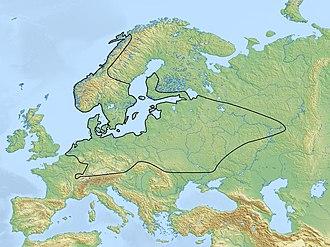
It is thought that they spread Proto-Indo-European language further north and west as they migrated and settled. Seemingly continuing the tradition from their ancestors of wandering warbands of young men helps explain the cultural diffusion process. With their wives from farming families bringing agricultural knowledge with them.
More reading on the Sinâdus (Corded Ware) culture:
- Re-theorising mobility and the formation of culture and language among the Corded Ware Culture in Europe, by Kristian Kristiansen, Morten E. Allentoft, Karin M. Frei, Rune Iversen, Niels N. Johannsen, Guus Kroonen, Łukasz Pospieszny, T. Douglas Price, Simon Rasmussen, Karl-Göran Sjögren, Martin Sikora, and Eske Willerslev
- Corded Ware Coastal Communities, Using ceramic analysis to reconstruct third millennium BC societies in the Netherlands (PDF), by Sandra Beckerman
Continue to Chapter Two, Part Three: Cloccogandnon (Bell Beaker)
 Bessus Nouiogalation