
Audio reading of this section (English)
The houses in which Senogalatîs lived were generally made from what is called wattle and daub which entails the weaving of branches together and binding them with mud, clay, and/or other filling material such as lime. The frames of their buildings were made of timber, and their roofs were normally made of thatch – though wooden shingles weren’t unknown. Multi-story buildings existed but were rare. Stone was rarely used but can be found in foundations occasionally. Bricks of mud aren’t unheard of either.


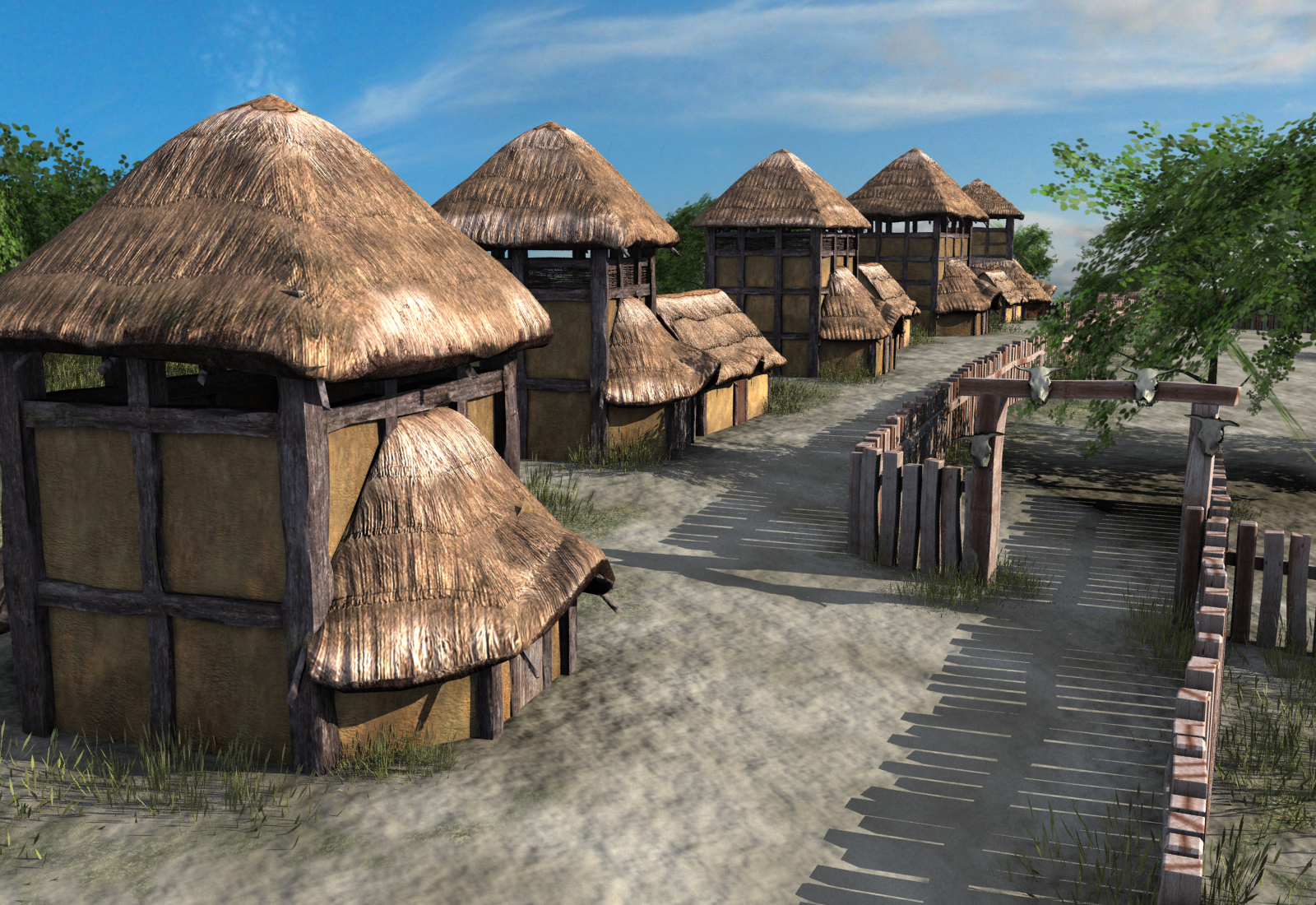
Top to Bottom – Reconstruction of houses from the oppidum (fortified town) at Manching [Wikimedia Commons], interior of a reconstructed house at Bibracte [Bibracte Museum], an artistic rendering of the oppidum at Acy-Romance [National Museum of Archaeology (France)]
Usually, houses were grouped together in small hamlets. While there are a few notable examples of proto-urbanisation, the majority of the Senogalatîs lived in much smaller settings with a few houses grouped together. Most social activity because of this took place in what can be thought of as a commons, a communal large yard between the residences. This is how most Senogalatîs lived. There wasn’t much individual ownership of land, or what we’d today call private property. There was certainly *personal* property, for example a family owned their home, but the land was generally speaking in the hands of the community. The exception may be the more aristocratic housing, reminiscent of the Roman villas, that the most affluent had. This of course was more the exception than the rule. Though that system was undoubtedly growing in influence and power which was evident in the systems of clientage that was a predecessor of feudal holds in the mediaeval period. The dunon (oppidum) also appeared in several places scattered throughout the lands of the Senogalatîs. These were in essence fortified proto-cities. In most cases, they were built on the tops of hills for added defence.
The interiors of their homes were usually set with a fireplace or hearth in the centre, the smoke being let out often through the roof – an advantage of thatched roofs. There would have usually been some modest furnishings. Things like tables, jars and containers for food storage, as well as mattresses and benches. Small crafting projects and fixes for small equipment would have been attemptable in the home, but larger ones of course, outdoors. According to structures like the palace at Vix, homes could also be painted. With all of this, it is easy to paint a picture of the Senogalatis era landscape: of the high dunâ (oppida, hillfort towns), the many rural settlements not far away in the magoi (fields), and the allatiâ (wild) of the forests, caves, and rivers touched quite well by then by road networks (to disabuse peoples of the “noble savage” romanticism of boar hunting woodland warbands). Without a doubt there were far more wilds then than there are now, but there was also much development. Indeed, the picture of a complex and varied society.
Further reading and exploration of the homes and towns of the Senogalatîs:
As opposed to the usual articles, there are a few websites of archaeological sites in France through the French Ministry of Culture and their National Museum of Archaeology, as well as other efforts from places in France that have sites and ruins from the Senogalatis age.
And of course, a favourite book of the author: ‘Les Gaulois’ by Jean-Louis Brunaux (A frequently cited work in this commentary.)

Continue to Chapter Seven, Part Two: Cintoues etic Damicâs (Firsts and Important Items)
 Bessus Nouiogalation