
Audio reading of this section (English)
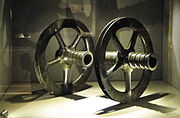
Around 720-170 SA (according to our calendar), otherwise 1300-750 BCE entered the Ulumagos (“ash plain” – or in academia, the Urnfield) culture. The name given (likely obviously) because they buried their dead in urns and placed them in fields. This culture yields a few particularly interesting innovations that hadn’t been seen in central Europe, one such innovation was that of the spoke wheeled chariot. Which had at long last made its way from its place of origin, central Asia, some 1200 years before. We find evidence of them in early Ulumagos (Urnfield) burials.
Ulumagos (Urnfield) culture. [Wikimedia Commons]

Bronze chariot wheels from the Ulumagos (Urnfield) culture. [Wikimedia Commons]
By the grave goods found, and being the Aisson Cassês (Bronze Age) cuirasses made of bronze sheets, as well as bronze swords are often found around the urns that hold the ashes of the deceased. It wasn’t all about war of course. Elaborate bronze pins and bracelets, as well as brooches, and offering dishes are frequent accompaniments. These being far more common finds than weaponry and armour. It is considered possible by some linguists that Senocelticos (the Proto-Celtic language), the hypothetical ancestral language to all Celtic languages began to form during this period.
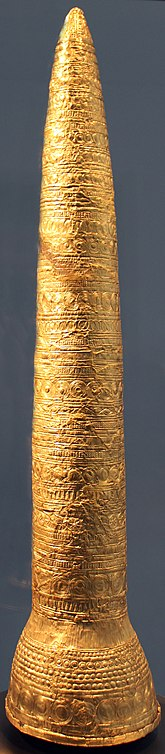
A particularly interesting find from this period are four golden hats (from Berlin, Avanton, Schifferstadt, and Ezelsdorf-Buch). They are thought to be of religious and/or of royal significance. The designs on these hats are thought to be calendrical (in something of a Metonic fashion) in nature. This demonstrates the prevalence of lunisolar timekeeping, where both the position of the sun, and the phases of the moon are accounted for in calculating the year.
Golden Hat of Ezelsdorf-Buch [Wikimedia Commons]
More reading on the Ulumagos (Urnfield) Culture:
- Breaking and Making the Ancestors. Piecing together the urnfield mortuary process in the Lower-Rhine-Basin, ca. 1300 -400 BC, by Arjan Louwen
- Mobility and Social Dynamics in Bavaria and North Tyrol in the Urnfield Culture, by Silviane Scharl and Birgit Gehlen
- Der bronzezeitliche Goldkegel “Berlin” – eine mitteleuropäische Wissensgeschichte, by Katharina Mosig
Continue to Chapter Two, Part Seven: Iextis Senocelticos (The Proto-Celtic Language)
 Bessus Nouiogalation