
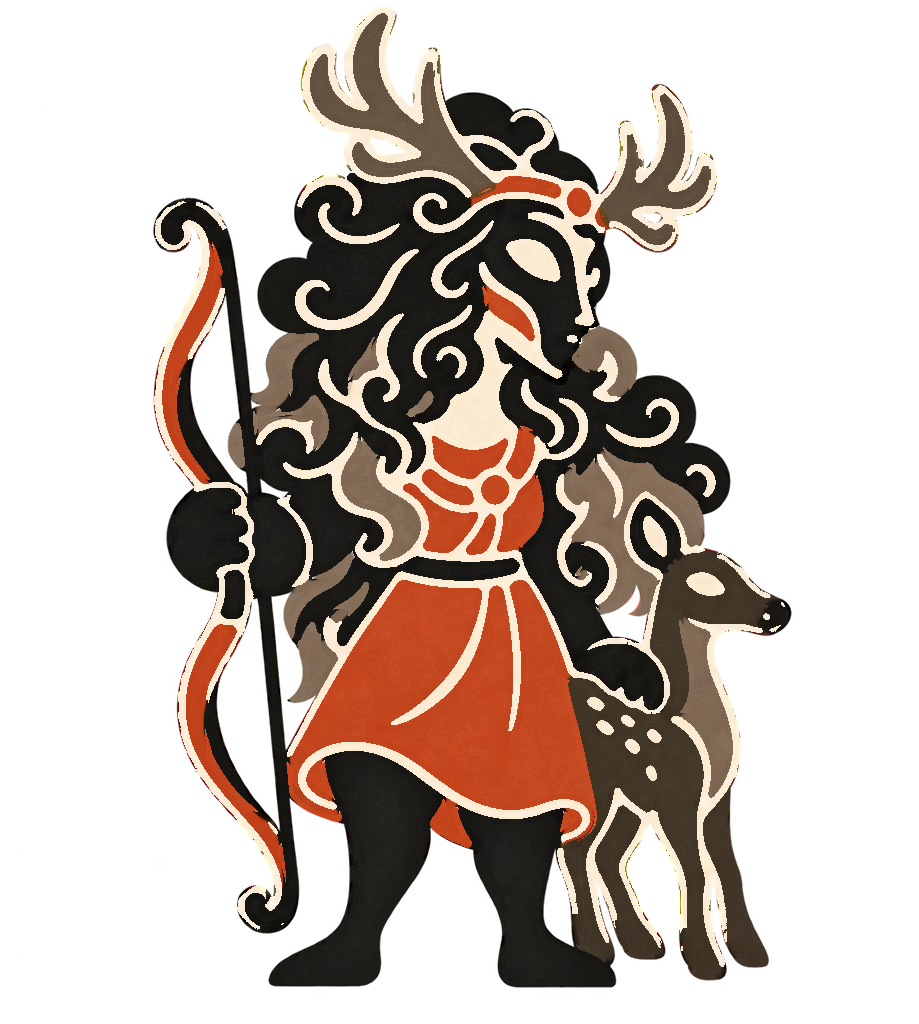
Abnobâ is closely associated with the Black Forest, where Roman-period dedications preserve her name and connect her with Diana. Within Bessus Nouiogalation, we honor her as a guardian of wilderness, a Dêuâ of the night, and a presence in the changing flow of rivers.
Historical evidence
Her name
The meaning of Abnoba is still discussed. One scholarly approach connects the name with Celtic words for rivers or water. Linguist Václav Blažek proposed interpreting the related mountain name, Mons Abnobae, as “mountain rich in rivers.” This gives us a possible connection with water, though it is a proposed explanation of the mountain name rather than a settled translation of the goddess’s name.
For that reason, it is best to describe the river connection as a possibility. It should not carry the same weight as the inscriptions that name her directly.
Where we find her
Abnoba’s surviving dedications come from the Roman province of Germania Superior, in what is now southwestern Germany. She is generally understood as a goddess of the Black Forest, which was known in antiquity as Abnoba mons. The FERCAN inscription corpus discusses ten dedications, although some identifications are uncertain and it rejects one proposed restoration from Lahr. A simple count needs some explanation.
Three examples show the kinds of evidence we have:
| Findspot | Evidence | What it tells us |
| Badenweiler | An altar dedicated to Diana Abnoba by Marcus Sennius Fronto. | Her worship was present at the Roman thermal baths. |
| Karlsruhe-Mühlburg | An inscribed statuette dedicated to Dea Abnoba by Lucilius Moderatus, catalogued as CIL XIII 6326. | Her name appears on a surviving image of the goddess. |
| Bad Cannstatt, Stuttgart | An altar dedicated to Abnoba by Marcus Proclinius Verus, catalogued as CIL XIII 11746. | A named worshipper fulfilled a vow to her. |
These examples are drawn from the Badenweiler monument record and the FERCAN inscription catalogue. They are a selection rather than a complete inventory.
Abnoba and Diana
Some dedications call her Diana Abnoba. The statuette from Karlsruhe-Mühlburg also presents her in the appearance of a huntress: she wears a short garment and boots and reaches back toward her quiver for an arrow. The Badisches Landesmuseum dates it to the second or third century CE.
This connection gives us good grounds for discussing hunting as part of her Roman-period worship. It also shows how worshippers brought a local goddess into relationship with Diana.
The animals beside the statuette deserve a little care. The museum describes a hunting dog catching a hare. The FERCAN catalogue agrees that the smaller animal is a hare but questions whether the larger animal is a dog or a deer. The hunting imagery is clear; the identification of every detail is less certain.
The baths at Badenweiler
At Badenweiler, Abnoba’s worship belonged to the setting of the thermal baths. The site’s interpretation identifies Diana Abnoba as their divine protector. Marcus Sennius Fronto’s altar records the fulfillment of a vow, although it does not tell us what prompted him to make it.
This adds a bathing and healing context to the evidence. It does not tell us that every dedication to Abnoba concerned healing, but it helps us see that her worship reached beyond hunting alone.
What remains uncertain
The evidence gives us names, offerings, places, and an image. It leaves many questions about how her worshippers understood her.
Her association with Diana should not, by itself, be treated as proof that all of Diana’s attributes belonged to Abnoba. In particular, the night vigils, dream practices, and teachings about change described below belong to our BNG gnosis.
Abnobâ in Bessus Nouiogalation
The following expresses our understanding of Abnobâ within our living custom. It develops through devotion and relationship, informed by the historical evidence.
Guardian of wilderness
We honor Abnobâ as a guardian of wilderness and the many beings who make their lives there.
Her presence reminds us that forests, rivers, and wild places have value in themselves. They sustain lives beyond our own, and our relationship with them carries responsibilities.
Within Bitus, we live among other beings whose needs and ways of life deserve attention. Honoring Abnobâ calls us to preserve their places, notice the effects of our actions, and take care with what we gather or use.
Forest conservation and ethical hunting are central to this understanding. Devotion includes the choices we make when entering the woods and the care we give to what lives there.
Dêuâ of the night
Within BNG, we also honor Abnobâ as a Dêuâ of the night.
Night vigils, meditation, dream magic, stargazing, and quiet contemplation offer ways of approaching her. These practices give us time to listen and to become more attentive to the life around us.
A forest changes after sunset. Different beings become active, familiar sounds take on new importance, and our own senses adjust. In this setting, we seek Abnobâ through patience, awareness, and respect.
Rivers and change
Rivers hold an important place in our relationship with Abnobâ.
Their changing currents express the movement of life: growth, loss, renewal, and the changes through which we become who we are. In our gnosis, Abnobâ helps us meet that movement with greater understanding.
River ceremonies give us a way to acknowledge change, reflect on what we are carrying, and consider how we wish to move forward.
This teaching belongs to our custom. The possible connection between her ancient name and water offers a point of reflection, while the meaning we give to that relationship develops through our practice.
Honoring her
We honor Abnobâ through attention to wilderness, the sacred night, and flowing water. Our practices may include:
- Forest conservation and care for local habitats.
- Ethical hunting and respectful use of natural resources.
- Night vigils, meditation, and stargazing.
- Dream work and reflection.
- River ceremonies that acknowledge change and renewal.
- Community gatherings that strengthen our relationships with the living world.
Through these practices, we seek harmony and healing within our communities and a deeper connection with the beings around us. Abnobâ can teach us to attend to the places we inhabit, protect what sustains life, and meet change with care.

