
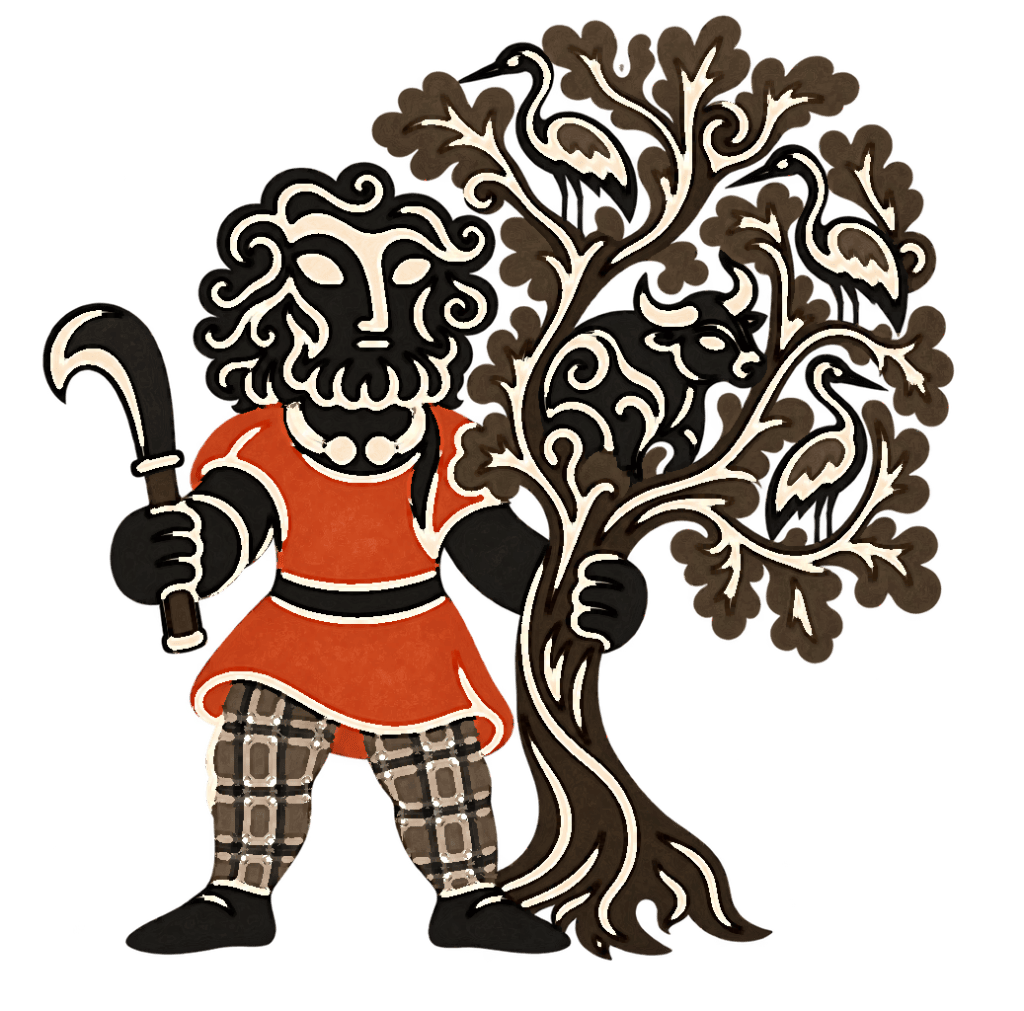
Aisus, often called Esus in historical sources, is known especially through the image of a god working on a tree. The surviving monuments offer a glimpse of a story involving a tree, a bull, and three birds, though much of it remains unknown. In Bessus Nouiogalation, we honor him as the Celestial Woodsman, the Dêuos of Drus, and a teacher of sacrifice and care for sacred spaces.
Historical evidence
His name
The meaning of Esus remains uncertain. “Lord” or “Master” is a familiar proposed interpretation, connected by some scholars with Latin erus or herus, “lord, master.” It is best treated as a possibility rather than an established translation.
Another proposal connects the name with a reconstructed Indo-European root written *ais-, associated with honor, respect, or reverence. This has led to interpretations such as “the Revered One.” Related discussions compare the name with ancient Italian forms in ais- / aisu- associated with divinity, although the linguistic relationship remains debated.
A different explanation looks to *eis-, associated with energy, passion, or fury, giving a possible interpretation of “the Impetuous One” or “the Furious One.” Here, “fury” describes an intense, forceful quality; the proposed root alone cannot establish the god’s character or religious functions. These are competing explanations, not several confirmed meanings of the same name.
In our bessus, we use Aisus. This form appears in a healing charm preserved by Marcellus of Bordeaux, where Gustav Must and Léon Fleuriot interpreted it as the name of Esus. Fleuriot explicitly supported that identification. Aisus has a basis in an ancient text, though identifying the charm’s figure with Esus remains an interpretation. Our use of this spelling does not require us to settle the name’s disputed meaning.
The Paris monument
The clearest named depiction appears on the Pillar of the Boatmen from Roman Paris. Discovered beneath Notre-Dame in 1711, it includes a relief labeled ESVS.
The god wears a short tunic and works on a tree with a cutting tool. A neighboring face shows a bull with three cranes and bears the name Tarvos Trigaranus, commonly understood as “Bull with Three Cranes.” Anne Ross dates these sculptures to before the middle of the first century CE.
The name above the figure matters: we can identify the Paris god as Esus directly, without relying only on similarities in appearance.
The Trier monument
A related scene survives on a monument from Trier, in present-day Germany. A figure cuts into a tree whose foliage contains a bull’s head and three birds.
This figure is not labeled Esus. His identification comes from comparison with the Paris reliefs. Duval understood the two monuments as preserving versions of the same mythic scene.
| Monument | What survives | Basis for identification |
| Paris — Pillar of the Boatmen | A god working on a tree; a neighboring panel shows Tarvos Trigaranus. | The figure is explicitly named ESVS. |
| Trier — sculpted monument | A tree-cutting figure, a bull’s head, and three birds within the foliage. | Comparison with the named Paris scene. |
Together, these monuments give us a recurring group of images. Their precise meaning remains open to interpretation.
The tree, bull, and birds
The relationship between these figures has drawn considerable scholarly attention. The repeated imagery supports the possibility of a shared story, but the carvings do not explain its events or identify the tree as a World Tree.
We can see the god cutting or working on a tree. Whether that action represents pruning, felling, sacrifice, or another mythic task requires interpretation.
Likewise, the bull and birds should not automatically be described as a sacrifice, an omen of death, or the flight of a soul. Such readings may be explored, but they go beyond what the monuments show directly.
Lucan and the sacrifice accounts
The Roman poet Lucan names Esus alongside Teutates and Taranis in Bellum Civile, also called Pharsalia, 1.444–446. He presents their worship through frightening imagery involving blood and harsh altars.
Later commentary on Lucan, known as the Bern scholia, describes a person being suspended in a tree as an offering to Esus. The commentary also preserves differing Roman identifications, associating him with Mars in one account and Mercury in another. Cunolugus reproduces and translates these passages in his collection of classical sources.
These are accounts about his worship, and they need to be read with attention to their authors and transmission. Lucan’s brief poetic description and the later explanations do not give us a complete account of Esus’s rites.
A possible appearance in a healing charm
A more uncertain reference occurs in Marcellus’s De medicamentis, 15.106, in a charm intended to remove something lodged in the throat.
Gustav Must and Léon Fleuriot interpreted part of the formula as the name Aisus, making it an invocation of the god. Other scholars have questioned that reading. Andreas Hofeneder’s discussion emphasizes the difficulties of the text and rejects treating this identification as secure.
The charm is worth mentioning as a possible reference. It does not establish that Aisus was a god of healing or magic.
Aisus in Bessus Nouiogalation
The following expresses our gnosis and understanding of Aisus within our living custom.
The Celestial Woodsman
We honor Aisus as the Celestial Woodsman and Dêuos of Drus, our World Tree.
We understand his work upon the tree as part of its care. A living tree grows, loses branches, and changes over time. Tending it requires knowing what supports its life and what must be removed.
In our gnosis, Aisus tends Drus and, at times, sacrifices it. His work holds both care and cutting: the actions through which life is maintained, changed, and renewed.
This understanding of Drus belongs to our bessus. It is how we approach the ancient image through our own cosmology and relationship with him.
Teacher of sacrifice
Within BNG, Aisus enables sacrifice and teaches its proper practice.
The bull in the surviving imagery offers us a point of reflection. Whether Aisus himself sacrifices Tarvos Trigaranos is not the central question in our gnosis. We understand him as making sacrifice possible and imparting knowledge of its sacred arts.
He asks us to approach an offering deliberately. What are we giving? To whom? What relationship does the act serve? What responsibilities come with it?
Through Aisus, we consider the preparation, attention, and care that make an offering meaningful.
Keeper of the Nemeton
Our nemetons, or sacred spaces, are microcosms of Drus. In tending them, we participate in the care of the greater sacred order.
Aisus also shows us that these spaces require continuing attention. We prepare them, maintain them, and consider how our actions affect the beings and people who meet there.
This care can include cleaning a household shrine, tending a grove, preparing a place for offerings, or maintaining a shared space for the Toutâ.
The work continues between ceremonies. Returning to a place and caring for it is itself part of our relationship with the sacred.
Cutting and renewal
The removal of dead branches gives us an image through which to understand Aisus’s teaching.
Care sometimes requires a difficult decision. Something once useful may no longer support the life around it. A practice may need revision; a neglected space may need restoration.
Aisus calls us to make those decisions with discernment. We seek to understand what we are tending, what the consequences of cutting may be, and what continued growth requires.
Honoring Aisus
Within our bessus, ways of honoring Aisus may include:
- Preparing and maintaining a nemeton or household sacred space.
- Learning the purpose and responsibilities of offerings.
- Caring for trees with knowledge and attention to their needs.
- Reflecting on what requires tending, renewal, or release.
- Helping maintain the spaces our community shares.
As keeper of Drus, Aisus brings our attention to the work that sustains a sacred place. Through him, we learn to approach that work with intention and care.
Sources and further reading
- Duval, Paul-Marie. “Esus et ses outils sur des bas-reliefs à Trêves et à Paris.” In Travaux sur la Gaule (1946–1986). Rome: École française de Rome, 1989, pp. 463–470. A study of the reliefs and the tools shown with Esus.
- Fleuriot, Léon. “Sur quelques textes gaulois.” Études celtiques 14, no. 1 (1974), pp. 57–66, particularly pp. 59–60. Supports interpreting Aisus in a charm preserved by Marcellus of Bordeaux as the name of Esus.
- Hofeneder, Andreas. Die Religion der Kelten in den antiken literarischen Zeugnissen. Sammlung, Übersetzung und Kommentierung. Vol. III: Von Arrianos bis zum Ausklang der Antike. Vienna: Verlag der Österreichischen Akademie der Wissenschaften, 2011, particularly pp. 370–372. Read the relevant chapter. Reviews the competing readings of Marcellus’s charm and rejects its identification as an invocation of Esus.
- Lucan. Bellum Civile (Pharsalia) 1.444–446; and the Bern scholia commenting on this passage. Extracts and English translations are available in Cunolugus’s “Classical Sources for the Gaulish Gods.” Lucan’s poem and the later scholia should be distinguished as separate sources.
- Poitrenaud, Gérard. “Remarques sur Ésus, l’Excellent abatteur.” 2015. Discusses proposed etymologies and offers a wider interpretation of the god’s imagery. His conclusions are interpretations rather than an established scholarly consensus.
- Ross, Anne. “Esus et les trois ‘grues’.” Études celtiques 9, no. 2 (1961), pp. 405–438. Examines Esus, the bull, and the three birds, with comparative interpretations of their imagery

