
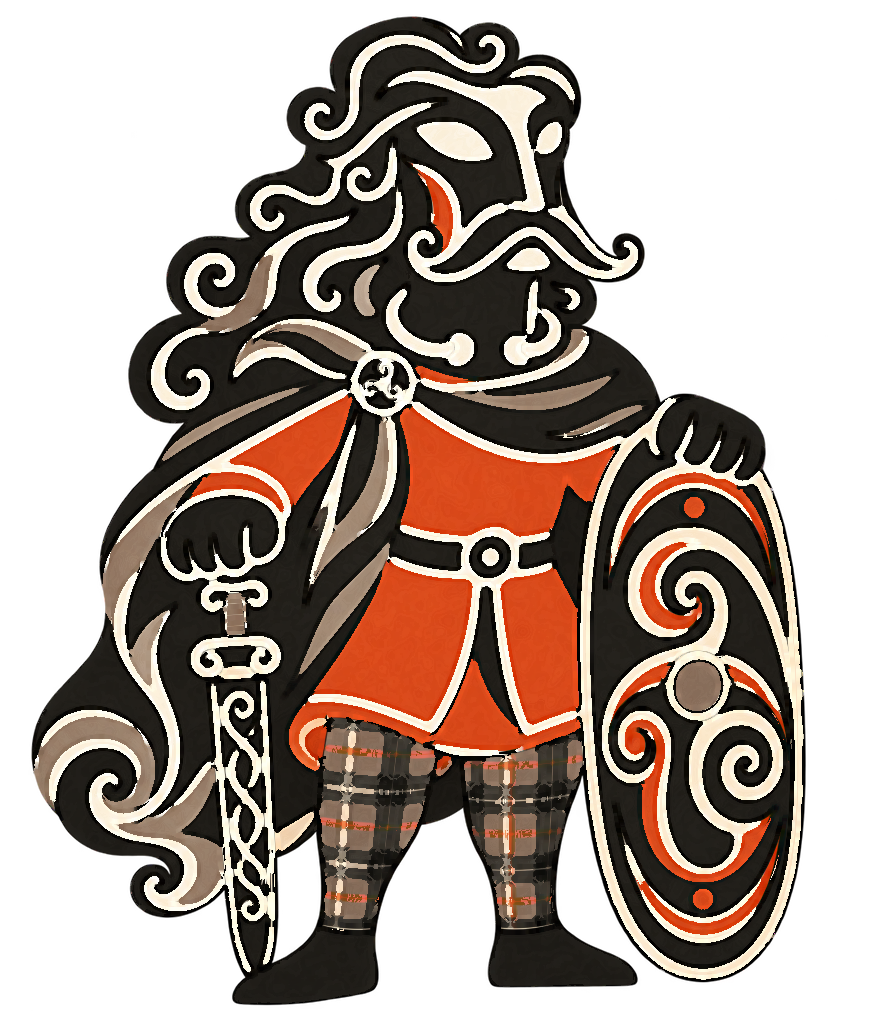
Ambicatus is a legendary king remembered in Livy’s account of Gaulish migrations. Within Bessus Nouiogalation, we honor him among our ancestral figures, reflecting upon leadership, the well-being of the people, and our responsibilities toward those who follow.
Historical evidence
His name
Within BNG, we use Ambicatus, while the account commonly published under Livy’s name uses Ambigatus.
The name is generally explained through ambi-, “around” or “on both sides,” and catu-, “battle.” English renderings include “one who fights on both sides” or “fighter all around.” The battle element occurs widely in Celtic personal names.
Grigory Bondarenko gives the interpretation “fighter around himself” when comparing Ambigatus with figures of ideal kingship in Irish tradition. Such explanations bring a martial quality to the name; they do not independently establish the king’s deeds or historical identity.
The king in Livy’s account
Our principal ancient source is Livy’s History of Rome, Book 5, chapter 34.
Livy presents Ambigatus as a king of the Bituriges, whose people supplied the ruler for the wider Celtic population described in the passage. His reign is marked by personal distinction, good fortune, abundant harvests, and a population that has become difficult to sustain.
The aging king responds by sending his sister’s sons, Bellovesus and Segovesus, to establish settlements elsewhere. They are his nephews in Livy’s account; the passage does not describe them as foster sons.
Livy places the story during the reign of Tarquinius Priscus at Rome. This is the chronology of the ancient narrative, rather than independent confirmation of Ambicatus’s lifetime.
Kingship and prosperity
Livy connects Ambigatus’s personal distinction and good fortune with the prosperity of the people under his rule. The land produces abundant crops, and the population grows.
Prosperity is an important feature of his portrayal as a king. His challenge arises from abundance: the population has become difficult to sustain, and he must consider its future.
This invites discussion of leadership and collective well-being. It does not establish that Ambicatus was worshipped as a fertility deity or preserve a ceremony connecting his kingship with the land.
Divine guidance and the departing communities
Religious consultation forms part of the decision to depart. Ambigatus proposes that his nephews settle where the gods indicate through augury. The narrative then describes Segovesus receiving the Hercynian forest by lot, while Bellovesus receives the route into Italy.
Bellovesus gathers followers from several peoples: the Bituriges, Arverni, Senones, Aedui, Ambarri, Carnutes, and Aulerci. The story concerns a movement involving several communities, rather than the departure of the king’s relatives alone.
These details place divine guidance within an account of communal decision-making. They do not explain the exact divinatory procedure or establish that all Gaulish migrations followed this pattern.
History and ancestral legend
Ambicatus is best approached as a legendary king preserved in an ancient historical narrative. Livy’s account alone cannot establish that he ruled a unified Gaul or that the events happened exactly as described.
His story also lends itself to comparison with other traditions of kingship. Bondarenko discusses him alongside the Irish Conn Cétchathach, considering the image of a foundational king with a martial character. This is a scholarly comparison, rather than evidence that the figures were historically identical.
The distinction matters for our practice. The evidence discussed here gives us an ancient story about a king, rather than an inscription identifying Ambicatus as a deity or documenting an ancient cult in his honor.
Ambicatus in Bessus Nouiogalation
An honored ancestral figure
Within Bessus Nouiogalation, Ambicatus holds a place among our honored ancestral figures. We remember him as a great leader of the Gauls and as a figure through whom we cultivate a relationship with the ancestral past.
His importance does not depend upon proving every detail of his life. The story preserved under his name gives us a point of remembrance: a ruler faced with the needs of his people and the responsibility of considering their future.
Our relationship with him belongs to our living custom. Through remembrance, offerings, and reflection, his story becomes part of the ancestral life of our Toutâ.
Leadership and responsibility
For us, Ambicatus invites reflection on what leadership requires.
A community needs more than someone willing to hold a position. It needs people who attend to its circumstances, listen to its members, and consider how their decisions will affect others.
His story reminds us that prosperity brings responsibilities. Resources must be used thoughtfully, knowledge must be shared, and people need opportunities to develop their abilities.
We honor this understanding by asking practical questions: Who needs support? What work requires attention? What are we helping others become capable of carrying forward?
Making room for those who follow
The departure of the younger generation offers a further point of reflection within our bessus.
We understand responsible leadership as including the preparation of others to take on responsibility. Teaching, encouragement, and the sharing of experience help a community endure beyond any one person.
Through Ambicatus, we consider what we are making possible for those who follow. What knowledge, relationships, and resources will they inherit? Have we given them room to contribute and grow?
These are contemporary teachings we draw from his story. They express how we bring ancestral remembrance into the responsibilities of our own community.
His place in our reckoning of time
BNG also uses Ambicatus as the reference point for our customary reckoning of years.
Our terms are Are Ambicatû, “Before Ambicatus,” and Sepans Ambicatû, “Following Ambicatus.” This is a modern BNG convention grounded in his place within our ancestral narrative.
It is a meaningful reference point within our custom, rather than a surviving ancient Gaulish dating system or proof of a precisely established reign.
Through this reckoning, Ambicatus becomes part of how we locate ourselves within a continuing story: remembering the past while accepting responsibility for what we carry forward.
Honoring Ambicatus
- Offering water, bread, or a drink in remembrance.
- Reading his story aloud alongside the honoring of the Regentiâ.
- Reflecting on the responsibilities of leadership.
- Listening to those affected by a communal decision.
- Teaching a newcomer or sharing a useful skill.
- Preserving community history and knowledge.
- Helping another person prepare to carry a responsibility.
- Planning thoughtfully for the future of the Toutâ.
- Supporting work whose benefits will continue beyond your own involvement.
Before accepting a responsibility, you might make an offering and consider what the role requires, whose needs deserve attention, and what support will help the work endure.
These are suggestions for contemporary practice within BNG, rather than claims about a documented ancient rite for Ambicatus.
Sources
Ancient source
- Livy. History of Rome 5.34. Translated by Canon Roberts, 1912. English text. Latin text, Packard Humanities Institute.
Academic studies
- Bondarenko, Grigory. “Conn Cétchathach and the Image of Ideal Kingship in Early Medieval Ireland.” Studia Celtica Fennica 4 (2007): 15–30, especially 15 — comparison with Ambigatus and interpretation of his name.
- Salomon, Corinna. “Some Remarks on the Personal Name System of Raetic.” 2020, especially 379 — comparative linguistic support for Celtic katu-, “battle,” in personal names; not a study of Ambicatus specifically.

