
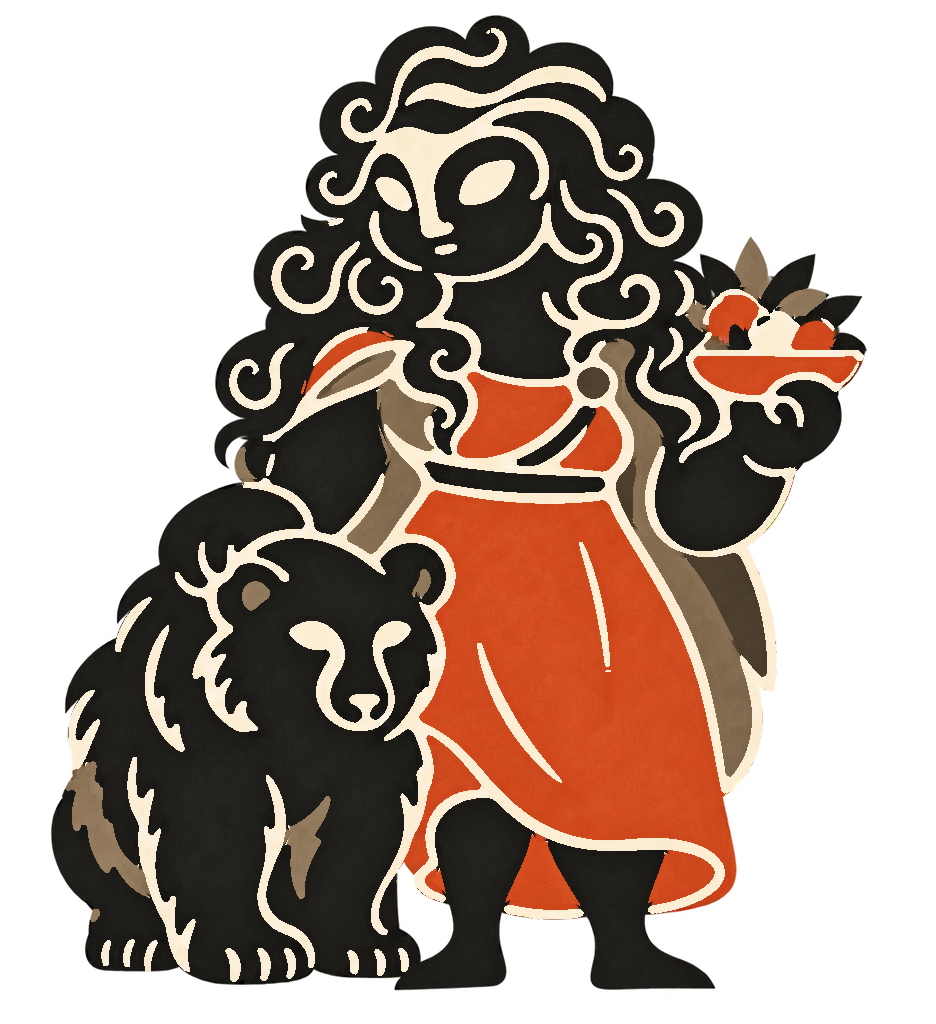
Artiû is a Dêuâ closely connected with the bear. Her best-known surviving image comes from Muri, near Bern in Switzerland, where a bronze group brings together a bear, a seated goddess, a tree, and fruit.
Within Bessus Nouiogalation, we honor her through strength, protection, seasonal rhythms, and the wisdom found in rest and dreams.
Historical evidence
Her Name
The name Artio is formed from the Celtic arto-, “bear.” The FERCAN inscription catalogue records this interpretation with reference to Xavier Delamarre’s linguistic work. Her name and the bear represented in the Muri bronze group support the same connection.
The Muri dedication reads Deae Artioni Licinia Sabinilla: “To the goddess Artio, Licinia Sabinilla [dedicated this].” Artioni is the dative form—the grammatical case identifying the recipient of the dedication. It means “to Artio,” rather than being a separate name for her.
“Bear Goddess” is a useful description of the relationship expressed by her name and imagery. More specific titles, such as “Mother Bear” or “Powerful Bear,” should be identified as devotional interpretations rather than literal translations of the name.
In our bessus, we use Artiû. We distinguish this customary form from Artioni, the form preserved in the ancient dedication, and Artio, the form generally used in scholarly discussions.
The bronze group from Muri
The most recognizable evidence for Artio is a group of Roman-period bronzes discovered at Muri, near Bern, in 1832.
The group includes a bear facing a seated female figure, together with a tree and a container of fruit. Its base carries the inscription:
DEAE ARTIONI
LICINIA SABINILLA
This can be translated as:
“To the goddess Artio, [from] Licinia Sabinilla.”
The inscription is catalogued as CIL XIII 5160. It gives us both the goddess’s name and the name of the woman who dedicated the group.
The objects were found separately. Their arrangement was reconstructed through examination of the base, including traces showing where the bear had been attached. The familiar display rests on study of the surviving pieces.
What the imagery suggests
The bear is central to the group. Alongside the name, it gives us a strong basis for understanding Artio as a bear goddess.
The tree and fruit add other elements to the scene. They invite discussion of vegetation, nourishment, and the living landscape, although they do not explain exactly how her worshippers understood those relationships. In her study of ancient bronze trees, Marina Castoldi suggests that the tree accompanying Artio represents the wild landscape.
Calling her a bear goddess is well grounded. Describing a complete ancient teaching about motherhood, hibernation, dreams, or seasonal renewal would require evidence that this group does not provide.
Other places where her name appears
Artio’s name also survives beyond Muri. A rock inscription near Ernzen, in present-day Germany, reads ARTIONI BIBER, naming the goddess and a dedicator called Biber.
A damaged statue base from Stockstadt am Main has also been interpreted as a dedication to Artio. Here, however, part of the goddess’s name is restored by scholars. The FERCAN catalogue marks the identification with a question mark.
| Findspot | Evidence | What needs care |
| Muri, near Bern | Bronze group with the dedication Deae Artioni / Licinia Sabinilla. | The arrangement was reconstructed from separately discovered pieces. |
| Ernzen | Rock inscription reading Artioni Biber. | The brief dedication gives little information about her worship. |
| Stockstadt am Main | Fragmentary inscribed statue base. | The identification as Artio depends on restoration of missing letters. |
Artiû in Bessus Nouiogalation
The following expresses our gnosis and relationship with Artiû within our living custom.
Strength and protection
We honor Artiû as a protective presence whose strength is expressed through the bear.
A mother bear’s care for her young offers us an image of that protection. She guards, nourishes, and teaches. Within our bessus, we approach Artiû as a Dêuâ who helps us develop these qualities in our own relationships.
Her strength calls us to consider what needs protecting and how we can meet that responsibility with care.
Teacher of the living world
Artiû is also a teacher of how to thrive within the natural world.
As a bear teaches her cubs to find food and respond to their surroundings, we understand Artiû as offering wisdom through attention and experience. Her guidance encourages us to learn about the places we inhabit: their seasons, resources, dangers, and the beings who share them.
Through her, we seek a practical relationship with the living world—one that grows as we observe, learn, and return.
Seasons and rest
The bear’s winter withdrawal holds meaning within our gnosis.
We connect Artiû with the changing seasons and the rhythms of activity and rest. There are times to move outward, gather, and act. There are also times to withdraw, recover, and allow what has been gathered to settle.
Her deep slumber within the cave reminds us that rest has a place in life’s continuing movement. We may approach her when we need to recognize that rhythm in ourselves.
Dreams and inward journeys
Within BNG, Artiû’s cave and slumber also connect her with dreams and the deeper places of the mind.
We understand her as a guide through the dreamtime, helping us approach what is unfamiliar or difficult to understand within ourselves. Her guidance can be gentle, allowing insight to emerge through reflection and return.
Dream work, meditation, and quiet contemplation offer ways of developing this relationship. We take time with what arises, considering its meaning through our experience and practice.
Honoring Artiû
Ways of honoring Artiû within our bessus may include:
- Learning about bears and caring for their habitats.
- Protecting and supporting those entrusted to our care.
- Observing seasonal changes in the places where we live.
- Making room for rest and reflection.
- Keeping a dream journal or practicing quiet meditation.
- Developing the knowledge needed to live attentively within the natural world.
Through Artiû, we seek strength that protects, wisdom that teaches, and a deeper understanding of when to act and when to rest.
Sources and further reading
- FERCAN, “Artio? CF-GeS-1091”: the Stockstadt inscription, its uncertain restoration, and linguistic references.
- Martín S. Ruipérez, “La ‘Dea Artio’ celta y la ‘Artemis’ griega: Un aspecto religioso de la afinidad celto-iliria”, Zephyrus 2 (1951): the repository summary describes the Muri discovery, inscription, and reconstruction.
- Marina Castoldi, “Bronze Trees from the Greek to the Roman World”, in Artistry in Bronze (2017).
- Ubi Erat Lupa, “Weihung für Artio,” no. 32157: the Ernzen rock dedication.
Further reading
- Annemarie Kaufmann-Heinimann, Dea Artio, die Bärengöttin von Muri: Römische Bronzestatuetten aus einem ländlichen Heiligtum (2002).

