
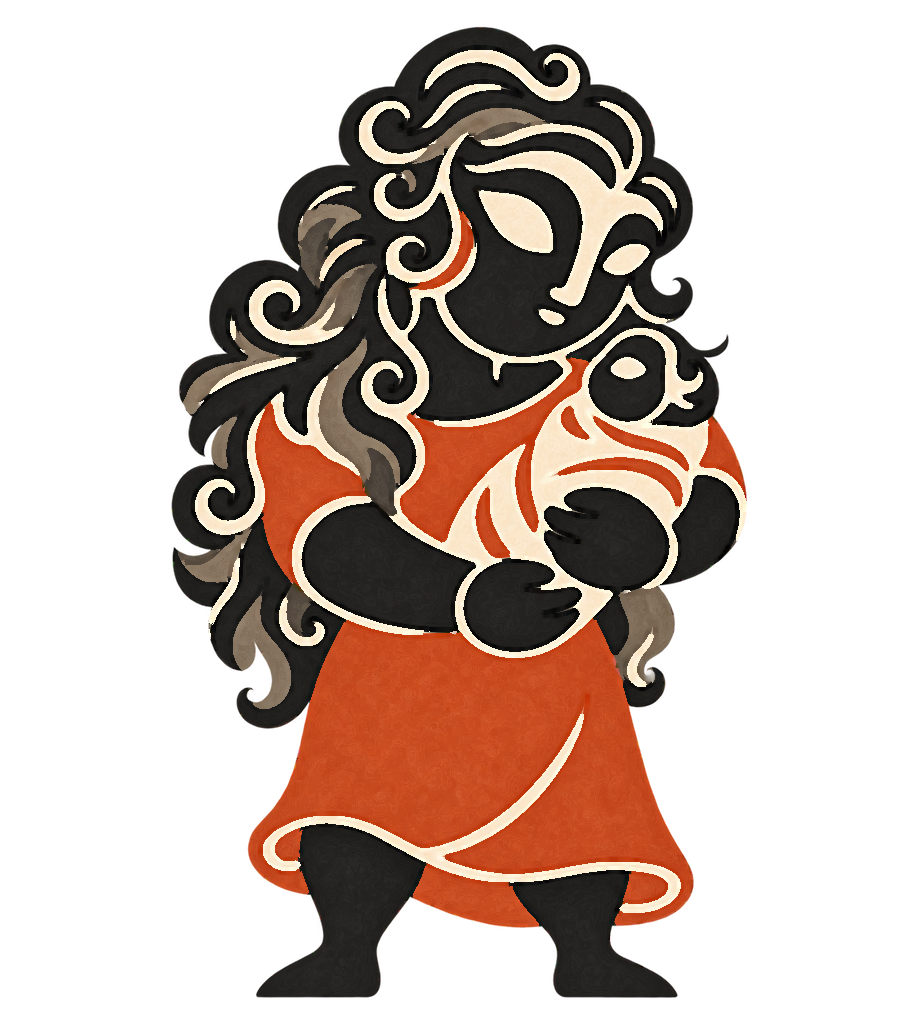
Auetâ is associated with motherhood, nourishment, and the care of life. Her ancient name survives in dedications from Trier, where scholars also connect her worship with clay figures of nurturing goddesses.
Within Bessus Nouiogalation, we honor her as a Dêuâ of midwives, fertility, nursing, and the protection of children.
Historical evidence
Her Name
The meaning of Aveta is not securely established. One proposed interpretation is “rich in descendants,” reported for Corinna Scheungraber’s treatment of the name in her study of ancient Germanic and Celtic divine names. This remains a proposal; for this page, we leave her name untranslated.
Her maternal associations should also be distinguished from the name’s meaning. Images and evidence of worship can help us understand a goddess without necessarily providing a translation of her name.
In our bessus, we use Auetâ. This is our customary spelling of the name generally written Aveta in scholarly discussions.
Her worship at Trier
Some of the clearest evidence comes from the Altbachtal sanctuary complex at Trier, ancient Augusta Treverorum, in present-day Germany.
An inscribed limestone plaque found there in 1924–1925 reads:
DEAE AVETAE
ADFINES
The dedication addresses “the goddess Aveta.” The word adfines identifies the dedicators as relatives by marriage. The archaeological catalogue dates the object to approximately 140–160 CE and records its discovery in Building 16, identified as an Aveta sanctuary.
A second monument, a sandstone altar found in 1929 in neighboring Building 17, also names Dea Aveta. Several people contributed to its dedication, which ends with dono dederunt, meaning “gave as a gift.” The catalogue dates this altar broadly to 150–250 CE.
| Object | Findspot | What it preserves |
| Inscribed plaque | Altbachtal, Building 16 | A dedication to Aveta by people described as adfines. |
| Sandstone altar | Altbachtal, Building 17 | Aveta’s name and a dedication made by several people. |
These inscriptions give us direct evidence of her worship. They also preserve something of the people who honored her, through family relationships and a shared gift.
Mother figures and nourishment
In “The Celtic Goddess as Healer,” Miranda Green describes Aveta as a spring goddess of the Treveri. She records that worshippers at Trier offered small clay figures of mother goddesses accompanied by babies, dogs, or baskets of fruit.
These images support discussion of nourishment, fertility, and maternal care. There is an important distinction, though: figures offered to a goddess do not necessarily all portray that goddess herself. Green describes them as offerings of mother-goddess figures, so we should avoid identifying every similar figurine as Aveta.
For the same reason, a nursing figure from another site should not automatically be labeled Auetâ without evidence connecting it to her worship.
Water and healing
Green places Aveta within her discussion of spring and healing goddesses. She also considers dogs among the animals associated with healing and renewal in this wider imagery.
This gives us a scholarly basis for discussing water and healing alongside maternal nourishment. It does not establish every detail of her ancient role, or tell us exactly how her worshippers understood the dogs.
The clearest starting points are her named dedications at Trier and the nurturing imagery associated with offerings there.
Auetâ in Bessus Nouiogalation
The following expresses our gnosis and relationship with Auetâ within our living custom.
Dêuâ of midwives and childbirth
We honor Auetâ as a Dêuâ of midwives, fertility, and childbirth.
She holds a place in our devotion wherever new life is welcomed and those bringing it into the world need support. We approach her through the skill, patience, and care involved in attending birth.
Her presence also reminds us to care for the mother. The needs of those carrying, birthing, and nurturing children deserve attention throughout these changes.
Nursing and nourishment
Auetâ’s care continues through nursing and the nourishment of children.
Within our bessus, feeding a child is one expression of the continuing relationship through which life is sustained. It requires time, attention, and an understanding of another being’s needs.
We honor Auetâ through that work and through supporting those who undertake it. Her place in our custom includes the ordinary acts of care that help children grow.
Protector of children
We understand Auetâ as a protector of children beyond the moment of birth.
Her care extends to their well-being, development, and the relationships that surround them. Honoring her calls us to consider whether children are safe, nourished, listened to, and given room to grow.
This responsibility belongs to the wider community as well as the household. Within our bessus, devotion to Auetâ can take shape through helping families and supporting those who care for children.
Dogs and protective care
Dogs hold meaning within our gnosis through their companionship, watchfulness, and protective presence.
We understand the dogs associated with Auetâ’s imagery as an expression of care around vulnerable life. Their connection with healing also offers us a way to reflect on comfort, recovery, and the support that helps life flourish.
This is our devotional interpretation of the imagery.
Water and renewal
Water is another important element in our relationship with Auetâ.
We connect it with nourishment, renewal, and the continuing movement of life. Water sustains us through daily acts of drinking, washing, and tending. These familiar actions offer ways to approach her with gratitude and attention.
Within our custom, her relationship with water deepens our understanding of the care through which life is maintained.
Honoring Auetâ
Ways of honoring Auetâ within our bessus may include:
- Supporting midwives and those preparing for childbirth.
- Helping parents and caregivers with practical needs.
- Caring for children’s safety and well-being.
- Giving food, supplies, or time to families who need support.
- Offering clean water with gratitude.
- Recognizing the daily work of nursing and nurturing.
Through Auetâ, we honor motherhood and the responsibility of safeguarding young life.
Sources
- Zimmer, Stefan. Review of Corinna Scheungraber, Altgermanische und altkeltische Theonyme: die epigraphische Evidenz aus der Kontaktzone (2020). Beiträge zur Namenforschung 56, no. 3 (2021), pp. 285–288. Read online.
- Ubi Erat Lupa, “Weihung für Aveta,” no. 32160: the inscribed plaque from Altbachtal Building 16.
- Ubi Erat Lupa, “Altar für Aveta,” no. 32161: the altar from Altbachtal Building 17.
- Miranda Green, “The Celtic Goddess as Healer,” in Sandra Billington and Miranda Green, eds., The Concept of the Goddess (Routledge, 1996), pp. 26–40, especially pp. 33 and 37. Publisher’s book page.

