
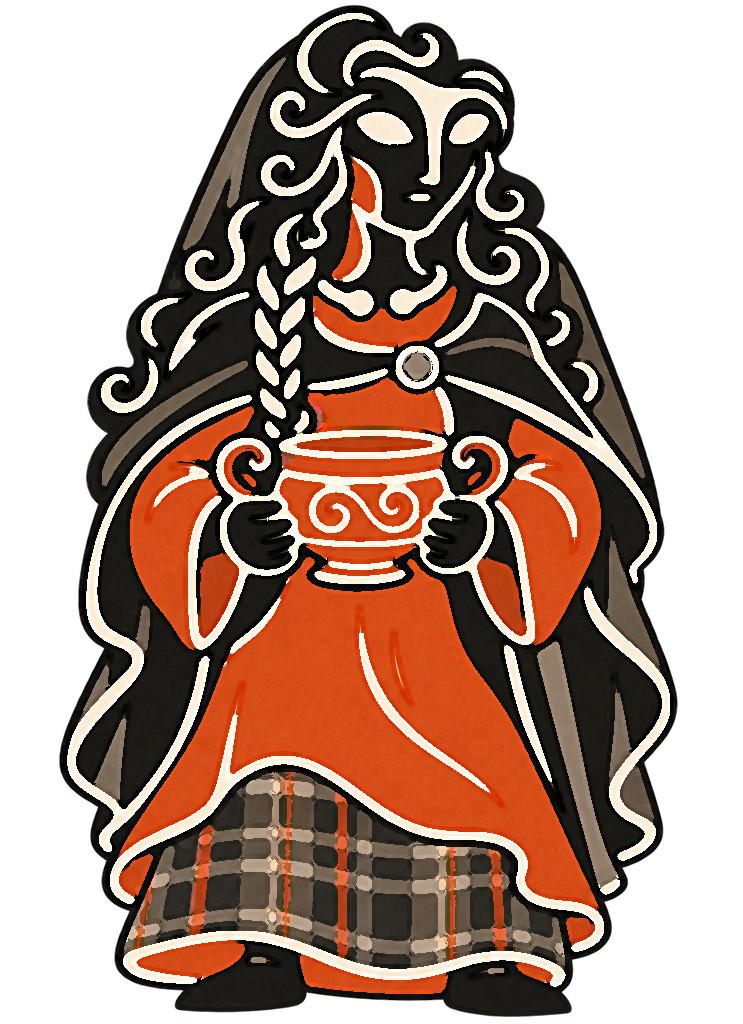
Camma is remembered in ancient literature as a Galatian priestess of Artemis, admired for her intelligence, generosity, and resolve. Her story concerns religious service, bereavement, and resistance to a powerful man’s coercion. Within BNG, her remembrance offers a focus for considering dignity, commitment, and the responsibilities of sacred service.
Historical evidence
Her name
Ancient Greek sources preserve her name as Κάμμα, conventionally written Camma or Kamma.
For this page, we leave it untranslated. A specific meaning would require a securely identified linguistic explanation.
A priestess in Galatia
Our principal source is Plutarch, who tells Camma’s story in both On the Bravery of Women and Dialogue on Love.
He places her in Galatia, in Asia Minor, rather than continental Gaul. She is married to Sinatus, one of the region’s powerful tetrarchs.
In On the Bravery of Women, Plutarch describes her as intelligent, high-minded, and loved for her kindness and generosity. He explicitly identifies her as a priestess of Artemis, appearing prominently in processions and sacrifices. Her religious role belongs to the surviving account, rather than being inferred from her name.
Her religious service
In Dialogue on Love, 768B–D, her priesthood is described as hereditary. The account also presents service to Artemis as a refuge following her husband’s death.
These details are valuable evidence for how an ancient author portrayed a Galatian woman’s religious position. They do not establish that all Galatian priesthoods were hereditary or that the same arrangements existed throughout Gaul.
The goddess should retain the name Artemis when discussing these sources. The passage does not supply a separate Celtic name that would allow us to identify her with a particular Dêuâ honored within BNG.
The story of Sinatus and Sinorix
Plutarch recounts that Sinorix, another powerful Galatian, desired Camma and murdered Sinatus. He subsequently sought to marry her, with pressure also coming from people around her.
Camma eventually appeared to accept. At the sanctuary, she shared a poisoned drink with Sinorix, bringing about both his death and her own.
The narrative presents her action as revenge for her husband’s murder. It is a tragic story shaped by ancient ideals of marital devotion, rather than a model requiring imitation.
Other ancient retellings
Polyaenus, in Stratagems 8.39, also tells Camma’s story. He identifies her as a priestess of Artemis and emphasizes her deliberate use of the proposed marriage ceremony to deceive Sinorix.
The recurrence of the story shows its circulation in ancient literature. It does not establish that each author possessed independent evidence for the events.
History and literary purpose
Plutarch’s works preserve stories selected to explore virtue, love, and conduct. Camma appears within those discussions as an example of a woman’s resolve and attachment to her husband.
This literary purpose is important when considering speeches, motives, and dramatic details. The surviving narratives are not neutral biographies, and they leave much of her life unknown.
Her exact lifetime is not securely established by the passages discussed here. Nor do they document an ancient cult honoring her after death.
What we can say about her
The tradition remembers Camma as a Galatian priestess, a woman of public standing, and a person admired for intelligence and generosity.
Her story also preserves the pressures surrounding a woman whose wishes were disregarded by a powerful man. These themes can inform contemporary reflection without supplying a complete account of her religious teachings or personal life.
Camma in Bessus Nouiogalation
An ancestor of sacred service
We may honor Camma as an ancestor of religious service.
Her remembrance gives a named woman a place within our consideration of ancient religious life. Through her, we reflect upon those who tended sanctuaries, participated in ceremonies, and carried responsibilities within their communities.
Within our bessus, sacred service asks for attention, preparation, and care toward the people and beings involved.
Kindness and responsibility
The kindness and generosity attributed to Camma deserve remembrance alongside her more dramatic story.
Religious standing carries responsibilities toward others. The welcome offered to a newcomer, the patience given to a question, and the practical help provided during difficulty all contribute to a community’s sacred life.
Through honoring her, we can consider whether our conduct supports the people we are meant to serve.
Dignity and freely given consent
Camma’s story brings the misuse of power into view.
Within BNG, we affirm that affection, status, or desire does not entitle someone to another person. Relationships require freely given consent, and pressure from relatives, friends, or influential people does not replace it.
Her remembrance can accompany reflection on boundaries and the duty to take coercion seriously.
Grief and continuing care
The ancient story joins bereavement with a fatal act of revenge. Our contemporary honoring need not make that ending the measure of loyalty or courage.
We may instead remember Camma through care for those who grieve: offering companionship, respecting their wishes, and helping with the ordinary responsibilities that loss can make difficult.
Love for someone who has died can continue through remembrance and through the life we sustain.
Remembering beyond the tragedy
Camma’s life was larger than the circumstances of her death.
We remember the priestess, the intelligence and generosity attributed to her, and the relationships that ancient authors only briefly describe. Where knowledge ends, we allow uncertainty rather than filling every gap.
Honoring Camma
- Offering water, bread, or a drink in remembrance.
- Reading the ancient accounts with attention to their differences.
- Supporting those who prepare and maintain communal rites.
- Tending a shrine or sacred gathering place.
- Offering kindness without using religious status to demand obedience.
- Respecting consent and personal boundaries.
- Supporting someone experiencing coercion.
- Helping a bereaved person with practical needs.
- Remembering women whose religious service has been overlooked.
- Reflecting on the responsibilities attached to authority.
A simple observance might include an offering followed by an act of service for someone in your community.
These are contemporary suggestions for honoring Camma among the Regentiâ, rather than practices documented in an ancient cult devoted to her.
Sources
Ancient sources
- Plutarch. On the Bravery of Women, chapter 20, “Camma”, Moralia 257E–258C. Translated by Frank Cole Babbitt.
- Plutarch. Dialogue on Love (Amatorius), 768B–D — the parallel account describing her hereditary priesthood. Greek text and older English translation.
- Polyaenus. Stratagems 8.39, “Camma”. Translation adapted from R. Shepherd’s 1793 edition.
Further research
- Comparison of Plutarch’s two versions is particularly useful for examining how he shapes Camma’s story around religious service, marital attachment, and virtue. The accounts should be read as related literary treatments, rather than independent confirmation of every detail.
Support and resources
The sexual violence, coercion, and abuse of power described in the stories of Chiomara and Camma are not confined to the ancient world. People continue to experience these harms today, in conflict, in relationships, and within their communities.
Within BNG, honoring these women includes caring for people facing abuse now: listening without blame, respecting their choices, and helping them access safety and support. Their stories do not prescribe how anyone must respond to violence. A person’s dignity never depends upon resistance, revenge, or sacrificing their own life.
The following resources offer support for people affected by sexual violence, domestic abuse, or coercion, and for those seeking to support someone they care about.
Finding support internationally
- NO MORE Global Directory — Search by country or region for domestic and sexual violence support services, including resources for people of different genders and sexual orientations.
Sexual violence and abuse support
- RAINN — National Sexual Assault Hotline — U.S. service offering free, confidential support around the clock for people affected by sexual violence and their loved ones.
- National Domestic Violence Hotline — U.S. support for people experiencing relationship abuse, including advocacy, safety planning, and connections to community resources.
- Domestic Violence Awareness Project — Seeking Help — Information about recognizing abuse and finding support, including national services and connections to local resources.
- Sexual Assault Kit Initiative — Resources for Survivors — A collection of support services and informational resources for survivors of sexual assault.
Community and specialist support
- House of Apples — Macha’s Justice — Domestic violence education and resources for Pagan and polytheist communities, including a directory of trained spiritual service providers.
- Military OneSource — Domestic Abuse Help — Information about advocacy, safety planning, and support through the Family Advocacy Program for eligible military personnel, partners, and families.
- FORGE — Resources and support for transgender and nonbinary survivors of violence, their loved ones, and service providers.
- SurvivorsUK — UK-based specialist support for male and nonbinary survivors of sexual violence.
- isurvive — Online peer-support forums and resources for adult survivors of childhood abuse and their loved ones.
Legal information, stalking, and digital safety
- WomensLaw — Plain-language U.S. legal information concerning domestic violence, sexual assault, and stalking. Despite its name, its resources support survivors of all genders.
- SPARC — Stalking Prevention, Awareness, and Resource Center — Information about stalking, documentation, and safety planning. SPARC is an educational resource and does not provide direct survivor services.
- Safety Net Project — Technology Safety — Information about digital privacy, monitoring, online harassment, and technology-facilitated abuse, including a toolkit for survivors.

