
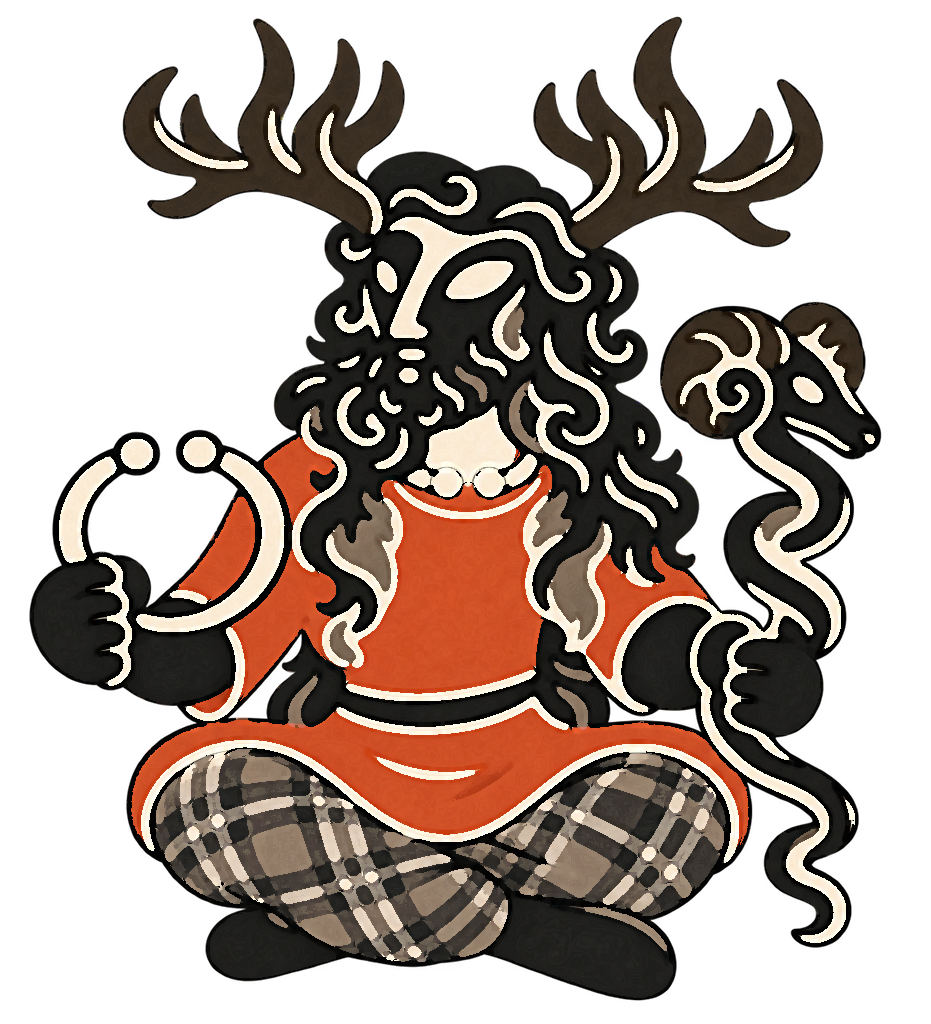
Carnonos is the name we use within Bessus Nouiogalation for the antlered Dêuos commonly known as Cernunnos. Ancient images connect him with animals, torcs, and abundance, while his precise roles remain open to interpretation. Within our bessus, we honor him as Guardian of the Threshold, a guide between worlds, and an intermediary through whom relationships and crossings become possible.
Historical evidence
His name
Cernunnos is commonly interpreted as “the Horned One” or “the Antlered One.” This interpretation draws upon both the proposed linguistic origin of his name and the antlers shown on the Paris monument.
The name is generally connected with the Indo-European word-family for horns and antlers. In his comparison of Cernunnos and the Anatolian deity Kuruntas, Fred C. Woudhuizen derives both names from this horn-root. He refers to Calvert Watkins’s comparative linguistic work and Xavier Delamarre’s discussion under carnon in his Dictionnaire de la langue gauloise (Woudhuizen 2014, p. 56, citing Watkins 1999, pp. 15–20, and Delamarre 2003, pp. 106–107). This linguistic comparison does not establish that the deities had identical roles. The broad connection with horns is easier to explain than the precise formation of Cernunnos. We retain “the Horned One” as a conventional interpretation without presenting the expanded translation “the Great Horned God” as certain.
The related form Carnonos has been proposed from a Gaulish inscription written in Greek letters, catalogued as RIG I G-224. It is commonly called the Montagnac inscription, although a correction of its reported findspot places it in the neighboring commune of Aumes, in the Hérault region of southern France.
Linguist Michel Lejeune read its central word as καρνονου, transliterated karnonou, and interpreted it as a dative divine name: “to Carnonos.” Under his reading, Alleteinos made a dedication to a locally identified Carnonos, whom Lejeune tentatively connected with Cernunnos. Other interpretations of the inscription have been proposed. Even the final word has been understood differently—as a local designation or as part of the dedicator’s parentage.
Carnonos is the proposed nominative form reconstructed from karnonou. Comparing it with Cernunnos involves explaining differences in the vowels and the single or doubled n. We should avoid presenting them simply as interchangeable spellings or claiming that Carnonos was certainly the original form.
Within our bessus, we use Carnonos, drawing upon the proposed Montagnac divine name while acknowledging the uncertainty surrounding its relationship with the Paris Cernunnos.
The Pillar of the Boatmen
Our clearest link between his name and appearance comes from the Pillar of the Boatmen, erected at ancient Lutetia, now Paris, during the reign of Tiberius, AD 14–37. Its dedication names the boatmen of the Parisii, who paid for the monument together. Its carvings bring Gaulish and Roman divine figures into the same setting.
On his panel, Cernunnos appears as a bearded figure with animal-like ears and branching antlers. A torc hangs from each antler. The inscription above him survives as […]ERNVNNOS, conventionally restored as CERNVNNOS.
Only the upper part of the figure survives. Although he is often reconstructed sitting cross-legged, that posture cannot be confirmed from the Paris carving itself. Alexandre Léonet discusses the uncertainties surrounding both the restoration of the name and the missing lower portion of the figure.
The Gundestrup Cauldron
Another important comparison is the antlered figure on the Gundestrup Cauldron, found in Denmark in 1891.
He sits cross-legged, wears a torc around his neck, holds another torc, and grasps a ram-headed serpent. Animals surround him. These features have led to his widespread identification as Cernunnos, including in the National Museum of Denmark’s presentation of the object. However, no accompanying inscription names him. The identification rests upon comparison with other images.
Although found in Denmark, the National Museum dates the cauldron’s manufacture approximately to 150 BC–AD 1 and places its probable production in southwestern Romania or northwestern Bulgaria, where Celtic and Thracian traditions could meet. It is an important comparison for Celtic religious imagery, but it was not a find from Gaul.
The Reims relief
A stone relief from Reims, now held by the Musée Saint-Remi, shows another figure commonly identified as Cernunnos. The museum dates it to the first century AD.
The central figure sits between Apollo and Mercury, wearing a torc and holding a bag from which grain or coins pour. A stag and a bull stand below him. His antlers are damaged, but traces of their attachment remain.
Unlike the Paris monument, this relief does not supply his name. Its identification comes from the figure’s appearance and comparison with other representations.
The overflowing bag has encouraged interpretations involving abundance and prosperity. Keeping “grain or coins” in the description reflects the uncertainty over exactly what the carving depicts.
The Lyon cup
A silver cup found at Lyon shows a reclining male figure wearing a torc, holding another torc and a cornucopia, with a stag and a dog nearby. Elsewhere on the vessel appear Mercury and a serpent entwined around a tree.
The figure’s head is missing, so we cannot establish whether he originally had antlers. His identification as Cernunnos rests upon the combination of attributes and comparison with other images, particularly the Gundestrup figure.
Fickett-Wilbar discusses the cup as a possible representation of Cernunnos expressed through a more classical artistic style. It adds to the discussion of abundance, animal companions, and associations with Mercury, while remaining an unnamed and uncertain identification.
The ram-headed serpent
The ram-headed serpent is an important companion in images associated with Cernunnos. On the Gundestrup Cauldron, the antlered figure holds one behind its head. Other sculptures bring comparable serpents into close contact with figures identified as the same deity.
The creature combines features of a serpent and a ram. Its meaning remains debated, and its appearance elsewhere in Gaulish imagery shows that it was not exclusive to Cernunnos.
Interpretations have connected it with the Earth, abundance, and powers associated with the world below. How the god relates to it also matters. Holding the serpent can be understood as restraint, while other representations have encouraged readings involving cooperation or nourishment.
The author of Deo Mercurio favors understanding the god and serpent as allies. This provides a useful modern interpretation to consider alongside readings that emphasize tension or the release of wealth. Neither explanation is preserved in an ancient account describing the images.
Abundance and the world below
In her study Cernunnos: Origin and Transformation of a Celtic Divinity, Phyllis Pray Bober developed an influential interpretation connecting Cernunnos with the underworld and its wealth. Léonet discusses this interpretation within the history of scholarship on the deity.
This offers another way of approaching his abundance imagery. Wealth can be understood through what comes from the Earth, as well as through animals, food, and exchange.
Some scholars have consequently considered Cernunnos a candidate for the deity whom Caesar calls Dis Pater. Caesar does not name Cernunnos in that passage, however, so the identification remains a hypothesis.
Liminality, exchange, and bidirectionality
David Fickett-Wilbar, also known as Ceisiwr Serith, develops another interpretation in Cernunnos: Looking a Different Way. He examines contrasts within the imagery, including human and animal features, wild and domesticated animals, and the possession and distribution of wealth.
He proposes understanding Cernunnos through liminality, mediation, exchange, and bidirectionality: crossing boundaries and moving in both directions. Comparisons with Mercury and other deities contribute to his argument.
This is a comparative interpretation, rather than a function explicitly described in a surviving Gaulish text. It has informed our understanding of Carnonos within BNG, particularly our emphasis on passage, relationship, and return.
What remains uncertain
The surviving evidence gives us an antlered figure named at Paris and a wider group of images linked through comparison. It does not preserve a complete mythology or an explanation of his ceremonies.
Animals, torcs, serpents, and abundance provide starting points for interpretation. They should not be treated as a fixed code in which every object has one meaning. Our understanding benefits from keeping the surviving objects, scholarly arguments, and modern devotional developments distinguishable.
Carnonos in Bessus Nouiogalation
Guide of the Threshold
Within our bessus, we understand Carnonos as a Dêuos of liminality and bidirectionality: a deity of thresholds, crossings, and movement between worlds.
He stands where different realms meet. We approach him at the boundary between settlement and wilderness, between the ordinary and the sacred, and between our world and the presence of the divine.
As Guide of the Threshold, he watches over boundaries and the passages through them. His guardianship includes recognizing when a crossing is appropriate and the care required of those who undertake it.
Through Carnonos, we approach sacred space with attention to where we are entering, whom we are addressing, and the responsibilities carried into that relationship.
Walker between Samos and Giamos
We understand Carnonos as a conduit between Samos and Giamos, moving between them and connecting their different conditions.
Cunolugus explores a related interpretation of the Reims relief. He proposes reading Apollo through Samos and Mercury through Giamos, with Carnonos seated between them as their mediator. This is a modern reading of the arrangement rather than an explanation supplied by the monument itself.
Within BNG, this offers a way to contemplate Carnonos’s place between complementary powers. Both Samos and Giamos contribute to existence. Carnonos moves between them, allowing passage, relationship, and exchange.
This movement in both directions is central to our understanding of him. He can lead outward into unfamiliar places and guide the journey home. He knows the boundary from both sides.
Intermediary and relationship
Carnonos’s place between worlds gives him an important role as an intermediary within our bessus.
We approach him when establishing relationships across a boundary: between ourselves and the Dêuoi, between household and surrounding land, or between people whose experiences differ.
Relationship requires listening, reciprocity, and recognition that another being has its own presence and agency. Through Carnonos, we seek to cross with respect and remain attentive to what we receive and what we owe.
Departure and return can both change us. A journey may bring knowledge, gifts, or responsibilities that affect the community to which we return.
Guide and messenger
Carnonos is our great guide and messenger. We turn toward him when we are lost, when the way ahead is unclear, and when we must pass beyond what we already know.
His guidance matters in travel and in the crossings that shape our lives. Beginning a new responsibility, leaving a familiar situation, or learning to live after a loss can place us at a threshold.
Within our gnosis, Carnonos knows the paths through the unknown. We seek his help in moving with care, recognizing our direction, and finding our way home.
Carnonos and Antumnos
Within BNG, we understand Carnonos as a guardian of the passages toward Antumnos, the Otherworld, and as a guide for the departed Anation.
In our funerary understanding, the living offer their farewell, make final offerings, and establish the sacred entry. Carnonos leads the Anation onward toward Lituia and her waters. What follows belongs to the mystery of the Dêuoi and lies beyond our knowing.
This is our living theology, not a recovered account of ancient Gaulish funerary belief.
Honoring Carnonos
Ways of honoring Carnonos within our bessus may include:
- Offering prayer at the opening of a rite or when entering sacred space.
- Asking for guidance before a journey and giving thanks upon returning.
- Spending quiet time at a doorway, woodland edge, or another place where different surroundings meet.
- Practicing reciprocity and honoring the obligations created through exchange.
- Helping those navigating unfamiliar places or difficult changes.
- Respecting boundaries and seeking permission where appropriate.
- Remembering the departed and supporting those who grieve.
- Caring for relationships with the beings of home and land.
Through Carnonos, we honor the crossings that shape our lives and our responsibility to move through them with attention, reciprocity, and care.
Sources and further reading
Objects and historical interpretation
- French Ministry of Culture. Le Pilier des Nautes.
- Musée Saint-Remi. Autel de Cernunnos, inventory 978.20189.
- National Museum of Denmark. The pictures on the Gundestrup Cauldron.
- National Museum of Denmark. The dating and origin of the silver cauldron.
- Léonet, Alexandre. “Cernunnos : approche historiographique d’une figure emblématique gauloise.”
- Woudhuizen, Fred C. “Luwian Kuruntas and Celtic Cernunnos: Two Closely Related Manifestations of the Same Indo-European God.” Živa Antika 64 (2014), pp. 55–60, particularly p. 56.
- Bober, Phyllis Pray. “Cernunnos: Origin and Transformation of a Celtic Divinity.” American Journal of Archaeology 55, no. 1 (1951), pp. 13–51. Her interpretation is discussed here through Léonet’s historiographical study.
- Wuilleumier, Pierre. “Gobelet en argent de Lyon.” Revue archéologique, sixth series, vol. 8 (1936), pp. 46–53.
Linguistic and epigraphic references
- Delamarre, Xavier. Dictionnaire de la langue gauloise. 2nd ed. Paris: Errance, 2003, pp. 106–107, entry carnon. Referenced here through Woudhuizen.
- Watkins, Calvert. “A Celtic Miscellany.” In Proceedings of the Tenth Annual UCLA Indo-European Conference, Los Angeles, 1998. Washington, DC: Institute for the Study of Man, 1999, pp. 3–25. Referenced here through Woudhuizen.
- Lejeune, Michel. Recueil des inscriptions gauloises. Vol. I: Textes gallo-grecs. Paris: CNRS, 1985, inscription G-224, pp. 318–325. His interpretation is discussed through subsequent presentations of the inscription.
- Odysseum. Cernunnos, dieu celte aux bois de cerf. Consulted for its presentation of the Montagnac inscription.
Modern practitioner interpretations
- Fickett-Wilbar, David. “Cernunnos: Looking a Different Way.” Proceedings of the Harvard Celtic Colloquium 23 (2003), pp. 80–111. Author’s online draft, under the name Ceisiwr Serith.
- Cunolugus. “Carnonos, Samos, and Giamos on the Reims Votive Relief.” Druid Hearth, March 16, 2023.
- Deo Mercurio. “Cernunnos.” Consulted through a supplied copy of the page, particularly for its discussion of related names, antlered goddesses, and interpretations of the ram-headed serpent.

