
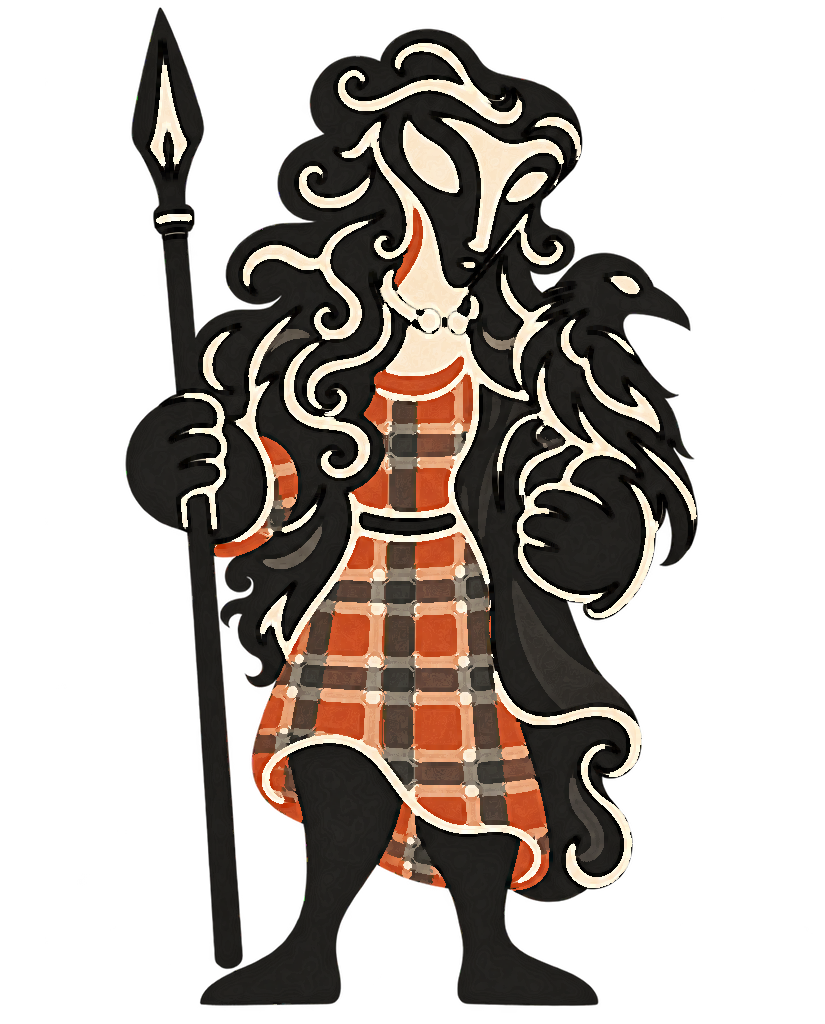
Catuboduâ is commonly understood as the “Battle Crow.” The surviving evidence is small: a single Gallo-Roman dedication from southeastern France, with some disagreement over how her name should be read.
Historical evidence
Her name
Cathubodua is commonly interpreted as “Battle Crow.” Under this reading, the name combines Gaulish catu-, “battle” or “combat,” with bodua, “crow.” The compound brings together warfare and the bird associated with it, providing the main linguistic basis for understanding her as a battle goddess.
This interpretation depends on how we read her surviving name. In 1868, Adolphe Pictet proposed restoring an initial C to the inscription’s ATHVBODVAE, producing [C]ATHVBODVAE. His explanation connected the resulting name with battle and the crow.
The restoration was questioned. Max Ihm records that Otto Hirschfeld, who examined the stone, doubted whether a letter was missing at all. Ihm also mentioned the Celtic personal names Ateboduus and Atebodua as comparisons worth considering. These do not establish an alternative translation, but they give us reason to retain Athubodua alongside the familiar restored reading.
Within BNG, we use Catuboduâ and adopt the “Battle Crow” interpretation. We distinguish this customary form and understanding from the unresolved reading of the ancient inscription.
The dedication from Mieussy
The inscription was discovered in 1860, at Les Fins de Ley, near Mieussy in Haute-Savoie, France. It is catalogued as CIL XII, 2571.
With the proposed initial letter restored and the abbreviations expanded, it reads:
[C]athuboduae Aug(ustae)
Servilia Terentia
v(otum) s(olvit) l(ibens) m(erito)
In English:
“To the August Cathubodua, Servilia Terentia willingly and deservedly fulfilled her vow.”
The square brackets mark the proposed restoration. The dedication gives us the name of a worshipper, Servilia Terentia, and records the fulfilment of a vow. It does not explain what she requested or describe the goddess’s appearance.
Comparison with Irish Badb
The proposed name has encouraged comparison with Badb Catha, the Irish “Battle Crow.” In her comparative study of Celtic goddesses, Noémie Beck discusses the linguistic relationship and the association of Irish Badb with warfare, ominous appearances, and the battlefield.
This comparison offers a possible context for understanding Catuboduâ. It cannot supply a missing Gaulish mythology, however. Stories about Irish Badb should remain identified as Irish evidence rather than presented as surviving stories about Catuboduâ.
What the evidence leaves open
The inscription establishes that a goddess named Athubodua, often restored as Cathubodua, received a votive dedication at Mieussy. Her interpretation as a battle goddess rests chiefly on that restoration and its linguistic comparison with Badb Catha.
It does not establish that she selected those who would die in battle, carried their souls to the Otherworld, or cared for people facing illness. Those belong in our account of BNG gnosis.
Catuboduâ in Bessus Nouiogalation
Guardian in the passage of death
Within our bessus, Catuboduâ is a Dêuâ closely involved in death and the passage beyond it.
We perceive her as both guardian and guide. With outstretched wings, she bears the fallen and accompanies them toward a benevolent afterlife. Her presence holds the courage of those who have faced death and the care needed in their passing.
Those who fall in battle
We understand Catuboduâ as a guide for warriors who die in battle. In our gnosis, she receives the fallen and carries them onward.
The Battle Crow holds a compassionate place within our bessus. Alongside her connection with warfare, we recognize her care for those whose lives have ended amid its violence.
Those facing illness
Her care also extends to those struggling with illness. We perceive her alongside people meeting pain, uncertainty, and the possibility of death with courage.
Within our understanding, that courage matters beyond the battlefield. Catuboduâ’s wings shelter those approaching death through illness as well as those who fall in war.
Guardian and guide
These relationships shape how we know her: the Battle Crow, guardian of the fallen, and guide through the passage of death.
Her place within BNG joins courage with tenderness. We honor her as one who accompanies the departed and carries them onward with care.
Honoring Catuboduâ
- Remembering the fallen and speaking their names.
- Offering prayer for those approaching death.
- Giving a simple offering in remembrance of the departed.
- Sitting quietly with memories of those who have died.
- Offering companionship and listening to those facing illness.
- Helping people who are ill, and their caregivers, with everyday needs.
- Respecting the wishes of those receiving care.
Through Catuboduâ, we honor courage, compassionate care, and the dignity of those approaching death.
Sources
- CIL XII, 2571 — the Mieussy dedication, discussed in the studies below.
- Adolphe Pictet (1868), “Sur une nouvelle déesse gauloise de la guerre”, Revue Archéologique, nouvelle série 18, pp. 1–17 — the early proposal to restore the name as Cathubodua.
- Max Ihm (1896), “Athubodua”, Paulys Realencyclopädie der classischen Altertumswissenschaft, II.2, col. 2072 — records the objection to restoring an initial C.
- Noémie Beck (2009), Goddesses in Celtic Religion: Cult and Mythology: A Comparative Study of Ancient Ireland, Britain and Gaul — consulted through the republished section on territorial and war goddesses, particularly “Divine Crows of War: Badb, Cathubodua and Cassibodua.”

