
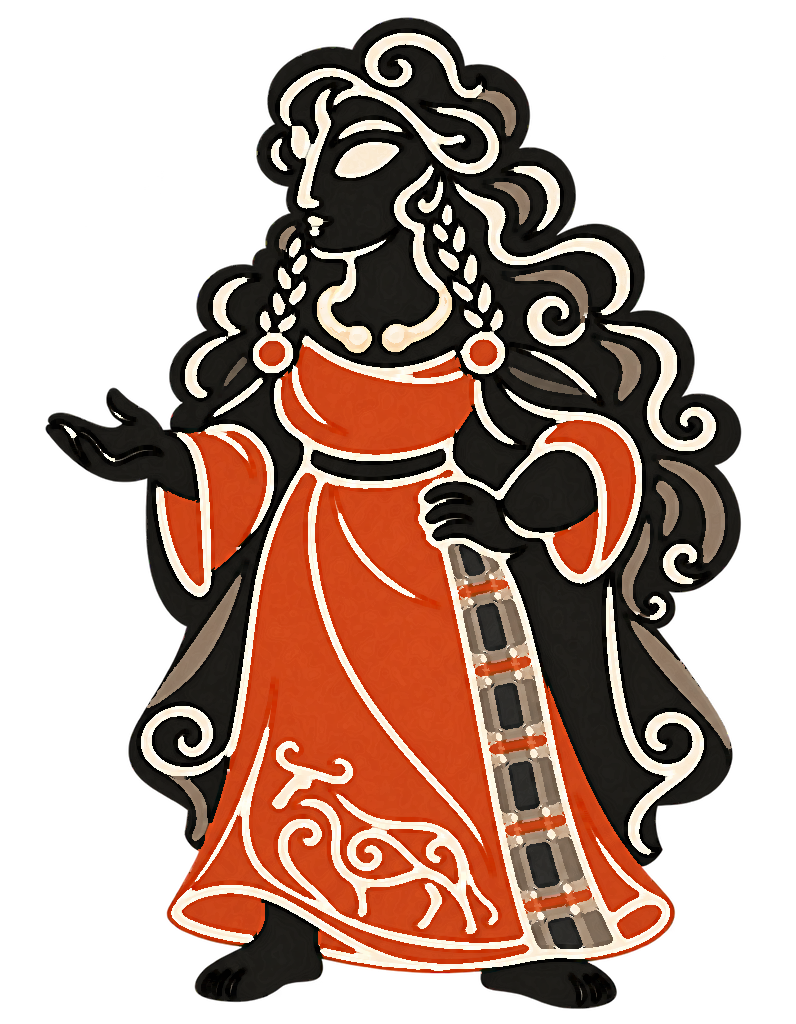
Celtînâ is honored within Bessus Nouiogalation as an ancestral mother of the Galatîs, the partner of Ogmios, and the mother of Galatos. Her place within our bessus draws upon ancient ancestry stories and our own sacred storytelling, through which we understand her courage, strength, and freely chosen bonds.
Historical evidence
Her name
Celtînâ is our customary form of Celtine, also transliterated Keltine, the name preserved by Parthenius.
Her name closely resembles Celtus, the son through whom his story explains the name of the Celts. This places her within an ancestral narrative concerned with the identity and naming of a people. It does not, by itself, establish a literal translation such as “Mother of the Celts.”
We therefore leave her name untranslated while explaining its place within the story.
McCone’s interpretation of the name “Celts”
Linguist Kim McCone proposes interpreting Keltos as “descended from the hidden one.” Under this explanation, the plural Keltoi, “Celts,” would describe descendants of that ancestral being, often paraphrased as “Children of the Hidden One.”
McCone connects his proposal with Caesar’s statement that the Gauls claimed descent from a deity whom Caesar calls Dis Pater. It is an etymological interpretation of the people’s name, rather than an established translation of Celtine.
This offers another perspective on ancestry and collective identity. It does not establish that Celtînâ was herself the Hidden One or that Parthenius intended his story to express this interpretation.
Celtine in Parthenius
In Love Romances, chapter 30, Parthenius of Nicaea tells of Heracles travelling through the country of the Celts while bringing back the cattle of Geryon. He reaches the household of Bretannus, whose daughter is Celtine.
Celtine desires Heracles and hides the cattle, making their return conditional upon his sleeping with her. The narrator says that Heracles agrees, being attracted by her beauty as well as anxious to recover the herd.
Their son is Celtus, through whom the story explains the name of the Celtic people. This is an ancestry narrative, rather than an account of ceremonies or worship offered to Celtine.
The unnamed mother in Diodorus
A related account appears in Diodorus Siculus’s Library of History, 5.24.1–3.
A ruler of Celtica has a daughter distinguished by her stature, strength, and beauty. She refuses her suitors until Heracles arrives during his expedition against Geryon.
Their son is Galates, who becomes a powerful ruler. Diodorus explains the name of the Gauls through him. Unlike Parthenius, he does not name the mother.
The accounts should therefore remain distinguishable:
| Ancient account | Mother | Father | Son |
|---|---|---|---|
| Parthenius, chapter 30 | Celtine, daughter of Bretannus | Heracles | Celtus |
| Diodorus, 5.24.1–3 | Unnamed daughter of a ruler of Celtica | Heracles | Galates |
Neither passage explicitly identifies the mother as a goddess or describes a cult devoted to her.
Ancestry stories and their interpretation
Scholar Jürgen Zeidler discusses Celtine’s story within the wider range of ancient accounts explaining Celtic origins. These traditions offered several genealogies and migration stories rather than one consistent account.
His discussion places Parthenius’s narrative within a broader tradition of descent from Heracles. Such stories connected peoples and places with a hero familiar to Greek audiences.
Their literary setting matters. The surviving narratives may contain material shaped through cultural contact, but they cannot simply be treated as unchanged records of indigenous Gaulish mythology.
Heracles and Ogmios
Neither Parthenius nor Diodorus names Ogmios in these genealogies.
The connection comes through a separate ancient source: Lucian’s Heracles, which describes a Gaulish deity called Ogmios represented with the equipment of Heracles and explained through the power of eloquence.
Within BNG, we bring this association into conversation with the ancestral narratives. Our genealogy of Celtînâ, Ogmios, and Galatos develops through that interpretation and our own sacred storytelling. It is not a genealogy explicitly preserved by any one ancient author.
Her appearance
The ancient passages do not supply a recognizable set of ritual objects or symbols by which Celtînâ could be securely identified in ancient art.
Diodorus’s description of the unnamed mother offers a literary image of stature, strength, and beauty. Within BNG, these qualities inform our understanding of Celtînâ, while her contemporary images express our own devotional relationship.
Celtînâ in Bessus Nouiogalation
An ancestral mother
Within Bessus Nouiogalation, Celtînâ is the mother of Galatos, our Toutatis, and the partner of Ogmios.
We honor her as an ancestral mother of the Galatîs. She holds a place within the sacred genealogy through which we understand our community and its identity.
Our account draws the ancient stories together while developing them within our bessus. We give the mother the name Celtînâ, recognize Ogmios as her partner, and know their son as Galatos.
Strength, valor, and beauty
We hold Celtînâ as preeminent in strength, valor, and beauty.
These qualities belong to her own presence and dignity. We recognize her courage in speaking, choosing, and accepting responsibility.
Through her, we reflect upon how strength can serve others and how our commitments become visible in our conduct.
Courage and commitment
Our myth, Golden Words, Golden Bonds: The Birth of Galatîs, develops these qualities through a story of threatened communal survival and the return of stolen cattle.
Celtînâ’s concern for her people leads her to act. She takes her words seriously and insists upon responsibility for the commitment she has made.
Within our understanding, her courage includes resolve, honesty, and attention to the consequences of her choices.
A freely chosen bond
The story also gives particular attention to mutual choice.
Ogmios’s respect for Celtînâ allows their relationship to develop beyond obligation. Their bond is freely offered and returned.
Through them, we contemplate relationships sustained by consent, dignity, and recognition of one another’s worth.
Mother and teacher of courage
Celtînâ’s motherhood includes the raising of Galatos and the teaching of bravery.
We honor her in the patient work of helping another person grow: offering care, setting an example, and encouraging the courage needed to meet life’s responsibilities.
These themes belong to our modern BNG myth.
Read Golden Words, Golden Bonds: The Birth of Galatîs →
Belonging within our bessus
Celtînâ’s ancestral place offers us a way to reflect upon belonging.
Within BNG, relationship with her develops through participation in our custom. It does not require a claim of biological descent from a legendary figure.
We enter this relationship through remembrance, devotion, and the responsibilities we accept toward one another. Through honoring her, we consider what we receive from our ancestral stories and what we will carry forward.
Honoring Celtînâ
- Offering water, food, or a drink in remembrance.
- Honoring her alongside Ogmios and Galatos.
- Including her in observances for the Regentiâ.
- Reading and reflecting upon our ancestral stories.
- Keeping commitments with honesty and care.
- Respecting freely given choices in relationships.
- Supporting parents, caregivers, and those raising children.
- Encouraging another person’s courage and confidence.
- Standing beside someone who needs support.
- Helping preserve the community’s shared knowledge.
You might approach her when seeking courage, renewing a commitment, or reflecting upon your relationship with the Toutâ.
These are suggestions within contemporary BNG custom, rather than practices documented for an ancient cult of Celtine. Her place in our bessus is honored through remembrance and through the conduct we cultivate.
Sources
Ancient sources
- Parthenius. Love Romances 30, “The Story of Celtine.” Translated by S. Gaselee. Theoi Classical Texts Library.
- Diodorus Siculus. Library of History 5.24.1–3. Translated by C. H. Oldfather. LacusCurtius.
- Lucian. Heracles, especially §§1–5. Translated by A. M. Harmon. Perseus Digital Library. A separate account of Ogmios, used comparatively rather than as an explicit source for Celtînâ’s genealogy.
Academic discussion
- Zeidler, Jürgen. “Ancient and Medieval Celtic Myths of Origin.” Paper presented at the 17th Irish Conference of Medievalists, Kilkenny, 26–28 June 2003, especially p. 4. Conference paper.
- McCone, Kim. “The ‘Celts’: Questions of Nomenclature and Identity.” Cahiers de l’ILSL 38 (2013): 21–37, especially 24.

