
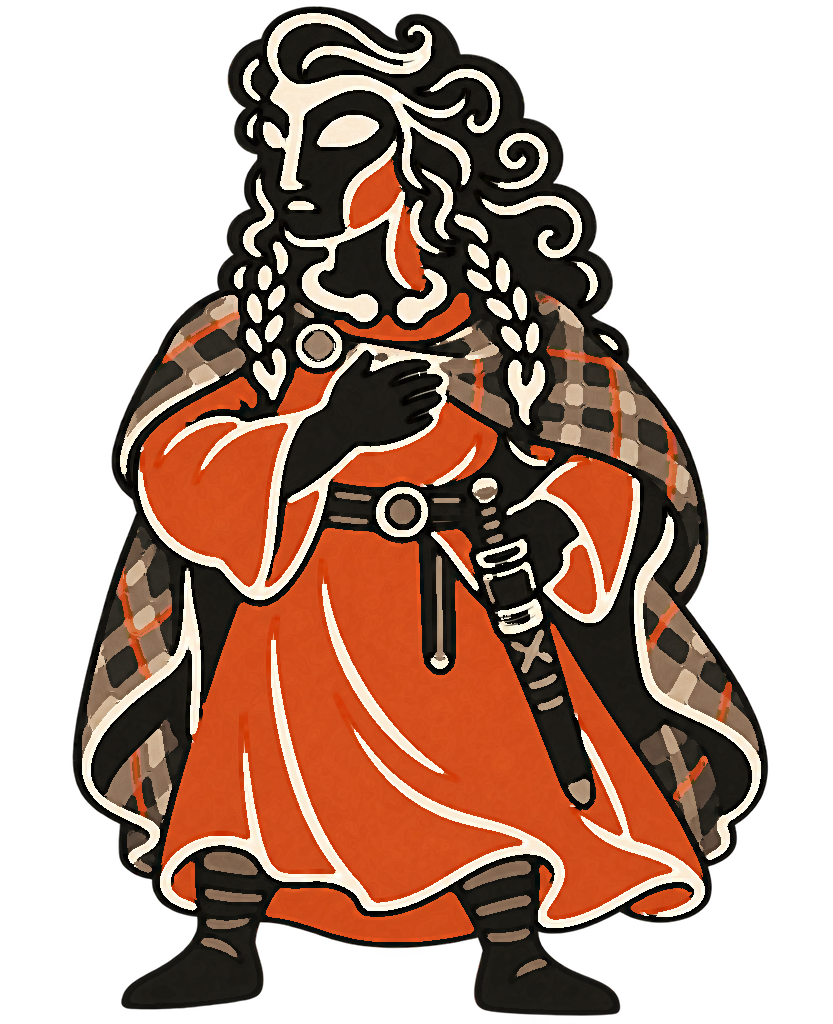
Chiomara was a Galatian woman remembered in ancient accounts for her courage and intelligence after captivity and sexual violence during Rome’s campaign of 189 BCE. Within BNG, her remembrance offers a way to honor dignity, resistance to abuse, and care for those whose lives have been affected by violence.
Historical evidence
Her name
The ancient accounts preserve her name as Chiomara.
For this page, we leave it untranslated. A specific explanation of its formation would require a securely identified linguistic study; resemblance to other Celtic names is not enough to establish its meaning.
A woman of Galatia
Chiomara belonged to the Galatian communities of Asia Minor, in present-day Türkiye. She should be distinguished geographically from women living in continental Gaul.
She was the wife of Ortiagon, whose name also appears as Orgiagon in the surviving tradition. Her story belongs to the Roman campaign led by Gnaeus Manlius Vulso in 189 BCE.
The historical setting is conquest and captivity. The accounts describe a woman of high social standing whose position did not protect her from violence after military defeat.
The surviving story
In Plutarch’s On the Bravery of Women, chapter 22, Chiomara is captured during the Roman defeat of the Galatians. A Roman centurion sexually assaults her and subsequently arranges to release her in exchange for ransom.
When her countrymen bring the payment, she directs them to kill him. She then carries his severed head to her husband.
The story presents her as taking decisive action against the man who assaulted her. It also frames that action through ancient expectations concerning marriage and sexual fidelity. These elements belong to the account’s literary and social setting; they should not be treated as instructions for contemporary conduct.
Polybius and the transmission of her story
Plutarch adds that Polybius met and conversed with Chiomara at Sardis, admiring her spirit and intelligence.
This is an important detail, but the way the account survives matters. The passage printed as Polybius, Histories 21.38, is preserved through Plutarch. It should not be counted as an entirely independent surviving narrative alongside him.
The report of their meeting gives us reason to consider the historical person behind the story. It does not mean that we possess her own written testimony or a word-for-word record of their conversation.
Livy’s account
Livy, History of Rome 38.24, also relates the episode, identifying the woman through her husband rather than supplying her personal name.
His version likewise describes captivity, sexual violence, ransom, and the killing of the centurion. Its conclusion praises her subsequent conduct through Roman ideals of female respectability.
The agreement between accounts is useful, but their relationship and shared literary tradition require care. Several retellings do not necessarily amount to several independent witnesses.
Courage, gender, and literary interpretation
Classicist Jessica Clark, in her conference abstract “Chiomara and the Roman Centurion,” examines how the story complicates Roman representations of women, power, and violence.
Clark draws attention to the difficulty of recovering Chiomara as an individual when authors and later interpreters repeatedly turn her into an example of a particular virtue or type of woman.
This is especially relevant to ancestral remembrance. We can acknowledge the courage attributed to her while recognizing how little of her life survives outside this episode.
What the evidence leaves open
The surviving accounts do not describe Chiomara’s religious practices, identify her as a priestess, or document an ancient cult honoring her.
They also leave much of her life unknown: her upbringing, interests, relationships, and activities beyond the story preserved by male authors.
Her intelligence and force of character deserve attention alongside the violence she endured. Remembering her as a person requires leaving room for everything the sources have not preserved.
Chiomara in Bessus Nouiogalation
An ancestor remembered for courage
Within our bessus, we may honor Chiomara as an ancestral figure of courage and resolve.
Her story brings attention to people whose choices and lives were constrained by conquest. Through remembering her, we make room for experiences that accounts of battles and rulers can leave at the margins.
Her courage does not require us to imitate every action attributed to her. We can reflect upon her determination while choosing how courage should take shape in our own circumstances.
Dignity and freedom from abuse
Our remembrance of Chiomara affirms that a person’s dignity is not diminished by violence committed against them.
We do not make her worth depend upon the ancient language of chastity, her relationship with her husband, or her ability to obtain revenge. Responsibility for the assault belongs to the person who committed it.
Within BNG, honoring her can include defending personal boundaries, respecting consent, and helping make our communities places where abuse is taken seriously.
Intelligence and agency
The surviving tradition remembers Chiomara’s intelligence as well as her courage.
We may honor her through thoughtful action: understanding a difficult situation, recognizing available choices, and supporting another person’s ability to decide for themselves.
This includes listening to people rather than deciding what their experiences must mean. Care should preserve their agency and respect their wishes.
Care after violence
Remembrance can also lead to practical support.
People affected by violence may need companionship, privacy, resources, advocacy, or simply someone willing to listen. Their needs differ, and no single response should be demanded of them.
Through Chiomara, we can bring courage into the work of standing beside others and helping make care available.
Remembering the whole person
Chiomara’s life was larger than the episode through which ancient writers preserved her name.
When honoring her, we can acknowledge both what survives and what is lost. We remember a woman described as intelligent and spirited, while allowing her unknown life to remain beyond our claims.
Honoring Chiomara
- Offering water, bread, or a drink in remembrance.
- Reading her story with attention to its historical setting.
- Remembering those affected by conquest and captivity.
- Respecting consent and personal boundaries.
- Listening without demanding that someone disclose their experiences.
- Supporting services that assist people affected by sexual or domestic violence.
- Helping maintain fair and accountable community procedures.
- Standing beside someone seeking safety or support.
- Recognizing courage in survival, recovery, and asking for help.
A simple observance might include an offering and a commitment to one practical act of care.
These are contemporary suggestions for honoring Chiomara among the Regentiâ. They do not depend upon treating her as a deity or claiming knowledge of her ancient religious life.
Sources
Ancient sources
- Plutarch. On the Bravery of Women, chapter 22, Moralia 258D–F. Translated by Frank Cole Babbitt.
- Polybius. Histories 21.38, translated by W. R. Paton. The passage concerning Chiomara is preserved through Plutarch.
- Livy. History of Rome 38.24, especially 38.24.2–11. Latin text.
Academic discussion
- Clark, Jessica. “Chiomara and the Roman Centurion.” Society for Classical Studies, 151st Annual Meeting, paper 60.6. Published conference abstract consulted; not a full journal article.
Further reading
- Campanile, Maria Domitilla. “Il valore di Chiomara. Storia e racconto nelle campagne di Manlio Vulsone contro i Galati.” 2020. Publication and institutional abstract verified; the full contribution was not consulted for this draft.
Support and resources
The sexual violence, coercion, and abuse of power described in the stories of Chiomara and Camma are not confined to the ancient world. People continue to experience these harms today, in conflict, in relationships, and within their communities.
Within BNG, honoring these women includes caring for people facing abuse now: listening without blame, respecting their choices, and helping them access safety and support. Their stories do not prescribe how anyone must respond to violence. A person’s dignity never depends upon resistance, revenge, or sacrificing their own life.
The following resources offer support for people affected by sexual violence, domestic abuse, or coercion, and for those seeking to support someone they care about.
Finding support internationally
- NO MORE Global Directory — Search by country or region for domestic and sexual violence support services, including resources for people of different genders and sexual orientations.
Sexual violence and abuse support
- RAINN — National Sexual Assault Hotline — U.S. service offering free, confidential support around the clock for people affected by sexual violence and their loved ones.
- National Domestic Violence Hotline — U.S. support for people experiencing relationship abuse, including advocacy, safety planning, and connections to community resources.
- Domestic Violence Awareness Project — Seeking Help — Information about recognizing abuse and finding support, including national services and connections to local resources.
- Sexual Assault Kit Initiative — Resources for Survivors — A collection of support services and informational resources for survivors of sexual assault.
Community and specialist support
- House of Apples — Macha’s Justice — Domestic violence education and resources for Pagan and polytheist communities, including a directory of trained spiritual service providers.
- Military OneSource — Domestic Abuse Help — Information about advocacy, safety planning, and support through the Family Advocacy Program for eligible military personnel, partners, and families.
- FORGE — Resources and support for transgender and nonbinary survivors of violence, their loved ones, and service providers.
- SurvivorsUK — UK-based specialist support for male and nonbinary survivors of sexual violence.
- isurvive — Online peer-support forums and resources for adult survivors of childhood abuse and their loved ones.
Legal information, stalking, and digital safety
- WomensLaw — Plain-language U.S. legal information concerning domestic violence, sexual assault, and stalking. Despite its name, its resources support survivors of all genders.
- SPARC — Stalking Prevention, Awareness, and Resource Center — Information about stalking, documentation, and safety planning. SPARC is an educational resource and does not provide direct survivor services.
- Safety Net Project — Technology Safety — Information about digital privacy, monitoring, online harassment, and technology-facilitated abuse, including a toolkit for survivors.

