
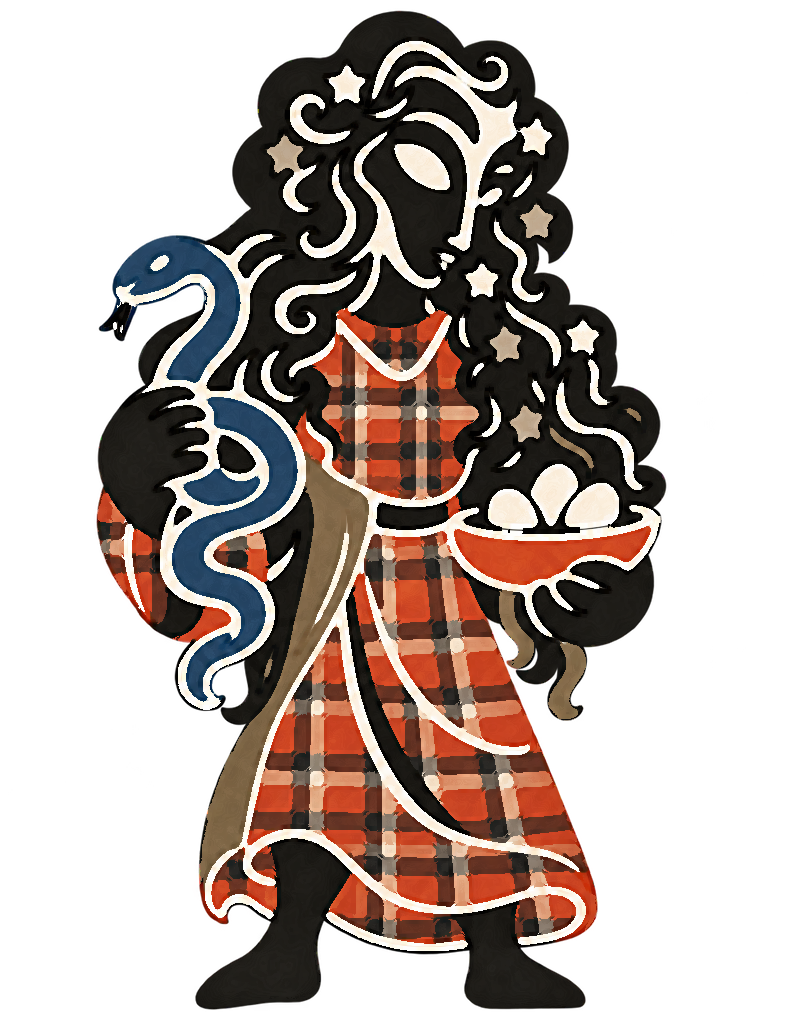
Ðironâ, more commonly written Sirona, is a Gaulish goddess associated with springs and healing. Her name appears in dedications across Gaul and several other Roman provinces, sometimes alone and often alongside Apollo. Archaeological finds give us several identifiable images of her, including the well-known figure holding eggs and a snake from Hochscheid.
Historical evidence
Her name
Sirona is commonly connected with a Celtic word for “star.” Noémie Beck summarizes this interpretation in the work of linguists and scholars including Whitley Stokes, Jan de Vries, Pierre-Yves Lambert, and Xavier Delamarre. Related Celtic vocabulary includes Old Irish ser and Breton sterenn.
The precise formation remains debated. The University of Graz’s FERCAN catalogue cites Patrizia de Bernardo Stempel and Manfred Hainzmann for “divine star,” while Corinna Scheungraber discusses “great or exalted star” and “belonging to the stars.” These are alternative explanations of the name’s formation, rather than several established translations.
Ancient spellings include Sirona, Đirona, and Thirona. The crossed Đ, commonly called the tau gallicum, and the spelling TH reflect ways of representing a Gaulish consonant sound. Beck discusses proposed pronunciations involving ts or st. These spelling differences do not by themselves indicate separate goddesses.
Beck also reports alternative derivations: Jacques Lacroix proposed a connection with water or drops, while Garrett Olmsted suggested a connection with a heifer. The stellar interpretation has substantial scholarly support, but it is not the only proposal.
Within BNG, we use Ðironâ and understand her name through its stellar interpretation. Our identification of her with Venus as the morning and evening star belongs to our gnosis; the name alone does not identify a particular heavenly body.
The sanctuary at Hochscheid
One of the strongest examples of her relationship with water comes from Hochscheid, in the Hunsrück region of present-day Germany.
The sanctuary collected spring water in a basin within its central chamber. A dedication names Apollo and Sacred Sirona, and sculptures of both deities were discovered there. Together, the setting, inscription, and images connect their worship with the spring.
Her sandstone figure was found in the temple’s central chamber in 1939 and is now held by the Rheinisches Landesmuseum Trier. The archaeological catalogue dates it to the Antonine period, within the second century AD.
She wears a long tunic, mantle, and diadem. A snake coils around her right forearm, while her left hand holds a vessel containing three eggs. The snake invites comparison with Hygieia, the Greek goddess of health, placing this image within the wider visual language of healing in the Roman world.
A temple dedication from Grossbottwar
An inscription from Grossbottwar, in present-day Germany, records a temple dedicated to Apollo and Sirona in AD 201.
The donors were Gaius Longinius Speratus, a veteran of the Twenty-Second Legion, his wife Iunia Deva, and their four children. They erected the temple with its sacred images on their own property in fulfilment of a vow.
Catalogued as CIL XIII, 6458, the dedication shows an entire family supporting a place of worship devoted to the two deities.
Other surviving dedications
Other inscriptions preserve individual offerings, temple responsibilities, and further examples of her association with Apollo.
| Inscription | Location | What it records |
|---|---|---|
| CIL XIII, 6272 | Nierstein, Germany | Iulia Frontina fulfilled a vow to Apollo and Sirona. The altar was discovered during work on the spring now known as the Sironaquelle. |
| CIL XIII, 7570 | Wiesbaden, Germany | Gaius Iulius Restitutus funded a dedication to Sirona. His title is interpreted in the catalogue as curator templi, indicating responsibility connected with a temple. |
| AE 1933, 140 | Alzey, Germany | A fragmentary altar names Apollo and Sirona. The surviving text does not securely identify the dedicator. |
| CIL III, 5588 | Baumburg, Germany, in ancient Noricum | An altar names Apollo Grannus and Sirona, with part of her name restored. Its reliefs show Sirona with ears of grain and grapes, and Apollo with a stringed instrument. |
The Nierstein and Wiesbaden inscriptions give us named worshippers and different forms of participation: fulfilling a vow and personally funding a dedication connected with a temple.
Alzey supplies another dedication to Apollo and Sirona. Baumburg explicitly names Apollo Grannus, making it particularly useful when discussing her relationship with Grannos.
For a wider collection of dedications, visit Sirona Inscriptions.
Her appearance
Her imagery varies between monuments. At Hochscheid, she has a snake, three eggs, and a diadem. At Baumburg, she appears with grain and grapes, broadening the surviving imagery associated with her to include agricultural abundance. lupa.at
The Hochscheid catalogue describes her headpiece as a diadem, without identifying it as star-shaped. We keep the stellar interpretation in the discussion of her name rather than treat a star-shaped crown as an established attribute.
Likewise, dedications naming Apollo should retain that name. We should use Apollo Grannus where the epithet is actually present, rather than supply it throughout her evidence.
What the evidence tells us
Spring settings, dedications, and healing imagery support understanding Ðironâ as a goddess associated with water and healing. Her name offers a possible celestial dimension.
These sources leave much of her ancient theology unknown. They do not explain a relationship with Venus, seasonal renewal, or the subconscious. Those subjects belong to our living understanding of her.
Ðironâ in Bessus Nouiogalation
Healing waters and renewal
Within our bessus, Ðironâ is a Dêuâ of healing, stars, springs, wells, and fertility.
We understand these relationships through the life around us. Water sustains growth, eggs shelter developing life, and snakes return to activity after winter. These offer ways of approaching her presence through renewal and the emergence of life.
Spring holds particular meaning in this understanding. Growing warmth, flowing waters, and returning activity remind us that restoration can begin quietly before its effects become visible.
The morning and evening star
Within our gnosis, we associate Ðironâ with Venus, appearing as the morning or evening star.
Its presence near the edges of day draws our attention to transitions. Dawn and dusk become occasions to contemplate her: the light that appears as darkness gathers, or that remains as morning approaches.
We understand her through these meetings of darkness and light, where change is underway and its outcome has yet to become clear.
Cycles and inward reflection
Our association of Ðironâ with Venus draws our attention to cycles of change and return. Over approximately eight years, Venus completes five cycles relative to Earth and the Sun, returning to a similar pattern of appearances in our sky. spaceplace.nasa.gov Its recurring appearances as the morning and evening star offer a rhythm through which we contemplate renewal.
Within our bessus, we understand this movement as an invitation to reflect upon our own journeys. There are times to act, times to withdraw, and times to return to what needs our attention. Venus’s apparent backward movement during retrograde offers a devotional symbol for this inward turn: reconsidering our values, motivations, relationships, and service to the Dêuoi and community.
Through Ðironâ, we approach these returns as opportunities to deepen understanding. Revisiting an old question or tending an old hurt can reveal what has changed and what still needs care. Her cycle reminds us that renewal takes time, and that returning can be part of moving forward.
Healing of body and mind
We perceive Ðironâ as concerned with physical and mental healing, including the less visible processes of the subconscious.
Her presence extends to the inward work of recovery: what we carry beneath awareness, what gradually comes into view, and what needs time and attention.
Within our gnosis, her healing has a mystical dimension. We approach her in quiet reflection, in dreams, and in the patient work of understanding ourselves. Her waters offer an image through which we can contemplate what lies beneath the surface of our lives.
Ðironâ and Grannos
We honor Grannos as her companion.
Within BNG, we associate him with the sun, warmth, and healing. Alongside him, Ðironâ brings a stellar and liminal presence, with particular attention to mental healing and the subconscious.
Both can be approached for healing of body and mind. A practitioner may feel drawn toward one more strongly for a particular need, while recognizing the breadth of both their care.
Their companionship brings these relationships together: light and water, outward vitality and inward restoration, and the continuing work of sustaining life.
Honoring Ðironâ
Ways of honoring Ðironâ within our bessus may include:
- Offering clean water with prayer and gratitude.
- Praying for those facing physical illness or mental distress.
- Observing dawn or dusk in contemplation of her connection with Venus.
- Caring for springs, wells, and waterways.
- Supporting people who are ill through companionship and practical help.
- Making time for rest, reflection, and appropriate care.
- Reflecting upon personal values, responsibilities, and devotion.
- Allowing recovery its own pace.
Through Ðironâ, we honor renewal, compassionate care, and the patient work of healing.
Sources and further reading
Historical and linguistic evidence
- FERCAN, University of Graz — Sirona, CF-GeS-1025 — Alzey dedication, AE 1933, 140, distribution, and references to linguistic interpretations.
- FERCAN — CF-GeS-1117 — Grossbottwar temple dedication, CIL XIII, 6458.
- FERCAN — CF-GeS-1023 — Nierstein dedication, CIL XIII, 6272.
- FERCAN — CF-GeS-1080 — Wiesbaden dedication, CIL XIII, 7570.
- Ubi Erat Lupa — Hochscheid figure, no. 32129 — archaeological context, dating, and description.
- Ubi Erat Lupa — Baumburg altar, no. 9119 — CIL III, 5588, inscription and accompanying reliefs.
- Beck, Noémie (2009). Goddesses in Celtic Religion: Cult and Mythology: A Comparative Study of Ancient Ireland, Britain and Gaul — consulted through the republished section on water goddesses, particularly the discussion of Sirona. Linguistic proposals attributed through Beck and FERCAN were consulted through those discussions.

