
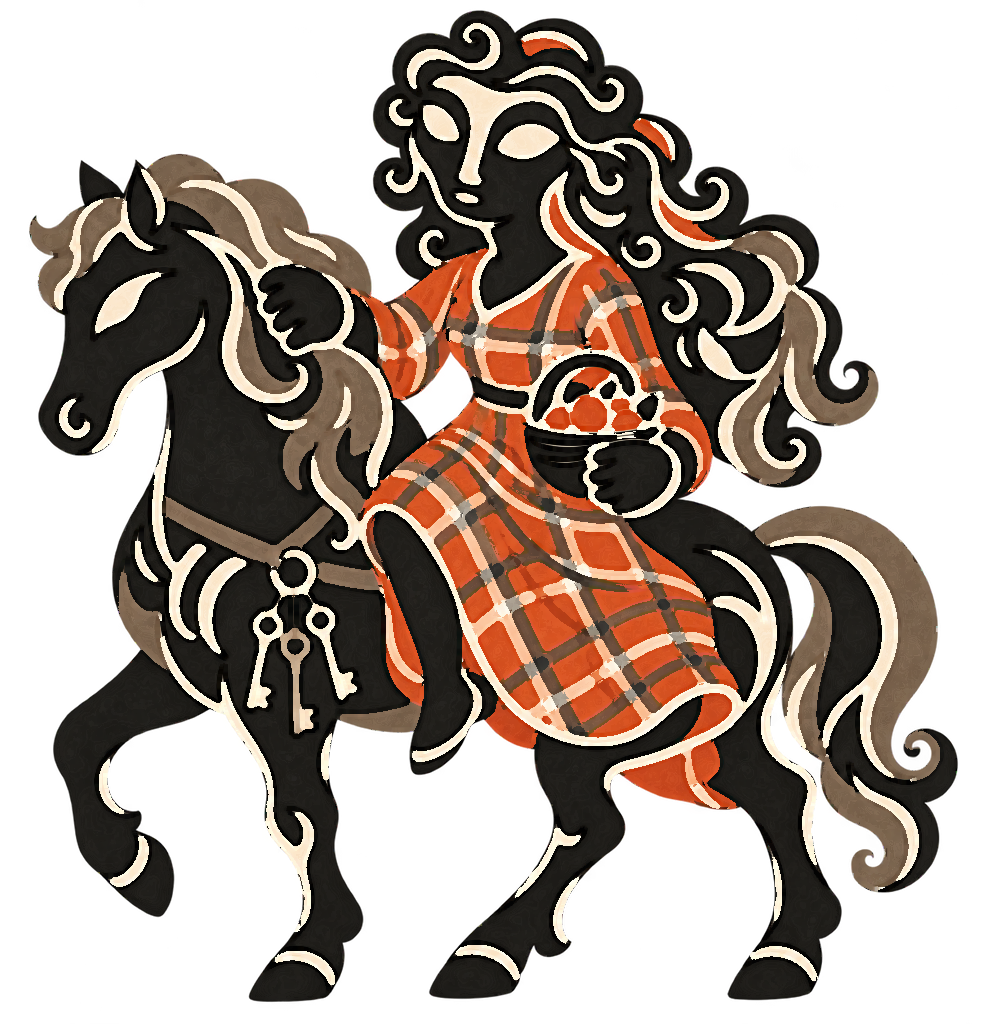
Eponâ is a Gaulish goddess closely associated with horses, nourishment, and abundance. Her worship became established across the Roman world, among soldiers and civilians alike. Within Bessus Nouiogalation, we honor her through the sovereignty of the land, her guidance between worlds, and the winter passage of the Spectral Ride.
Historical evidence
Her name
Epona comes from Gaulish epos, “horse,” with epo- forming the base of her name. The University of Graz’s FERCAN catalogue gives “Divine Mare” and “Horse Goddess” as interpretations, citing the linguistic work of Patrizia de Bernardo Stempel.
The horse word belongs to an older Indo-European family. Related words include Latin equus, Old Irish ech, and Greek hippos. EPONA.net summarizes these relationships with reference to Xavier Delamarre’s Dictionnaire de la langue gauloise. Their similarities reflect descent from a shared ancestral word.
The name’s ending has received different explanations. “Great Mare” interprets -on- as augmentative, conveying greatness or heightened significance. Other interpretations emphasize a divine or relational meaning. The linguist Rosemarie Lühr, for example, discusses Eponā among Celtic goddess names formed with -onā and translates it as “Goddess of the horses.” The ending should not be treated simply as a separate word meaning “great.”
These interpretations agree on her close relationship with horses. “Mare” expresses the feminine interpretation of the divine name; the underlying word epos means “horse.”
Within BNG, we use Eponâ. “Great Mare” and “Divine Mare” are meaningful interpretations, while “Horse Goddess” provides a straightforward explanation of her name’s central association.
Her appearance
Eponâ appears in several arrangements. Some images show her seated sideways on a horse; others place her between horses. A Romano-British copper-alloy figure in the British Museum, found in Wiltshire, England, depicts her seated between two small equines.
Her imagery also includes food and offerings. A named relief from Öhringen, Germany, shows her seated with a large vessel of fruit in her lap. Beside her are a horse, a smaller attendant presenting offerings, and an altar.
The relief was discovered in a Roman well in 1986 and is catalogued as AE 1990, 764. Its inscription records a vow associated with Publius Iunius, whose final name is damaged. The monument brings together her horse association, abundance imagery, and an act of worship.
The key and the passage of the dead
Some representations identified as Eponâ show her holding a key. In his study of Eponâ and Apuleius, Jeffrey T. Winkle discusses these images and the earlier interpretation of Fernand Benoît, who connected the key with access to the world beyond death.
The identification of at least one of the figures cited by Winkle is disputed. The key is an occasional attribute in images attributed to Eponâ, rather than something found throughout her imagery.
Her possible funerary role also draws upon monuments from La Horgne-au-Sablon, near Metz. Winkle cites Miranda Green’s interpretation of a scene in which a human figure follows the mounted goddess: she understands it as Eponâ accompanying the deceased into the afterlife.
The funerary contexts, accompanying figures, and key imagery have encouraged scholars to interpret Eponâ as a protector of the dead or psychopomp—a guide of souls. These remain interpretations of objects rather than functions explained by a surviving ancient narrative.
Inscriptions and worshippers
Dedications preserve evidence of individual offerings, temple patronage, and worship among Roman soldiers. These examples show something of that variety:
| Inscription | Location | What it records |
|---|---|---|
| AE 1990, 764 | Öhringen, Germany | The inscribed relief described above, offered by Publius Iunius, whose final name is damaged. |
| RIB 2177 | Auchendavy, Scotland | Marcus Cocceius Firmus, a centurion of the Second Augustan Legion, honors Eponâ alongside Mars, Minerva, the Campestres, Hercules, and Victory. |
| CIL XIII, 2902 | Entrains-sur-Nohain, France | Connonius, son of Icotasgus, gave a temple and its furnishings to Eponâ at his own expense. |
| AE 1973, 438 | Szentendre, Hungary | Iulius Victor, a cavalryman and standard-bearer, dedicated an altar to the spirit of his squadron and Epona Regina, “Eponâ the Queen.” It is dated June 1, AD 241. |
Auchendavy places Eponâ among the deities honored by a Roman officer. It establishes her presence in his religious life without implying that every aspect of her worship concerned warfare. romaninscriptionsofbritain.org
Entrains-sur-Nohain shows support for a temple, while Szentendre supplies an explicit example of her title Regina. “Queen” belongs to her surviving ancient titles, although the title alone does not establish a particular ceremony of kingship or marriage to the land. www.epona.net
For a wider collection of dedications arranged by Roman province, visit Epona Inscriptions.
Eponâ in the Roman world
Eponâ retained her Gaulish name while becoming established within Roman religious life. Her worship reached Rome itself, where dedications associated with the equites singulares, the emperor’s mounted guard, include her among their honored deities.
Eric Birley discusses these dedications alongside those from Auchendavy. They provide direct evidence that worship of a goddess with a Gaulish name formed part of the religious life of Roman military communities. journals.socantscot.org
The military was an important setting for her worship, but the evidence also includes temple patronage and the everyday world of stables. Her place within Roman religion extended across these different settings.
Eponâ in the stable
An ancient literary reference offers a glimpse of everyday devotion.
In Apuleius’s Metamorphoses, 3.27, Lucius, transformed into a donkey, notices an image of Eponâ in a small shrine on a pillar supporting a stable’s roof. Her image is decorated with fresh roses, which he tries to eat in the hope of recovering his human form.
Although the scene belongs to a novel, it provides an ancient reference to Eponâ honored within a stable and to roses decorating her image. It does not describe a particular annual festival.
December 18
A stone calendar from Guidizzolo, in northern Italy, assigns December 18 to Eponâ. This provides an ancient date for honoring her, although it does not establish how widely the observance was shared. www.nardecchiadigital.it
The calendar does not explain why this date was chosen or describe its ceremonies. Its proximity to midwinter is meaningful for modern reflection, but we cannot establish an ancient connection with the solstice or the Spectral Ride from the date alone.
What remains uncertain
The evidence establishes strong connections with horses, abundance imagery, votive offerings, temples, and Roman military and stable settings. It also preserves her title Regina, “Queen.”
Her interpretation as a protector or guide of the dead has precedents in scholarship on funerary imagery. The surviving material does not give us a complete account of her relationship with the departed.
Eponâ in Bessus Nouiogalation
The sovereign land
Within our bessus, Eponâ is closely connected with the sovereignty and living community of the land.
We understand sovereignty through responsibility: knowing a place, respecting its inhabitants, and caring for the relationships that sustain it. Her presence calls those entrusted with authority to attend to the well-being of the land and its communities.
The land includes human settlements, fields, woods, waters, animals, ancestors, and other beings. Eponâ’s guardianship reaches across this wider community.
Rider between worlds
We perceive Eponâ as a rider between worlds and a guide of the departed toward Antumnos.
She knows paths and crossings beyond ordinary human travel. Her relationship with horses gives us a way of approaching her capacity to carry, accompany, and guide.
Within our gnosis, the key expresses her knowledge of passages and her authority to open a way. It offers a devotional image through which we contemplate her relationship with departure, arrival, and the boundaries between worlds.
Her guidance does not require us to describe everything that happens beyond death. We leave room for the participation of other Dêuoi and for what remains beyond our understanding.
Leader of the Spectral Ride
Within our bessus, Eponâ leads the Rêdâ Sebracâ—the Spectral Ride, also understood as the Wild Hunt.
We envision her company traveling through the winter landscape, along its roads, fields, and wild places. Spirits and the departed may accompany her, each with relationships and journeys of their own.
Eponâ leads because she knows the land and its crossings. She guides the company traveling with her and watches over the wider community through which they pass.
Their winter journey includes care for those vulnerable to cold and exposure. The Ride draws our attention to lives beyond the shelter of our own homes: animals in fields and stables, neighbors facing hardship, and the many beings sharing the land.
A warning of the coming days
Eponâ’s Ride heralds the harder winter days ahead.
Her warning is an expression of care. It calls us to prepare while we can: secure shelter, check provisions, tend animals, and remember neighbors who may need help.
The company’s passage asks something of us. Have the animals been checked? Is their bedding dry? Can they reach food and unfrozen water? Does someone nearby lack warmth or companionship?
We honor Eponâ by answering these needs. Her guardianship calls us to fulfill our own responsibilities within the community she watches over.
Giamolitus—the Winter Feast
We honor Eponâ at Giamolitus, the “Winter Feast,” also called Îuos Eponiâs.
This one-day holiday falls around the full moon closest to the winter solstice. Moonlight illuminating the winter landscape offers an image through which we contemplate her presence during the darkest part of the year.
Warmth, feasting, gift giving, and time with loved ones shape the observance. Lights and evergreen decorations express the continuing presence of life, while horse motifs honor Eponâ at the center of the feast. Sweet cakes may be offered in gratitude and welcome.
In our seasonal lore, we give the company room to pass and gather within the shelter of the home. Necessary care for animals and neighbors remains part of honoring her passage.
The feast renews our bonds before the difficult days ahead. What we share at the table expresses the care we carry into the rest of winter.
Giamolitus takes shape through how we treat those around us.
The land has inhabitants with their own needs, relationships, and movements. Human households belong within that community. Eponâ’s Ride shows us to attend to those whose lives meet our own.
Animals in our care depend upon our preparation. We bring them into suitable shelter where appropriate, check their bedding and water, provide adequate food, and attend to those especially vulnerable to the weather.
We also look toward our human neighbors. Sharing provisions, checking on someone living alone, or helping secure warmth can become acts of devotion.
Through Eponâ, we recognize winter care as a shared responsibility. Her warning calls us to act, and her Ride reminds us that we do not pass through winter alone.
Honoring Eponâ
Ways of honoring Eponâ within our bessus may include:
- Caring for horses, donkeys, and other equines.
- Supporting equine welfare and responsible care.
- Checking animals’ shelter, bedding, food, and water during cold weather.
- Helping vulnerable neighbors prepare for winter.
- Sharing provisions, warmth, and companionship.
- Offering grain, seasonal produce, or sweet cakes upon the shrine.
- Decorating her shrine with roses, inspired by Apuleius’s description.
- Honoring her on December 18, drawing upon the ancient calendar.
- Celebrating Giamolitus around the full moon closest to the winter solstice.
- Decorating for the feast with lights, evergreens, and horse motifs.
- Remembering the departed and praying for her guidance.
- Contemplating the key as a symbol of passage within our practice.
- Respecting the beings and places encountered in the land.
Through Eponâ, we honor responsible guardianship, care in crossing between worlds, and the work of helping one another through winter.
Sources and further reading
Historical and linguistic evidence
- FERCAN, University of Graz—Epona, CF-GeS-1124—the Öhringen relief, AE 1990, 764, and linguistic interpretations of her name.
- British Museum—Eponâ figure, museum no. 1882,1214.1—the Romano-British figure from Wiltshire.
- Roman Inscriptions of Britain—RIB 2177—the Auchendavy dedication.
- Apuleius. Metamorphoses, Book III, section 27—Eponâ’s image decorated with roses in a stable.
- Birley, Eric. “Marcus Cocceius Firmus: An Epigraphic Study.”—the Auchendavy dedications and comparison with military worship at Rome.
- Lühr, Rosemarie. “Spatial cognition in landscape designations in the area of the Old European Hydronymy.” Particularly p. 75, on Eponā and -onā.
- Winkle, Jeffrey T. “Epona Salvatrix?: Isis and the Horse Goddess in Apuleius’ Metamorphoses.” Ancient Narrative 12, pp. 71–90, particularly p. 76—key imagery and funerary interpretations, including discussion of Benoît and Green. Their interpretations are cited here through Winkle.
- EPONA.net—Introduction and etymology—linguistic discussion, including references to Delamarre.
- EPONA.net—Inscriptions—the Entrains-sur-Nohain and Szentendre dedications, and the Guidizzolo calendar.
- EPONA.net—Depictions—an overview of her surviving imagery.
- “Il lungo viaggio di Epona: dalle Gallie a Roma.” Scienze dell’Antichità 27.2 (2021)—her worship’s spread, the Guidizzolo calendar, and military dedications at Rome.
Modern discussion and inscription resources
- Cunolugus Drugaisos. “Epona.” Druid Hearth—modern discussion and comparative interpretation.
- Epona Inscriptions—inscription index—further dedications arranged by Roman province.

