
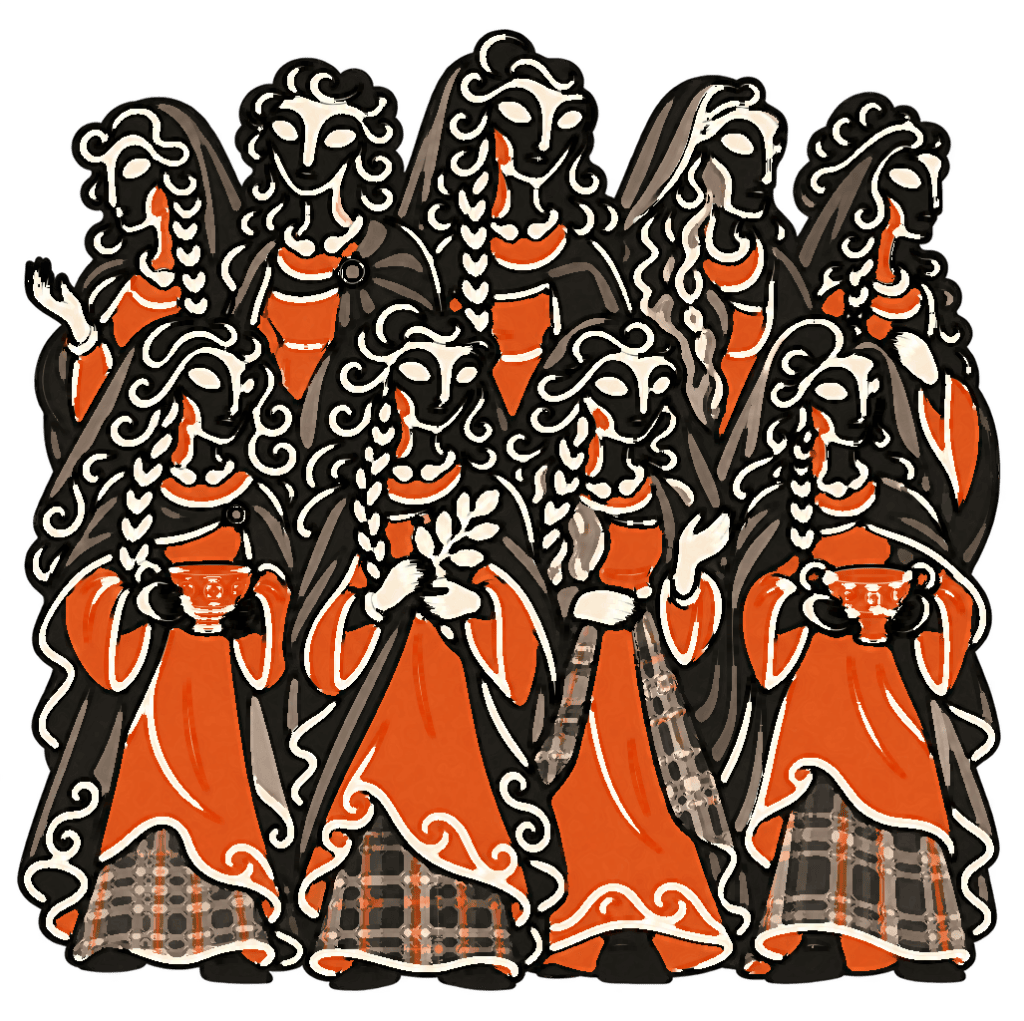
An ancient account remembers the Gallizenae as nine priestesses who served an island oracle. Within Bessus Nouiogalation, we honor them among our spiritual ancestors and remember them as Senā Uātiai Nauā, the Nine Seeresses of Sena.
Historical evidence
Their name
Gallizenae is the conventional name for the priestesses described by Pomponius Mela. The Latin edition linked below gives Gallizenas, while Xavier Delamarre quotes a translation that reads Galli Senas. These different readings leave room for debate about how the name was formed and what it meant. We use “the women of Sena” as a description.
The oracle of Sena
In De Chorographia 3.48, the first-century Roman geographer Pomponius Mela describes Sena, an island opposite the coast of the Osismi, generally identified with Île de Sein off western Brittany. He reports that nine priestesses, consecrated by perpetual virginity, served the oracle of a Gaulish divine being.
The women were said to raise winds and seas through chants, assume animal forms, heal otherwise incurable illnesses, and foretell the future. Mela says they attended to seafarers who had come expressly to consult them. He presents these abilities as things people believed about the women and gives no indication that he witnessed them himself.
Sena: antiquity or magical knowledge?
Patrizia de Bernardo Stempel connects Sena with a Celtic element meaning “old.” In her study of a small altar from Saint-Bertrand-de-Comminges, she interprets the inscription SENA[E] as a possible dedication to an “Old One” and compares it with the island oracle. The altar comes from Aquitania; it does not identify the deity served on Sena.
Xavier Delamarre distinguishes the familiar sĕno-, “old,” from a proposed sēno- associated with magical binding. He suggests that the island’s name might refer to magicians or sorceresses, drawing on Mela’s account of the women. These proposals offer different ways to read the name, but neither establishes what it meant to the island’s inhabitants.
Priestesses and the limits of the account
Mela calls the women antistites, a Latin term for religious officiants. He does not call them druids or tell us how they organized their community, passed on their knowledge, or conducted their rites. He gives neither their individual names nor the name of the divine being they served.
The Gallizenae in Bessus Nouiogalation
Ancestors of sacred practice
Within our bessus, we honor the Gallizenae among the Regentiâ, our ancestors. We remember them collectively as Senā Uātiai Nauā — “The Nine Seeresses of Sena.” This is our contemporary devotional name for the women, whose own names have not come down to us. Our relationship with them grows through remembrance and devotion, without requiring a claim of descent or an unbroken lineage.
What stands out to us is that the oracle was served by a group of women. We do not know how they shared their duties, but their story invites us to think about how sacred knowledge can be cultivated and carried together. In our own community, that can mean learning from one another, making room for women’s religious leadership, and sharing what we know with care.
Their relationship with Morisenon
Morisenon, “the Ancient Sea One,” is the devotional name we use in BNG for the divine presence we approach in connection with Sena’s oracle. We honor them as a Dêuos of the sea, revelation, and the vast unknown. This relationship belongs to our living custom; Mela leaves the oracle’s deity unnamed.
When we honor the Gallizenae alongside Morisenon, we give the women their own place in the observance. Our devotion to Morisenon and our remembrance of the women are distinct relationships that can be tended in the same rite.
Knowledge and responsibility
The Nine Seeresses invite us to consider what we owe to someone who comes to us for guidance. We can listen to the question they are actually asking, acknowledge what we do not know, and leave them room to make their own decisions. In divination, that means offering an interpretation with care and being willing to say when the answer is unclear.
Crossing the waters
Those who sought the women’s counsel crossed the sea. From an animistic perspective, we can reflect on what it means to approach a sacred place through waters, winds, and weather that move in their own ways. The crossing may change how we listen and what we are ready to hear. Whether it had any ritual significance for the women themselves remains unknown.
Honoring the Gallizenae
You can begin wherever you live. Set out a bowl of water, speak the name Senā Uātiai Nauā, and take a moment to listen before asking for guidance. You might do this during an observance for the Regentiâ or alongside devotion to Morisenon.
- Reading Mela’s account and considering what it preserves and what it leaves unanswered.
- Practicing divination with care and being honest about the limits of your interpretation.
- Supporting women’s religious learning and leadership.
- Sharing knowledge in a way that helps others develop their own judgment.
- Caring for the waters and living beings where you live.
Sources and further reading
- Pomponius Mela. De Chorographia 3.48. Latin text, Packard Humanities Institute — the principal ancient account of Sena and the Gallizenae.
- De Bernardo Stempel, Patrizia. “The ‘Old’ Celtic Goddess Sena: A New Testimony from Aquitania.” Veleia 24–25 (2007–2008): 1203–1206.
- Delamarre, Xavier. “Magiciens et magiciennes gauloises, à propos des thèmes seno-, saino-.” Études celtiques 47 (2021): 35–46, especially p. 37.
- Branos Carnutodrûidion/Urādos. “The Gallizenae: Priestesses of the Isle of Sena.” Bessus Nouiogalation, 9 October 2026 — the companion article explores the devotional name, the animistic meaning of the sea crossing, and comparisons with Strabo’s island women, Larzac, Avalon, and the much earlier burials at Téviec and Hoëdic.

