
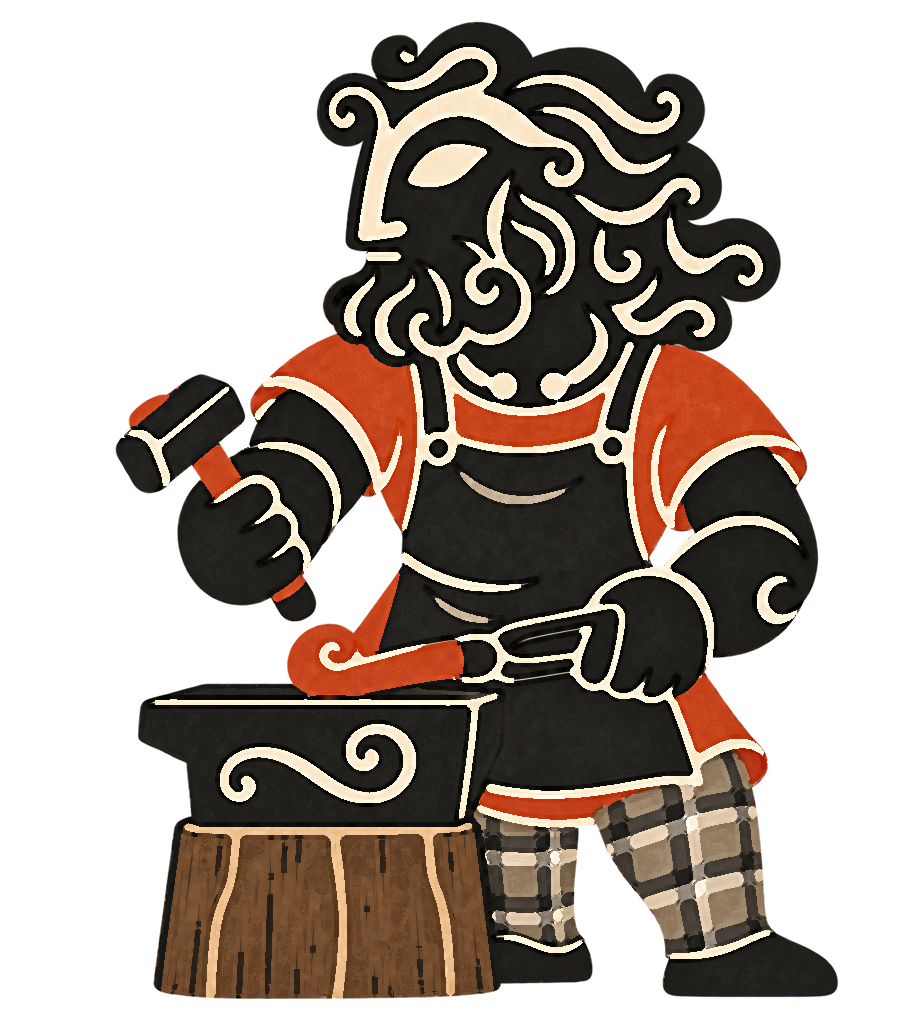
Gobannos is a divine smith whose name connects him with the working of metal. Ancient dedications preserve forms including Gobannos and Cobannus, while surviving bronze figures show him in military dress. Within Bessus Nouiogalation, we honor him as a maker, teacher, and World Traveller, whose craft sustains communities and offers a way of understanding transformation.
Historical evidence
His name
Gobannos is connected with the Celtic word for “smith.” His name identifies him through a skilled craft: the working of metal.
Patrice Lajoye, drawing upon Xavier Delamarre’s treatment of goben-, discusses the relationship between this word and the divine name. Related vocabulary survives in Celtic languages, including Breton goff, “smith.”
The evidence includes forms such as Gobannos, Cobannos, and Latinized Cobannus. Lajoye treats the initial g/c variation as compatible with a relationship between these names. Within BNG, we use Gobannos.
The word’s deeper origin is less certain. Lajoye reports that Delamarre did not identify a secure Indo-European root for it. The connection with smithing is more secure than any proposed meaning beyond “smith.”
The smith and the community
The smith’s importance reached beyond the forge. Metal tools supported farming, woodworking, construction, transport, and defense. People depended upon skilled makers to produce useful objects and keep them in working condition.
Repair mattered alongside manufacture. A damaged tool could interrupt necessary work; restoring it allowed that work to continue. The smith supported the activities of others through both making and maintenance.
We should not imagine every Gaulish village having an identical arrangement or its own resident smith. Workshops in larger settlements provide particularly clear archaeological evidence. At Bibracte, the Aeduan settlement on Mont Beuvray, excavations near the Porte du Rebout uncovered organized metalworking spaces.
Alain Duval’s report describes a copper-alloy workshop containing furnaces, a casting pit, crucibles, mould fragments, unfinished objects, and failed castings. Small objects, particularly **fibulae—the brooches used to fasten clothing—**were manufactured there.
These remains reveal different stages of production and the practical knowledge behind finished objects. Research presented by the CNRS combines examination of the Bibracte finds with experimental casting, investigating the equipment, actions, and time involved in making a fibula. Even a familiar object depended upon considerable skill.
This gives us a practical setting for understanding a divine smith. It does not establish that all smiths shared one social rank or served as priests or magicians.
Ucuetis and Bergusia at Alésia
At Alésia, evidence for the religious life of smiths includes dedications to Ucuetis and Bergusia.
The Gaulish inscription of Martialis, son of Dannotalos, catalogued as CIL XIII, 2880, names Ucuetis and includes gobedbi, referring to smiths. Although parts of its translation remain debated, it connects an offering—usually understood as a building—with the god and a community of metalworkers.
A separate Latin dedication, CIL XIII, 11247, appears on a bronze vessel:
Deo Ucueti et Bergusiae
Remus Primi fil(ius) donavit
v(otum) s(olvit) l(ibens) m(erito)
It records that Remus, son of Primus, gave the vessel to Ucuetis and Bergusia, willingly fulfilling his vow.
Bergusia’s name is commonly connected with words for a height or mountain, ultimately related to the Indo-European root *bhergh-, “high.” Noémie Beck interprets her as a goddess associated with the heights, possibly Mont-Auxois, where Alésia stands. Her further interpretation as a goddess of mines or mineral wealth is a hypothesis, rather than something established by the dedication.
Ucuetis’s relationship with Gobannos is unknown. We cannot establish whether he was understood as a distinct deity, a regional manifestation of a divine smith, or a name or epithet associated with Gobannos. The Alésia dedications do not explicitly identify them with one another. For this discussion, we retain the names preserved in the evidence and leave that relationship open.
The dedication near Vézelay
A stone interpreted as a road or distance marker, found near Fontenay-près-Vézelay, preserves a dedication to Cobannus. It is catalogued as AE 1993, 1198.
Lajoye discusses its location in the Bois de Couan, near a junction of ancient roads, within a wider landscape containing religious sites and ironworking activity. That setting is relevant to a deity associated by name with smithing, although it does not establish that the marker belonged to a smiths’ sanctuary.
The Bern zinc tablet
Another much-discussed object is a zinc tablet from the Engehalbinsel at Bern, Switzerland. Its inscription uses predominantly Greek letters to write a Celtic text.
In her discussion, Anna Willi gives the following transliteration:
DOBNOREDO
GOBANO
BRENODOR
NANTAROR
One proposed interpretation understands this as a dedication to Dobnoredos Gobannos, from the people of Brennodurum in the Aare valley. Under this reading, Dobnoredos is an epithet, possibly meaning “World Traveller.”
The tablet’s unusual material and discovery outside a controlled excavation raised questions about its authenticity. Willi explains that more recent scholarship generally regards it as probably authentic, while its date and exceptional character remain problematic.
Both the translation and the explanation of the epithet require care. The text does not describe journeys or teaching. Our account of Gobannos traveling the world to share his craft develops from the proposed epithet within BNG gnosis.
The bronze dedication to Cobannus
A bronze figure catalogued by the J. Paul Getty Museum provides another named dedication. The museum dates it to approximately AD 125–175.
Its base names Cobannus and records that Lucius Maccius Aeternus, a duumvir, dedicated it in fulfilment of a vow. A duumvir was one of a pair of civic magistrates.
The figure wears a helmet, cloak, long-sleeved tunic, and close-fitting leggings. Its missing attributes are reconstructed as a spear and shield. The museum calls the object “Mars-Cobannus.”
That title reflects the figure’s appearance. The surviving dedication names Cobannus, without explicitly identifying him as Mars.
A smith represented as a warrior
In her study of Roman bronze statuettes, Annemarie Kaufmann-Heinimann discusses three figures associated with Cobannus. Two follow the familiar appearance of a youthful, unclothed Mars. The larger figure combines a military helmet with a tunic, trousers, and cloak.
She places the group in the territory of the Aedui, in modern Burgundy near Vézelay, on the basis of its inscriptions.
The figures complicate the expectation that a smith deity must appear with a hammer or anvil. His name supports the smithing interpretation, while the sculptures show that worshippers could represent him through military forms.
A relationship between metalworking and martial power is understandable: weapons depend upon skilled manufacture. However, this connection does not settle what the military imagery meant within his worship.
Comparisons with other Celtic smith figures
Gobannos has linguistic and functional parallels in Irish Goibniu and Welsh Gofannon. Their names are related formations rather than identical forms. Their stories belong to different places and periods.
In the Irish Cath Maige Tuired, Goibniu supplies replacement weapons for the Túatha Dé Danann. His work allows them to continue fighting when their weapons are damaged. The narrative places his contribution alongside the work of other skilled craftspeople. celt.ucc.ie
The comparison helps us recognize a divine smith whose contribution enables the deeds of others. It does not prove that the same stories were told about Gobannos in Gaul.
What the evidence leaves open
The dedications establish worship of Gobannos or Cobannus, while his name supports an association with smithing. The bronze figures add military imagery to that picture.
The evidence does not preserve a full account of his mythology, teaching, or relationships with other Dêuoi. Within BNG, his journeys as a teacher, his sorcery, and his making of Lugus’s spear belong to our living understanding.
Gobannos in Bessus Nouiogalation
The divine smith
Within our bessus, Gobannos is the divine smith, an instructor in shaping both the world around us and ourselves.
His craft gives us a way to approach transformation. Material is worked through heat, pressure, and repeated attention until it takes a useful form. We perceive him in this deliberate process of making.
The smith’s work also supports the wider community. Tools allow others to grow food, build shelter, repair equipment, and practice their own crafts. Through Gobannos, we recognize the maker’s contribution to the work of many hands.
The World Traveller
Within our bessus, we embrace the proposed interpretation of Dobnoredos as “World Traveller.” We understand Gobannos as traveling the world, teaching the skills of his craft and sharing knowledge among communities.
His journeys connect people through making and learning. Wherever he teaches, his craft helps others create tools, maintain what they depend upon, and develop skills they can pass onward.
Teaching belongs to his sacred work. We honor him by sharing knowledge patiently, helping others gain confidence, and respecting the experience of those from whom we learn.
The ancient epithet’s translation remains uncertain. His travels as a teacher express how we understand it within BNG.
Fire, water, and transformation
We understand Gobannos as a masterful sorcerer, working through the powers of fire and water.
Heating, shaping, cooling, and returning to the work offers an image of his transformative power. Through skill and attention, materials acquire new forms and possibilities.
We also turn toward him in the work of shaping ourselves. Learning requires patience, mistakes, correction, and growing judgment. Gobannos invites us to remain attentive to the work without expecting it to be finished at once.
Repair and renewal
Repair belongs to Gobannos’s craft.
We honor him when we restore something useful, maintain tools, or learn how to care for what we already possess. Such work recognizes the effort and materials held within an object.
Repair also requires judgment. We must learn what can be restored, what needs replacing, and what has reached the end of its useful life. His craft teaches us to attend to the condition of things before deciding how to act.
The responsibility of craft
Gobannos teaches responsibility toward the whole work: its materials, its makers, and those who will depend upon it.
Skill grows through relationships. Makers learn from others, contribute experience, and pass knowledge onward. Cooperation and acknowledgment of another person’s work belong to that responsibility.
An animistic understanding also draws our attention to metal, fuel, air, and water, and to the places from which materials come. Making creates obligations toward what we use and what we leave behind.
Through Gobannos, we seek to work carefully, avoid needless waste, and make things that serve their purpose well.
The spear of Lugus
In a story developed within BNG, Gobannos crafts a spear for Lugus, helping him rescue his Rosmertâ.
Gobannos’s contribution is essential. Lugus undertakes the rescue with the aid of what the smith has made. The story recognizes craftsmanship alongside the deeds it makes possible. This also speaks to Divine Tools made for the Deuoi.
This relationship connects their seasonal observances. We celebrate Gobannos’s îuos, Cerdolitus, before Cintumessus, when Lugus accomplishes the rescue.
Honoring Gobannos
Ways of honoring Gobannos within our bessus may include:
- Offering prayer before beginning a craft or learning a skill.
- Making a useful object with care.
- Repairing belongings and maintaining tools.
- Supporting craftspeople and respecting their labor.
- Teaching patiently and acknowledging those who taught us.
- Helping others learn safe and responsible working practices.
- Cooperating with people whose skills complement our own.
- Using materials thoughtfully and reducing needless waste.
- Dedicating sustained practice toward a skill or personal quality.
- Celebrating Cerdolitus and remembering his part in the story of Lugus and Rosmertâ.
Through Gobannos, we honor skilled making, shared knowledge, and the responsibility to create and maintain what sustains our communities.
Sources and further reading
- Willi, Anna. “Writing Latin in Germania Superior,” in Latinization, Local Languages, and Literacies in the Roman West—discussion of the Bern zinc tablet, its interpretation, and uncertainties.
- Lajoye, Patrice (2008). Des dieux gaulois : petits essais de mythologie. Budapest: Archaeolingua. Particularly printed pp. 145–148, on Cobannos, linguistic comparisons, dedications, and military imagery. Delamarre’s linguistic interpretation is cited here through Lajoye.
- J. Paul Getty Museum—Statuette of Mars-Cobannus, inventory 96.AB.54—date, appearance, and dedicatory inscription.
- Kaufmann-Heinimann, Annemarie. “Roman Medium-Sized Statuettes,” in Artistry in Bronze—discussion of the Cobannus bronze figures.
- Duval, Alain (1992). “Les fouilles du Mont Beuvray : sous le bronzier, un forgeron.” Bulletin intérieur de l’Association française pour l’étude de l’âge du Fer 10, pp. 38–39.
- CNRS Images (1989). Le Secret de la fibule.—research and experimental reconstruction concerning metalworking at Bibracte.
- Gray, Elizabeth A., editor and translator (1982). Cath Maige Tuired: The Second Battle of Mag Tuired. Irish Texts Society 52. Electronic edition through University College Cork’s CELT project—particularly §§99 and 122–125, on Goibniu and the other craftspeople.
- De Cazanove, Olivier, and María José Estarán Tolosa (2023).“Religion, Language Maintenance, and Language Shift: Dedications, Cult Places, and Latinization in Roman Gaul.” In Social Factors in the Latinization of the Roman West, pp. 206–236, particularly the discussion of Alésia.
- Beck, Noémie (2009). Goddesses in Celtic Religion: Cult and Mythology—consulted through the republished section “Nature and Bounty,” particularly the discussion of Ucuetis and Bergusia.

