
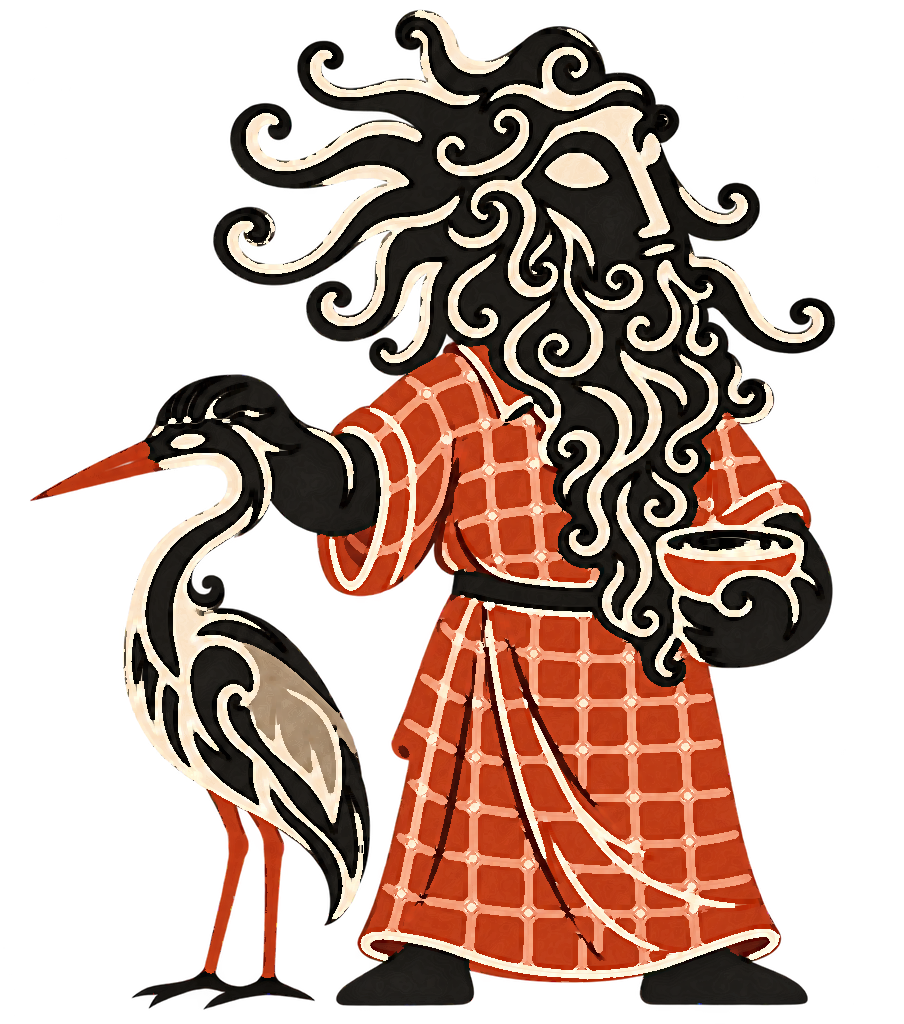
Grannos is a Gaulish healing deity frequently honored in ancient inscriptions as Apollo Grannus. His worship extended across several Roman provinces, and his reputation appears in an account of the emperor Caracalla seeking divine help. Within Bessus Nouiogalation, we honor him as a Solar Dêuos whose warmth, waters, and far-reaching gaze bring healing, vitality, and clarity.
Historical evidence
His name
The meaning of Grannos, usually written Grannus in Latin inscriptions, remains debated. Jürgen Zeidler’s study examines three principal explanations.
The first connects the name with words referring to hair, a beard, or eyebrows, giving an interpretation such as “the bearded one.” This is a proposed linguistic relationship, rather than a description established by his surviving images.
The second connects it with an Indo-European root meaning “warm” or “hot.” This has encouraged interpretations involving warmth, the sun, or thermal waters. The University of Graz’s FERCAN catalogue records “Hot God,” citing Patrizia de Bernardo Stempel.
A third proposal connects the name with a root meaning “shine” or “gleam.” This is a separate explanation from the derivation involving heat, even though both invite consideration of light and warmth.
These proposals should remain distinct. They do not combine into one established meaning, and his name should not be translated simply as “Sun.”
Within BNG, we use Grannos. Our understanding of him as a Solar Dêuos can enter into conversation with these scholarly proposals without depending upon one being conclusively established.
Apollo Grannus
The combined name Apollo Grannus appears directly in inscriptions. It shows that ancient worshippers brought Grannos into relationship with Apollo.
At Alzey, Germany, Martius Senopatius Novellus dedicated a monument to Apollo Grannus on August 18, AD 175. The inscription, AE 1933, 138, was discovered in 1929, reused in the late Roman fort.
The catalogue identifies it as a building inscription, traditionally understood as evidence for a temple that no longer survives. Its date records this particular dedication; it does not establish a universal annual festival.
The name appears across a wide geographical area. FERCAN records evidence from provinces including Belgica, Germania Superior, Raetia, Noricum, Britannia, and Dacia, as well as Rome. His worship extended well beyond one sanctuary or community.
Other inscriptions and worshippers
Additional dedications preserve personal names, epithets, and relationships with other deities:
| Inscription | Location | What it preserves |
|---|---|---|
| CIL XIII, 2600 | Monthelon, France | Apollo Grannus Amarcolitanus, honored by Veranus Tilander, son of Vercus. |
| CIL XIII, 5315 | Horbourg, France | Apollo Grannus Mogounus, with an altar funded by Quintus Licinius Trio. |
| CIL XIII, 3635 | Trier, Germany | A dedication by Lucius Ingenuvius Primanus, with the additional abbreviated name PHOEB. |
| CIL III, 5873 | Faimingen, Germany | Apollo Grannus alongside Sacred Hygia. |
Hofeneder discusses the first three inscriptions. The Faimingen monument is also recorded in Ubi Erat Lupa. The Faimingen dedication is particularly useful because it adds another healing deity to his documented associations. It does not establish that Hygia and Sirona were interchangeable.
Amarcolitanus—the far-seeing one
Amarcolitanus is interpreted as “the far-seeing one,” suggesting a wide-reaching gaze. Hofeneder considers solar vision, oracular knowledge, and healing involving sight as possibilities. The epithet does not settle which meaning predominated.
References placing the dedication at Branges concern the same Monthelon inscription, rather than another attestation.
Healing sanctuaries and waters
Faimingen, in present-day Bavaria, was an important center of worship for Apollo Grannus. Its substantial temple remains and nearby dedications provide an archaeological setting for a sanctuary with significance beyond a single household.
Grannos also appears in the healing context shared with Sirona, whom we call Ðironâ. At Bitburg, a fragmentary dedication to Apollo Grannus and Sirona was found near a perennial spring.
This supports a relationship with healing waters. It does not mean that every sanctuary associated with him contained a thermal spring, or that every dedication to Apollo and Sirona explicitly names Grannos.
The Ten Nights of Grannos
An inscription from Limoges, ancient Augustoritum, records decamnoctiacis Granni, interpreted as the “Ten Nights of Grannos.”
Catalogued as AE 1989, 521, it names Postumus, son of Dumnorix, a vergobret, and records his funding of an aqua Martia connected with the observance. It supplies neither a festival date nor a description of its ceremonies.
The inscription offers an ancient point of connection for a modern Ten Nights observance. Its present timing and practices belong to the development of our custom.
Caracalla’s appeal for healing
A passage from Cassius Dio, preserved in the Constantinian historical excerpts, describes Caracalla seeking help from Apollo Grannus, Asclepius, and Serapis.
The unsuccessful appeals serve Dio’s hostile judgment of the emperor. Nevertheless, the passage identifies Grannos among prominent deities approached for healing.
What the evidence tells us
The evidence supports Grannos’s relationship with healing, his worship as Apollo Grannus, and his presence in religious settings associated with water. Inscriptions also preserve additional epithets and an observance lasting ten nights.
Solar interpretations have a place in scholarship, particularly in discussions of his name and epithets. They should be presented as interpretations rather than as a complete ancient account of his character.
Within BNG, we develop these relationships through his solar presence, healing gaze, and companionship with Ðironâ.
Grannos in Bessus Nouiogalation
The solar healer
Within our bessus, Grannos is a benevolent healer of body and spirit and a Solar Dêuos.
We perceive him in warmth, illumination, and the renewal of vitality. Sacred waters warmed by the sun offer an image through which we contemplate his healing presence.
We turn toward him for well-being, protection, and the strength needed to recover. His warmth also reminds us of the conditions that help healing unfold: rest, nourishment, companionship, and attentive care.
The bow and the gaze
Within our gnosis, the bow and the eyes carry particular significance.
The bow’s arrows suggest the sun’s rays and their healing reach. The eyes express his capacity to look deeply, including into aspects of ourselves that are difficult to recognize.
We connect this understanding with Amarcolitanus, the far-seeing one. Through Grannos, we contemplate the clarity needed to recognize a problem, seek help, and attend to what recovery requires.
His gaze also calls us to look beyond immediate appearances. Someone’s suffering may be less visible than we expect, and care begins with paying attention.
Healing and accountability
Our gnosis recognizes that Grannos’s power can bring affliction as well as relief. We understand him as capable of acting against those who cause harm, including ourselves when we act harmfully.
This calls us to examine our conduct and take responsibility for its effects. It does not justify judging another person’s illness or assuming that suffering reveals wrongdoing.
Through Grannos, we seek the honesty to recognize harm and the resolve to change how we act.
Grannos and Ðironâ
We understand Ðironâ as his companion. Both hold physical and mental healing within their care, while bringing different qualities to our experience of them.
Grannos carries a solar presence of warmth, vitality, and illumination. Ðironâ brings the stellar, liminal, and subconscious dimensions described on her own page.
A practitioner may turn more readily toward Grannos for physical recovery and toward Ðironâ for inward or mental healing. These are devotional emphases, rather than restrictions upon either deity’s care.
Together, they hold a place within our bessus as Dêuoi of restoration and renewed well-being.
The Ten Nights within our custom
The ancient reference to the Ten Nights provides a starting point for sustained devotion to Grannos.
We honor Grannos through Noxsās Decan Grannī, the Ten Nights of Grannos, also called Îuos Grannī. This observance offers time for healing, reflection, and renewal through water and light.
Learn more about the Ten Nights of Grannos →
Honoring Grannos
- Offering clean water with prayer and gratitude.
- Praying for healing, vitality, protection, and clarity.
- Spending quiet time in sunlight when conditions are comfortable.
- Caring for springs, waterways, and their inhabitants.
- Supporting people recovering from illness or injury.
- Helping make rest, nourishment, and companionship possible.
- Attending to our health and seeking appropriate care.
- Reflecting honestly upon our actions and addressing harm.
- Honoring Grannos and Ðironâ together.
- Keeping a sustained observance during the Ten Nights of Grannos, according to our custom.
Through Grannos, we honor healing, clear attention, and the practical work of caring for ourselves and others.
Sources and further reading
- FERCAN, University of Graz—Apollo Grannus, CF-GeS-1004—the Alzey dedication, AE 1933, 138, geographical distribution, and references concerning his name.
- Hofeneder, Andreas (2013). “Apollon Grannos—Überlegungen zu Cassius Dio 77, 15,5–7.” In Théonymie celtique, cultes, interpretatio, pp. 101–111—inscriptions, epithets, sanctuaries, the Ten Nights, and Caracalla’s appeal.
- Zeidler, Jürgen (2003). “On the Etymology of Grannus.” Zeitschrift für celtische Philologie 53, pp. 77–92—consulted through the publisher’s abstract; fuller discussion also considered through Hofeneder.
- Ubi Erat Lupa—no. 6422—the Faimingen dedication to Apollo Grannus and Sacred Hygia, CIL III, 5873.
- Stadt Lauingen—Apollo-Grannus-Tempel—official presentation of the Faimingen sanctuary.
- Beck, Noémie (2009). Goddesses in Celtic Religion: Cult and Mythology—consulted through the republished discussion of water goddesses, including Sirona’s association with Apollo Grannus.

