
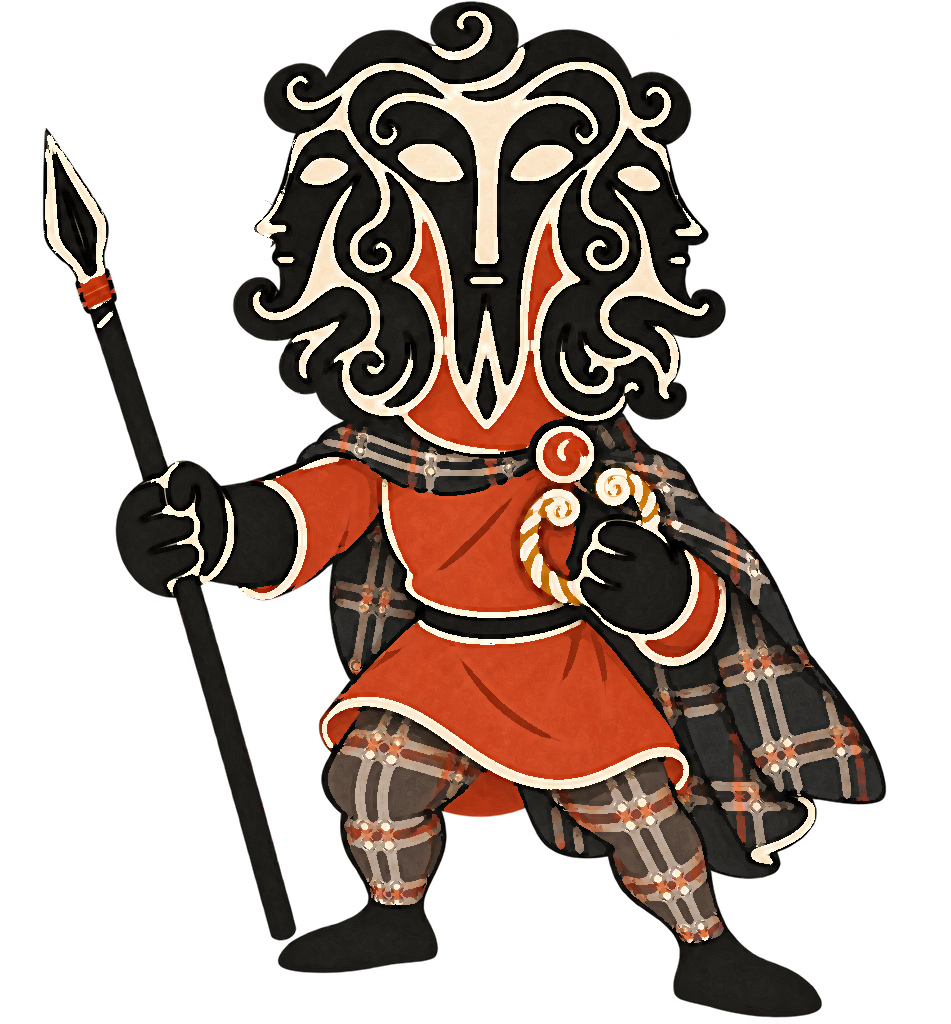
Lugus is approached through inscriptions naming the Lugoves and related divine figures, comparisons with Irish Lug and Welsh Lleu, and scholarly interpretations of Gaulish Mercury. Within Bessus Nouiogalation, we honor him as a master of skills, protector of the community, guide on journeys, and guardian of oaths and commitments.
Historical evidence
His name
The meaning of Lugus remains uncertain. Two interpretations are especially relevant to discussions of his character: a connection with light, and a connection with oaths or binding.
“The Shining One” is familiar in scholarship and modern practice. Daniel Gricourt and Dominique Hollard adopt a luminous interpretation in their comparative study. However, the derivation presents linguistic difficulties and should not be treated as an established translation.
Another proposal connects the name with Celtic vocabulary for oath-taking. The linguist John T. Koch records reconstructed *lugiom, “oath, to swear,” alongside Old Irish lugae and Middle Welsh llw. The asterisk indicates a reconstructed form rather than one preserved directly in an inscription.
This supplies relevant Celtic vocabulary, although connecting it with the divine name requires a further argument. The existence of an oath word resembling Lugus does not, by itself, settle the name’s origin.
Cunolugus Drugaisos favors the oath interpretation in his discussion of Lugus. It offers a meaningful comparison for BNG’s understanding of him as a guardian of commitments, without requiring us to translate his name definitively as “God of Oaths.”
The related names Irish Lug and Welsh Lleu are important to comparative study. Their relationship does not mean that every story or attribute recorded in Ireland and Wales can automatically be assigned to the continental deity.
Within BNG, we retain Lugus without a fixed English translation.
The Lugoves at Avenches
An important inscription comes from Avenches, Switzerland, ancient Aventicum.
A limestone Corinthian capital preserves the word Lugoves, with recesses where metal letters were once attached. It was discovered near the Cigognier sanctuary in 1844 and is held by the Roman Museum of Avenches.
The archaeological catalogue dates it approximately to AD 200–250. It is catalogued as CIL XIII, 5078.
The plural form is significant, but the short inscription does not explain the figures’ number, appearance, or relationship with a singular Lugus.
The dedication from Osma
Another inscription comes from Uxama, near modern Osma in Spain, and is catalogued as CIL II, 2818.
It names the Lugoves and connects the dedication with a college of shoemakers. Gricourt and Hollard discuss this as evidence for a relationship with craftsmanship, particularly leatherworking.
They compare it with the Welsh tradition in which Lleu and Gwydion practice shoemaking. The comparison brings together a continental inscription and a later Welsh narrative, while leaving them as distinct sources.
Other surviving dedications
Northwestern Iberian inscriptions preserve related divine names and local epithets:
| Inscription | Location | What it preserves |
|---|---|---|
| AE 1912, 12 | Sinoga, Galicia, Spain | Lucoubu Arquien(-?-), honored by Silonius Silo in fulfilment of a vow. |
| IRLugo 67 | Liñarán, Sober, Galicia, Spain | Lugubo Arquienob(o), honored by Gaius Iulius Hispanus. |
| AE 2003, 951 | Lugo, Galicia, Spain | Lucobo Arousa(-?-), honored by Rutilia Antiania in fulfilment of a vow. |
These readings are recorded by the university-based DEpHis catalogue. Question marks indicate unresolved elements of the names or their expansion.
DEpHis groups forms such as Lucoubu, Lugubo, and Lucobo for comparison under Lugoves, while noting linguistic uncertainties. We preserve their recorded forms rather than silently rewriting them as dedications to a singular Lugus.
For more texts and references, visit Lugus Inscriptions.
What does the plural mean?
The form Lugoves has encouraged interpretations involving a divine grouping or plurality associated with Lugus. The inscriptions do not explain that relationship.
Gricourt and Hollard explore a comparison with a Welsh triad of shoemakers. This is a comparative argument, rather than evidence that the Avenches inscription names exactly three beings. The plural also does not establish a three-faced appearance.
The possibility of divine plurality belongs in the historical discussion. Its precise meaning remains open.
Caesar’s “Mercury”
In ** Gallic War 6.17**, Caesar describes Mercury as the deity the Gauls worship most. He presents him as an inventor of the arts, a guide on roads and journeys, and a power concerned with trade and profit.
Caesar uses the Roman name Mercury. He does not supply the name Lugus.
Identifying this figure with Lugus is an influential scholarly interpretation. It should remain a proposal rather than a direct statement from Caesar. Bernhard Maier’s study specifically questions this identification.
Caesar’s account can help us explore the comparison, but it cannot establish that every Gaulish image or dedication to Mercury represents Lugus.
Irish Lug, Welsh Lleu, and the many skills
Comparisons with Irish Lug and Welsh Lleu have played a major role in attempts to understand Lugus.
In the Irish Cath Maige Tuired, Lug’s admission to the royal court turns upon his possession of many skills together. The story offers an image of knowledge brought into coordinated action: different abilities united in one figure.
Welsh Lleu supplies a separate body of stories involving craftsmanship, weapons, rulership, and difficult conditions surrounding his life.
These traditions help explain the broader interpretation of Lugus as a master of skills. The Osma inscription provides a particular connection with shoemakers; the wider portrait develops through comparison. Irish and Welsh narratives remain evidence from their own cultures and periods.
His imagery
Lugus is associated with three faces, a spear, ravens, roosters, and a purse. Historically, this collection should not be presented as a securely identified set of ancient attributes.
The Avenches capital supplies a name without a divine figure. Caesar supplies a description under the name Mercury. Identifying particular images as Lugus requires another interpretive step.
His three-faced appearance and the meanings we give these symbols belong within our account of BNG gnosis. Scholarly proposals concerning possible images remain valuable when identified as interpretations.
What the evidence tells us
The inscriptions establish worship of the Lugoves and related named divine figures. Osma supplies a connection with a craft community, while Iberian dedications preserve additional local names and epithets.
Comparison with Mercury, Irish Lug, and Welsh Lleu contributes to broader interpretations involving skill, journeys, leadership, and divine knowledge. These relationships are important to study, but they do not amount to a complete surviving Gaulish mythology.
Lugus in Bessus Nouiogalation
Master of the arts
Within our bessus, Lugus is a Dêuos of craftsmanship, arts, and skills.
We understand him as a master whose knowledge reaches across different kinds of work. His presence encourages the development of ability through learning, practice, and attention.
His many skills also remind us to recognize how different kinds of knowledge meet. A difficult task may require practical ability, sound judgment, clear speech, and cooperation.
Through Lugus, we consider how the skills we cultivate can serve the people around us.
The clarifying word
Within our bessus, Lugus’s skill extends to communication: teaching, explaining, and helping others understand. We perceive him in the words that make a difficult task clearer, reveal a connection, or give someone the knowledge to proceed.
We understand his speech as a lamp, illuminating what needs attention and helping us find our direction. This also shapes his relationship with sovereignty. A leader’s responsibilities include explaining decisions, giving sound instruction, and making shared work possible.
Îanolabâ – Right Speech
Through Lugus, we approach Îanolabâ, right speech, as both a virtue and a devotional practice.
We honor him by speaking honestly, explaining carefully, and checking that we have understood one another. Sharing knowledge carries responsibility: our words influence what others learn, how they act, and whether they feel able to ask questions.
His guidance encourages us to make our knowledge useful to others. Teaching a skill, offering clear directions, or patiently explaining something unfamiliar can become ways of honoring him.
Leader of the warband
Lugus is our leader of the warband, offering protection and championing us in our battles.
We perceive him with spear in hand and knowledge in mind. His leadership joins the capacity to act with the understanding needed to act well.
Within our gnosis, he stands ready to protect our sovereignty and prosperity. Honoring this aspect includes considering what deserves our defense and what responsibilities accompany strength.
Cintumessus and Rosmertâ
We associate Lugus with the protection of the harvest and agricultural prosperity, particularly through Cintumessus, which he shares with Rosmertâ, our Queen of the Harvest.
In BNG lore, Gobannos crafts the spear that helps Lugus rescue Rosmertâ. The story connects the divine smith’s skill with Lugus’s protective action and the restoration celebrated at Cintumessus.
Their relationship shows us that prosperity depends upon many contributions: the land’s abundance, skilled work, protection, and the care through which a community sustains itself.
Guide on all roads
Lugus is our guide on all roads, safeguarding travelers in their journeys.
We turn toward him when setting out, finding our direction, or undertaking work that requires unfamiliar skills. His knowledge and watchfulness accompany movement through the world.
This guidance also calls for our attention. Preparing carefully, listening to advice, and recognizing when we need help can express devotion to him.
Oaths and vows
We honor Lugus as a Dêuos of oaths and vows. You can find out more about Oaths HERE
This relationship places attention upon the commitments we make and our responsibility to carry them through. Honoring him includes considering our words carefully and understanding what we are promising.
A commitment creates a relationship with those who depend upon it. Through Lugus, we seek the judgment to undertake responsibilities honestly and the determination to meet them.
Watchfulness in every direction
Within BNG, Lugus’s three-faced image expresses watchfulness in multiple directions.
We contemplate it alongside his work as protector, guide, and guardian of commitments. It shows us to look beyond the immediate moment: to consider what brought us here, what is happening around us, and what our actions may bring.
This imagery expresses our understanding without fixing the number or nature of the ancient Lugoves.
Honoring Lugus
- Offering prayer before practicing a skill or beginning important work.
- Devoting time to learning, creating, or teaching.
- Making a handmade offering with care.
- Recognizing the knowledge and contributions of others.
- Preparing thoughtfully before a journey.
- Helping travelers find their way.
- Keeping commitments and speaking carefully when making promises.
- Defending the well-being and dignity of the community.
- Exercising leadership with sound judgment and accountability.
- Honoring Lugus and Rosmertâ together during Cintumessus.
- Offering seasonal produce and giving thanks for the work that sustains the harvest.
Through Lugus, we honor capable action, faithful commitments, and the use of knowledge in service to community.
Sources and further reading
Historical and comparative evidence
- Ubi Erat Lupa—Avenches capital, no. 8680—CIL XIII, 5078, naming the Lugoves.
- Julius Caesar. Gallic War 6.17—the description of Gaulish Mercury.
- Gricourt, Daniel, and Dominique Hollard (1997). “Le dieu celtique Lugus sur des monnaies gallo-romaines du IIIe siècle.” Dialogues d’histoire ancienne 23.1, pp. 221–286—particularly p. 228 on the Osma inscription and comparative craftsmanship traditions.
- Koch, John T. (2019). “Rock art and Celto-Germanic vocabulary: Shared iconography and words as reflections of Bronze Age contact.” Adoranten, pp. 80–95, particularly p. 92 for Celtic oath vocabulary. This passage concerns the vocabulary itself, rather than establishing the etymology of Lugus.
- Gray, Elizabeth A., editor and translator (1982). Cath Maige Tuired: The Second Battle of Mag Tuired. Irish Texts Society 52. Electronic edition through University College Cork’s CELT project.
- DEpHis—Lugoves—overview of the Iberian forms and uncertainties in their analysis.
- DEpHis—Sinoga dedication—AE 1912, 12.
- DEpHis—Liñarán dedication—IRLugo 67.
- DEpHis—Lugo dedication—AE 2003, 951.
Further academic reading
- Maier, Bernhard (1996). “Is Lug to be Identified with Mercury (Bell. Gall. VI 17.1)? New Suggestions on an Old Problem.” Ériu 47, pp. 127–135. Publication details verified; the full article was not consulted for this draft.
Modern discussion and inscription resources
- Cunolugus Drugaisos. “Lugus.” Druid Hearth—modern discussion and comparative interpretation.
- Lugus Inscriptions—a devotional collection with inscription references. Its identification of other Mercury-associated deities with Lugus reflects the compiler’s interpretation.

