
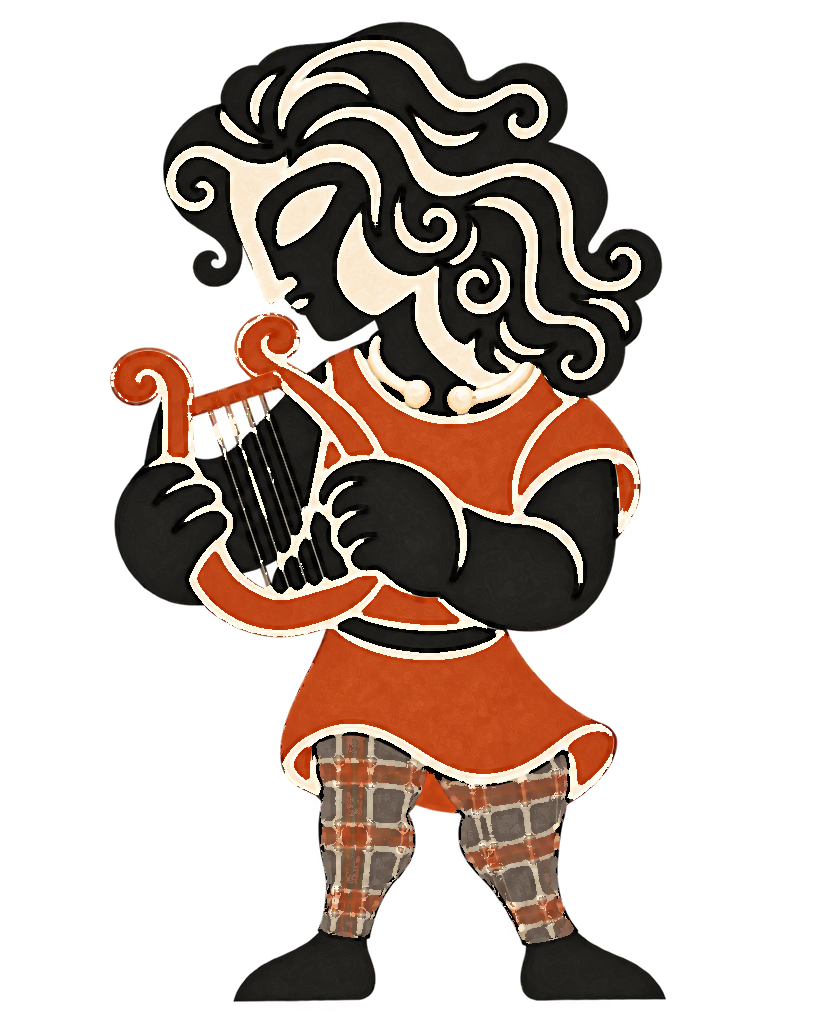
Maponos is known through inscriptions in Britain and Gaul, including dedications to Apollo Maponus and the Gaulish-language tablet from Chamalières. His name connects him with youth, while his surviving imagery includes the lyre. Within Bessus Nouiogalation, we honor him through music, artistic expression, curiosity, and the healing that creativity can bring.
Historical evidence
His name
The name Maponos is built upon Celtic mapo-, meaning “son” or “boy.” Colette Bémont describes him as “the Son,” understanding the name as an expression of divine youth. This gives us a firmer linguistic starting point than we have for many Gaulish divine names.
The ending -onos requires a little more explanation. It occurs in discussions of Celtic divine names and is often understood as giving the name an elevated or divine force. This accounts for familiar translations such as “Divine Son” and “Great Son.” These express how scholars understand the formation; the ending should not be treated as a separate word that always translates directly as “great.”
Jean-Charles Berthet, discussing Celtic name formation, specifically places Gaulish Maponos and Welsh Mabon together as examples of a divine-name formation. Their relationship is linguistic, although it does not mean that every later story about Mabon can be transferred directly to ancient Maponos.
Maponus is the Latinized spelling found in British dedications. Forms such as Mapono occur because Latin changes the ending of a name according to its grammatical role: here, the dedication is made “to Maponus.”
Within BNG, we use Maponos. His name supports an understanding of youth and sonship, but does not identify his parents or establish that he was a solar deity.
Inscriptions and worshippers
Several British inscriptions preserve his name. Together, they show repeated worship in northern Britain and the participation of people from different backgrounds.
| Evidence | Place | What it preserves |
|---|---|---|
| RIB 583 | Ribchester, Lancashire | A dedication to Apollo Maponus by Aelius Antoninus, a centurion commanding the local Sarmatian cavalry unit, dated 31 August AD 241. |
| RIB 1120 | Found at Hexham; assigned by RIB to Corbridge | A dedication to Apollo Maponus by Quintus Terentius Firmus, a camp prefect of the Sixth Legion Victrix, originally from Saena in Italy. |
| RIB 1121 | Corbridge | A dedication to Apollo Maponus by a tribune whose name is partly restored as Calpurnius. |
| RIB 1122 | Preserved in Hexham Abbey’s crypt; assigned to Corbridge | A damaged dedication to Maponus Apollo by a centurion of the Sixth Legion Victrix. |
| RIB 2063 | Reportedly found near Brampton; exact provenance uncertain | A dedication to Maponus and the emperor’s divine presence by four men described as Germans. |
The Corbridge inscriptions provide several individual examples of military devotion. Their surviving texts name officers who dedicated monuments or fulfilled vows to him.
RIB 2063 adds something useful: it names Maponus without Apollo. Durio, Ramio, Trupo, and Lurio jointly fulfilled a vow to him and the emperor’s divine presence. The inscription describes them as Germans, although it does not state their occupations. Its original location remains uncertain.
These dedications show that his worship crossed cultural boundaries within Roman Britain. Bémont treats the concentration of evidence and the varied origins of the dedicants as signs of an established local cult.
Apollo Maponus and music
The Ribchester monument gives us an especially useful connection between a named dedication and an image.
It is part of a larger monument rather than an altar. A relief on its side shows Apollo with a cloak hanging from his shoulders, a quiver on his back, and a lyre beside him. The accompanying inscription names Apollo Maponus.
The lyre gives us a historical basis for discussing music in connection with his worship. “Lyre” is also more accurate here than “harp.” The dedication concerns the welfare of the emperor and the cavalry unit, placing this musical image within a public and military setting.
The association with Apollo is explicit, but its full meaning is not explained by the inscriptions. It allows comparison with Apollo’s familiar qualities without establishing that Maponos shared every one of them. In particular, the combined name alone is insufficient grounds for calling him a sun god.
The lyre in Gaulish culture
The lyre also appears in Gaulish art beyond images of Apollo Maponus. Stone sculpture and coins show that it formed part of the visual world of Iron Age Gaul, before the surviving Roman-period dedications to him.
One important example is the “Bard of Paule,” a stone bust discovered in 1988 at the fortified aristocratic residence of Saint-Symphorien in Paule, Brittany. The figure wears a torc and holds a lyre against his chest. Inrap dates the sculpture to the second century BC.
The figure is commonly interpreted as a bard. In their archaeological study, Yves Ménez and his collaborators discuss ancient accounts of bards accompanying their poetry with lyre-like instruments. Such performances could praise individuals, criticize them, and preserve the memory of notable deeds.
Lyres also appear on coins from different parts of Gaul.
A Coriosolite billon statère, held by the Musée départemental breton under inventory number 2007.0.21, provides a clear example. The museum dates it to approximately 50 BC. Its reverse shows a human-headed horse with a charioteer above it and a four-stringed lyre beneath it.
The Bibliothèque nationale de France also catalogues gold statères attributed to the Arverni within a “lyre series.” One example, BnF 5283, belongs to the Lapte type and is included in Sylvia Nieto-Pelletier’s scholarly catalogue of Arvernian coins.
These examples establish the lyre’s presence in Gaulish coin imagery. They do not, by themselves, tell us whose instrument it represents or whether its meaning was the same across different coin series. A lyre beneath a horse cannot securely identify either the horse or the accompanying head as Maponos.
For understanding Maponos, this material supplies a wider musical context. The Ribchester monument remains especially valuable because its lyre-bearing image accompanies a dedication explicitly naming Apollo Maponus.
The Chamalières tablet
In Gaul, Maponos appears on a lead tablet discovered on 15 January 1971 at the Source des Roches sanctuary in Chamalières, near Clermont-Ferrand.
The text is written in Gaulish using Latin cursive letters. Its discovery at a spring sanctuary, among numerous wooden votive objects, places the invocation within a substantial setting of religious activity.
The tablet matters because it preserves more than a short Latin dedication. It names Maponos within an extended Gaulish ritual text, offering evidence of how his name could be used in an invocation.
Its interpretation remains difficult. Pierre-Yves Lambert proposed a translation in 1979 while openly acknowledging that several passages allowed competing explanations. Patrick L. Henry, writing in 1984, challenged parts of that interpretation and offered alternatives. Their disagreement concerns both individual words and the purpose of the text.
The inscription is commonly discussed as a magical or binding text. That is a useful description of its scholarly context, provided we acknowledge that its exact request and ritual circumstances remain debated.
Maponos and the Arverni
A word accompanying his name on the Chamalières tablet is often interpreted as connecting him with the Arverni, the people of the surrounding region.
This produces readings such as “Maponos of the Arverni.” However, the reading and interpretation have not been unanimous. Lambert’s earlier analysis proposed a different explanation, while Henry argued in favor of the geographical connection.
The regional interpretation is therefore worth mentioning, with its status visible. It suggests a locally identified form of Maponos, without establishing that this was his only place of origin or worship.
Springs, healing, and the limits of the evidence
Chamalières places Maponos within the religious life of a spring sanctuary. Bémont brings this setting into her comparison with British Apollo Maponus and his youthful character.
This gives healing a place in the historical discussion, although the spring setting does not settle the tablet’s purpose. An invocation deposited at a sanctuary may concern a particular need that differs from the wider activities of the site.
The surviving evidence supports connections with youth, music, Apollo, and worship at a sacred spring. It leaves his mythology and many details of his ancient worship unknown. Our understanding of artistic expression as emotional healing, and creativity as a means of approaching Antumnos, develops within BNG.
Maponos in Bessus Nouiogalation
Music and artistic expression
Within our bessus, Maponos is a Dêuos of artistic expression, music, and the healing that creativity can bring.
We honor him in the making of a melody, the shaping of a poem, the telling of a story, and the moments when something within us finds expression through art.
His presence belongs to the enjoyment of creating and to the attention it asks of us. Practicing an instrument, trying a new technique, or returning to unfinished work can all become ways of developing our relationship with him.
Creativity and healing
Music and art can help us express grief, approach difficult feelings, and communicate experiences for which ordinary conversation seems insufficient.
Within our understanding, Maponos accompanies this emotional work. A song may give voice to sorrow; an image may help us recognize something we have struggled to name. Creating can also make room for pleasure and connection during difficult times.
We approach this healing patiently. What matters in devotion is the care given to expression and the relationship that grows through it.
Art and Antumnos
We also understand creativity as a possible means of connection with Antumnos, the Otherworld.
A song, image, or story can draw our attention beyond familiar experience. Through artistic expression, we may approach mystery, contemplate the presence of the Dêuoi, or encounter meanings that take time to understand.
This relationship between creativity and Antumnos belongs to our living understanding of Maponos.
The youth within us
Maponos is the youth within us all.
We recognize him in curiosity, play, discovery, and the willingness to begin something unfamiliar. His youthfulness reminds us that these possibilities remain throughout our lives.
Learning often asks us to accept uncertainty and make mistakes. Through Maponos, we make room for experimentation and for the simple enjoyment of discovering what we can do.
Honoring Maponos
- Playing or singing music in his honor.
- Writing poetry, telling stories, drawing, dancing, or making other art.
- Dedicating time to practice and experimentation.
- Returning to an artistic activity that brings meaning to your life.
- Making room for curiosity, play, and learning.
- Sharing music or art with others as an act of care.
- Supporting artists and opportunities for others to create.
- Reflecting on how creativity helps you express emotion.
- Approaching Antumnos through devotional song, imagery, or storytelling.
You do not need to be an accomplished artist to honor him. Attention, willingness, and the care given to creating can all form part of devotion.
Sources and further reading
- Roman Inscriptions of Britain: RIB 583, RIB 1120, RIB 1121, RIB 1122, and RIB 2063 — texts, translations, find circumstances, and descriptions of the monuments.
- Bémont, Colette (1981). “Observations sur quelques divinités gallo-romaines : les rapports entre la Bretagne et le continent.” Études celtiques 18: 65–88, especially pp. 78–79.
- Berthet, Jean-Charles. “Myrddin et Merlin. De l’onomastique à la mythologie.” Iris — consulted specifically for the discussion of name formation and the Maponos–Mabon comparison in note 37.
- Lambert, Pierre-Yves (1979). “La tablette gauloise de Chamalières.” Études celtiques 16: 141–169.
- Henry, Patrick L. (1984). “Interpreting the Gaulish inscription of Chamalières.” Études celtiques 21: 141–150.
- Ménez, Yves, with Pierre-Roland Giot, Fanette Laubenheimer, Elven Le Goff, and Christophe Vendries (1999).“Les sculptures gauloises de Paule (Côtes-d’Armor).”Gallia 56: 357–414, especially the discussion on p. 411.
- Musée départemental breton.Coriosolite statère, inventory 2007.0.21.
- Bibliothèque nationale de France.Arvernian gold statère, lyre series, Lapte type I, BnF 5283. Catalogue entry referencing Sylvia Nieto-Pelletier, Catalogue des monnaies celtiques. 1, Les Arvernes (centre de la Gaule) (2013), no. 1.

