
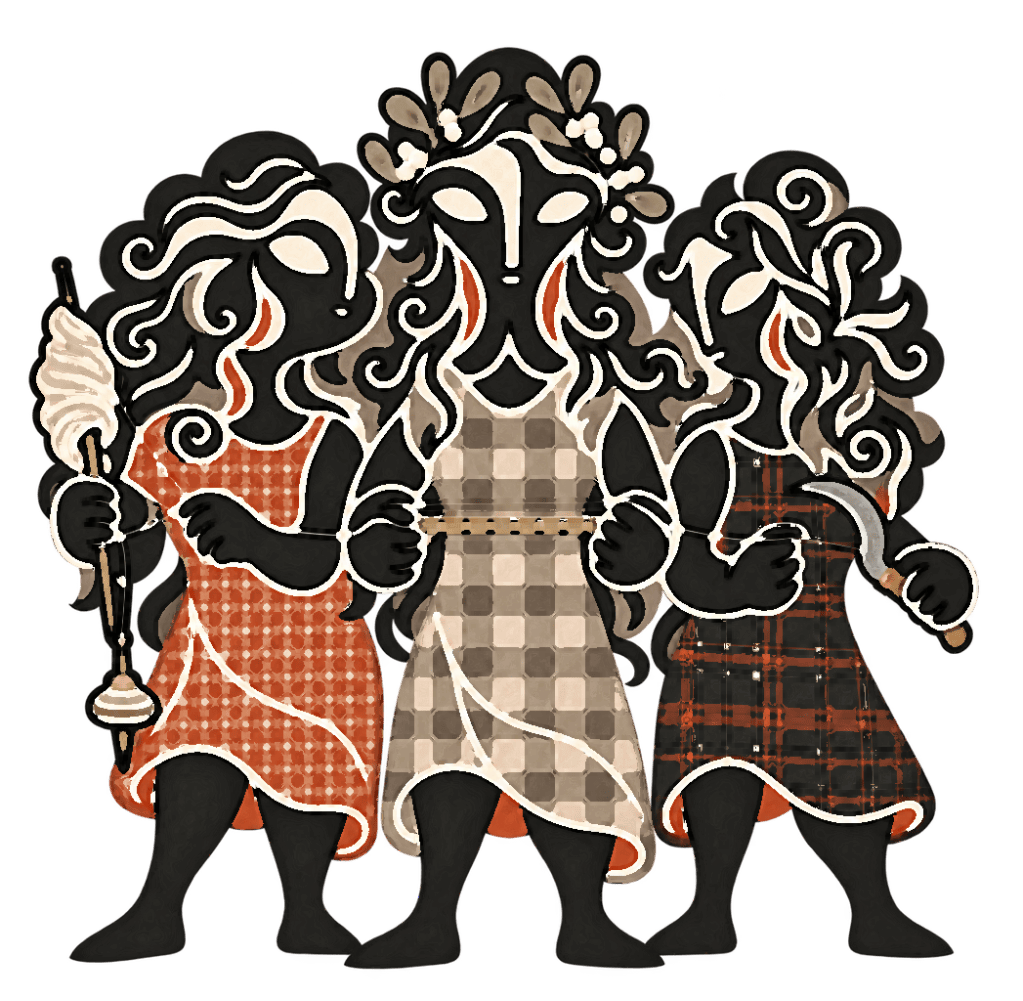
The Materês are the Mothers, honored in groups across the ancient Celtic and Roman worlds. Their inscriptions preserve local names, while their images often show them with fruit and other signs of abundance. Within Bessus Nouiogalation, we honor them as nurturers and protectors of the Cosmos, present in the unfolding of life and fate.
Historical evidence
The Mothers were honored across Gaul, Britain, the Rhineland, northern Italy, and other parts of the Roman world. Ancient inscriptions preserve several related titles, including Matres and Matronae, and many groups received names connecting them with a particular place or community.
Their worship was widespread, but the surviving evidence does not point to one identical group understood in the same way everywhere. Each dedication gives us a glimpse of the Mothers as they were honored in a particular setting.
Their name
Within BNG, we call them the Materês, the Mothers. This is the form we use in our bessus. Ancient inscriptions preserve different forms according to language and grammar.
One Gaulish form is matrebo, meaning “to the Mothers.” It appears in inscriptions from southern Gaul, including the dedication to the Mothers of Glanum. The ending tells us that the Mothers are the recipients of the dedication.
In Latin inscriptions, they are often called Matres, “Mothers,” or Matronae, “Matrons.” The inscribed forms may appear as Matribus or Matronis, meaning “to the Mothers” or “to the Matrons.”
The Latin word matrona could refer to a married or respectable woman. As a divine title, Matronae was used for groups of goddesses. Scholars have discussed the relationship between the Latin term and Celtic divine naming; the title appears in regions where Celtic, Germanic, and Roman languages and traditions met.
“Mothers” is the straightforward meaning. “Divine Mothers” makes clear that we are speaking of goddesses. “Great Mothers” can be a devotional description, though it is not the literal translation of every form found in inscriptions.
Inscriptions and places of worship
Dedications to the Mothers come from Gaul and several other parts of the Roman world. Some name Mothers connected with a particular place; others address them in relation to a household or fate.
In Gaul
| Evidence | Place | What it preserves |
|---|---|---|
| RIG G-64 | Glanum, Saint-Rémy-de-Provence | A Gaulish inscription in Greek letters addressed to the Mothers of Glanum, matrebo glaneikabo. |
| RIG G-203 | Nîmes | A Gaulish inscription in Greek letters addressed to the Mothers of Nîmes, matrebo namausikabo. |
| Lugdunum Museum, AD201 | Lyon | A relief and Latin dedication to the August Mothers by Phlegon, a physician. |
| CIL XIII, 1765 | Irigny, near Lyon | A damaged Latin dedication to the August Mothers Eburnicae. |
The dedications from Glanum and Nîmes are especially useful because they preserve the Gaulish form matrebo, “to the Mothers,” alongside names connecting the goddesses with each place. The interpretation of other parts of the inscriptions remains debated.
At Lyon, Phlegon’s dedication accompanies a relief of three seated Mothers holding fruit and a cornucopia. The museum dates the monument to the first or second century CE. We discuss its imagery further below.
The Eburnicae dedication was found incorporated into a wall at Irigny. Its inscription preserves the Mothers’ distinctive name, though the monument’s original setting is not known from the findspot alone.
Beyond Gaul
| Evidence | Place | What it preserves |
|---|---|---|
| RIB 3031 | Dover, England | Olus Cornelius Candidus records building a shrine to the Mothers of Italy, Matres Italicae. |
| RIB 652 | York, England | A dedication to the Mothers of the household, Matres domesticae. |
| RIB 653 | York, England | A soldier dedicates an altar to the African, Italian, and Gallic Mothers. |
| RIB 951 | Carlisle, England | A dedication to the Mothers, the Fates, Matribus Parcis, for the welfare of Sanctia Gemina. |
| CIL V, 5791 | Milan, northern Italy | Gaius Rufinius Apronius fulfills a vow to the Matronae Dervonnae. |
| CIL V, 4208 | Calvagese della Riviera, near Brescia, northern Italy | Marcus Rufinius Severus fulfills a vow to the Fates Dervones, Fatis Dervonibus. |
The York altar RIB 653 is another good addition: although found in Britain, it explicitly names Gallic Mothers alongside African and Italian Mothers. Marcus Minucius Audens, a soldier and pilot of the Sixth Legion, made the dedication.
The Milan and Calvagese inscriptions can remain in the table because northern Italy was part of Cisalpine Gaul in antiquity. They are worth distinguishing geographically from the examples found in what is now France. Their possible relationship with fate is explored below in “The Dervonnae.”
Local Mothers and their names
Many groups of Mothers received an additional name. Some names connect them with a town, region, people, or household; others are difficult to explain.
The Mothers of Glanum and the Mothers of Italy give us two clear examples. Their names show that a group could be identified through a relationship with a particular place. The Mothers of the household offer a different kind of connection, centered on the people and life of a home.
In the Rhineland, many dedications address Matronae with distinctive names. Linguist Corinna Scheungraber notes that their names include Celtic and Germanic elements, reflecting contact between languages and communities in the Roman provinces.
These local names help us see the variety within their worship. They also leave open questions about how worshippers understood the relationship between one group of Mothers and another.
Their appearance
Images of the Mothers often show three seated women. Fruit, baskets, vessels, and horns of plenty appear in their hands or laps. These objects suggest nourishment and abundance, though the details vary between monuments.
A marble relief from Lyon, now in the Lugdunum Museum, shows three seated Mothers and carries a dedication by Phlegon, a physician. The figures hold fruit, while the central goddess holds a small offering dish and a cornucopia. The museum dates the relief to the first or second century CE.
Phlegon’s profession gives us a glimpse of one person who honored them. The dedication does not explain what led him to make the offering.
Three figures are common in their imagery, but an inscription naming “the Mothers” does not necessarily tell us exactly how many goddesses a particular worshipper had in mind.
Honoring the Mothers in the Roman period
Some monuments show people approaching the Mothers as well as the goddesses themselves.
A votive stone from Bonn dedicated to the Matronae Aufaniae depicts a sacrificial scene beneath the seated goddesses. The University of Bonn describes figures gathered around an altar, including a man in Roman dress and a woman wearing clothing identified with the local region. The inscription names Quintus Caldinius Certus as the dedicator.
The scene gives us a glimpse of devotion in a community where Roman and local ways of dressing and presenting worship appeared together. It also reminds us that the surviving monuments were connected to acts of devotion by particular people.
The Mothers and fate
The connection between the Mothers and fate has direct inscriptional support.
The Carlisle dedication RIB 951 addresses the Mothers, the Fates, for the welfare of Sanctia Gemina. It gives us a small but meaningful glimpse of someone seeking their care. The stone does not tell us who made the dedication or what circumstances prompted it.
That inscription supports an association between the Mothers and fate in this particular setting. It does not preserve a complete Gaulish teaching about destiny or establish that every group of Mothers had the same role.
Comparisons with the Greek Moirai or Scandinavian Norns can help us explore the idea of divine beings concerned with fate. Those traditions have their own histories and should remain comparisons rather than substitutes for missing Gaulish stories.
The Dervonnae: Mothers, oaks, and fate
Two inscriptions from northern Italy preserve similar divine names in dedications to the Matrons and the Fates.
At Milan, an inscription catalogued as CIL V, 5791 records a vow fulfilled by Gaius Rufinius Apronius to the Matronis Dervonnis—the Matronae Dervonnae.
Another altar, found at Calvagese della Riviera, near Brescia, is catalogued as CIL V, 4208. It records a vow fulfilled by Marcus Rufinius Severus to the Fatis Dervonibus, commonly understood as the Fates Dervones. The second inscription uses the word Fatis; it does not itself call them Matronae.
Linguist Patrizia de Bernardo Stempel interprets the two names as related and connects them with oak. She considers the dedications to refer to the same oak-associated divine beings, addressed through the titles Matronae and Fatae. This is a scholarly interpretation based on the names in the two inscriptions.
These dedications offer another possible connection between the Mothers and fate. They do not describe the goddesses spinning a thread of life or place them beneath a World Tree. Those images can be explored through comparison and within our own living understanding.
What the evidence leaves open
The inscriptions and images give us Mothers associated with places, households, abundance, and, in some cases, fate. They also preserve the names of people who honored them and the vows or dedications those people made.
They leave many questions unanswered. We do not have a complete account of the Mothers’ stories or a single ancient teaching explaining their place throughout the cosmos. The understanding that follows belongs to BNG and grows from our relationship with them.
The Materês in Bessus Nouiogalation
Guardians of fate
For us, the Materês guide, measure, and safeguard fate. We honor them through birth, life, and death, recognizing their presence in the unfolding of individual lives and the lives of communities.
As knowers of fate, they understand connections and possibilities that we cannot fully see. A life unfolds among other lives, shaped by what came before it and contributing to what follows. Through the Materês, we contemplate our place within those relationships.
We may approach them for guidance when a path is uncertain, for protection during a significant change, or in gratitude for the care that has sustained us.
Nurturers of the Cosmos
The Materês are nurturers and protectors of the Cosmos. Their care sustains its vitality, allowing life to grow and relationships among beings to continue.
We understand their motherhood in this wider sense: the tending of all that lives and becomes. Their care extends to individuals, communities, and civilizations, as well as to the many other beings with whom we share existence.
Our gnosis compares their work with that of gardeners. They tend the conditions through which life flourishes, attending to growth and to the many relationships that support it.
At the roots of Drus
Within our bessus, we understand the Materês as dwelling at the roots of Drus, the World Tree. There, we contemplate their care for the life and relationships that flow through the Cosmos.
The name Matronae Dervonnae, with its proposed connection to oak, offers a historical point of inspiration for this understanding. Their place beneath Drus belongs to our BNG gnosis.
Within BNG, we leave the individual Materês unnamed. We honor them together as the Mothers, without assigning each one a separate name.
Honoring the Materês
The Materês may be honored with offerings of bread, fruit, grain, or a drink, accompanied by gratitude for nourishment, protection, and guidance. These are suggestions for our present-day practice; the food offerings draw inspiration from their ancient imagery.
- Giving thanks at births and other important changes in life.
- Asking for guidance when facing an uncertain future.
- Supporting parents, caregivers, children, and elders.
- Sharing food and helping sustain the community.
- Tending a garden or caring for the conditions that allow life to flourish.
- Remembering those whose care helped shape your life.
- Reflecting on our relationships with others and the responsibilities we carry within them.
An offering can be followed by an act of care. Preparing a meal, helping someone through a difficult transition, or tending something that depends upon you can bring devotion to the Mothers into everyday life.
Sources and further reading
- Beck, Noémie (2009). Goddesses in Celtic Religion: Cult and Mythology—A Comparative Study of Ancient Ireland, Britain and Gaul. Relevant material is available in the republished chapter on the Matres and Matronae.
- University of Cambridge, Department of Anglo-Saxon, Norse & Celtic. “Saint Rémy de Provence: Gaulish RIG G-64.” — text and translation of the dedication to the Mothers of Glanum.
- Roman Inscriptions of Britain. RIB 3031 — Mothers of Italy, Dover; RIB 652 — Mothers of the household, York; and RIB 951 — Mother Goddesses, the Fates, Carlisle.
- Lugdunum Museum and Roman Theatres. “Autel dédié aux Mères augustes par un médecin.” — description and date of Phlegon’s relief.
- Scheungraber, Corinna. “Old Germanic and Old Celtic Theonyms.” — conference handout discussing Celtic, Germanic, and Roman language contact, including names of the Matronae.
- University of Bonn. “Roman Bonn Site Descriptions.” — includes a description of the votive stone to the Matronae Aufaniae.
- de Bernardo Stempel, Patrizia. “Celtic and Other Indigenous Divine Names Found in the Italian Peninsula.” — discussion of the Fatae Dervones and Matronae Dervonnae, pp. 88–89.
- Ubi Erat Lupa. Altar to the Fates Dervones, no. 33997. — CIL V, 4208, including the inscription and findspot.
- Cunolugus Drugaisos. “Matronās Deruonās.” — a modern devotional interpretation of the Mothers, fate, and the World Tree.
- Bessus Nouiogalation. “The Materês and your Tegobessus.” — a further introduction to honoring the Mothers within household practice.
- RIG G-203: Michel Lejeune’s catalogue designation for the Nîmes dedication, discussed in the academic study available through CORE and in Noémie Beck’s discussion of the Matres and Matronae.
- Roman Inscriptions of Britain: RIB 653 — African, Italian, and Gallic Mothers.
- Lugdunum Museum: Phlegon’s dedication to the August Mothers, inventory AD201.

