
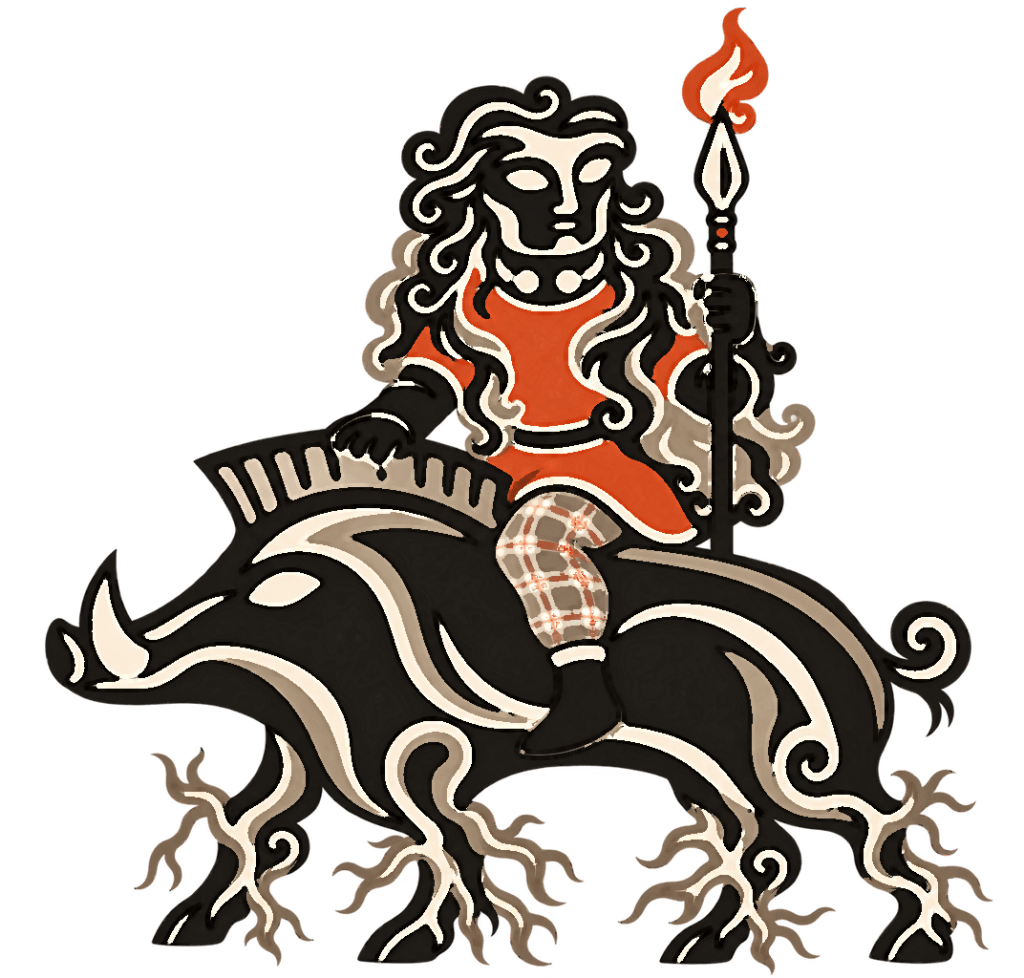
Moccus is named in a Roman-period dedication from Langres, where he was honored as Mercury Moccus. His name has traditionally been connected with pigs and boars, although that interpretation remains debated. Within Bessus Nouiogalation, we honor him as the Boar of the Living Earth: a protector whose strength finds expression in courage, nourishment, and care.
Historical evidence
His name
The ancient dedication preserves Mocco, the Latin grammatical form meaning “to Moccus.”
His name has traditionally been compared with Celtic words for pigs: Old Irish mucc, Welsh moch, and Breton moc’h. This comparison underlies the familiar description of Moccus as a pig or boar deity. The comparison does not, however, establish that his name referred specifically to a wild boar, rather than to pigs more generally.
In his study of Mercury Moccus, Paul Quentel reviews this animal interpretation alongside proposals connecting the name with a locality. The meaning has been debated for longer than some modern summaries suggest.
A recent linguistic qualification
Linguist David Stifter raises a further difficulty in a 2025 discussion of Celtic pig words.
The Irish and Brittonic forms do not fit together as straightforwardly as their resemblance might suggest. Their vowels require explanation, and different reconstructions affect whether the name Moccus can belong to the same word family. Stifter consequently treats the divine name as being of uncertain meaning, while allowing that a connection remains possible.
For this page, “boar-associated deity” describes the traditional interpretation, rather than giving a settled translation of his name. Our relationship with Moccus within BNG does not depend upon resolving that linguistic question.
The dedication from Langres
The securely named dedication discussed here comes from Langres, ancient Andemantunnum, in the territory of the Lingones. It is catalogued as CIL XIII 5676, also ILS 4603. These are two references to the same monument.
Its central wording addresses:
Deo Mercurio Mocco
“To the god Mercury Moccus.”
| Place | Catalogue references | What it preserves |
|---|---|---|
| Langres, Haute-Marne, France | CIL XIII 5676 / ILS 4603 | A dedication to Mercury Moccus, made in fulfillment of a vow by a man and his mother. |
Quentel reports its discovery in 1642. The inscription also honors the imperial household and describes the offering as made ex voto, in fulfillment of a vow.
It preserves an act of devotion, but does not explain what the worshippers requested or why they approached Moccus.
Mercury, hunting, and local identity
The connection with Mercury is explicit. Its significance is less certain: the combined name does not establish that Moccus shared every role attributed to Roman Mercury.
Quentel records several scholarly approaches. Paul-Marie Duval interpreted Mercury Moccus as a hunting deity, while Pierre Lambrechts emphasized his local character. Earlier explanations proposed an animal divinity subsequently represented through Mercury.
These are interpretations of limited evidence. They do not establish a single history in which an originally boar-shaped god necessarily became a human-shaped Mercury.
The figure from Euffigneix
The limestone sculpture commonly called the God of Euffigneix, now in the Musée d’Archéologie nationale, provides a useful comparison.
It shows a human figure wearing a torc, with a large boar carved across the front of the torso. The museum places it in the first century BCE, while acknowledging uncertainty concerning its dating and identity. The figure may represent a deity, an ancestor, or a hero.
No inscription identifies it as Moccus. Its value here lies in the striking relationship between the human figure and the boar, rather than in a securely recovered divine name.
Boars in the wider religious setting
The significance of boars in ancient Celtic societies deserves consideration beyond this one deity. Agnieszka Bartnik’s book Moccus. Dzik w wierzeniach starożytnych Celtów examines the boar in ancient Celtic beliefs and offers a substantial direction for further study. Its publication has been verified, but the full book was not consulted for this article.
Wider animal imagery can help us understand the setting in which a boar-associated deity might have been approached. It cannot establish that every boar image represented Moccus or that every practice involving pigs belonged to his worship.
What remains unknown
The surviving material does not preserve a detailed mythology, a festival calendar, or instructions for his rites.
Our historical starting point remains a named dedication to Mercury Moccus, a debated linguistic connection with pigs, and comparative imagery whose divine identities are uncertain. The fuller understanding below belongs to our living custom.
Moccus in Bessus Nouiogalation
The Boar of the Living Earth
Within our bessus, Moccus is a Dêuos of the Living Earth, closely connected with roots, soil, forests, and the lives sustained through them.
We perceive him through the boar’s strength and persistence. As a boar roots through the ground, uncovering what lies beneath, Moccus shows us to attend to the life and nourishment often hidden from view.
Strength that protects
Moccus is fierce and gentle, courageous and kind.
His strength finds expression in protecting, nurturing, and defending. We honor him as a protector of the herd, the household, and the wider community.
Through him, we understand courage as the willingness to care, including when that care requires patience, effort, or sacrifice.
Galâ and perseverance
Moccus carries Galâ, the inner fire of the Galatis.
We recognize this fire in the courage to endure, the determination to continue, and the strength to remain faithful to our responsibilities. His presence encourages us when the work is difficult and progress comes slowly.
Strength also carries obligations. What we are able to do should help sustain the lives entrusted to our care.
Resourcefulness and finding a way
Within our bessus, we also understand Moccus as a Dêuos of resourcefulness. The boar’s search for nourishment offers an image of persistence, attention, and the ability to find what lies beneath the surface.
Through Moccus, we learn to notice what is available, adapt when circumstances change, and find another way when a familiar path is closed. Resourcefulness may mean repairing something, learning a skill, asking for help, or bringing people together to meet a shared need.
His strength encourages us to use what we have thoughtfully. What can be repaired, shared, or put to another purpose? What knowledge might help us through a difficulty?
For us, resourcefulness carries the same responsibility as courage: finding ways to sustain ourselves while caring for the land and those around us.
Uncovering and remembering
His relationship with the ground also shapes how we approach memory and learning.
Within our gnosis, Moccus helps us uncover what has been forgotten, learn from what came before, and cultivate what will sustain those who follow. Patient study can become part of this devotion: examining evidence, reconsidering assumptions, and acknowledging uncertainty.
What we uncover should nourish the custom we pass on.
Moccus also encourages us to venture beyond what we already understand. We approach unfamiliar ground with courage, curiosity, and compassion, trusting that patient attention may reveal a way forward.
Forest, field, and community
We encounter Moccus in wild places and cultivated land.
His care brings our attention to the relationships through which food, shelter, and community become possible. Tending soil, protecting woodland, growing food, and sharing resources give practical expression to our relationship with him.
For us, the boar is a sacred image of courage, perseverance, and belonging. Through Moccus, these qualities become responsibilities we strive to live.
Honoring Moccus
- Offering water, grain, roots, or a portion of a shared meal.
- Placing a boar image upon the household shrine.
- Asking for courage when carrying a difficult responsibility.
- Tending soil, growing food, and caring for woodland.
- Helping a household through hardship.
- Sharing food and supporting those facing scarcity.
- Protecting others with patience and sound judgment.
- Studying the past carefully and sharing what you learn.
- Practicing perseverance without losing kindness.
These are suggestions within our contemporary custom, rather than offerings or activities documented for his ancient worship.
Through Moccus, we honor strength placed in the service of life.
Sources
- CIL XIII 5676 / ILS 4603 — the dedication to Mercury Moccus from Langres, discussed by Quentel below.
- Quentel, Paul. “Mercurius Moccus.” Revue internationale d’onomastique 29 (1977): 61–82. The opening discussion supplies the inscription and reviews earlier interpretations; the references to Duval and Lambrechts above were consulted through Quentel.
- Stifter, David. “The ogam formula word MUCOI.” OG(H)AM research project, 9 April 2025. Includes discussion of the Celtic pig words and the uncertain position of the name Moccus.
- Musée d’Archéologie nationale. “Statuette du dieu dit d’Euffigneix,” inventory MAN 78243 — description, dating, and uncertainty concerning the figure’s identity.
- CNRS, ARBRES. “Moc’h, pemoc’h” — reference for Breton vocabulary; not evidence establishing the meaning of Moccus.
Further reading
- Bartnik, Agnieszka. Moccus. Dzik w wierzeniach starożytnych Celtów [Moccus: The Boar in the Beliefs of the Ancient Celts]. Katowice: Wydawnictwo Uniwersytetu Śląskiego, 2012. Publication verified; the full book was not consulted for this article.

