
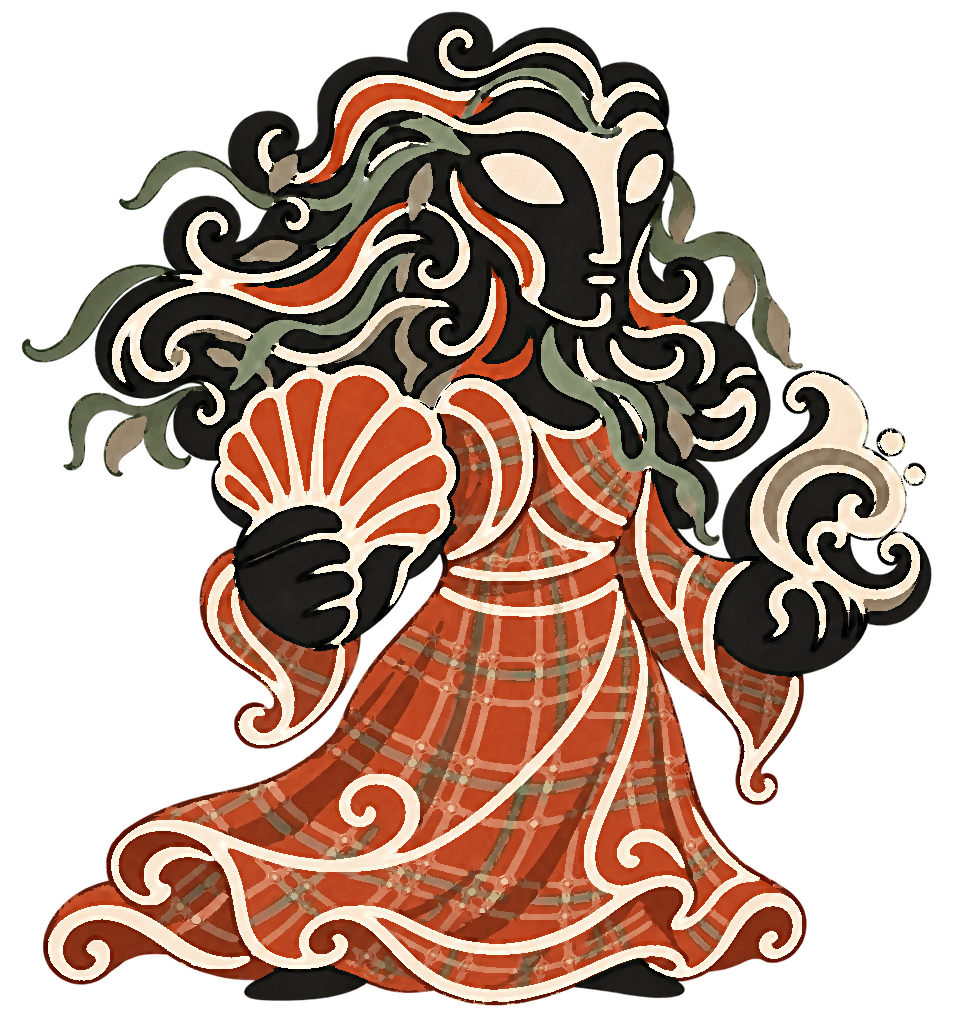
Morisenon, the Ancient Sea One, is the name we use within BNG for a Dêuos of the sea, revelation, and the vast unknown. We also approach it as a devotional epithet for the unnamed Dêuos of the oracle on Sena, described by the Roman geographer Pomponius Mela. The ancient account survives; the name Morisenon belongs to our living custom.
Historical evidence
The oracle of Sena
Writing around AD 43–44, the Roman geographer Pomponius Mela describes an island called Sena, opposite the coast of the Osismi, a people of western Armorica. Sena is generally identified with Île de Sein, off the coast of Brittany near the Pointe du Raz.
In De Chorographia 3.48, Mela says that Sena was known for an oracle of a Gaulish divine being. He describes nine priestesses, called Gallizenae, who were reportedly dedicated to lifelong virginity.
According to Mela, they were believed capable of stirring the sea and winds through chants, taking animal forms, healing illnesses considered incurable by others, and foretelling the future. He says their services were reserved for voyagers who had traveled specifically to consult them.
This is a striking account, but Mela presents these abilities as things reported or believed about the priestesses. He does not describe witnessing their rites.
What does this tell us about the deity?
Mela’s passage places a Gaulish oracle in a maritime setting. It associates its priestesses with prophecy, healing, transformation, and power over wind and water.
Those abilities are attributed to the priestesses. The passage does not explicitly assign them to the deity they served, and Mela does not give that deity a name. It also does not establish that the deity was understood as a god of the whole ocean.
For our purposes, the historical foundation is an account of a Gaulish divine oracle on Sena, served by priestesses reputed to possess extraordinary abilities. The island and its surrounding waters provide inspiration for our practice, while Morisenon’s name and role belong to our living understanding.
A possible dedication to Sena
A small altar found at Saint-Bertrand-de-Comminges, in southwestern France, preserves the incomplete inscription SENA[—]. It was found in 1938, reused in a medieval wall, and was published as no. 53 in Robert Sablayrolles and Jean-Luc Schenck’s 1988 catalogue of votive altars.
Linguist Patrizia de Bernardo Stempel proposes restoring the inscription as SENA[E] and interpreting it as a dedication to a Celtic goddess named Sena, which she understands as “the Old One.” She also proposes a connection between this goddess and the deity of the island oracle described by Mela.
The restoration remains an interpretation. The catalogue’s earlier editors suggested that the surviving letters might be part of a person’s name. The altar gives us a possibility to consider, but it does not establish the identity of the deity served at Sena’s oracle.
The name of Sena
The meaning of the island’s ancient name, Sena, has received different interpretations.
The Gaulish element *sĕno- means “old” or “ancient.” This element appears in a number of Gaulish personal and place names. An interpretation of Sena through this element is one possibility, though it does not settle the meaning of the island’s name.
Xavier Delamarre offers another explanation in his 2021 study, Magiciens et magiciennes gauloises, à propos des thèmes seno-, saino-. He distinguishes *sĕno-, “old,” from a proposed *sēno-, which he connects with a root meaning “to bind” and interprets in relation to magic.
Applying this proposal to the island’s name, Delamarre suggests that Sena may have been understood as an “island of the sorceresses.” He considers this alongside Mela’s account of the women who served the oracle.
The proposal is especially interesting because Mela attributes extraordinary abilities to the Gallizenae. It remains a proposed etymology, however. Neither interpretation allows us to recover with certainty what the island’s name meant to its ancient inhabitants.
The name Morisenon
Within BNG, Morisenon is our chosen devotional name, intended to mean “the Ancient Sea One.” It draws on mori-, “sea,” and seno-, “old” or “ancient.” Xavier Delamarre discusses seno- as an established element in Gaulish names.
Morisenon is a modern formation, not a name preserved in Mela’s account. The intended English meaning expresses how we use it within our bessus; the complete formation has not been established here as an ancient Gaulish word.
We honor Morisenon beyond the distinction of masculine and feminine and use they/them when speaking of them. This expresses our understanding of the deity rather than a grammatical meaning established by the ending -on.
Morisenon in Bessus Nouiogalation
The Ancient Sea One
Within our bessus, Morisenon—“the Ancient Sea One”—can be understood as a devotional epithet for the unnamed Dêuos of the Gallizenae, the priestesses of the oracle on Sena.
Our use of Morisenon and our understanding of their relationship with the sea arise from the maritime setting of Mela’s account and from our living practice.
We honor Morisenon as a Dêuos of the sea, the ocean, revelation, and the vast unknown. We encounter them in hidden depths, shifting waters, and the knowledge that remains beyond our present understanding.
Sena in our reflection
Within our bessus, the accounts and proposed meanings surrounding Sena invite us to contemplate the island as a place where memory, sacred knowledge, and relationships between human and divine beings meet.
The Gallizenae stand within this reflection as women associated with an oracle, the sea, and the seeking of knowledge. Their story gives us a way to consider how people approach the divine when they seek guidance through uncertainty.
This is a modern spiritual reflection inspired by the surviving account. It is not a translation of the island’s name or a claim that we know how its ancient inhabitants understood it.
Honoring the women of Sena
Our relationship with Morisenon also includes ancestor work. Through this practice, we honor the women of Sena and remember the priestesses whose story has reached us through Mela.
We approach them as ancestral figures whose lives and traditions are part of the past that informs our bessus. We do not need to claim a family line to them, or claim to know the details of their lives, to offer remembrance and respect.
Through Morisenon, we make space to remember the Gallizenae and reflect on the knowledge, devotion, and relationships that may be held within their story. An offering, a spoken remembrance, or a period of quiet attention can become part of this work.
This is our way of honoring the women of Sena within BNG. It is a present-day practice, rather than a rite preserved in Mela’s account.
The Wolf’s Howl
Morisenon’s revelations travel upon wind and waves. Within our gnosis, we speak of this voice as the Wolf’s Howl: a call carrying truths to those who approach with sincerity and purity of heart.
We understand revelation as something that asks for attention. Like a sound carried across water, it may be distant or difficult to recognize. We turn toward Morisenon with patience, listening for what may become clearer through reflection and experience.
The changing sea
Morisenon is also a shapeshifter. We understand their changing forms through the many conditions of the sea, quiet waters, powerful currents, and raging storms.
The transformations attributed to Sena’s priestesses inspire this aspect of our understanding. Our relationship with Morisenon as a shapeshifter belongs to our living tradition.
They command wind and waves and may offer protection to sailors who honor them. Yet their sea can also be destructive. Our gnosis recognizes both shelter and danger within their power, calling us to approach with respect.
At the threshold of worlds
Morisenon stands at the threshold of worlds. We understand them as a guide through transitions between ignorance and knowledge, the ordinary and the divine, and life and death.
Like a voyage across unfamiliar waters, approaching them asks us to accept that we cannot see the whole journey from its beginning. We seek their guidance with a willingness to listen and to be changed by what we learn.
Honoring Morisenon
Morisenon may be honored through offerings, contemplation, remembrance, and care for the sea and its living beings. A cup of water offered at the hearth can provide a starting place for someone who lives far from the coast.
- Offering a drink before a sea journey or in gratitude afterward.
- Spending time listening to waves or wind with deliberate attention.
- Seeking guidance through a divinatory practice you have developed.
- Recording dreams and reflecting on them over time.
- Remembering the women of Sena through an offering, spoken words, or quiet reflection.
- Caring for beaches, waterways, and marine life.
- Marking an important transition with an offering and a period of quiet reflection.
In honoring Morisenon, we bring the ancient account of Sena into conversation with the relationships and practices of our bessus. We also remember the women whose story continues to inspire our ancestor work.
Sources and further reading
- Pomponius Mela. De Chorographia 3.48. Latin text, Packard Humanities Institute. An English translation of the passage is also available through Gaulish Polytheism.
- Sablayrolles, Robert, and Jean-Luc Schenck (1988). Collections du Musée Archéologique Départemental de Saint-Bertrand-de-Comminges, 1: Les autels votifs. Toulouse, no. 53, p. 62. — The fragmentary altar discussed here is cited through de Bernardo Stempel’s article; the catalogue itself was not consulted for this page.
- de Bernardo Stempel, Patrizia (2007–2008). “The ‘Old’ Celtic Goddess Sena: A New Testimony from Aquitania.” Veleia 24–25: 1203–1206. — An interpretation of the fragmentary SENA[—] inscription and a proposed connection with the island oracle.
- Delamarre, Xavier (2021). “Magiciens et magiciennes gauloises, à propos des thèmes seno-, saino-.” Études celtiques 47: 35–46, especially p. 37. — Discussion of seno- and a proposed interpretation of Sena’s name in relation to magic.
- Bessus Nouiogalation. “The Gallizenae: Priestesses of the Isle of Sena.” — A fuller discussion of Mela’s account, interpretations of the island’s name, and our modern approach to the priestesses.

