
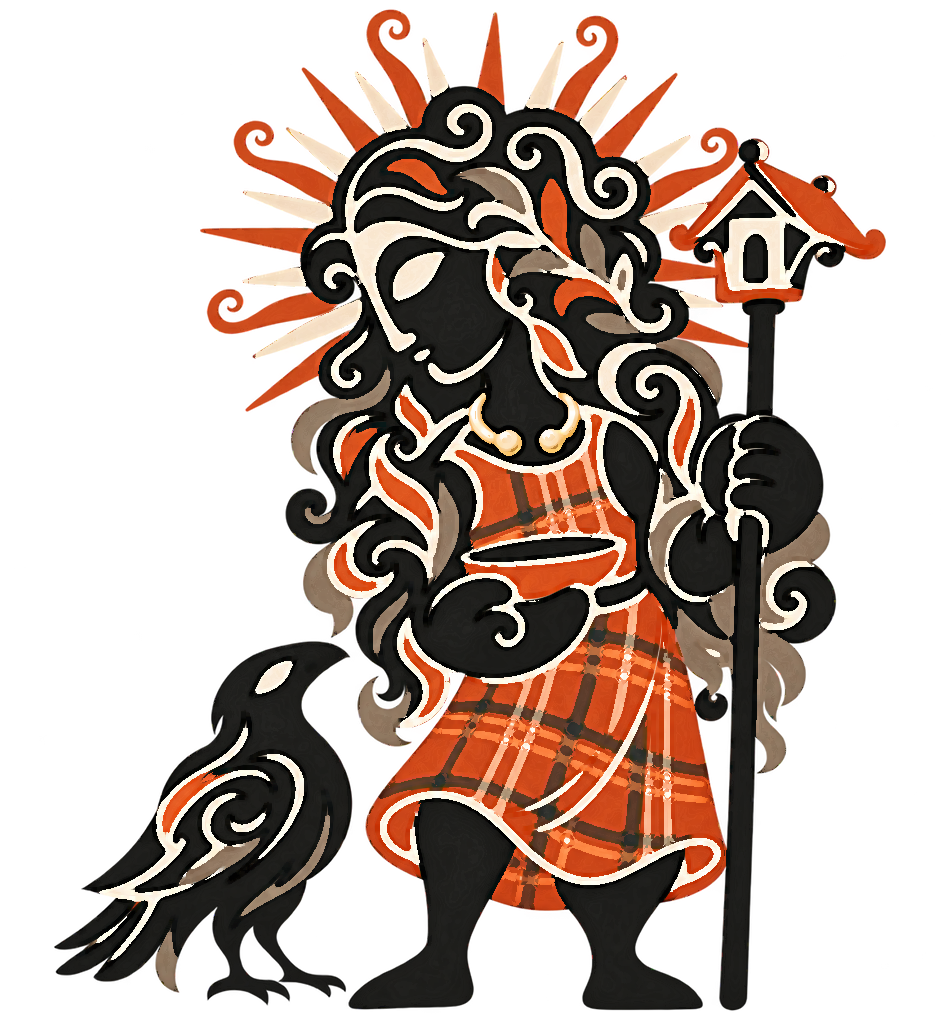
Nantosueltâ is named beside Sucellos on an altar from Sarrebourg, where she carries a small house-like object on a pole. Other images identified through comparison add to the evidence for her worship. Within Bessus Nouiogalation, we honor her as a Dêuâ of shelter, prosperity, and the emergence of life from darkness.
Historical evidence
Her name
The meaning of Nantosuelta remains uncertain, but several scholars connect the first part of her name with a Gaulish word for a valley or watercourse.
The University of Vienna’s Lexicon Leponticum, written by linguist Corinna Salomon, discusses the element nant- in Gaulish names and inscriptions. One piece of evidence is the Endlicher Glossary, which explains nanto with the Latin word valle, “valley.” The related Welsh word nant can mean a valley, watercourse, or stream.
That gives us a reasonable starting point for the first part of her name. The second part, -suelta, is more difficult, and scholars have proposed several ways of understanding it.
One familiar interpretation connects the name with a bend or winding course of a valley or stream. This is the background to translations such as “Winding Stream.” Linguist Pierre-Yves Lambert, however, questions whether this is the best explanation of the name’s formation.
Lambert proposes another possibility: that the name refers to the grass, pasture, or produce of a valley. In his discussion, he considers whether its elements could express the valley’s abundance or yield. This is a linguistic proposal rather than a meaning established by an ancient explanation of her name.
A further interpretation connects the second element with sunlight or warmth, producing translations such as “sunlit valley.” Noémie Beck discusses this approach in her study of Nantosuelta, referring to the work of Xavier Delamarre and Garrett Olmsted. This interpretation is included here through Beck’s discussion.
The connection with valley or watercourse is a useful starting point. The meaning of the complete name remains open.
Within BNG, we use Nantosueltâ.
The Sarrebourg dedication
The clearest named evidence comes from Sarrebourg, in present-day Moselle, France. An altar depicts Nantosuelta beside Sucellus, with an inscription naming both deities.
Catalogued as CIL XIII, 4542, the dedication records Bellausus, son of Massa, fulfilling a vow. It is usually presented in expanded form as:
Deo Sucello
Nantosuelt(a)e
Bellausus Mass(a)e filius
v(otum) s(olvit) l(ibens) m(erito)
In English:
“To the god Sucellus and to Nantosuelta, Bellausus, son of Massa, fulfilled his vow willingly and deservedly.”
Sucello and Nantosuelt(a)e are grammatical forms used to address the recipients of the dedication. The closing abbreviation, V.S.L.M., is a familiar Latin formula recording the fulfillment of a vow.
This monument matters because it connects the divine names with their images. We can identify this pair through the inscription rather than relying entirely on their appearance.
The discovery was reported to the Académie des Inscriptions et Belles-Lettres by Salomon Reinach in 1896. His account emphasizes the importance of the inscription for identifying a divine pair that had already been recognized in other images.
The altar was found near Sarrebourg’s Mithraic sanctuary. Proximity places the finds in the same general area, but it does not establish that Nantosuelta and Mithras shared a single cult.
A second altar from Sarrebourg
Another altar found at Sarrebourg shows a goddess with a similar house-like object. Its inscription records a vow by Marcus Tignuarius, but it does not name Nantosuelta.
The goddess has been identified as Nantosuelta through comparison with the named monument. This provides useful visual evidence, while remaining distinct from the dedication made by Bellausus.
Both monuments were found near the Mithraic sanctuary. Their location has encouraged discussion of possible connections, although the finds alone do not explain how the worshippers understood the relationship between the sites or deities.
Her appearance and symbols
On the named Sarrebourg altar, Nantosuelta wears a long garment and holds a small house-like structure on a pole. In her other hand she carries an offering dish above an altar. A large bird, usually identified as a raven, appears below the divine pair.
The offering dish places an act of devotion within the image itself. The carving does not tell us precisely what the dish contained.
The little structure has prompted several interpretations: a house, a small shrine, a funerary container, or a beehive. These readings have led scholars to discuss household protection, death, and nourishment, but the object’s precise meaning remains uncertain.
Scholar G. Baratta notes that the house-like object has often encouraged a domestic interpretation, while its possible identification as a funerary container or shrine has also led to associations with death. The beehive is another proposed reading.
The bird has likewise encouraged different interpretations. As a raven, it may invite reflection on death and the Otherworld, but the image itself does not explain what the bird meant to Bellausus or other ancient worshippers.
The relief from Speyer
A relief from Speyer, ancient Noviomagus, provides another comparison. It shows a standing goddess holding a staff topped by a small round house-like structure. A damaged bird appears near her feet, and a radiate head identified as Sol, the Sun, appears above the figure.
The relief is held by the Historisches Museum der Pfalz, which dates it to the third century CE. It was reused in Speyer Cathedral and rediscovered in 1947. The museum identifies the goddess as Nantosuelta.
The relief does not preserve her name. Its identification depends on comparison with attributes such as the house-like object and bird. The figure of Sol adds another feature to the image, but it does not establish that Nantosuelta was herself a sun goddess or prove a particular interpretation of her name.
The Strasbourg relief
A damaged third-century relief in the Strasbourg archaeological museum offers another comparison. An old photograph preserves its earlier appearance: beside the figure identified as Sucellus stood a goddess with a cornucopia and a rounded object held against her chest.
The museum identifies her as Nantosuelta. This identification rests on the imagery and her companion rather than a surviving inscription naming her. The female figure was lost when the monument was damaged in 1870.
This relief is useful for considering a divine pair and imagery of abundance, while keeping its identification separate from the named Sarrebourg altar.
Her relationship with Sucellos
The Sarrebourg dedication directly establishes that Nantosuelta and Sucellus were honored together. It does not tell us their genealogy or preserve a story explaining their relationship.
As Bernard Sergent notes, no ancient literary narrative survives about this pair. Their images and dedications give us a foundation for understanding their worship, while leaving much of their relationship unexplained.
Other monuments show Sucellus with female figures, but their identification needs to be considered individually. The presence of a goddess beside him does not by itself establish that she is Nantosuelta.
What the evidence leaves open
The named Sarrebourg altar gives us a goddess honored with Sucellus, carrying a house-like object and an offering dish, with a bird beneath the pair. Other reliefs offer possible comparisons and show how scholars have used imagery to identify her.
The objects invite discussion of household care, abundance, and death, but they do not preserve a complete account of her ancient roles. Our understanding of Nantosueltâ as a guide from Dubnos toward renewed life belongs to the BNG gnosis described below.
Nantosueltâ in Bessus Nouiogalation
Bringer of life from darkness
Within Bessus Nouiogalation, Nantosueltâ is the bringer of life from darkness, a Dêuâ of prosperity, shelter, and the soul’s passage through the cycles of existence.
We understand her as present in the movement from what is hidden toward the conditions in which life can flourish again. Her care reaches across times of loss, change, and emergence.
Nantosueltâ and Sucellos
We know Nantosueltâ as the companion of Sucellos. Their relationship holds an important place in our understanding of life, death, and renewal. Together, they teach us to recognize how these movements belong to one continuing cycle.
Nantosueltâ and Sucellos hold a place in our seasonal observances, including Cintusamos, when we honor the emergence of growth and the renewal of life.
From Dubnos toward the light
Nantosueltâ stands with her great house upon a pole as her ravens fly around the well of Dubnos. She takes our hand and guides us toward the light of Sonnos and the blooming valleys at our emergence.
This image belongs to our living gnosis. It expresses the guidance and shelter we find in her presence.
Shelter and prosperity
Her house also speaks to our household custom. We honor her through the work of making a home that sustains those who live within it: preparing food, tending our surroundings, caring for one another, and providing shelter through difficult times.
Her prosperity includes the means to live well, the nourishment that supports life, and the relationships through which care can be given and received.
Valleys, water, and wind
We also encounter Nantosueltâ through the natural world, in valleys, beside flowing water, and in the winds moving through the land.
Within our practice, these places invite attention to her presence and to the life she helps sustain. They also offer space to reflect on change, growth, and the relationships between shelter and the wider living world.
Honoring Nantosueltâ
Nantosueltâ may be honored at the household shrine with water, bread, or another offering suited to your circumstances. These are suggestions within our contemporary custom.
- Preparing a nourishing meal for yourself or others.
- Tending and caring for the home.
- Repairing something needed in the household.
- Helping someone find shelter or supporting them through a difficult transition.
- Placing a small house image upon the shrine as a reminder of her shelter and guidance.
- Using raven imagery to contemplate her place in BNG’s understanding of life, death, and renewal.
- Visiting a valley or waterway with attention and respect.
- Approaching her when seeking guidance through uncertainty or beginning again after loss.
- Honoring her alongside Sucellos during Cintusamos.
Take time to acknowledge what sustains you and what care you are able to offer in return.
Sources and further reading
- Heckenbenner, Dominique (1997). “Sarrebourg : Pons Saravis, un bourg sur la Sarre.” In Les agglomérations secondaires de la Lorraine romaine, pp. 271–284, especially p. 272 — archaeological context for Sarrebourg and CIL XIII, 4542.
- Reinach, Salomon (1896). “Deux autels gallo-romains découverts à Sarrebourg.” Comptes rendus des séances de l’Académie des Inscriptions et Belles-Lettres 40.1: 35–36.
- Baratta, G. (1995). “Nantosuelta.” Enciclopedia dell’Arte Antica — discussion of her imagery and its interpretations.
- Salomon, Corinna. “nant-.” Lexicon Leponticum, University of Vienna — linguistic evidence for the element associated with “valley” and related words.
- Lambert, Pierre-Yves (2013). “Le statut du théonyme gaulois.” In Théonymie celtique, cultes, interpretatio — discussion of the formation and possible meanings of Nantosuelta.
- Beck, Noémie (2009). Goddesses in Celtic Religion: Cult and Mythology. Consulted through the republished discussion of Nantosuelta — proposed etymologies and interpretations of her imagery.
- Sergent, Bernard (2012). “Sucellus et Viśvakarman.” Études celtiques 38: 175–195, especially p. 175 — the evidence for Sucellus and his divine companions.
- Musées de Strasbourg. “Stèle de Sucellus,” inventory MAS 20368. — the damaged relief and its identification.
- Historisches Museum der Pfalz, Speyer. Relief identified as Nantosuelta, inventory D_0001. — museum record for the Speyer relief.
- Ubi Erat Lupa. Nantosuelta relief from Speyer, no. 25707. — archaeological catalogue and photographs.

