
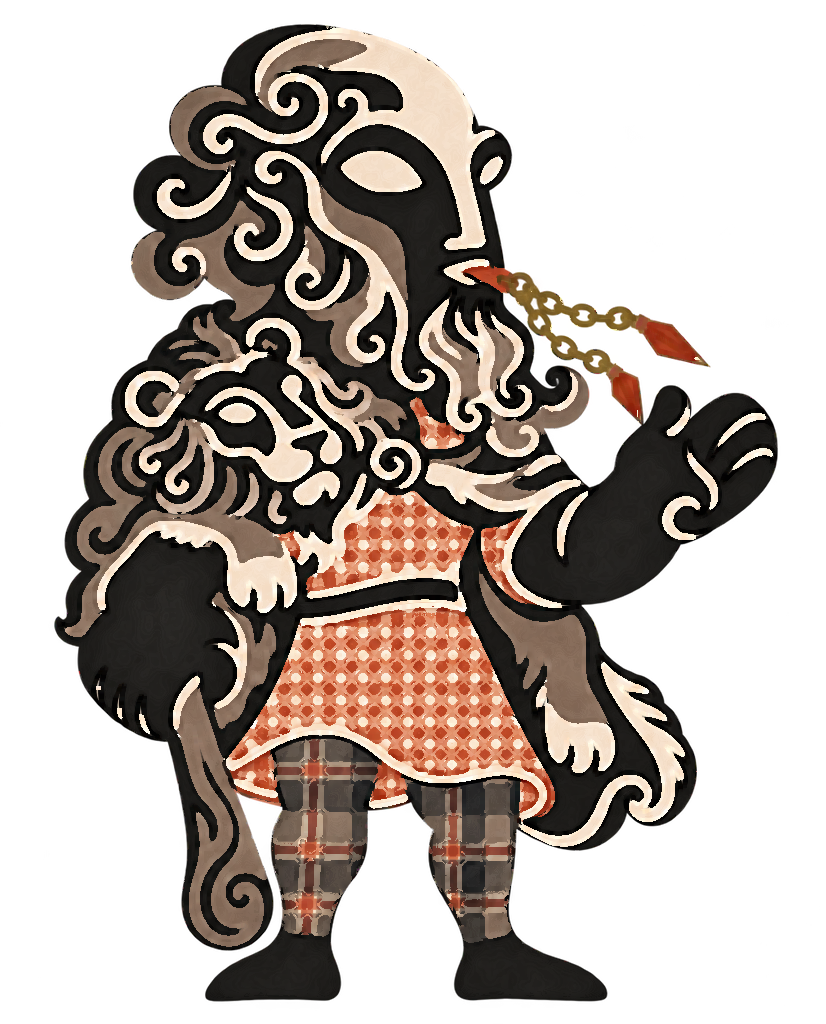
Ogmios is known through Lucian’s description of an elderly Gaulish Heracles whose speech draws willing followers, and through two curse tablets from Bregenz. Within Bessus Nouiogalation, we honor him as a Dêuos of eloquence, the Father of the Gauls, and a guiding presence in the formation of our bessus.
Historical evidence
His name
The meaning of Ogmios remains uncertain. Linguistic studies offer several possibilities, but no single English translation should be treated as established.
David Stifter discusses the reconstructed Celtic form ogmo-, connected with a track, line, or groove. In his treatment of the related Irish name Ogma, he explains an adjectival formation expressing association or belonging. This suggests something like “associated with a track, line, or groove,” while leaving its significance unresolved.
Stifter also mentions Katherine Forsyth’s suggestion that ogmo- may have referred to writing. The asterisk marks a reconstructed form, rather than a Gaulish word directly preserved with that meaning.
John Carey, in “Ogmios and the Eternal Word,” explores the possibility that ogmos designated a system of numerical notation that contributed to the development of ogham. This connects the name with marking and learned knowledge, but remains a scholarly hypothesis.
These discussions explain why paths, lines, grooves, and writing appear in interpretations of his name. They do not securely establish “Guide,” “Conductor,” or “God of Writing” as its literal meaning. Within BNG, we retain Ogmios without assigning it a settled translation.
Lucian’s description
In Heracles, the second-century writer Lucian of Samosata describes a picture of a deity whom the Celts call Ogmios.
He appears as an elderly man with a bald forehead, a few remaining gray hairs, wrinkled skin, and a deeply sun-darkened complexion. He carries the equipment of Heracles: a lion skin, club, bow, and quiver.
Fine chains connect his tongue to the ears of a crowd. The people follow willingly and joyfully, while Ogmios turns toward them smiling.
A Celtic speaker explains that this figure represents the strength of eloquence, which reaches maturity in old age. Even his arrows are understood as words capable of penetrating the soul.
This is a literary description of an image, rather than a surviving named sculpture or an account of a ceremony.
Lucian’s Heracles introduces a public address. Near its conclusion, he explains that remembering the elderly Ogmios encouraged him to speak again despite his age and time away from lecturing.
The episode serves a purpose within Lucian’s presentation of himself. Experience and command of language can give an older speaker considerable strength.
That context helps explain his interest in the deity’s age and eloquence. It also reminds us that the passage is carefully composed literature, rather than a straightforward record of Gaulish worship.
Ogmios, Ogma, and ogham
The Irish Ogma provides an important comparison.
Medieval Irish tradition presents him as a figure of extraordinary strength. The learned tract Lebor Ogaim also associates him with language and poetry and credits him with inventing ogham.
Stifter distinguishes this medieval explanation from a demonstrated historical origin of the script. It shows that Irish scholars connected Ogma with ogham; it does not establish that ancient Gaulish worshippers regarded Ogmios as its inventor.
Carey considers the combination of strength and eloquence a meaningful connection between Ogma and Lucian’s Ogmios. The relationship nevertheless remains a matter of linguistic and historical interpretation. Irish narratives can inform the discussion while remaining distinct from continental evidence.
Inscriptions from Bregenz
Two curse tablets from Brigantium, modern Bregenz in Austria, are generally recognized as the inscriptional attestations of Ogmios. Their difficult readings should remain visible.
| Find | Reference | What it preserves |
|---|---|---|
| Lead tablet discovered in 1865 | CIL III 11882 | A curse against people speaking against a woman named Brutta. A damaged passage is read as invoking O[g]mio. |
| Lead tablet discovered in 1930 | Egger 1943, especially p. 114 | A difficult text interpreted as invoking Ogmios against a woman identified by AMC, including preventing her marriage. |
The brackets in O[g]mio mark a restored letter. Andreas Hofeneder discusses the readings and reproduces the earlier scholarship.
Bernard Mees describes the 1930 discovery as a rolled lead sheet deposited in a grave. Its writing includes abbreviations, unusual spellings, and words written backward.
Dating requires care. Mees describes a first-century grave, while Hofeneder reports Egger’s proposed third-century dating of the text on linguistic grounds. These assessments should be distinguished rather than combined into one unquestioned date.
Other proposed inscriptions
A few further inscriptions have been connected with Ogmios, but they should not be counted as secure attestations.
| Place | Reference | Why the identification is uncertain |
|---|---|---|
| Reims, France | CIL XIII 11295 | The abbreviated opening OGL. AVG. SAC. was proposed to refer to Ogmios and the Augustan Lares. That expansion has generally been rejected. |
| Salins-les-Thermes, France | CIL XII 5710 | A lost inscription was reinterpreted as naming Hercules Ogmius. Hercules Graius is considered the more likely reading. |
| Piedimonte Matese, Italy | CIL IX 2322 | The dedication names Hercules Gallicus, rather than Ogmios. Their identification remains a proposal. |
These examples illustrate the difference between an inscription naming Ogmios and one brought into discussion through a disputed reading or comparison.
Speech and binding
The Bregenz texts place Ogmios in a harsher setting than Lucian’s willing procession.
Jean Loicq considers eloquence and magical binding together: speech can attract and persuade, but it can also constrain. His comparative interpretation explores knowledge and coercive power alongside Irish and other Indo-European material.
Those comparisons are attempts to interpret the evidence, rather than additional surviving Gaulish accounts. Binding remains a useful theme, provided we preserve the difference between willing persuasion in Lucian and the harmful restraint sought through the tablets.
Eloquence, praise, and blame
The place of poets in Gaulish society provides another context.
In Library of History 5.31.2, Diodorus Siculus describes bards singing with instruments resembling lyres. Their songs could praise people or speak against them. His account shows how poetic performance could affect reputation and communal standing.
Diodorus does not name Ogmios or identify him as their patron. Connecting these activities with the deity is an interpretive step.
Cunolugus Drugaisos develops that comparison in his discussion of Ogmios, considering praise poetry alongside harmful speech and curses. It offers a modern interpretation of the different effects eloquence can produce.
An Otherworld connection?
The tablets’ funerary contexts and interpreted association with underworld powers have encouraged scholars to consider an Otherworld dimension to Ogmios.
Jürgen Zeidler supports exploring this possibility, also noting Lucian’s comparison of the elderly figure with Charon and Iapetus.
Neither those comparisons nor a curse deposited in a grave directly establishes that Ogmios guided the souls of the dead. An underworld association is worth discussing; a securely documented role as a psychopomp would go beyond what these sources explicitly describe.
Heracles and ancestral traditions
Ancient writers preserve related accounts connecting Heracles with the ancestry of the Celts and Gauls.
In Parthenius’s Love Romances 30, Heracles travels through Celtic territory with the cattle of Geryon. There he encounters Celtine, daughter of Bretannus. Their union produces Celtus, from whom the Celts are said to receive their name.
In Diodorus Siculus’s Library of History 5.24.1–3, Heracles fathers Galates with the unnamed daughter of a ruler of Celtica. Galates grows into a man distinguished by courage and strength, succeeds to kingship, and extends his rule. His subjects receive the name Galatae after him.
These are ancestral narratives explaining the origins and names of peoples through founding figures. Parthenius names Celtine and Celtus; Diodorus leaves the mother unnamed and calls the son Galates.
Diodorus also connects Heracles with the founding of Alesia. This belongs to his literary account of the hero’s activities in Celtica; it is not archaeological evidence that Heracles established the settlement.
Neither writer names Ogmios. The connection comes through Lucian, who describes Ogmios as the deity the Celts identify with Heracles. Reading these sources together provides the foundation for BNG’s understanding of Ogmios as the father of Galatos.
Ogmios in Bessus Nouiogalation
The power of words
Within our bessus, Ogmios is a Dêuos of eloquence and the power of words.
Words can encourage, teach, reconcile, wound, or commit us to a course of action. Through Ogmios, we attend to what we say and to what our words ask of those who hear them.
We approach eloquence as a responsibility. Speaking well includes honesty, careful listening, and a willingness to correct ourselves.
The binding word
We understand Ogmios through speech that captures attention, moves the heart, and draws people toward a shared purpose.
His chains express the lasting relationships formed through words. A teaching can shape a life. A promise can establish an obligation. Words of encouragement can remain with someone through difficulty.
Within BNG, these bonds carry responsibilities. The influence of speech asks us to respect another person’s freedom and understanding.
Îanolabâ-right speech
Ogmios guides us in Îanolabâ, right speech.
This practice involves considering what we mean, whether it is true, how to express it clearly, and what effect it may have. It also requires knowing when to listen and when silence gives another person room to speak.
In our reflection on Lugus and Ogmios, we distinguish their emphases. Lugus helps us contemplate speech that clarifies and teaches; Ogmios, speech that inspires and moves. Both qualities can meet in prayer, teaching, and everyday conversation.
The responsibility of eloquence
Praise can recognize good deeds and encourage others. Criticism can confront harm and call for accountability. Both require judgment.
Honoring Ogmios includes checking what we repeat, correcting false statements, and taking care with another person’s reputation. Persuasiveness alone does not make a statement worthy of trust.
We seek agreement between our words and conduct. What we promise should be reflected in what we undertake.
Father of Galatos and Father of the Gauls
Within our bessus, Ogmios is the father of Galatos, our Toutatis. Through this relationship, we honor him as the Father of the Gauls.
Our understanding draws particularly upon Diodorus’s account of Heracles fathering Galates, read alongside Lucian’s identification of the Gaulish Heracles as Ogmios. Parthenius’s account of Heracles, Celtine, and Celtus provides a related ancestral tradition.
We use Galatos within our bessus, while retaining Galates when describing Diodorus’s account. His place as our Toutatis, the protector of our people, belongs to our living theology.
Ogmios’s fatherhood also has meaning in the life of our community. We understand him through the teaching, speech, and shared commitments that bring people into relationship. Through Galatos, we honor the protection and continuity of the people gathered through those relationships.
This ancestral understanding concerns our belonging within the bessus. It does not require Gaulish ancestry or make membership a claim of biological descent.
The ancient narratives provide a foundation for this genealogy. Their development into the relationship between Ogmios and Galatos, our Toutatis, is an expression of BNG gnosis rather than a genealogy explicitly preserved under those names in an ancient text.
The ancestral mystery of Dis Pater
Honoring Ogmios as Father of the Gauls does not settle the identity of the deity Caesar calls Dis Pater.
Within our bessus, we leave that ancestral mystery open. Ogmios’s fatherhood of Galatos gives him a particular ancestral relationship with our people, while the wider mystery of divine ancestry can be approached through more than one Dêuos.
Our genealogy of Ogmios and Galatos does not require us to identify Ogmios conclusively with Caesar’s Dis Pater.
His place in the founding of BNG
Ogmios holds a particular place in our account of BNG’s beginnings.
The founders brought different devotions and understandings to the formation of the bessus. In Branos’s account, Ogmios became a guiding presence despite having received little previous attention from them. His influence was experienced through clear speech, integrity, purposeful teaching, and virtuous conduct.
Our symbol expresses this relationship. His chains represent the bond joining our community to the responsibilities we have accepted.
Branos’s personal account also describes learning to approach writing as devotion: examining a thought, revising a sentence, and taking responsibility for what it communicates. This experience informs our understanding of language as a spiritual discipline.
Honoring Ogmios
- Offering a drink with spoken gratitude or praise.
- Composing poetry, stories, prayers, or teachings in his honor.
- Practicing clear, truthful, and considerate speech.
- Listening fully before responding.
- Keeping commitments made through your words.
- Checking information before repeating it.
- Correcting something you have said when it proves mistaken.
- Recognizing another person’s good deeds through thoughtful praise.
- Speaking against harm with care and sound judgment.
- Making room for others to speak within the community.
- Revising your writing so that it expresses your meaning faithfully.
- Honoring Ogmios alongside Galatos in recognition of their relationship within our bessus.
Before a difficult conversation, you might make an offering/prayer and consider what needs to be said, what you need to hear, and what responsibilities the conversation may bring.
Following your words with the conduct they promise is an ongoing act of devotion.
Sources
- Lucian. Heracles, §§1–7, translated by A. M. Harmon — Ogmios’s appearance, eloquence, and identification with Heracles.
- Stifter, David. “Ogam, Ogma and Ogmios.” OG(H)AM research project, 5 March 2025.
- Carey, John. “Ogmios and the Eternal Word.” Cosmos 30 (2014): 1–35. The linked journal volume begins with this article.
- Hofeneder, Andreas. “73. Lukianos aus Samosata.” In Die Religion der Kelten in den antiken literarischen Zeugnissen, vol. III (2011), particularly pp. 82–96.
- Egger, Rudolf. “Aus der Unterwelt der Festlandkelten.” Jahreshefte des Österreichischen Archäologischen Institutes in Wien 35 (1943): 99–137. Consulted through Hofeneder’s discussion and transcription.
- Mees, Bernard. “Fragments.” In Celtic Curses (2009), pp. 88–112. The accessible chapter preview was consulted for the 1930 discovery and difficulties of interpretation.
- Loicq, Jean. “Le dieu Ogmios et le nom de l’Ogam.” Études celtiques 29 (1992): 476–478.
- Diodorus Siculus. Library of History 5.24.1–3 and 5.31.2 — Heracles and Galates; separately, bards and their songs of praise and blame.
- Zeidler, Jürgen. “Ancient and Medieval Celtic Myths of Origin.” Conference paper, 2003.
- Parthenius. Love Romances (Erotica Pathemata) 30, “Celtine.” — Heracles, Celtine, and Celtus.
Modern interpretation and BNG writings
- Cunolugus Drugaisos. “Ogmios.” Druid Hearth.
- Branos. “Dis Pater in Bessus Nouiogalation — A Gaulish Interpretation of the ‘Rich Father.’” 21 June 2025.
- Branos. “Ogmios Walks Beside Me — How the God of Speech Shaped Bessus Nouiogalation.” 12 July 2025.
- Branos. “A Reflection on Lugus, Ogmios, and Îanolabâ in BNG.” 26 November 2025.

