
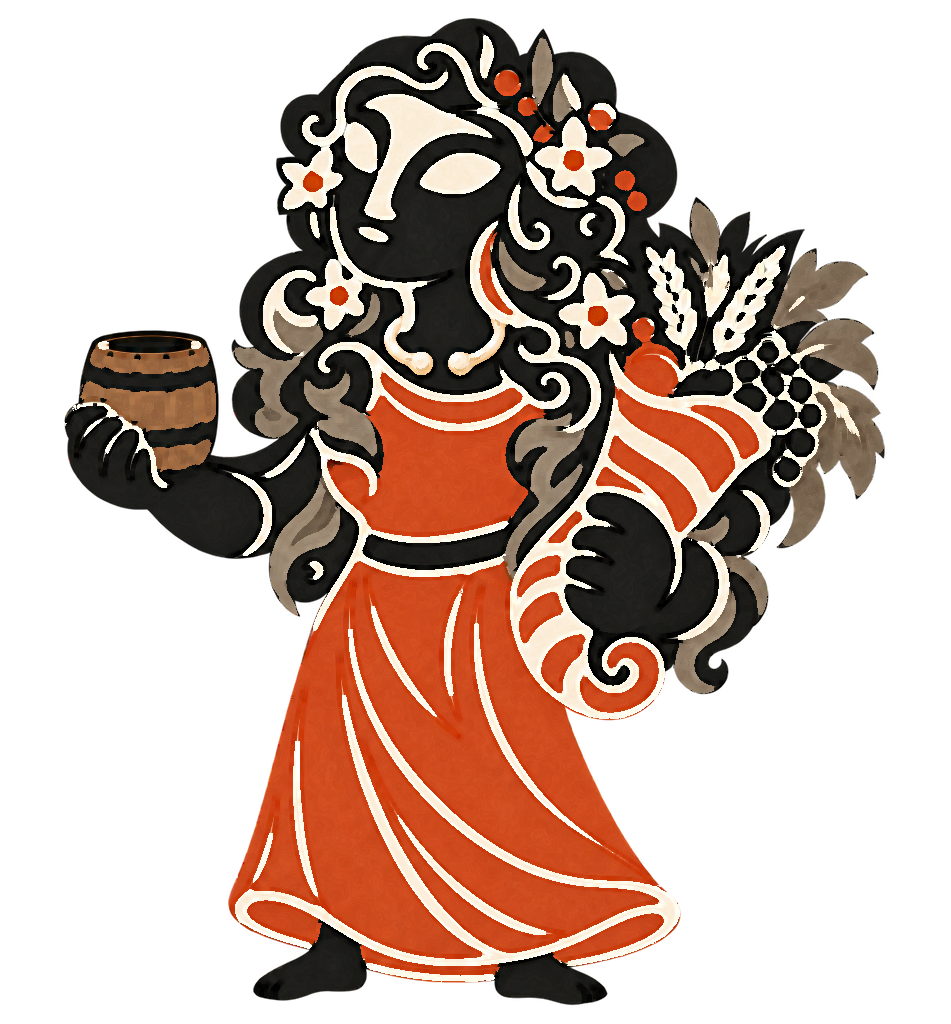
Rosmertâ is known from Gallo-Roman inscriptions and images, frequently alongside Mercury. Her name is commonly understood through provision and attentive care. Within Bessus Nouiogalation, we honor her as Queen of the Harvest, a giver of abundance, and a Dêuâ whose cup holds wisdom, prophecy, and the responsibilities of sovereignty.
Historical evidence
Her name
Rosmerta is a Gaulish name, written Rosmertâ within BNG. It is commonly explained as “the Great Provider” or “the Great Bestower.”
The name is usually analysed as an intensive element ro-, expressing greatness or abundance, joined to smert-, associated with provision and care. This interpretation concerns the act of attending to needs and supplying what sustains life.
The University of Graz’s FERCAN catalogue records several scholarly approaches. It cites Patrizia de Bernardo Stempel and Manfred Hainzmann, alongside Corinna Scheungraber, for an interpretation expressed as “great care.” It also records Xavier Delamarre’s interpretation emphasizing a provider who cares with foresight.
These explanations overlap, but their emphases differ. “Great Provider” stresses bestowal, while interpretations involving care and foresight emphasize the attention through which provision becomes possible.
“Great Foresight” should remain an interpretation rather than the only accepted translation. In particular, a linguistic connection with foresight does not by itself establish that ancient worshippers understood her as a goddess of prophecy.
The linguistic interpretations above are presented through FERCAN’s discussion of Rosmerta, rather than through direct consultation of every work it references.
Inscriptions and places of worship
Rosmerta’s dedications preserve named worshippers, fulfilled vows, and gifts supporting places of worship. The following examples are a selection rather than a complete inventory.
| Place | Reference | What it preserves |
|---|---|---|
| Eisenberg, Germany | CIL XIII 11696 | Marcus Adiutorius Memor dedicates a monument naming and depicting Mercury and Rosmerta. |
| Worms, Germany | CIL XIII 6222 | Lucius Servandius Quietus records setting up a dedication to Mercury and Rosmerta on his own property. |
| Alzey, Germany | CIL XIII 6263 | A fragmentary dedication restored as naming Mercury and Rosmerta. The donor’s name is incomplete. |
| Andernach, Germany | CIL XIII 7683 | Flavia Pri[…] records a fulfilled vow. The damaged text is reconstructed as an offering to Mercury and Rosmerta involving an altar and two divine images. |
| Ueß, Germany | AE 1935, 29 | Gaius Saturninius Viriaucus records giving a temple to Mercurius Excingiorigiatis and Rosmerta. |
| Escolives-Sainte-Camille, France | Bémont 1969, pp. 23–44 | An inscribed relief names Rosmerta directly, allowing secure identification of the depicted goddess. |
The fuller texts should be distinguished from restored passages. At Andernach, for example, an alternative reconstruction proposes a temple rather than an altar.
Worshippers and their offerings
The Worms dedication gives us a useful glimpse of the setting of an offering. Lucius Servandius Quietus states that he erected it in suo, understood as on his own property. This does not establish that it stood inside a household shrine, but it does place the monument within privately owned space.
At Andernach, Flavia Pri[…] appears as a female donor. Her inscription preserves evidence of a woman supporting the worship of the divine pair, although her complete name and the precise form of her gift remain uncertain.
At Ueß, Gaius Saturninius Viriaucus records giving a temple. The inscription does not tell us exactly what kind of building was meant.
These dedications show people committing resources and property to worship. They preserve the fulfilment of obligations, even where the circumstances behind the original vows are unknown.
Her appearance
At Eisenberg, Rosmerta stands beside Mercury wearing a dress and mantle. The current catalogue describes vessels in her hands, one probably an offering bowl. The accompanying inscription names both deities, making this a particularly useful example of her appearance.
Her identification elsewhere requires more care. Colette Bémont’s study of the Escolives relief explains why a named image matters: Mercury also appears with Maia and other goddesses. An unnamed female companion cannot automatically be identified as Rosmerta.
The wider imagery attributed to her includes cornucopiae, fruit, purses, offering bowls, and the caduceus. These support discussion of abundance and prosperity, but the identification of each monument must be considered separately.
Mercury and Lugus
Rosmerta’s association with Mercury is directly supported by inscriptions. Several dedications name them together, and the Eisenberg monument also depicts the pair.
Understanding that Mercury as Lugus requires a further interpretation. These inscriptions do not name Lugus. Nor does a shared dedication, by itself, establish marriage or preserve a story explaining the relationship.
Within BNG, the partnership between Rosmertâ and Lugus develops through our own mythology and gnosis. Its historical point of comparison is the worship of Mercury and Rosmerta together; its particular expression belongs to our living custom.
The lady with the mead cup
Michael J. Enright’s Lady with a Mead Cup: Ritual, Prophecy and Lordship in the European Warband from La Tène to the Viking Age offers a comparative framework for discussing cup-offering, communal bonds, and leadership.
Cunolugus Drugaisos applies this framework to Rosmerta, interpreting her as a divine bestower of the authority to lead. His discussion connects her provision with the ritual drink, prophecy, and relationships between a leader and followers.
Cunolugus also acknowledges an important limitation: this interpretation relies partly on comparative Germanic material and on reading Rosmerta’s vessel as a cup of sovereignty. An offering bowl is a widespread religious attribute.
A depicted vessel does not establish that it contained mead. The inscriptions discussed here also do not describe a Rosmerta-specific ceremony in which drinking conferred leadership.
The comparison is useful for interpretation, while the detailed meanings of her cup require care. Enright’s book is included below as further reading; its treatment here draws upon the publisher’s description and Cunolugus’s discussion rather than direct consultation of the complete book.
Provision, leadership, and communal bonds
The comparative cup-offering interpretation draws attention to the relationship between receiving gifts and accepting obligations.
In Cunolugus’s treatment, Rosmerta’s provision is considered alongside shared drinking, loyalty, generosity, and the authority to lead. This offers a way of exploring how abundance might relate to the maintenance of a group.
It remains a modern interpretation informed by comparative scholarship. We should distinguish it from the direct evidence of Rosmerta’s name, monuments, and dedications.
Rosmertâ in Bessus Nouiogalation
Queen of the Harvest
Within our bessus, Rosmertâ is the Queen of the Harvest, a nurturing mother of the land and its provision.
We honor her in the bounty that sustains us and in the care needed to bring it to fruition. Planting, tending, gathering, preserving, and sharing all belong to our relationship with her.
Her harvest reaches into the life of the household and community. The food upon the table carries the work of many beings and people. Honoring Rosmertâ includes recognizing those relationships and caring for their continuation.
Provision and foresight
We understand Rosmertâ’s provision through thoughtful preparation.
Abundance must be used with care. What is available today may need to sustain us through a difficult season, support someone whose needs are greater, or provide the conditions for future growth.
Her relationship with foresight reminds us to consider both immediate needs and what lies ahead. Gratitude for what we receive finds expression in how we preserve and share it.
The cup of wisdom and prophecy
Within our gnosis, Rosmertâ’s cup holds wisdom and prophecy.
We approach her for insight into the paths unfolding before us and for the understanding needed to meet them well. Her guidance concerns the use of our gifts as much as their reception.
The cup invites us to pause before acting: to consider what we have been given, what we can reasonably undertake, and whose lives our choices may affect.
These meanings belong to BNG’s living understanding of her.
Sovereignty and responsible leadership
We also understand Rosmertâ’s cup through sovereignty: the authority and responsibility to guide, sustain, and care for a community.
Receiving authority creates obligations. Leadership requires sound judgment, generosity, and attention to the people affected by decisions.
Within our bessus, prosperity carries a similar responsibility. Resources entrusted to us should help sustain the lives and relationships that depend upon them.
Rosmertâ’s cup expresses this connection between receiving and giving. Her abundance asks us to become capable caretakers of what comes into our hands.
Rosmertâ and Lugus
Rosmertâ and Lugus form a divine partnership within our gnosis.
Her provision and guidance meet his skill and protective action. Together, they help us contemplate the conditions through which a community can flourish: nourishment, understanding, capable leadership, and the safeguarding of what sustains life.
Our sacred stories include Lugus’s rescue of Rosmertâ with the spear forged by Gobanos. This narrative belongs to BNG mythology and informs our seasonal understanding of their relationship.
Cintumessus
We honor Rosmertâ and Lugus together during Cintumessus, our harvest festival.
We give thanks for the bounty received and consider how it will sustain us through the coming season. Feasting, offerings, and generosity can accompany reflection upon what needs to be gathered, preserved, and shared.
Through Rosmertâ, the harvest becomes an occasion to recognize our dependence upon the land and upon one another.
Honoring Rosmertâ
- Offering grain, bread, fruit, or a drink with gratitude.
- Giving thanks before a meal.
- Sharing food and resources with others.
- Supporting food banks, community kitchens, or mutual aid.
- Tending a garden and caring for the land that sustains it.
- Preserving food and reducing avoidable waste.
- Preparing thoughtfully for times of scarcity.
- Seeking guidance about the use of resources or authority.
- Practicing generosity and accountability in leadership.
- Honoring her alongside Lugus during Cintumessus.
Mead may be offered within present-day practice when appropriate, but it is not required. Water or another drink suited to your circumstances can also accompany devotion.
A simple practice is to offer a portion of food or a drink, acknowledge what has sustained you, and consider how you can extend that care to someone else.
Sources
- FERCAN, University of Graz. Rosmerta, CF-GeS-1050 — CIL XIII 6222, the Worms dedication by Lucius Servandius Quietus.
- FERCAN, University of Graz. Rosmerta, CF-GeS-1051 — CIL XIII 6263, the fragmentary Alzey dedication.
- FERCAN, University of Graz. Rosmerta, CF-GeS-1052 — CIL XIII 11696, the Eisenberg monument, imagery, and linguistic references.
- FERCAN, University of Graz. Rosmerta, CF-GeS-1053 — CIL XIII 7683, the Andernach dedication by Flavia Pri[…].
- FERCAN, University of Graz. Mercurius Excingiorigiatis and Rosmerta, CF-GeS-1054 — AE 1935, 29, the temple dedication preserved at Ueß.
- Bémont, Colette. “À propos d’un nouveau monument de Rosmerta.” Gallia 27.1 (1969): 23–44.
Further academic reading
- Enright, Michael J. Lady with a Mead Cup: Ritual, Prophecy and Lordship in the European Warband from La Tène to the Viking Age. Four Courts Press, 1996; paperback edition 2013. Referenced here through the publisher’s description and Cunolugus’s discussion.
- Scheungraber, Corinna. Altgermanische und altkeltische Theonyme: Die epigraphische Evidenz aus der Kontaktzone. Ein Handbuch zu ihrer Etymologie. Innsbrucker Beiträge zur Sprachwissenschaft 163. Innsbruck, 2020, especially pp. 456–459. Consulted through FERCAN’s references.
Modern interpretations and further discussion
- Cunolugus Drugaisos. “Rosmerta.” Druid Hearth.
- Cunolugus Drugaisos. “Epona, Rosmerta, and Ulatis.” 5 March 2023.
- Cunolugus Drugaisos. “The Gaulish Warband.” 19 September 2022.

