
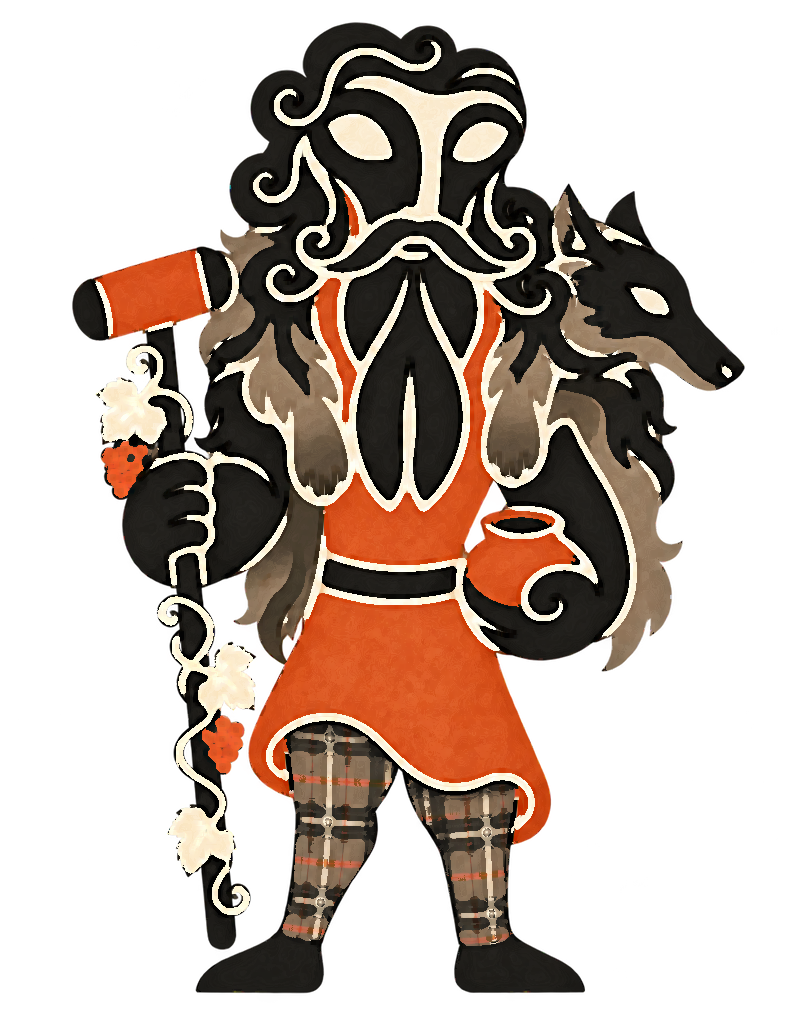
Sucellos is best known as the Gaulish Dêuos who carries a long-handled mallet and a small pot. His images sometimes include a dog, barrels, or an animal pelt. Within Bessus Nouiogalation, we honor him as a generous father, a presence in the depths of the earth, and a teacher of cultivation, transformation, and boundaries. Nantosueltâ is his companion, and their relationship holds a central place in our understanding of him.
Historical evidence
His name
Within BNG, we use Sucellos. Museum collections and archaeological studies commonly use the Latinized form Sucellus. Dedications preserve forms such as Sucello and Sucelo, meaning “to Sucellos” in their inscriptional setting.
The familiar interpretation is “the Good Striker.” This explanation separates the name into su-, “good” or “well,” and an element connected with striking. It suits his mallet, although agreement between a proposed translation and an image does not, by itself, prove the etymology.
Other explanations place more emphasis on the implement. The University of Graz’s FERCAN catalogue records an interpretation meaning “he who has a good hammer,” referring to Corinna Scheungraber’s linguistic discussion. This understands the name through possession of the hammer rather than simply the act of striking.
Kim McCone proposes a different explanation. He derives Sucellus from a reconstructed su-kel-no-s, which he translates as “well hidden” or “good hider.” The second element belongs to a root meaning “hide” or “conceal.” McCone discusses this possibility in connection with an underworld interpretation of the deity and the proposed relationship with Dis Pater. His 2013 article summarizes an argument developed in his earlier work.
These proposals offer different ways of understanding the name. “The Good Striker” remains a familiar rendering, while “the Well-Hidden One” has a genuine scholarly basis in McCone’s interpretation. Neither should be presented as an uncontested translation.
Inscriptions and places of worship
Sucellos’s name survives on stone monuments, pottery, and personal objects. These finds place his worship across parts of Gaul and neighboring provinces, with a named dedication also reaching Britain.
Our collection brings together eleven inscription entries associated with him. This is a collected selection, rather than a complete count of all known evidence. Some readings and identifications require qualification.
| Place | Evidence | Reference |
|---|---|---|
| Mainz, Germany | Dedication to Jupiter Sucaelus and the Genius of the place. The relationship between Sucaelus and Sucellos remains a question of interpretation. | CIL XIII 6730 |
| Worms, Germany | Altar associating Sucellos with Silvanus. | CIL XIII 6224 |
| Vichy, France | Inscribed ceramic fragments associated with his worship. | ILTG 497 |
| Ancey–Mâlain, France | Altar dedicated to Sucellos by Resus, son of Torogillus. | AE 1990, 768 |
| York, Britain | Silver ring inscribed Deo Sucelo. | RIB 2422.21 |
| Augst, Switzerland | Dedication discussed in scholarship in connection with Sucellos and Silvanus; its abbreviated wording requires interpretation. | AE 1925, 5 |
| Sarrebourg, France | Altar naming Sucellos and Nantosuelta together. | CIL XIII 4542 |
| Metz, France | Inscribed bronze ring. | Finke 87 |
| Vienne, France | Altar dedicated by Gellia Iucunda. | CIL XII 1836 |
| Yverdon, Switzerland | Recorded dedication on a stone monument now lost. | CIL XIII 5057 |
| Lyon, France | Fragmentary inscription associated with Sucellos. | AE 1982, 712 |
The Vienne entry refers to Vienne in southeastern France, rather than Vienna in Austria.
These inscriptions preserve different expressions of devotion. Some record the fulfillment of a vow; others place his name on an object that could be worn or used. They also show why a list of inscriptions needs more than a total: a complete divine name, a damaged reading, and a proposed identification do not carry equal weight.
Sucellos and Nantosuelta at Sarrebourg
The altar from Sarrebourg, discovered in 1895 and reported by Salomon Reinach in 1896, is particularly important because it joins the divine names with their images.
Its dedication names Sucellos and Nantosuelta and records the fulfillment of a vow by Bellausus, son of Massa. The correct reference is CIL XIII 4542.
Sucellos appears with his mallet and vessel. Nantosuelta carries her distinctive house-like structure on a pole. A bird, usually identified as a raven, appears below them.
The inscription establishes that they were honored together. It does not preserve a story explaining their relationship or identify them explicitly as husband and wife. Nevertheless, it gives their association a firm historical foundation.
The sanctuary at Ancey–Mâlain
The dedication from Ancey–Mâlain, in the territory of the ancient Lingones, also belongs to an archaeological setting.
The sanctuary report describes an altar, recovered in fragments, naming Sucellos and Resus, son of Torogillus. Its wording records the fulfillment of a vow and refers to an area, an enclosed space or precinct. Calling it a statue base obscures the identification made in that report.
Excavations also recovered fragments interpreted as belonging to a large cult image, including a substantial carved eye and a vessel. These remains help place the inscription within a sanctuary where a mallet-bearing deity was represented.
Louis Roussel suggested that the sanctuary’s position could be understood in relation to the town’s boundaries and another sanctuary associated with Mars Cicolluis. This is an archaeological interpretation of the arrangement of sacred places, rather than an inscription calling Sucellos a god of boundaries.
A dedication worn on the hand
The York ring offers a more personal object.
This silver octagonal ring bears the inscription:
Deo Sucelo
“To the god Sucelus.”
It was found in the city moat at St Maurice’s Road in 1875 and is now in the Yorkshire Museum. The inscription catalogue does not assign it a precise ancient date.
The ring is the named British dedication recorded by Roman Inscriptions of Britain. It shows that honoring Sucellos could involve a portable object carried upon the body, alongside the larger monuments known elsewhere.
His appearance
Sucellos commonly appears as a mature, bearded man, often wearing a belted tunic or coat and trousers. His most recognizable attributes are the long-handled mallet and a small vessel, conventionally called an olla.
A second-century bronze figure from Le Pouzin, now at Lugdunum, shows this combination. His raised left hand held the mallet shaft, while his right hand presents the vessel. The figure has no inscription, so its identification rests on its appearance and comparison with other representations.
Barrels and other containers appear in the wider imagery associated with him. These have encouraged interpretations involving storage, wine, nourishment, craftsmanship, and agricultural abundance. The imagery supports exploring those relationships without establishing one exclusive occupation or function.
Wine and the grape harvest
Sucellos has a strong place in scholarly discussions of wine, grape-growing, and the work of producing and storing the harvest.
Miranda Green connects him with fertility, particularly the grape harvest, drawing attention to the pots, barrels, and other vessels in his imagery. She discusses this symbolism especially in the wine-growing regions of Burgundy and the lower Rhône Valley. These objects express the abundance of the harvest and the means through which it was preserved and enjoyed.
Manfred Kotterba develops this interpretation further. Examining the deity’s attributes and the distribution of his monuments, he argues that Sucellos was particularly associated with winegrowers and wine merchants. His interpretation places the god within the practical work of cultivation, wine production, storage, and transport
Wine belongs in the historical discussion of Sucellos. His imagery supports a relationship with the cultivated vine and its gifts, while leaving room for the other responsibilities and associations explored by scholars.
The wolf pelt
A bronze figure from Vienne, now in the Walters Art Museum, offers an unusual representation. The museum identifies its garment as a wolf skin and dates the figure to the first–second century CE.
It holds an olla. Behind it stands a large mallet with five smaller mallets branching from it, giving the implement an especially prominent place in the composition.
The identification of animal-pelt figures has received scholarly debate. Manfred Kotterba argued for assigning some examples to Hercules Bibax, the drinking Hercules. The Artefacts catalogue challenges that separation, emphasizing similarities in posture and attributes within the group and noting that some pelts appear canine rather than leonine.
The wolf pelt belongs in the historical discussion, while the identification of particular figures remains open to examination. It should not be treated as an attribute present in every image of Sucellos.
The dog
Dogs accompany a number of reliefs associated with Sucellos. Kotterba’s study discusses roughly two dozen examples, showing that this is a recurring feature of the imagery.
In many representations, the dog stands quietly beside the deity. Its presence has encouraged interpretations involving companionship, protection, hunting, and the underworld. The image alone does not tell us which meaning its makers intended.
Some scholarship also discusses three-headed dogs in connection with mallet-bearing figures. McCone mentions such a monument, and Poitrenaud supplies references to further examples. These comparisons contribute to the underworld interpretation, but they should not make every dog beside Sucellos into Cerberus.
Within BNG, the hound’s role at the gates of Antumnos develops from our own understanding of this imagery.
Silvanus, woodland work, and cultivation
The Worms altar, CIL XIII 6224, associates Sucellos with Silvanus. Trees appear on its sides. The archaeological catalogue dates it approximately to 170–200 CE and places it in the Landesmuseum Mainz.
This association is relevant to discussions of woodland, cultivated land, and the work through which people maintained their surroundings. It also shows worshippers bringing a Gaulish deity into relationship with a Roman one.
Such evidence does not require us to understand Sucellos and Silvanus as identical in every place. Local associations could express particular relationships without providing a single explanation for all his worship.
Nor should his clothing and tools lead us to assume that his worship belonged exclusively to poor or rural people. Poitrenaud points out that finely made bronze figures themselves required resources. The social range of his worshippers cannot be reconstructed from a rustic appearance alone.
The mallet as productive power
The mallet has prompted interpretations ranging from woodworking and cooperage to protection, death, and divine authority.
Miranda Green suggests that it could represent the striking of the earth to awaken it after winter. Read alongside Sucellos’s associations with fertility and the grape harvest, its blows become an image of renewed growth. She also proposes that the mallet could express protection against disease and famine. These are interpretations of its symbolism rather than actions described in a surviving ancient story.
Gérard Poitrenaud likewise explores the mallet as an instrument of productive and life-sustaining power. Considered beside the vessel and barrels, it suggests work through which materials are transformed and abundance becomes available.
These interpretations help explain how a striking implement could express nourishment, protection, and renewal alongside strength.
Dis Pater and the ancestral depths
In Gallic War 6.18, Caesar says that the Gauls claimed descent from Dis Pater, a teaching he attributes to the druids. He supplies a Roman divine name and does not name Sucellos.
Scholars have nevertheless proposed Sucellos as a possible identification. His mature appearance, animal companions, mallet, and possible underworld associations have contributed to that discussion. McCone’s “well hidden” etymology offers another argument in its favor.
Stéphanie Boucher’s “Sucellus = Dispater?” examines the problem within the wider debate over his functions. The identification remains a proposal rather than something established by a dedication naming both figures.
The evidence allows us to explore an ancestral or underworld dimension. It leaves the precise identity behind Caesar’s Dis Pater unresolved.
Comparative approaches
Comparisons with other Celtic traditions have also shaped scholarship.
F. M. Heichelheim and J. E. Housman compared Sucellos’s mallet and vessel with the Dagda’s club and cauldron, exploring themes of nourishment, fertility, and power over life and death.
These are suggestive comparisons between different bodies of evidence. The medieval Irish stories remain Irish sources; they do not supply a surviving mythology for Sucellos or establish that the two deities were understood as one.
A recently reported painted image
A report published in 2026 describes a painted figure provisionally identified as Sucellos from the sanctuary at Mancey, in Saône-et-Loire, following excavations in 2025.
This is worth following because painting could add another form of representation to the discussion. For now, the identification should remain provisional: the news report does not provide an inscription naming the figure, and the original archaeological report requires consultation before drawing further conclusions.
Sucellos in Bessus Nouiogalation
The generous father
We honor Sucellos as a generous father and a friend of ordinary people. He teaches the cultivation of the land and the work through which its gifts become nourishment.
We encounter him in tended soil, stored food, a repaired tool, and the labor that keeps a household going. His generosity includes the conditions that make continued life possible.
His vessel holds abundance. His mallet expresses the effort and skill through which that abundance becomes available.
Receiving these gifts brings responsibilities. We care for what sustains us, acknowledge the labor of others, and share what we can.
The Well-Hidden One
Within our bessus, the Well-Hidden One expresses Sucellos’s presence in Dubnos, the depths beneath the visible world.
McCone’s proposed etymology gives us a scholarly point of connection. Our understanding of what that hiddenness means develops through our cosmology and relationship with Sucellos.
We contemplate him in the earth’s concealed activity: roots taking hold, seeds awaiting their season, and the gradual transformations through which life is sustained.
His hiddenness asks for patience. Much of what supports us takes place beyond our immediate sight.
The ancestral father
We also approach Sucellos as an ancestral presence, one who has entered the depths before us.
His fatherhood reaches into the relationships between the living, the dead, and the earth that receives and nourishes them. Through him, we contemplate what has been handed down and what our own lives will leave behind.
This understanding informs our reflection on Dis Pater, without requiring us to settle the identity behind Caesar’s account. Within BNG, that ancestral mystery remains open.
Sucellos’s place here has its own character. We continue to honor Ogmios as the father of Galatos, while approaching Sucellos through the earth’s depths, nourishment, and ancestral return.
The mallet and the earth’s gifts
In our gnosis, the resounding blows of Sucellos’s mallet stir and shape the earth, bringing forth its gifts.
His strength participates in cultivation and renewal. We understand him as helping prepare the conditions through which life emerges into the light of Sonnos.
The mallet also reminds us that creating something worthwhile requires attention. Soil must be tended, tools maintained, and useful work returned to over time.
Through Sucellos, strength becomes a responsibility to sustain what depends upon it.
Fermentation and transformation
We also honor Sucellos through fermentation, brewing, and the patient transformation of the earth’s gifts.
A vessel may appear still while great changes take place within it. Grain and fruit become something different through time, care, and the activity of other living beings.
Within our bessus, this offers a way of contemplating his hidden work. We participate by preparing the conditions, giving attention, and allowing a process to unfold.
The same understanding can inform our inward lives. Growth sometimes requires sustained care before its effects become visible.
Boundaries and cultivation
Sucellos shows us to establish and maintain boundaries within which life can flourish.
A garden boundary protects growing things. A home needs care and security. A community needs expectations that allow people to gather with trust.
Holding a boundary requires judgment. We must understand what it protects, whose needs it affects, and what responsibilities come with maintaining it.
We turn to Sucellos for steadiness: the strength to protect, the patience to repair, and the fairness to reconsider a boundary when it causes harm.
His wolf pelt and faithful hound
Our devotional imagery includes Sucellos wearing his wolf pelt, accompanied by his faithful hound.
Within BNG gnosis, the hound guards the gates of Antumnos. Its watchfulness expresses protection at the boundary between the familiar world and the mysteries beyond it.
The surviving animal imagery informs this understanding. The hound’s particular duty at those gates belongs to our living custom.
Through these companions, we contemplate loyalty, vigilance, and the care required when approaching what lies beyond our knowledge.
Nantosueltâ, his companion
Nantosueltâ is the companion of Sucellos. Their relationship is central to how we understand and honor them.
Sucellos holds a presence within the earth’s depths. Nantosueltâ moves through the waters and guides the soul through the movements of life, death, and return.
Together, they participate in the relationships that nourish life and receive it at its ending. We approach them through shelter, cultivation, ancestral remembrance, and the renewal that follows a time of darkness.
Their companionship gives us a way to contemplate how earthly abundance and the hidden depths belong within the continuing life of the world.
We give them particular attention during Cintusamos, honoring the emergence of growth and the conditions that sustain it.
Honoring Sucellos
- Offering water, bread, grain, wine, or another drink suited to your circumstances.
- Tending soil, growing food, and caring for the land that sustains you.
- Sharing food and supporting people whose needs are going unmet.
- Maintaining tools, repairing useful objects, and caring for the home.
- Brewing or fermenting with patience and deliberate attention.
- Establishing fair boundaries and taking responsibility for what they protect.
- Remembering ancestors and acknowledging what their lives have passed down.
- Honoring him alongside Nantosueltâ, especially during Cintusamos.
- Reflecting on the hidden work through which growth and renewal become possible.
Through Sucellos, we honor generosity expressed in labor, strength exercised with judgment, and the care that allows others to flourish.
Sources
Inscriptions, archaeology, and museum collections
- FERCAN, University of Graz. Sucellus, CF-GeS-1031 — the Worms dedication, distribution, and linguistic bibliography. Scheungraber’s interpretation of the name is cited here through the catalogue.
- Roman Inscriptions of Britain. RIB 2422.21 — silver ring from York.
- Ubi Erat Lupa. Worms altar, no. 27073 and Ancey–Mâlain dedication, no. 25427.
- Reinach, Salomon. “Deux autels gallo-romains découverts à Sarrebourg.” Comptes rendus des séances de l’Académie des Inscriptions et Belles-Lettres 40.1 (1896): 35–36.
- Groupe Archéologique du Mesmontois; text prepared by L. Roussel. “Mâlain : La ville gallo-romaine de Mediolanum.” Mémoires de la Commission des Antiquités de la Côte-d’Or 36 (1990–1992): 78–91, especially pp. 87–91.
- Gilles, A., M. Feugère, and A. Bonnefoy. “Statuette : Sucellus-Silvain.” Artefacts : Encyclopédie des petits objets archéologiques, STE-4273, version dated 9 January 2020.
- Walters Art Museum. Sucellus, inventory 54.998.
- Lugdunum Museum. Figure from Le Pouzin, inventory br.058.
Ancient testimony and scholarly studies
- Caesar, Julius. Gallic War 6.18 — the statement concerning Gaulish descent from Dis Pater; the passage does not name Sucellos.
- Boucher, Stéphanie. “Sucellus = Dispater? Remarques sur la typologie et les fonctions du dieu gaulois.” Revue belge de philologie et d’histoire 54.1 (1976): 66–77.
- Kotterba, Manfred. Sucellus und Nantosuelta: Untersuchungen zu einem gallo-römischen Götterpaar in den Nordprovinzen des Imperium Romanum. Doctoral dissertation, Albert-Ludwigs-Universität Freiburg, 2000. Particularly relevant are the discussions of dogs, animal pelts, the name, and the monument catalogue.
- McCone, Kim. “The ‘Celts’: Questions of Nomenclature and Identity.” Cahiers de l’ILSL 38 (2013): 21–37, especially p. 24. The discussion of Sucellus summarizes his earlier argument in The Celtic Question: Modern Constructs and Ancient Realities (2008), pp. 38–39; that earlier work was not consulted directly.
- Heichelheim, F. M., and J. E. Housman. “Sucellus and Nantosuelta in Mediaeval Celtic Mythology.” L’Antiquité classique 17.1 (1948): 305–316 — used for its comparative discussion, particularly the Dagda.
- Poitrenaud, Gérard. Sucellos ou le frappeur fécondant. 2015. Interpretive essay adapted from Cycle et Métamorphoses du dieu cerf (Toulouse: Lucterios, 2014), pp. 198–204.
- Sergent, Bernard. “Sucellus et Viśvakarman.” Études celtiques 38 (2012): 175–195. The opening discussion was consulted for the divine associations and absence of surviving narrative evidence.
- Green, Miranda J.Dictionary of Celtic Myth and Legend. London: Thames & Hudson, 1992; paperback edition 1997. See “Sucellus,” p. 200, and the entries “Barrel” and “Wine.”
- Kotterba, Manfred.Sucellus und Nantosuelta: Untersuchungen zu einem gallo-römischen Götterpaar in den Nordprovinzen des Imperium Romanum. Doctoral dissertation, Albert-Ludwigs-Universität Freiburg, 2000. See the discussions of wine-growing, the deity’s attributes, and the concluding summary. Publication record and abstract.
Recent discovery report
- Rafiel, Zack. “Archaeologists Discover Rare Painted Image of Celtic God Sucellus in Ancient French Sanctuary.” Ancientist, 16 March 2026. Secondary report concerning Mancey; the proposed identification remains provisional.
BNG and modern devotional writing
These explain the development of our living understanding and are distinct from the ancient evidence.
- Bessus Nouiogalation. “Dis Pater in Bessus Nouiogalation.”
- The Witch’s and Druid’s Den. “Father Sucellos.”
- The Witch’s and Druid’s Den. “Inscriptions to Sucellos and Nantosuelta” — a collected reference list; the qualifications and corrected locations given above should accompany its use.

