
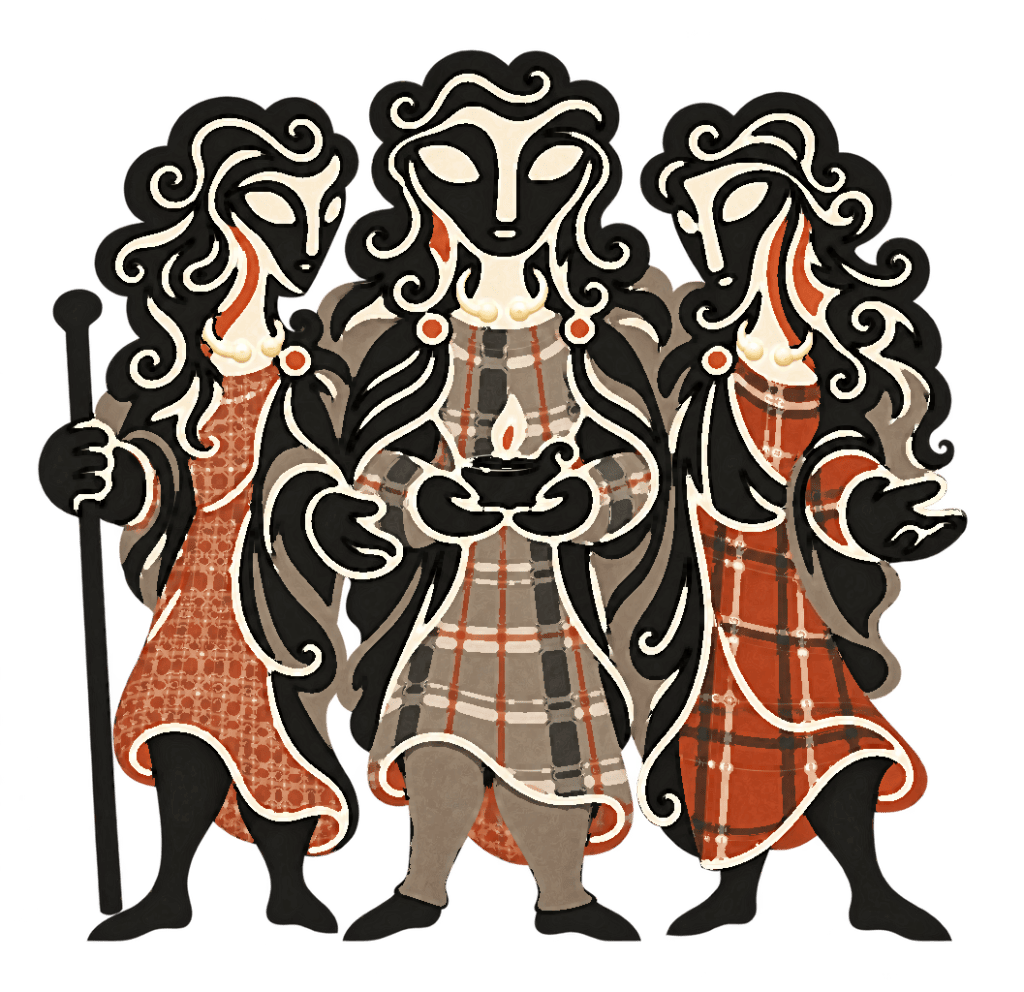
The Suleuiâs are guiding and protective goddesses known through inscriptions from Britain and continental Europe. Worshippers addressed them as Mothers, sisters, and household deities. Within Bessus Nouiogalation, we honor them as guides and protectors of the person, household, and community.
Historical evidence
Their name
Ancient inscriptions commonly call these goddesses Suleviae. The form Sulevis, frequently found in dedications, means “to the Suleviae.” Within BNG, we use Suleuiâs, with Suleuiâ as the singular form in our practice.
Linguist Léon Fleuriot explained their name through su-, “good” or “well,” and leu-, associated with steering or guiding. Comparisons include Welsh llyw, “rudder,” and Middle Breton leuyaff, “to steer.” Under this interpretation, their name means “Those Who Guide Well” or “Those Who Lead Well.”
Noémie Beck reports that Pierre-Yves Lambert and Xavier Delamarre accept this as the most probable explanation. These linguistic comparisons concern guidance and direction; they do not establish a particular connection with sailing.
The University of Graz’s FERCAN catalogue likewise records an interpretation meaning “the well-guiding [Mother Goddesses],” referring to Patrizia de Bernardo Stempel’s linguistic discussion. “Good Guides” is a useful short rendering supported by scholarship.
Inscriptions and places of worship
The inscriptions preserve individual acts of devotion alongside descriptions of the goddesses’ relationships with worshippers.
| Place | Evidence | Reference |
|---|---|---|
| Cirencester, England | Sulinus, son of Brucetus, dedicated an altar to the Suleviae in fulfillment of a vow. Found in 1899 alongside sculptures including reliefs of three Mothers. | RIB 105 |
| Cirencester, England | A damaged altar preserves a dedication by a person whose name is restored as Primus. Found in 1902 outside the town’s south gate. | RIB 106 |
| Bath, England | Sulinus, a sculptor and son of Brucetus, made a sacred dedication to the Suleviae. | RIB 151 |
| Colchester, England | Similis, son of Attus, identifying himself as a member of the Cantiaci, fulfilled a vow to the Mother Goddesses Suleviae. | RIB 192 |
| Cologne, Germany | The Fabii Ianuarius, Bellator, and Iullus dedicated a monument to their household Suleviae. | CIL XIII 12056 |
| Ladenburg, Germany | Lucius Gallionius Ianuarius, a cavalry officer, fulfilled a vow to the Suleviae sisters. | CIL XIII 11740 |
| Rinxent, France | A dedication addresses the goddesses as Suleviae Iunones. | CIL XIII 3561 |
These are selected examples rather than a complete inventory. They include civilian, household, and military settings, showing that their worship extended across different parts of daily life.
Sulinus at Cirencester and Bath
Two British inscriptions name Sulinus, son of Brucetus.
At Cirencester, his altar records the fulfillment of a vow. At Bath, the dedication identifies him as a sculptor. The matching names have led scholars to identify the dedicator as the same person.
The Bath monument is a statue base. It may preserve the setting for an image that Sulinus made or offered, although the inscription does not describe that image.
These dedications provide a glimpse of devotion maintained across more than one town and of a craftsman honoring the goddesses through a lasting sacred gift.
Household Suleviae
The dedication from Cologne, CIL XIII 12056, addresses:
Sulevis domesticis suis
“To their own household Suleviae.”
Its dedicators are the Fabii Ianuarius, Bellator, and Iullus. The wording places the goddesses within a relationship belonging to this household.
This is particularly valuable evidence for their domestic character. It supports discussing their care in relation to family and home, without establishing that every household honored a separately named group.
The Suleviae sisters
The Ladenburg altar, CIL XIII 11740, addresses the goddesses as:
Sulevis sororibus
“To the Suleviae sisters.”
The dedicator, Lucius Gallionius Ianuarius, was a decurio, a cavalry officer in the First Cavalry Regiment of the Cannanefates. He records fulfilling his vow gladly, willingly, and deservedly.
The catalogue dates the altar to the last third of the first century CE. It was found in 1906, reused in the medieval town wall, and is now recorded as lost.
“Sisters” tells us something about the relationship imagined within the divine group. It does not specify their number or preserve individual names.
The Suleuiâs and the Mothers
The Colchester dedication explicitly calls them Matres Suleviae, “Mother Goddesses Suleviae.” Their association with the Mothers has direct inscriptional support.
At Cirencester, the discovery of Sulinus’s altar alongside reliefs of three Mothers offers a possible connection between the inscription and the images. Interpretations of that find have included a sculptor’s workshop and a shrine of the Matres Suleviae.
The circumstances are suggestive, but they do not establish one appearance or a fixed number for the Suleviae everywhere.
The Suleuiâs and the Iunones
A dedication from Rinxent, in present-day Pas-de-Calais, addresses the goddesses as Suleviae Iunones, using the wording:
Sulevis Iunonibus
Catalogued as CIL XIII 3561, it associates them with another collective form of female divinity known in Roman religion.
Alongside “Mothers,” “sisters,” and “household Suleviae,” this title shows the range of descriptions through which people approached them. The wording records an association without explaining a complete mythology or making every use of these divine names interchangeable.
The Suleuiâs and Sulis
Their name should be distinguished from Sulis, the goddess honored at Bath.
Earlier scholarship sometimes connected the names and consequently proposed shared solar or healing functions. Beck argues against treating Suleviae as the plural of Sulis.
A dedication to the Suleviae at Bath establishes their presence there. It does not, by itself, establish that they shared Sulis’s healing responsibilities.
A cult carried across regions
Cristina Girardi’s study examines their worship across the western Roman Empire. Her published abstract proposes an origin in the German provinces during the first century CE and identifies the army as an important means through which the cult spread.
She finds men, especially military personnel, most frequently represented among the recorded dedicators, while also recognizing civilian worshippers. This concerns the surviving inscriptions rather than everyone who may have honored the goddesses.
The evidence brings together collective divine protection and personal devotion: goddesses honored across regions could also be addressed as belonging to a particular household.
What the evidence leaves open
Their name supports an understanding of benevolent guidance. Their titles connect them with sisterhood, divine motherhood, and household care. The inscriptions also show people making vows and offering monuments in gratitude.
They do not preserve detailed stories explaining the goddesses’ origins, establish that they always numbered three, or describe precisely how their guidance was experienced.
Protection of children is a reasonable development within household devotion, but it should not be presented as a duty explicitly stated in the household inscription. Our fuller understanding of their care belongs to our living custom.
The Suleuiâs in Bessus Nouiogalation
Guides and protectors
Within our bessus, the Suleuiâs are guides and protectors of the person, household, and community.
We turn toward them when considering a decision, accepting a responsibility, or trying to find a way through uncertainty. Their guidance asks us to become attentive to our circumstances and the lives affected by our choices.
We understand good guidance as something that helps us act with greater care and judgment. Seeking it includes being willing to listen, reconsider, and follow through.
Care of the household
We honor the Suleuiâs as protectors of the home and those who live within it.
A household contains many needs: food, rest, safety, companionship, and the practical work that allows daily life to continue. Their care accompanies our efforts to meet those needs.
Within BNG, this includes concern for children, elders, dependents, and anyone who needs support. Making a home safe and sustaining is one way we answer the protection we seek from them.
A household can take many forms. Our relationship with the Suleuiâs grows through the care shared among those who belong to it.
Personal guidance
Within our practice, we may approach a Suleuiâ individually or honor the Suleuiâs collectively.
This expresses the devotional relationships cultivated within BNG. It does not require us to recover individual ancient names or claim that every household followed the same practice.
We may seek their guidance in ordinary matters as well as major changes: finding the right words, recognizing an obligation, deciding where help is needed, or learning how to meet a difficult situation.
We return with gratitude when help comes and remain responsible for the actions we choose.
Guardians of the community
At the level of the Toutâ, we recognize their guiding and protective care in the relationships that hold our community together.
A community needs attention just as a household does. People must communicate, participate, share responsibilities, and notice when someone is being overlooked.
We seek the Suleuiâs’ guidance in that work. Their protection calls us to consider how our choices affect the community and what we can contribute to its well-being.
Through them, guidance becomes a shared responsibility: seeking good counsel, offering it thoughtfully, and helping one another find a way forward.
Honoring the Suleuiâs
- Offering water or another drink in gratitude for their care.
- Maintaining a household shrine and returning to it regularly.
- Asking for guidance before an important decision.
- Considering how your choices affect other people.
- Supporting the safety and well-being of those who share your home.
- Caring for children, elders, and others who depend upon support.
- Giving thanks after receiving help or finding a way forward.
- Offering thoughtful advice when it is welcome.
- Taking an active part in caring for the community.
- Following reflection with a practical act of care.
A simple practice is to make an offering, name the matter on your mind, and spend some quiet time considering what responsible action would involve.
Through the Suleuiâs, we honor the guidance that helps us live well together and the care that makes a household or community a place of belonging.
Sources
Inscriptions and archaeological catalogues
- Roman Inscriptions of Britain. RIB 105 — Cirencester; RIB 106 — Cirencester; RIB 151 — Bath; RIB 192 — Colchester.
- FERCAN, University of Graz. CF-GeI-39 — Household Suleviae, Cologne, CIL XIII 12056.
- FERCAN, University of Graz. CF-GeS-1095 — Suleviae Sisters, Ladenburg, CIL XIII 11740. Includes the linguistic reference to Patrizia de Bernardo Stempel, Corpus F.E.R.C.A.N. II/1, pp. 206–207, consulted indirectly through the catalogue.
- CIL XIII 3561 — Rinxent. Dedication to Suleviae Iunones; consulted through published discussions rather than direct examination of the monument.
Scholarly studies
- Beck, Noémie. Goddesses in Celtic Religion: Cult and Mythology—A Comparative Study of Ancient Ireland, Britain and Gaul. Doctoral thesis, 2009. Consulted through the republished discussion of the Matres and Matronae, particularly the Suleviae discussion and notes 190–199. The linguistic arguments of Fleuriot, Lambert, and Delamarre are cited indirectly through Beck.
- Girardi, Cristina. “The Cult of the Suleviae in the Western Roman Empire.” Epigraphica 84 (2022): 239–260. Published abstract consulted; full article not accessed.
Modern devotional writing
- Cunolugus Drugaisos. “Suleuiās.” Druid Hearth — modern discussion of their name, household protection, and associations with the Matres and Iunones.

