
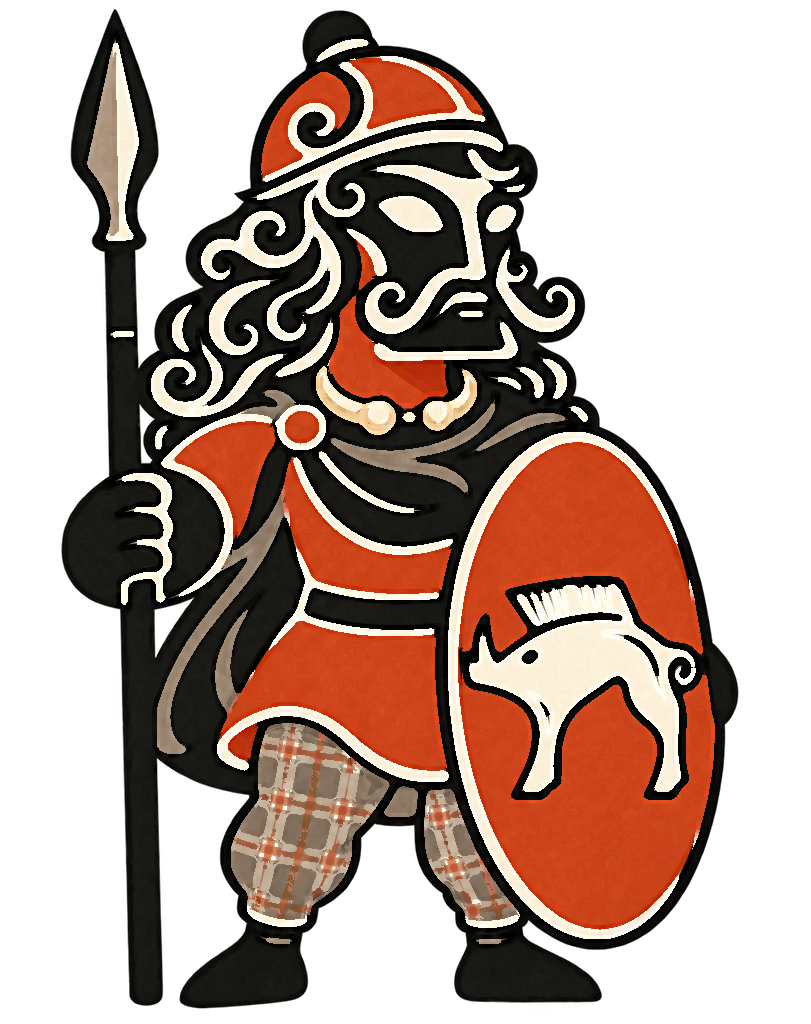
Toutatis is a divine name connected with the people or community. Ancient inscriptions preserve devotion through plaques, altars, pottery, and rings, sometimes associating him with Mars. Within Bessus Nouiogalation, we understand Toutatis as the role of a community’s divine guardian. Our Toutatis is Galatos, son of Ogmios and Celtînâ.
Historical evidence
His name
Toutatis belongs to the Celtic word family represented by Gaulish toutâ, meaning “people,” “tribe,” or “community.”
Related words include Old Irish túath and Welsh and Breton tud. Linguist Corinna Salomon, writing in Lexicon Leponticum, discusses the relationship between Continental Celtic forms beginning teut- and tout-, including the sound change from eu to ou.
This element occurs widely in Celtic names expressing relationships with a people or community. Its deeper Indo-European derivation remains debated, but its Celtic meaning is much firmer.
For the divine name, “of the people” or “belonging to the tribe” expresses the underlying relationship. “God of the tribe” is a useful explanatory rendering. “Protector of the tribe” describes the role inferred from that relationship; it does not mean that the name contains a separate word meaning “protector.”
Forms discussed in the evidence include Teutates, Toutatis, Totatis, and Tutatis. Inscriptions often preserve a grammatical form addressed to the deity, such as Toutati, “to Toutatis.”
A divine name or a title?
The name has encouraged an influential interpretation of Toutatis as a community’s divine guardian, potentially a title borne by different deities.
This fits the relationship expressed by toutâ. It does not establish that every ancient community used the title or that every recorded Toutatis was understood identically.
The distinction between a divine name and a title may also have mattered differently in different places. A designation emphasizing communal belonging could become a familiar name through worship. The surviving evidence does not require one explanation for every occurrence.
Roman names and Gaulish identities
Pierre-Yves Lambert highlights a difficulty in interpreting paired Roman and Gaulish divine names. In Latin dedications, an indigenous name can occupy the position of an epithet even when it previously functioned as a deity’s own name.
The wording “Mars Toutatis” therefore establishes an association, but does not by itself settle whether Toutatis was originally a proper name, a title, or a designation understood differently between communities. The arrangement of names in a Roman-period inscription may conceal distinctions that mattered in earlier worship.
Inscriptions and places of worship
Dedications associated with Toutatis survive on precious-metal objects, stone monuments, and pottery.
| Place | Evidence | Reference |
|---|---|---|
| Barkway, Hertfordshire, Britain | Silver plaque dedicated to Mars Toutatis by Tiberius Claudius Primus, freedman of Attius, in fulfillment of a vow. | RIB 219 |
| Cumbria, Britain; original findspot uncertain | Damaged altar whose published reconstruction includes Toutatis, alongside Jupiter, Riocalatis, and Mars Cocidius. | RIB 1017 |
| Beauclair, Puy-de-Dôme, France | Five pottery sherds bearing TOTATES in varying states of preservation, associated with a likely sanctuary of the deity. | Clémençon and Ganne, 2009 |
| Kelvedon, Essex, Britain | A coarseware jar bearing the explicit name TOVTATIS. | RIB 2503.131 |
| London, Britain | Pottery graffito TOT LV…, interpreted as a possible dedication to Toutatis followed by a personal name. | Brit. 41.62 |
| Sleaford area, Lincolnshire, Britain | Silver ring inscribed TOT, found in 2018. | Brit. 50.16 |
| Scredington, Lincolnshire, Britain | Silver ring bezel inscribed DEO TOT, found in 2024 and dated by its form to approximately 300–450 CE. | Brit. 56.38 |
These examples are a selection rather than a complete inventory. The Barkway plaque preserves an explicit divine pairing, while the damaged altar and abbreviated pottery graffito require more caution.
Mars Toutatis at Barkway
The silver plaque from Barkway reads:
Marti Toutati
Ti(berius) Claudius Primus
Attii liber(tus)
v(otum) s(olvit) l(ibens) m(erito)
“To Mars Toutatis, Tiberius Claudius Primus, freedman of Attius, willingly and deservedly fulfilled his vow.”
The plaque is shaped like a leaf, with the inscription contained within a handled panel. It was found in 1744, while a chalk pit was being dug in Rookery Wood, and is now in the British Museum.
The inscription gives us a named worshipper, his status as a freedman, and a fulfilled religious commitment. It directly establishes an association with Mars in this dedication, but does not explain what Primus requested.
The fragmentary altar from Cumbria
The small sandstone altar catalogued as RIB 1017 has lost part of its left side. Its published reconstruction includes Jupiter, Riocalatis, Toutatis, and Mars Cocidius, with a dedication attributed to Vitalis.
Its original findspot is unknown. Although associated with Cumbria, more precise locations proposed in earlier scholarship remain uncertain.
Both the damaged text and its uncertain provenance deserve acknowledgment. It should not be treated as equally straightforward evidence to the complete Barkway dedication.
Totates among the Arvernes
Bernard Clémençon and Pierre M. Ganne published an important study of pottery graffiti from Beauclair, near Giat and Voingt in the Puy-de-Dôme.
The group consists of five coarseware sherds bearing the name TOTATES, with different amounts of the lettering preserved. The graffiti come from a sanctuary setting in the western territory of the Arvernes.
These finds provide a valuable continental comparison with British dedications. They also show the divine name written on ceramic objects, widening the evidence beyond formal stone monuments and precious-metal offerings.
A dedication from Jort
Patrice Lajoye, with Claude Lemaître, published a study of a votive inscription to Toutatis discovered at Jort, in Normandy.
Their opening discussion places the ancient settlement at a crossing on the boundary between the Lexovii and Viducasses. This provides another continental setting for discussing his worship alongside the evidence from Beauclair.
The location invites consideration of communal and territorial relationships, but it does not establish what prompted the offering. The inscription’s detailed reading still requires examination before we reproduce its text or add a more specific description to the table.
Pottery dedications in Britain
A coarseware jar from Kelvedon, Essex, bears the name TOVTATIS. This is a useful example because the name is written out rather than reduced to the familiar abbreviation TOT.
A sherd found at Gresham Street in London carries TOT LV…, interpreted as a possible reference to Toutatis followed by a personal name, perhaps Lucius. The abbreviated and incomplete text leaves more room for uncertainty.
Together, these objects suggest that ceramic vessels could participate in devotion alongside plaques, rings, and altars. The London interpretation should retain the question mark supplied by its catalogue.
The TOT rings
Rings inscribed TOT form a substantial part of the British evidence. Many are silver, with a particularly strong concentration in Lincolnshire.
Adam Daubney studied these finds in relation to religious devotion and regional identity. Their distribution suggests a locally important cult, although findspots alone cannot establish every wearer’s community or explain exactly how each ring was used.
The Scredington bezel strengthens the devotional interpretation. Its inscription reads:
DEO
TOT
“To the god Toutatis.”
The RIB commentary records more than seventy TOT rings and treats the addition of deo, “to the god,” as confirmation of their dedicatory character.
Their form made them portable expressions of devotion. Questions remain about their individual histories, including whether they were worn, deposited as offerings, or used in more than one way.
Mars and the protection of the people
The Barkway plaque explicitly names Mars Toutatis. This makes Mars relevant to understanding his worship, but the inscription does not describe a battle or restrict the vow to military concerns.
Cunolugus emphasizes that protecting a community can encompass more than warfare. This offers a useful interpretation of the relationship expressed by the name.
We should nevertheless avoid automatically transferring every function of Roman Mars to Toutatis. Caesar’s description of a Gaulish deity under the name Mars does not supply the name Toutatis. Connecting them requires interpretation, supported in part by dedications such as Barkway.
Ancient literary accounts
Lucan names Teutates alongside Esus and Taranis in The Civil War, 1.444–446, in a passage describing bloody religious offerings.
Later commentary adds a claim that a person was submerged headfirst in a vessel as an offering to Teutates. This detail belongs to the commentary rather than Lucan’s own words.
The commentary traditions also associate Teutates with Mars and Mercury, while the Barkway plaque explicitly names Mars Toutatis. These sources come from different settings and periods. They do not provide one consistent explanation of the deity’s identity or worship.
The Gundestrup comparison
A scene on the Gundestrup Cauldron shows a large figure holding a smaller person over a vessel. Scholars and modern practitioners have compared it with the immersion described in the commentary on Lucan.
The resemblance is worth discussing, but the scene does not name Toutatis and has received other interpretations. It should therefore be presented as a proposed comparison, rather than a securely identified image of his worship.
Galatos and the ancestral stories
The name Galatos brings a separate body of ancient material into our discussion.
In Library of History 5.24, Diodorus Siculus tells of Galates, a son of Heracles and an unnamed daughter of a ruler of Celtica. Galates becomes a powerful ruler, and the story explains the name of the Gauls through him.
Parthenius, in Love Romances 30, tells a related story in which Heracles and Celtine have a son named Celtus, after whom the Celts are named.
These are related ancestral narratives, but their details differ. Neither identifies the son as Toutatis, and neither names Ogmios as his father.
Our understanding of Galatos as the son of Ogmios and Celtînâ, and as our Toutatis, develops within BNG through our engagement with these stories and our devotional relationships.
Toutatis in Bessus Nouiogalation
Galatos, our Toutatis
Within Bessus Nouiogalation, we understand Toutatis as the role of a divine guardian of a Toutâ.
Our Toutatis is Galatos, whom we know as the son of Ogmios and Celtînâ.
He is the guardian and custodian of our community’s sacred life. Within him resides the spirit of our Toutâ: the relationships, commitments, memory, and shared custom through which Bessus Nouiogalation takes shape.
Our relationship with him grows through the people who carry the bessus and the care through which they sustain it.
Guardian of the community
We turn to Galatos for protection, well-being, and peace.
His guardianship concerns the people of our Toutâ and the bonds that allow us to practice together. We approach him when welcoming members, facing difficulties, renewing commitments, or seeking strength for shared responsibilities.
His protection also calls for our participation. A community needs people willing to notice when help is needed and respond with care.
In honoring Galatos, we accept a share of responsibility for the people he guards.
Right speech and shared responsibility
Galatos’s relationship with Ogmios has particular meaning within our custom.
Right speech helps sustain the community Galatos protects. How we speak, listen, disagree, and correct mistakes affects whether others can trust us.
We honor this relationship through Îanolabâ: speaking honestly, listening carefully, and attending to the consequences of our words.
Community also requires action. Commitments must be followed through, shared work must be carried, and harm must be addressed fairly.
Ancestry and belonging
Galatos’s guardianship carries an ancestral dimension.
We approach him through the memory, relationships, and responsibilities that give our Toutâ continuity. Our sacred genealogy draws upon ancient ancestral stories while expressing our own relationship with these Dêuoi.
Belonging within BNG does not depend upon claiming Gaulish ancestry. It grows through participation, conduct, and commitment to the custom and its people.
Galatos guards the community we help bring into being through those relationships.
Galatos and the mystery of Dis Pater
Our reflection on Dis Pater leaves the ancient identity open.
Galatos participates in our contemplation of divine ancestry as a guardian and mythic ancestor of our Toutâ. This does not require us to identify him conclusively with the deity Caesar described.
We hold the relationship as part of our living theology, allowing ancestry, community, and divine protection to remain subjects of reflection.
Honoring Toutatis Galatos
- Offering water, food, or another drink for the well-being of the Toutâ.
- Naming the community and remembering members who need support.
- Welcoming newcomers and helping them find their footing.
- Checking on someone who has become quiet or withdrawn.
- Participating in shared work and keeping commitments.
- Supporting members through illness, grief, or other difficulties.
- Practicing right speech during disagreement.
- Addressing harm with fairness and care.
- Preserving the community’s stories, teachings, and memory.
- Giving thanks for the relationships that sustain our bessus.
He may be honored at the household shrine or during community rites, especially when welcoming members or renewing shared commitments.
When asking for his protection, consider what you can contribute to the well-being of those he guards. Our devotion takes shape through the community we help sustain.
Sources
Ancient testimony and inscriptions
- Lucan. The Civil War, 1.444–446 — the literary reference to Teutates. The later commentary traditions are discussed in Duval (1958).
- Roman Inscriptions of Britain. RIB 219 — Mars Toutatis plaque, Barkway.
- Roman Inscriptions of Britain. RIB 1017 — fragmentary altar, uncertain Cumbrian provenance.
- Roman Inscriptions of Britain. Brit. 41.62 — possible pottery dedication from London. Its commentary also discusses RIB 2503.131, the Kelvedon jar, and the Beauclair graffiti.
- Roman Inscriptions of Britain. Brit. 50.16 — silver TOT ring, Sleaford area.
- Roman Inscriptions of Britain. Brit. 56.38 — DEO TOT bezel, Scredington.
- Diodorus Siculus. Library of History 5.24. English translation reproduced on Gaulish Polytheism.
- Parthenius. Love Romances 30, “The Story of Celtine.” English translation.
Scholarly studies and linguistic resources
- Duval, Paul-Marie. “Observations sur les dieux de la Gaule.” Revue de l’histoire des religions 145.1 (1954): 5–17.
- Duval, Paul-Marie. “Notes sur la civilisation gallo-romaine, IV. ‘Teutates, Esus, Taranis’.” Études celtiques 8.1 (1958): 41–58.
- Salomon, Corinna. “tou̯t-.” Lexicon Leponticum, University of Vienna — linguistic discussion of the Celtic “people” word and related name formations.
- Clémençon, Bernard, and Pierre M. Ganne. “Toutatis chez les Arvernes : les graffiti à Totates du bourg routier antique de Beauclair (communes de Giat et de Voingt, Puy-de-Dôme).” Gallia 66.2 (2009): 153–169. Site discussion consulted directly; the five graffiti are also summarized in RIB, Brit. 41.62.
- Daubney, Adam. “The Cult of Totatis: Evidence for Tribal Identity in Roman Britain.” In A Decade of Discovery: Proceedings of the Portable Antiquities Scheme Conference 2007, edited by Sally Worrell and others, 109–120. 2010. Consulted indirectly through RIB’s discussion and bibliographic reference.
- Lambert, Pierre-Yves. “Le statut du théonyme gaulois.” In Théonymie celtique, cultes, interpretatio – Keltische Theonymie, Kulte, Interpretatio (2013), 113–124, especially pp. 113–114.
- Lajoye, Patrice, with Claude Lemaître. “Une inscription votive à Toutatis découverte à Jort (Calvados, France).” Études celtiques40 (2014): 21–28. Opening discussion consulted; the inscription’s detailed reading has not yet been examined.
Modern interpretation and BNG writing
- Cunolugus Drugaisos. “Toutatis.” Druid Hearth — modern interpretation and discussion of the ancient evidence.
- Bessus Nouiogalation. “Dis Pater in Bessus Nouiogalation.” BNG theology.

