
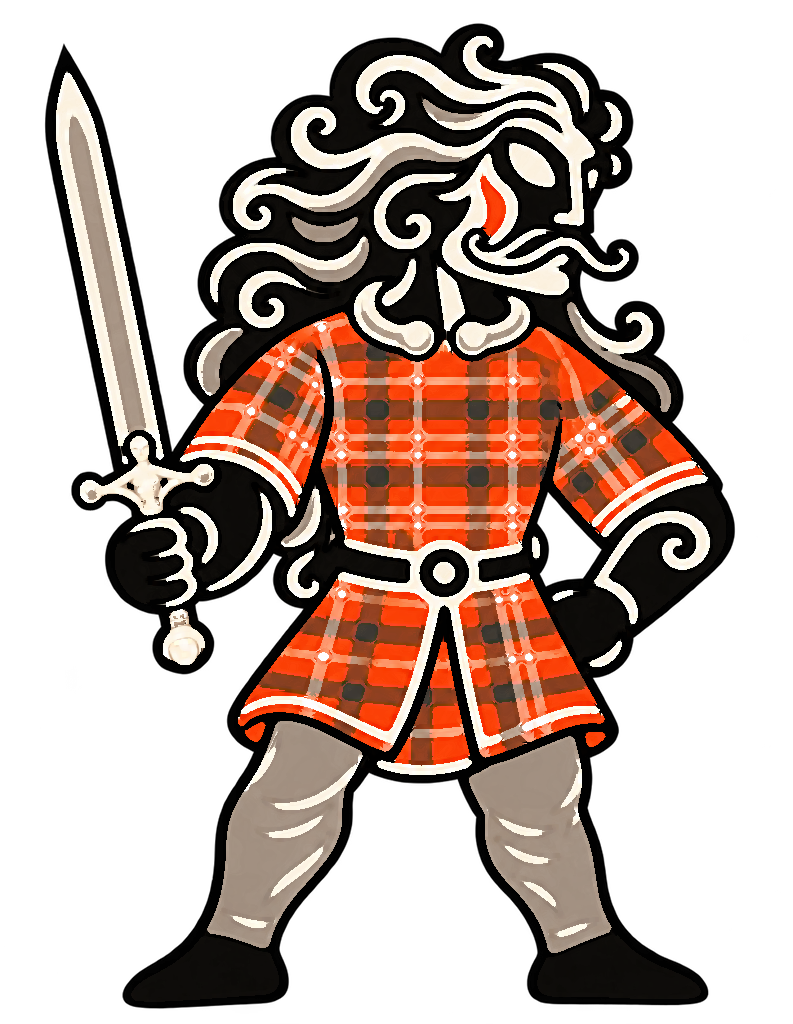
Vercingetorix led a major coalition against Caesar’s conquest in 52 BCE. Within Bessus Nouiogalation, we honor him among the Regentiâ, remembering his resistance alongside the responsibilities, difficult choices, and human losses that accompanied it.
Historical evidence
His name
Vercingetorix is a Gaulish compound generally explained through three elements: uer-, expressing superiority or intensification; cingeto-, associated with warriors; and rīx, “king” or “ruler.”
“Supreme king of warriors” or “great leader of warriors” conveys its usual interpretation.
Numismatist Dominique Hollard, writing for the Bibliothèque nationale de France, interprets it as a title associated with supreme military command rather than a birth name. This remains an interpretation: the meaning of a compound name cannot establish when or why someone received it.
The Arvernian leader
In Gallic War 7.4, Caesar identifies Vercingetorix as an Arvernian, the son of Celtillus. He describes opposition from established leaders, including Vercingetorix’s uncle Gobannitio, before Vercingetorix gathered sufficient support to return and receive the title of king.
His leadership emerged amid disagreement within his own community. It was not simply inherited authority over an already united Gaul.
Resistance in 52 BCE
Vercingetorix’s campaign included the successful defense of Gergovia, followed by defeat at Alesia.
At Alesia, Roman fortifications enclosed the defenders while protecting the besiegers against an approaching relief army. Attempts to break the siege from inside and outside failed.
His campaign involved cooperation among different communities. We should describe this as a coalition rather than assume that it represented a politically unified Gaul.
Alesia and archaeological evidence
Archaeologist Michel Reddé discusses the importance of comparing Caesar’s narrative with material evidence.
Franco-German investigations around the Mont-Auxois at Alise-Sainte-Reine, conducted between 1991 and 1997, examined Roman siege works and confirmed the identification of the site with ancient Alesia.
The excavations provide evidence alongside the written account. They do not independently confirm every speech, troop total, or explanation of events supplied by Caesar. Archaeology helps us assess the narrative while preserving that distinction.
Surrender and captivity
In Gallic War 7.89, Caesar reports that Vercingetorix offered himself to the assembled leaders, saying that he had undertaken the war for their collective freedom. Caesar then briefly records his surrender and the laying down of weapons.
This is the victorious commander’s narrative. Its presentation of Vercingetorix’s words is not an independently preserved transcript.
Writing considerably later, Cassius Dio reports that Vercingetorix was kept captive and subsequently executed in connection with Caesar’s triumph in 46 BCE. Dio does not specify the method of execution, so familiar descriptions of strangulation should not be presented as securely documented.
Coins bearing his name
Coins provide direct evidence of his name beyond the literary accounts.
Arvernian staters carry legends including VERCINGETORIXS. Their youthful, curling-haired heads have often been reproduced as portraits of him.
Hollard notes that similar heads appear on other Arvernian coins and interprets the image through divine imagery comparable with Apollo. The coins securely preserve the name; they do not establish a recognizable likeness of the man.
Coinage, chronology, and manufacture
The coins also contribute to the study of Arvernian minting.
Sylvia Nieto and Jean-Noël Barrandon explain that issues naming Vercingetorix provide an important chronological reference and support the attribution of this coinage to the Arverni. Their study combines the evidence of designs, metal composition, and archaeological associations.
Nieto’s subsequent research identifies another distinction: certain examples previously described as bronze are orichalcum, a copper-zinc alloy.
Some share dies with gold staters, demonstrating a connection in their manufacture. Finds from the siege ditches date examples of these related issues no later than 52 BCE.
This supplies evidence about coin production during the conflict. The precise purpose and circumstances of the unusual metal issues still require interpretation.
History and later remembrance
Vercingetorix became an important figure in nineteenth-century French national storytelling. That reception belongs to his later remembrance rather than providing evidence for how ancient Gauls understood him.
For our purposes, ancestral honoring does not require a flawless hero. We can remember resistance to conquest while examining leadership, violence, and the experiences of people less visible in the surviving sources.
Vercingetorix in Bessus Nouiogalation
Courage in defense of community
Within our bessus, we honor Vercingetorix among the Regentiâ, remembering his opposition to conquest and his effort to bring communities into common action.
His story offers a focus for contemplating courage when the future is uncertain. We can ask what deserves protection, what responsibilities we have accepted, and how we might support others facing a threat.
Our remembrance includes both the leader and the many people whose lives were affected by the conflict.
Leadership and accountability
Vercingetorix’s place in our ancestral practice invites reflection upon the responsibilities of leadership.
Determination alone does not ensure good judgment. Decisions made by leaders affect people who may have little influence over them. Honoring an ancestral leader can include asking difficult questions about authority, consequences, and the care owed to those who bear the costs.
Within BNG, this reflection accompanies courage and resolve. Leadership requires attention to the lives entrusted to its decisions.
Cooperation across differences
His coalition gives us a way to consider cooperation among communities with distinct interests.
For our Toutâ, shared purpose requires listening, trust, and a willingness to contribute. We may approach his remembrance when considering how to act together while respecting differences among us.
Cooperation also requires sustained effort. Commitments must be carried into the ordinary work through which a community continues.
Remembrance beyond victory
Defeat does not remove someone from ancestral remembrance.
Through Vercingetorix, we make room for grief, unfinished hopes, and lives disrupted by conquest. Military victory need not determine a person’s worth or the meaning of remembering them.
His remembrance can encourage perseverance while also asking us to recognize loss and care for those who endure it.
Remembering the wider community
The names of leaders survive more readily than those of many people around them.
Within our ancestral practice, we remember the households, caregivers, craftspeople, farmers, and others whose lives sustained their communities. Their experiences belong within our remembrance of the conflict.
Our relationship with Vercingetorix develops through study and practice. It does not require biological descent or identification with a modern nation.
Honoring Vercingetorix
Vercingetorix may be honored alongside the Regentiâ, particularly when reflecting upon courage, collective responsibility, and resistance to domination.
- Offering water, bread, or a drink in remembrance.
- Studying the ancient accounts alongside archaeological evidence.
- Remembering the wider communities affected by conquest.
- Supporting people facing displacement or oppression.
- Undertaking shared work that strengthens the Toutâ.
- Keeping commitments made to others.
- Reflecting honestly upon the consequences of leadership.
- Preserving historical knowledge without idealizing the past.
A simple observance may include an offering followed by consideration of one responsibility you can carry for others.
These are contemporary devotional practices, rather than a reconstruction of an attested ancient cult of Vercingetorix.
Sources
Ancient sources
- Julius Caesar. Gallic War, Book VII, particularly 7.4 and 7.89. Translated by H. J. Edwards — Vercingetorix’s rise and surrender.
- Cassius Dio. Roman History 40.41 and 43.19. Translated by Earnest Cary — captivity and execution.
Academic and museum resources
- Hollard, Dominique. “Ceci n’est pas le portrait de Vercingétorix !” Bibliothèque nationale de France — interpretation of the name, coin imagery, and later reception.
- Reddé, Michel. “La conquête de la Transalpine et la guerre des Gaules (IIe–Ier siècle av. J.-C.).” In La protohistoire de la France, edited by Jean Guilaine and Dominique Garcia. Paris, 2018, pp. 511–524 — archaeological evidence and the historical interpretation of the conquest.
- Nieto, Sylvia, and Jean-Noël Barrandon. “Le monnayage en or arverne : essai de chronologie relative à partir des données typologiques et analytiques.” Revue numismatique 158 (2002): 37–91 — Arvernian gold coinage and chronological analysis.
- Nieto, Sylvia. “Monnaies arvernes (Vercingétorix, Cas) en orichalque.” Revue numismatique 160 (2004): 5–25 — alloy analysis, die connections, and archaeological dating.
- Musée d’Archéologie nationale. “Vercingetorix and Alesia” — archaeological collections and the siege setting.
Further reading
- Reddé, Michel, and Siegmar von Schnurbein, directors. Alésia : fouilles et recherches franco-allemandes sur les travaux militaires romains autour du Mont-Auxois (1991–1997). Paris: Académie des Inscriptions et Belles-Lettres, 2001. Publication information. The publication description was checked; the complete excavation volumes were not consulted for this draft.

