
A long while back, I came across an archaeological article describing surviving fragments of a colossal statue identified as Sucellos. I was immediately excited by the thought that pieces of such a large image of him had survived, and I wanted to learn more about the place where it stood and the people who honored him there. This is a discovery I have not seen discussed very often in our community, so I have been looking forward to sharing the research. Following the evidence has brought together several questions: what was found, how the surrounding sanctuary developed, and how much of the statue’s original appearance we can reasonably recover.
Among the fragments reported by Louis Roussel at Les Froidefonds, near present-day Ancey–Mâlain in France’s Côte-d’Or, was an eye measuring nearly ten centimetres. The colossal figure held an olla, a pot or jar, and debris in the same temple chamber contained a dedication naming Sucellus. [1, p. 91] These discoveries connect a named god, an individual’s vow, and a monumental divine image with the eastern side of ancient Mediolanum, a town in Roman Gaul. They allow us to consider devotion to Sucellos within a particular place, where sacred space and the buildings occupying it changed over time.
The surviving evidence offers a valuable opportunity to study one local setting of his worship. It is also an opportunity for us to imagine how someone might have encountered the statue: entering the sanctuary, approaching the inner chamber, and standing before an image large enough to command our attention. Exploring that encounter requires us to distinguish the documented finds from the choices involved in reconstruction. The eye gives us a striking starting point, while the statue’s complete appearance, original position, and total height remain questions to investigate.
A named god and a fulfilled vow
The dedication recovered at Les Froidefonds reads:
DEO SVCELLO
AREAM RESVS
TOROGILLI
V S L M
A cautious translation is:
To the god Sucellus, Resus, son of Torogillus, [dedicated] an area or precinct, fulfilling his vow willingly and deservedly.
The final letters abbreviate votum solvit libens merito, a formula recording the fulfillment of a vow. “Son of” expresses the conventional interpretation of the relationship between the personal names, while the supplied English verb “dedicated” makes the sense clear without representing an additional surviving verb. [2, no. 108, p. 142] The inscription uses the Latin form Sucellus, appearing as Sucello in the dedication. This article uses Sucellos while retaining the inscription’s spelling when quoting it.
Resus’s offering concerned an area: an area, open space, or precinct. Roussel specifically cautions that this word does not itself designate the temple building. The dedication records a gift of sacred space without describing every structure that occupied it or identifying the person who commissioned the colossal statue. [1, p. 91] Keeping that distinction in view allows us to appreciate what the inscription preserves: an individual named Resus fulfilled a vow to Sucellos through a dedication involving the space of his worship.
The physical form of the inscribed monument presents a further question. Roussel identifies the inscribed fragment, its base, and part of its crowning as an archaeologically complete altar, while Kotterba discusses the possibility that the block belonged to a portico architrave. These interpretations require comparison against the surviving pieces. The reconstruction accompanying this article follows Roussel’s identification of an altar, although its precise restored form and placement remain interpretive. [1, p. 91; 2, p. 142]
A temple built in stages
The sanctuary contained more than one building, and their relationship helps place the colossal image within its wider setting. A square fanum, approximately ten metres on each side, had been excavated in 1967–1968. About fifteen metres west of it stood the larger building associated with Sucellos. According to Roussel, this larger building’s main sequence began early in the second century CE, when an eighteen-by-eight-metre rectangular hall was constructed after the destruction of an earlier enclosure. A surrounding colonnade opened the hall toward the sanctuary and landscape. Inside stood two small pavilions, interpreted as possible altars or small sacred chambers, whose western steps oriented the arrangement toward the town. [1, p. 89]
The building subsequently underwent changes that produced its distinctive T-shaped plan. The colonnade was replaced by a solid wall, and a chamber approximately ten by nine metres was later added on the east. Removing the dividing wall connected this chamber with the older rectangular hall. The eastern addition became the cella, the inner sanctuary, while the older hall served as the pronaos, or entrance hall. Two small service rooms were also added to the south. [1, p. 91] These alterations are important to understanding the setting in which the statue fragments were eventually recovered, since the temple’s surviving plan reflects successive stages of construction.
The documented development and use of the building belong principally to the second and third centuries CE. Roussel places its final occupation under Tetricus, whose reign in Gaul lasted from 271 to 274, while the neighboring fanum had already been abandoned by the end of the second century. [1, p. 91; 5] The passages examined provide no securely established installation year for the statue. The inscription’s date also remains disputed: Kotterba proposes the second half of the second century or the very beginning of the third, whereas Spickermann’s table gives 90–120 CE. [2, p. 142; 3, p. 143, table 1, no. 12] The building history gives us a chronological framework, within which the dating of the dedication and statue still requires clarification.
Inside the sanctuary, looking east
Roussel reports the colossal fragments among rubble covering the concrete floor of the cella, placing their discovery inside the temple’s inner sacred chamber. Together with his identification of the fragments as a cult statue, this supports an indoor setting for the image, although a debris findspot cannot fix its original pedestal position. [1, p. 91] The temple faced west toward Mediolanum, with the cella occupying its eastern part. Someone approaching from the west and looking into the chamber would have looked east toward the space where the cult image is reconstructed.
The accompanying drawing adopts this viewpoint, imagining Sucellos facing west toward the approaching visitor and the town. The building’s orientation is documented; the statue’s facing direction, exact position, and pose are inferred. The dedication of an area is compatible with this indoor interpretation, since a sacred enclosure could contain both open space and buildings. The inscription may also have been moved during the sanctuary’s development, so its wording cannot by itself determine where the colossal image originally stood. [1, p. 91; 2, p. 142]
Other finds around Sucellos
The sanctuary’s other finds help us understand the setting in which Sucellos was honored. Their recorded locations are particularly important, since objects recovered within the wider sanctuary need not have formed a single display around the colossal statue. Roussel’s account distinguishes finds from the cella, the neighboring fanum, and the gallery beside it, allowing us to retain those relationships when considering their significance. [1, pp. 89, 91]
| Find or feature | Recorded context | What it contributes |
|---|---|---|
| Colossal statue fragments, including the large eye and the reported olla | Debris over the cella floor | Evidence for the monumental cult image |
| Inscribed dedication, base, and crowning fragment, interpreted by Roussel as an altar | The same cella debris | Named worship of Sucellus |
| Coins | The cella | Further objects associated with the temple |
| A small mallet-bearing deity image | The neighboring fanum | Related divine imagery within the sanctuary |
| A dispersed deposit of mainly Gaulish coins, largely Lingonian potins | East side of the fanum’s gallery | A possible offering deposit; its interpretation as a basin remains provisional |
The wider sanctuary also provides a connection with Mars. Spickermann lists a bronze statuette of Mars among the Roman-period finds, citing earlier excavation literature, while Roussel considers the neighboring fanum probably dedicated to the Gaulish Mars. These observations add to our understanding of the sanctuary’s divine imagery, although neither establishes an original position for the bronze statuette beside the colossal Sucellos. [3, p. 135; 1, p. 91] The distinction matters when reconstructing an interior scene: a find from the sanctuary belongs to its religious history without necessarily belonging to the arrangement imagined within this particular chamber.
Water was another feature of the surrounding landscape. A stream ran near the fanum, an anciently captured source lay uphill, and conduits carried water through or past the sanctuary. These details help us understand the site’s physical setting, while leaving the religious significance of its water features open to further study. Roussel himself leaves the possibility of a spring cult unresolved. Infrastructure and proximity to water provide relevant evidence, but they require interpretation before a particular religious function can be established. [1, p. 91]
A separate local relief offers a comparison for the god’s appearance. Discovered at Les Chenevières in 1848–1849, it depicts a bearded god in a short tunic and mantle, with the surviving shaft of a mallet resting on a barrel and a dog at his feet. Its preserved height is twenty-six centimetres, and the hands and feet are missing. [2, no. 143, pp. 156–157] The relief contributes to our understanding of Sucellos’s local imagery, while its separate findspot and identity as a different object limit what it can establish about the colossal statue. A dog or barrel in one representation gives us a comparison to consider, rather than a documented feature of the lost monumental image.
How large might the statue have been?
The eye invites a proportional calculation, although the measurement itself presents the first difficulty. Roussel reports an eye measuring nearly ten centimetres without specifying whether he means the horizontal opening, the eyeball, the socket, or the surviving fragment. Each would provide a different basis for comparison. Before we could use the measurement to establish the statue’s height, we would need to know exactly what was measured and how that dimension related to the proportions of the complete sculpture.
For an exploratory example, we can suppose that the nearly ten-centimetre measurement describes the horizontal eye opening. A modern anthropometric study reports a mean male horizontal opening of thirty millimetres. Pairing that comparison with a hypothetical standing reference figure 1.70 metres tall produces the following calculation, using 100 millimetres as a rounded working value for “nearly ten centimetres”: [4]
(100 mm ÷ 30 mm) × 1.70 m ≈ 5.7 m
Under these assumptions, the result is a standing figure approximately 5.7 metres tall, or about nineteen feet. This is an exploratory model developed for this article: the reference height is a chosen example, and the modern eye measurement supplies a comparison dimension without establishing the proportions of ancient Gauls or of this sculpture. The sculptor’s choices could substantially change the result. If the eyes had been enlarged by fifty per cent relative to the body, the same inputs would produce a standing-equivalent height of approximately 3.8 metres. That enlargement factor is hypothetical, but it illustrates how strongly the estimate depends on artistic proportions.
Pose introduces another uncertainty. A seated figure could have a head of the same scale while occupying much less vertical space, and a pedestal or projecting attributes would require separate measurements. The cella’s ten-by-nine-metre ground plan provides no secure ceiling height against which to test the reconstruction. We can explore a five-to-six-metre standing scenario while retaining the more limited published finding: Roussel describes a colossal cult statue, but the available account does not establish its original total height. A scaled photograph, clearly defined measurement endpoints, and a fuller inventory of the fragments would provide a stronger basis for reconstructing its scale.
Sucellos overlooking Mediolanum
The temple’s orientation also informed Roussel’s interpretation of Sucellos’s relationship with the town. He sees the god watching over Mediolanum’s eastern limit, while Mars Cicolluis guards its western approaches. [1, p. 91] This reading is grounded in the sanctuary’s position and its relationship to the town, rather than in a protective title recorded in the dedication. It raises the possibility that Sucellos’s presence here carried significance for the community’s boundary and its relationship with the surrounding landscape. Roussel’s reference to Mars Cicolluis on the western approaches is also separate from the bronze Mars statuette recorded among the Froidefonds finds; their precise relationships require their own contextual study.
The Les Chenevières relief contributes another perspective through its barrel and mallet. Kotterba argues for a strong association between Sucellos, wine production, and related trades, an interpretation relevant to the wider discussion of his worship. Resus’s occupation and the contents of the colossal image’s olla nevertheless remain unknown. [2, pp. 96–97, 156–157] Taken together, the dedication, temple, monumental fragments, and local relief allow several aspects of devotion to Sucellos to emerge. Each contributes a particular kind of evidence, from an individual’s fulfilled vow to the imagery through which the god was represented.
Reconstructing the image
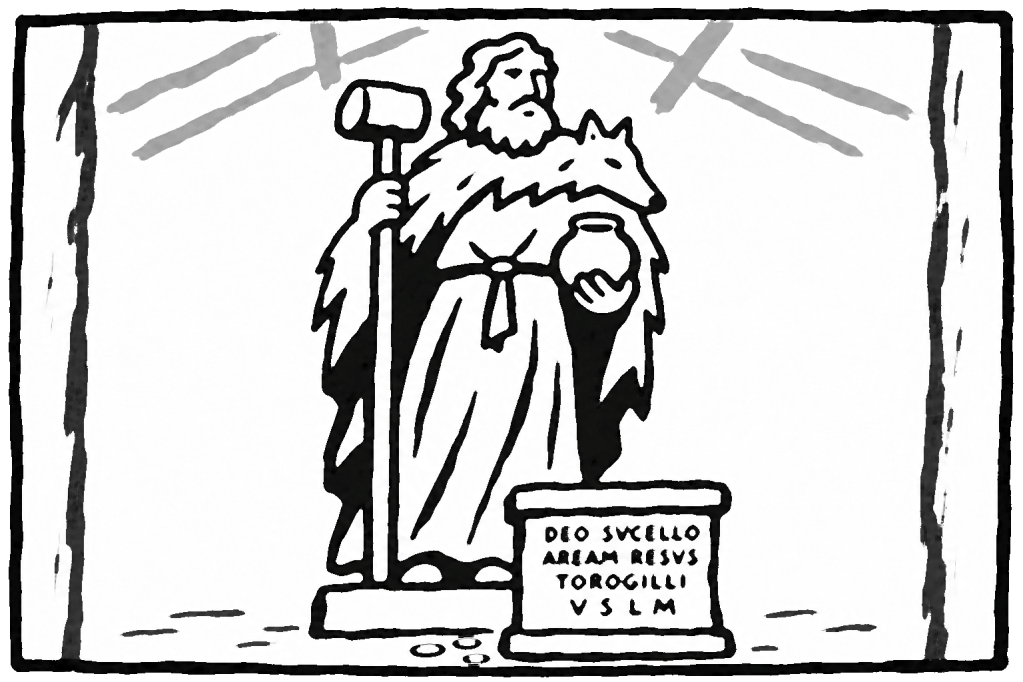
The accompanying line drawing brings these findings into a possible interior scene. It shows a colossal standing Sucellos holding an olla and a long-handled mallet, viewed from the west while looking east into the cella. An inscribed altar and a few coins provide further context. The reported olla, colossal fragments, dedication, and coins supply archaeological starting points, while the complete body, standing pose, clothing, beard, mallet, pedestal, roof, and arrangement of objects are conjectural. A mallet fits comparative Sucellos imagery, although the brief report does not identify a colossal mallet fragment from this statue.
The drawing follows Roussel’s interpretation of the inscribed monument as an altar without reproducing a measured restoration of its form. Its position, together with the number and placement of the coins, has been chosen to make the imagined setting easier to understand. Stating these choices allows the illustration to serve its purpose: helping us consider one possible encounter with the cult image while keeping the surviving evidence visible within the reconstruction.
Sources
[1] Groupe Archéologique du Mesmontois; text by Louis Roussel. “Mâlain: La ville gallo-romaine de Mediolanum.” Mémoires de la Commission des Antiquités de la Côte-d’Or 36, volume covering 1990–1992, pp. 78–91. The principal excavation account used here, especially pp. 87–91.
[2] Manfred Kotterba. Sucellus und Nantosuelta: Untersuchungen zu einem gallo-römischen Götterpaar in den Nordprovinzen des Imperium Romanum. Dissertation accepted in 2000; revised online text. Especially catalogue no. 108, p. 142, and no. 143, pp. 156–157. Freiburg repository.
[3] Wolfgang Spickermann. “Les noms des divinités celtes en Germanie et leur interprétation dans le cadre de l’histoire des religions.” In Andreas Hofeneder and Patrizia de Bernardo Stempel, eds., Théonymie celtique, cultes, interpretatio (2013), pp. 131–144. Especially p. 135 and p. 143, table 1, no. 12. Publisher’s chapter PDF.
[4] Faruk Öztürk, Guliz Yavas, and Umit Ubeyt Inan. “Normal periocular anthropometric measurements in the Turkish population.” Ophthalmic Epidemiology 13.2 (2006), pp. 145–149. Used only for a modern comparison measurement in the exploratory scale model. DOI: 10.1080/09286580500507220; PubMed abstract.
[5] British Museum. Collection authority record for Tetricus I, identifying his reign in Gaul as 271–274. Collection record.


Leave a Reply