In my time walking the Gaulish Path, I’ve noticed that two gods often feel strangely distant: Ogmios and Lugus. Not because they lack importance, but because people aren’t always sure how to approach them. Ogmios carries an intimidating weight — an old god whose eloquence binds hearts. Lugus, vast in his domains, is sometimes reduced to “crafts,” even though his reach extends far beyond that.
Yet these two share a powerful theme at their core, and that is speech — the sacred word, the breath that moves between worlds. Understanding how they differ helps us understand our own voices better.
Îanolabâ — Right Speech as Virtue and Devotion
If we look further back, into the deep roots of Proto-Indo-European thought, we find that speech itself was seen as a cosmic force. Across Indo-European cultures, the spoken word:
upheld truth and cosmic order
carried magical and ritual power
established sovereignty and law
acted as a bridge between humans, gods, and ancestors
preserved memory, identity, and tradition
In other words, the ancients believed that speech didn’t just describe reality — it shaped it.
Understanding speech helps illuminate one of our Îanoi — Îanolabâ, right speech. In light of PIE cosmology, this virtue becomes more than ethics; it becomes a sacred principle that maintains order, honors the gods, and sustains our community. Speech is the foundation of everything we do. It shapes our relationships, our rites, our teachings, and our shared identity. The other virtues naturally gather around it — flowing from how we speak and the intentions we carry. When we strive for right speech, we’re not only being mindful with our words; we are aligning ourselves with the powers of clarity and eloquence. We learn when to speak with light, and when to speak with resonance. We learn how to communicate truth and how to speak with heart.
This worldview helps us understand why Lugus and Ogmios take on such distinct roles. They are not redundant; they are two essential expressions of the sacred word.
Lugus: The Clarifying Word
Within this broader Indo-European frame, Lugus embodies the ordering and illuminating side of speech. His words teach, clarify, and bring hidden patterns into form. This is the speech of sovereignty — not rulership by force, but rulership by communication, insight, and instruction.
His speech is the cosmic “lamp”: the word that reveals, organizes, and connects.
Lugus is communication. His power is in how words clarify — teaching, instructing, crafting meaning, and passing knowledge from one mind to another. He is speech as connection, structure, and shared understanding.
Ogmios: The Binding Word
Ogmios, meanwhile, expresses the magical and compelling current of speech. Lucian’s image of golden chains from his tongue to the ears of followers reflects a very old Indo-European idea: that skilled speech has the power to bind, persuade, enchant, and direct the will.
This is the speech of charisma, of spellcraft, of influence. The word that pulls, moves, and reshapes hearts.
His speech is the “chain”: the word that captivates, persuades, and carries emotional force.
Ogmios is eloquence. His power is in how words move people — the charm, the persuasion, the emotional pull. He is the art of speaking in a way that binds hearts and compels attention.
When we strive for Îanolabâ, we’re aligning ourselves with both Lugus and Ogmios:
with Lugus, speaking with clarity, honesty, and understanding
with Ogmios, speaking in ways that inspire, encourage, and move the heart
Îanolabâ becomes both a discipline and a devotion — a daily practice shaped by these two divine voices.
The Sacred Word as Lamp and Chain
In the end, both gods show us that speech is more than breath — it is power, connection, and the shaping of our world. Ogmios stands as the Dêuos of Speech, the one whose eloquence binds hearts and moves the soul. Lugus, vast in scope, is the Dêuos of Many Skills, whose clarity, craft, and communication illuminate the path of knowledge and right action. Together they show us that the sacred word has both depth and direction, and that our practice is enriched when we learn to honor that current. To speak with truth and to speak with heart — this is the gift they place in our hands. And perhaps one of our tasks as Galatis is learning how to speak in a way that honors the cosmos around us so we can teach with clarity and to inspire with heart.
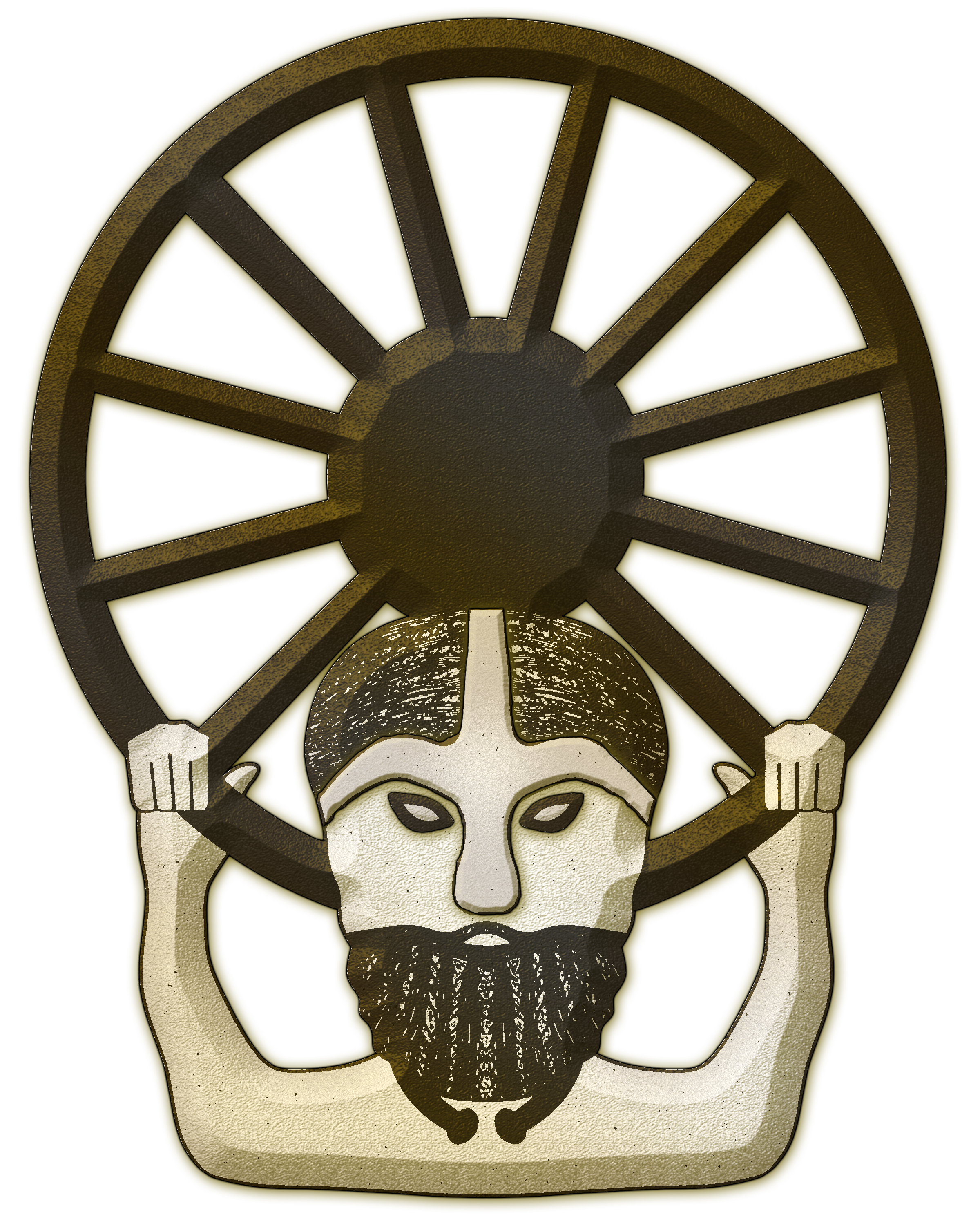
Taranis brings us the Îanoi (Virtues). If one is the center of the wheel, and the rim is that which is literally around us (family, community, the world, etc.), the virtues are the spokes. With all spokes present, the wheel can roll forward. The more spokes present, the smoother the ride. Too few, and the wheel breaks apart. Everything is connected in the great cycle of the cosmic order of things,each leading and affecting the other.
Ambactos Rotî (ambassador of the wheel) are those of us that follow the teachings of the wheel of Îanoi. We dedicate ourselves to the ever-spinning motion.
For a reading of this article in English, please click here.)
Îanoi, which in a more literal sense means from Îanos “right, just, correct,” essentially, in this case, “things that are right or correct.” For the purposes of the Bessus Nouiogalation (that is, “Custom of the New Galatîs,” plural form of “Galatis”), it also encompasses the term “virtues.” The understanding of virtues is essential so that we have a guide to live our lives in a way that helps us be better people. In turn, this helps us be better members of our communities.
So why codify something like virtues? The answer to which is simple, they give us something to refer to when we lose our way. The Dêuoi (worshipped beings) fulfill their actions perfectly. But they are Dêuoi. We are Donioi (humans). We aren’t perfect in our actions. No one is, and that’s okay. Every now and again, it doesn’t hurt to remember Nouiogalatis virtues, inspired by those of the ancient Gauls. As they will help us re-center ourselves and keep us in accordance with what is right.
The way we will break this down is by looking at what was thought to be the three laws the Druides (singular: Druið, pronounced “Dru-its”) taught. As you may guess, it translates to Druid. Though with the last law, we’ve been able to apply a more general interpretation to it. As our understanding of that one has changed. You’ll understand when you see it. We will list one law at a time, and there will be four virtues assigned to each to help us live up to each law.
They were originally recorded by Diogenes Laertius’s “Vitæ,” introductory verse 5:
I. The gods must be worshipped.
II. No evil done.
III. Exercise valour.
Now, we must be aware with the third law that there are multiple interpretations of it. And this is but one translation proffered. Another mentioned “manly behavior”, but even to the Gauls, there’s no reason to assume they only attributed these qualities to men. We must remember that these laws were recorded from someone who wasn’t a Gaul. After all, Onomaris was certainly courageous in leading her people to the east. We also must remember that valor doesn’t just apply to warriors. We can all think of people who have done courageous things far outside the field of combat that uphold notions of valor.
As such, in Bessus Nouiogalation — an independent and contemporary Gaulish-inspired custom — we strive to uphold these laws among our community. Developed from our interactions within Galatibessus of which we are a part, and dialogue with members of our specific bessus (custom). They are called the Trirextoues (The Three Laws).
Trirextoues/The Three Laws
Dugie Dêuûs – “Honor the Gods”
Gneie ne drucon – “Do no evil”
Delge āxtam – “Hold your behavior”
With these laws established, there are twelve virtues, and four each helps us align ourselves with these laws. So we will visit each law and discuss relevant virtues that can guide us. It should go without saying that there are more than twelve good qualities that can be exercised as virtues. However, many will relate to the ones discussed.
Let us start with the first law:
Dugie Dêuûs – “Honor the Gods”
Dêuocariâ (piety) Piety is important because by seeking and acting on honoring the Dêuoi, we bring ourselves closer to them. In doing so, it helps us learn all other right actions. Not every pious person is otherwise virtuous. However, they’re arguably not pious. As part of piety is not simply regular worship, but learning the virtues each of the Dêuoi has to teach.
And a peculiar and striking practice is found among the upper Celts, in connection with the sacred precincts of the gods; as for in the temples and precincts made consecrate in their land, a great amount of gold has been deposited as a dedication to the gods, and not a native of the country ever touches it because of religious scruple, although the Celts are an exceedingly covetous people.
Diodorus Siculus, Library of History V.27
All the Gauls are extremely devoted to superstitious rituals.
Caesar, The Gallic Wars VI.16
Luxtiâ (duty) The Dêuoi fulfill their duties perfectly. Of course, we do not always fulfill our duties perfectly. It’s part of being human. Though as donioi (humans), we don’t let imperfection stop us from acting. And so it’s important to remind ourselves to act on the duties we agree to — so long as it was made between two groups or people in equal positions of power. Just as the Dêuoi would.
Uissus (wisdom/knowledge) To be wise is to have knowledge of the teachings of the Dêuoi. As well as how to put them into action. The Druids of the past were exalted for their wisdom, but you don’t have to be one to learn the lessons of the Dêuoi and the world. Nor to act upon them. As wisdom is not passive, but active.
Îanolabâ (right speech) Something particularly relevant to the Gauls. As Ogmios, what the Romans said their northern neighbors called Hercules. However, (and you can read the account here) Ogmios was shown as older, as opposed to the younger Hercules. The reason why is that the Gauls in particular valued eloquence, as speech can bind wills more effectively than strength.
The Gauls are terrifying in aspect and their voices are deep and altogether harsh; when they meet together they converse with few words and in riddles, hinting darkly at things for the most part and using one word when they mean another; and they like to talk in superlatives, to the end that they may extol themselves and depreciate all other men. They are also boasters and threateners and are fond of pompous language, and yet they have sharp wits and are not without cleverness at learning.
Diodorus Siculus, Library of History V.31
Gneie ne drucon – “Do no evil”
Doniocariâ (compassion) Compassion is one of the most essential ways to ensure we do good instead of evil. How we respond to the suffering of others, and that we are aware of their pain is one of the most integral parts of the human condition.
Oigetocâriâ (hospitality) This is a key one. Through being hospitable, we forge connections and bonds with others, strengthening our communities. Both in person and online, as guest and host relations still apply.
“They invite strangers to their feasts, and do not inquire until after the meal who they are and of what things they stand in need.”
Diodorus Siculus, Library of History, 5.28
Raton (generosity) Until recently, people weren’t celebrated for being greedy. As one who is miserly is denying resources to the community. Sharing and generosity remind us that we are all interconnected. Without the goods or services others offer, a society cannot function. By being greedy in our personal lives, we cannot make friends. Generosity goes beyond material wealth, and includes company, kind words, a listening ear. Many qualities we associate with good people even today.
Uiridios (truth) This is a more complex concept than simply “not lying”. As sometimes, in rare cases, lying is a course of action that serves truth. An example would be lying to protect someone from violence and harm if the assailant was looking for them. To live in truth is to be truthful to one’s actions and be authentic. It is to act in a way that fosters honesty, justice, fairness, and virtue.
Delge āxtam – “Hold your behavior”
Decos (honour) We’ll get the obvious out of the way first. Honour ties into many other virtues as it is based on how well you live up to all of the other virtues. Thus, reputation ties directly into this as well. Your honour is measured by your integrity and virtue.
Uîrolaniâ (justice) To be honourable is to also be just. To exercise fairness in our decisions and actions. It also requires the knowledge of making decisions in a just manner. As acting in a fair and just way is important, so is speaking out when justice is being violated. And that takes a little of the next virtue.
Galâ (bravery) To be brave is another thing that isn’t always easily understood. It is not fearlessness. Bravery is doing something in spite of fear. And bravery is living up to the virtues even when it is inconvenient or when everyone around you disregards them. It’s also about having the fortitude to admit a mistake or flaw, as well as face consequences for one’s wrongdoings. Galâ is also ability—the cultivated skill to act with purpose and precision. True courage is not reckless; it is guided by knowledge and refined through practice. Ability transforms passion into action, ensuring that our strength serves wisely rather than blindly. Through ability, we learn to master our impulses, wield our talents for the good of others, and stand ready for whatever trials arise. To live with Galâ is to unite heart, mind, and hand in steadfast harmony. This is our resolve, it’s the inner passion and fire that fuels us. You can read more about the idea of Galâ here.
They reward brave warriors with the choicest portions of the meat, in the same manner as the poet introduces Ajax as honoured by the chiefs after he returned victorious from his single combat with Hector [in Illiad 7.321]: ‘To Ajax then were given of the backbone / Slices, full-length, unto his honour.
Diodorus Siculus, Library of History V.28
But the leader of the Celtic band soberly looked Alexander in the eye and said, “Nothing. We honor the friendship of a man like you more than anything in the world, but we are afraid of nothing at all. Except,” he added with a grin, “that the sky might fall down on our heads!
Ptolemy Soter quoted by Arrian and other historians
Ûxelliâ (pride) In the “over culture” we’re often taught that this is not a virtue. However, pride is not synonymous with arrogance. Being proud of one’s deeds is virtuous and can inspire others to also be virtuous. Whereas arrogance is for the self and doesn’t benefit anyone else. Pride also is about fostering a sense of self worth, and in turn recognising the worth of others. When in line with the other virtues, pride can help foster a sense of community and commitment to the common good.
As all traditions have ethical and moral codes, so do we. We’re confident that these virtues are a reasonable approach to right actions based on what was taught to the people by the Druides. There are many other virtues that could be listed but almost all of them are related to those listed in some way.
When thinking of what to do in a situation, try to remember the Îanoi!
A good practice is to, at the end of your day, take a look at what Îanoi you excelled at and what ones you had trouble with. Make a note of why look back a see what you could have done differently or why to excelled. Our Îanoi is not something talked about but acted on.


 Bessus Nouiogalation