A Reflection on Lugus, Ogmios, and Îanolabâ in BNG

Branos Carnutodrûidion. Gaulish Polytheism. Gaulish Paganism

Written by Branos Carnutodrûidion/Urādos – Gutuatir of BNG


In my time walking the Gaulish Path, I’ve noticed that two gods often feel strangely distant: Ogmios and Lugus. Not because they lack importance, but because people aren’t always sure how to approach them. Ogmios carries an intimidating weight — an old god whose eloquence binds hearts. Lugus, vast in his domains, is sometimes reduced to “crafts,” even though his reach extends far beyond that.

Yet these two share a powerful theme at their core, and that is speech — the sacred word, the breath that moves between worlds. Understanding how they differ helps us understand our own voices better.

Îanolabâ — Right Speech as Virtue and Devotion

If we look further back, into the deep roots of Proto-Indo-European thought, we find that speech itself was seen as a cosmic force. Across Indo-European cultures, the spoken word:

  • upheld truth and cosmic order
  • carried magical and ritual power
  • established sovereignty and law
  • acted as a bridge between humans, gods, and ancestors
  • preserved memory, identity, and tradition

In other words, the ancients believed that speech didn’t just describe reality — it shaped it.

Understanding speech helps illuminate one of our Îanoi — Îanolabâ, right speech. In light of PIE cosmology, this virtue becomes more than ethics; it becomes a sacred principle that maintains order, honors the gods, and sustains our community. Speech is the foundation of everything we do.
It shapes our relationships, our rites, our teachings, and our shared identity. The other virtues naturally gather around it — flowing from how we speak and the intentions we carry. When we strive for right speech, we’re not only being mindful with our words; we are aligning ourselves with the powers of clarity and eloquence. We learn when to speak with light, and when to speak with resonance. We learn how to communicate truth and how to speak with heart.

This worldview helps us understand why Lugus and Ogmios take on such distinct roles. They are not redundant; they are two essential expressions of the sacred word.

Lugus: The Clarifying Word

Within this broader Indo-European frame, Lugus embodies the ordering and illuminating side of speech. His words teach, clarify, and bring hidden patterns into form. This is the speech of sovereignty — not rulership by force, but rulership by communication, insight, and instruction.

His speech is the cosmic “lamp”: the word that reveals, organizes, and connects.

Lugus is communication.
His power is in how words clarify — teaching, instructing, crafting meaning, and passing knowledge from one mind to another. He is speech as connection, structure, and shared understanding.

Ogmios: The Binding Word

Ogmios, meanwhile, expresses the magical and compelling current of speech. Lucian’s image of golden chains from his tongue to the ears of followers reflects a very old Indo-European idea: that skilled speech has the power to bind, persuade, enchant, and direct the will.

This is the speech of charisma, of spellcraft, of influence.
The word that pulls, moves, and reshapes hearts.

His speech is the “chain”: the word that captivates, persuades, and carries emotional force.

Ogmios is eloquence.
His power is in how words move people — the charm, the persuasion, the emotional pull. He is the art of speaking in a way that binds hearts and compels attention.


When we strive for Îanolabâ, we’re aligning ourselves with both Lugus and Ogmios:

  • with Lugus, speaking with clarity, honesty, and understanding
  • with Ogmios, speaking in ways that inspire, encourage, and move the heart

Îanolabâ becomes both a discipline and a devotion — a daily practice shaped by these two divine voices.

The Sacred Word as Lamp and Chain

In the end, both gods show us that speech is more than breath — it is power, connection, and the shaping of our world. Ogmios stands as the Dêuos of Speech, the one whose eloquence binds hearts and moves the soul. Lugus, vast in scope, is the Dêuos of Many Skills, whose clarity, craft, and communication illuminate the path of knowledge and right action. Together they show us that the sacred word has both depth and direction, and that our practice is enriched when we learn to honor that current. To speak with truth and to speak with heart — this is the gift they place in our hands. And perhaps one of our tasks as Galatis is learning how to speak in a way that honors the cosmos around us so we can teach with clarity and to inspire with heart.

Why We Follow the Gaulish Invocation Formula (Adgarion) | Bessus Nouiogalation

Gaulish Polytheism. Gaulish Paganism

Written by Branos Carnutodrûidion/Urādos – Gutuatir of BNG


Our Gaulish Invocation Formula

One might ask why we follow a set formula for invocations — or Adgarion, as we say in Gaulish.

The formula itself is not unique to us alone. It is an ancient agent of connection — a pattern found throughout many cultures and ages. From the hymns of the Greeks to the invocations of Rome, Egypt, and the Near East, humanity has always used structured speech to commune with the sacred. This is not mere repetition or dogma; it is participation in an ancient art of divine language. Form brings order to intent, and order is what allows our words to bridge the realms. We bring structure to our intentions and weave them into the pattern of the cosmos. Ensuring harmony between our intent, our words, and the powers we call.

In the our tradition, the formula reflects the principle of Samos — light, harmony, and intelligibility — yet it always moves within the mystery of Giamos, the unseen and transformative. Speech becomes the meeting of these two: the clear articulation of Samos carried on the breath of Giamos. When we raise our voices to the Dêuoi, we enter the realm of Ogmios, the god of eloquence and sacred speech. He binds the hearts of listeners with golden chains of words — and so too do we, through our invocations, bind ourselves to the divine through word and will.

Our words are not mere sounds. They are acts of creation — living forces that shape reality, carry offerings, and open the way for the divine to move within our world. To speak with clarity, confidence, and reverence is to perform a magical act. This structure aids not only ritual coherence but also memory and confidence. When you stand at your altar, beneath a tree, or by a river, this rhythm becomes second nature. You may not have a set invocation memorized — nor do you need to. You may create freely within the pattern, shaping your words to the moment and the presence you feel.

The structure becomes the scaffold of inspiration — a way to keep your focus flowing, your voice sure, and your intent clear. Even when improvising, you are still walking the path of the formula: grounded in order, open to the breath of creation. Thus, the Adgarion is both an art and a discipline — the meeting of breath, voice, and spirit in sacred alignment.

My Reflection on our Gaulish Invocation Formula

Calling on the Recipient – opens the way and invites presence.
This is the moment of opening, where your voice reaches across the veil.
To call upon a Deuos, ancestor, or spirit is to awaken the relationship.
It is not a demand, but a recognition — an honoring of their presence and nature. Here, confidence and clarity are key. Speak their name with respect, and the space becomes charged with their awareness.

Offering to the Recipient – establishes balance and reciprocity.
The act of giving creates balance. Through offering, we express gratitude and reciprocity — the heartbeat of BNG’s gifting cycle. What we offer need not be grand; what matters is sincerity and alignment. Bread, drink, incense, or words — all carry weight when given with true heart.
In giving, we open ourselves to receive.

Arcimâs (Requests) – focuses intent and centers the will.
Though optional, this is where one may voice what is desired. But requests should come from humility, not entitlement. To ask is to align one’s will with the flow of the cosmos — not to bend it. Sometimes, no request is needed; the act of devotion itself is enough.

Argument – express purpose and desire.
This is where reason meets reverence. Here, we state why we are calling — the cause that shapes the rite. It need not be long; even a few words said with truth are powerful. This is the grounding of the act, the anchor that holds it in purpose.

Petition
The heart’s voice speaks here. This is the prayer, the direct appeal, the human reaching for the divine. It is not merely asking for aid — it is the meeting point where hope, trust, and divine will touch. The Petition is where the ritual becomes personal, and intention takes form in the unseen.

Closing – seals the rite, restoring harmony between the worlds.
All things must return to stillness. The Closing gives thanks, honors what has transpired, and seals the work. Here we complete the cycle of giving and receiving, returning the space to balance and peace. It is both farewell and fulfillment — the moment where the sacred and the ordinary part ways in mutual respect.

The Adgarion is not a mechanical sequence; it is a rhythm — a song of intention, voice, and divine exchange. When followed with mindfulness, it shapes the rite into an act of harmony with the order of things —where every word becomes both offering and spell, and every silence holds the echo of the Dêuoi.

This rhythmic order mirrors cosmic order (Couīrion). Creation began with the dance of fire and water, giving birth to breath and life. By following the formula, we reenact that sacred beginning — each invocation becoming a small cosmos in itself. Through this, we take part in Assus, the harmony of right order, and in Dedmis, the proper ways gifted by the Gods.
The Adgarion is not merely words spoken — it is how we help speak the world into being anew.


Note:
There are many ways to create and speak invocations, and each carries its own beauty and truth. We do not claim greater understanding or authority over any other path. Within BNG, we follow this older formula in honor of the ancestors — preserving the rhythm and order they once knew. This is simply the way BNG does it —a reflection of our tradition’s reverence for structure, voice, and a living connection to the sacred.

The Core Toutâdêuoi of BNG — Tribal Gods in Bessus Nouiogalation

Written by Branos Carnutodrûidion/Urādos – Gutuatir of BNG


When I first began walking this path — and helping to create it — I remember how overwhelming it felt to look upon the long list of deities within Gaulish Paganism. There were so many names, so many aspects of life represented, that it raised a natural question: how do we decide which deities to incorporate into Bessus Nouiogalation (BNG)?

I myself am a follower of Sucellos and Nantosuelts, another founding member is devoted to Taranis, and another to Carnonos, and so on. It would have been easy to simply include all of our personal favorites and call that our pantheon. But that approach felt too limited. If we were building a new bessus — a new custom, a new toutâ (tribe) — then it needed to be something with deeper meaning, something that reflected not just our individual devotions, but the spirit of the tribe itself.

And then, out of nowhere, Ogmios called to us. He became the voice of our work — the one who guided our words, our inspiration, and our devotion. From there, we began to think of how the ancient tribes may have related to their gods. Each toutâ likely had its own divine patrons: a Toutatis to guard the people, Materês to give life, Regentiâ the ancestors, and others who represented the shared virtues of the community.

It was from that reflection that our core Toutâdêuoi emerged — those who form the heart of our daily rites.

  • Ogmios, the first ancestor of the Galatîs, the speaker and guide.
  • Toutatis, the protector of the tribe.
  • Suleuiâs, the wise guides and keepers of right.
  • Materês, the life givers and knowers of fate.
  • Regentiâ, the honored ancestors.
  • Celtînâ, the mother of virtue.
  • Carnonos, the guardian between worlds and guide of many ways.

Many of these gods and goddesses were completely new to me, and to us. I didn’t know their stories, their symbols, or how to connect with them. But as time went on, I began to see that these deities are not far from us at all. They are animistic and symbolic, deeply woven into the rhythms of home, self, tribe, and the paths we walk. They are ancestral in a mythological sense, the living currents that have always been. Of course, our devotion doesn’t end with these few. Within our custom, there are many other Deuoi who hold their own sacred places—gods and goddesses who guide us through the seasons, who stand beside us in moments of magic, who embody the virtues we strive for, and who dwell within the natural forces that surround us.

Some Deuoi belong intimately to the tribe (the list above)—they are the core Toutâdêuoi, those whose presence defines and sustains the identity of Bessus Nouiogalation (BNG). Others, while still part of the tribe’s spiritual life, reach beyond it—they are more cosmic, seasonal, personal, or situational, touching wider aspects of life, nature, and spirit that transcend the boundaries of the tribe itself.

Together they form the living web of our devotion, from the hearth to the horizon.

For all initiated members of BNG, these daily rites form a shared rhythm — a way to remain connected with these tribal deities and with each other. It’s important for each of us to know their names and the invocations that call to them, for they represent the common spiritual ground of our community.

That said, your own household devotions may — and should — grow beyond this list. Over time, you might find other deities from the broader Gaulish pantheon, or from your own cultural and ancestral background, who speak to you. That is the natural flowering of practice. But for the tribe as a whole, these rites to the core Toutâdêuoi serve as our foundation — a place where all of us can meet, no matter where our paths lead.

Through these small daily gestures — the offering, the invocation, the quiet moment of reflection — we strengthen our dêuocariâ (piety), nurture Sumatreiâ (good relationship), and keep the flame of Gala alive within ourselves and our community.

Read the Daily Rites Here →

Ogmios Walks Beside Me — How the God of Speech Shaped Bessus Nouiogalation

Branos Carnutodrûidion. Gaulish Polytheism. Gaulish Paganism

Written By Branos Carnutodrûidion/Urādos – Gutuatir of BNG


I want to take a moment to share with all of you, whether you’re part of BNG or simply watching our journey unfold.

When BNG was first forming, three of us came together to shape what we hoped would be a living spiritual path rooted in Gaulish polytheism. At that time, we didn’t have a shared framework. Each of us brought our own cosmology, our own devotions, and our own understandings of the Deuoi. We came together with Sucellos, Taranos, Artio—gods who had long stood at the centers of our individual worship. It was a challenge just getting into the same spiritual rhythm.

And then something unexpected happened.

We didn’t summon Ogmios. We weren’t studying him. In fact, none of us had given him much attention at all. But like a quiet figure at the edge of a firelight, he stepped forward. Not loudly. Not in a flash. Just… undeniably. At first, it was disorienting. Ogmios pulled us out of our comfort zones. He demanded precision in speech, integrity in action, and courage in communication. He wasn’t interested in idle devotion or vague platitudes. He wanted us to speak clearly, to live virtuously, and to teach with purpose. And so, without ever formally choosing him, he became the guiding force of BNG. Our symbol became based on him. Our foundational teachings were shaped around his example. And over time, as our prayers took form and our doctrines unfolded, the presence of Ogmios wove itself into every part of what we were becoming. Eventually, the other founders stepped away, each for their own reasons, and I became the last of the original three still walking this path. Others came in to take up the work of the Delgaunoi, the Keepers of the Bessus, but Ogmios remained constant. And somewhere along the way, something even more unexpected happened: he stopped being just the guide of BNG and became the god who reshaped me.

You see, I never loved writing. Language, grammar, the art of shaping thoughts into words—it all felt like a burden to me. I stumbled through it. I avoided it. I didn’t think it mattered as much as action or devotion or feeling. But Ogmios thought otherwise. He became a teacher to me, in the truest sense of the word. Not one who scolded or demanded, but one who held up a mirror and asked, “What do you really mean?” He walked beside me as I tried, failed, rewrote, and slowly—painfully—learned how to find my voice. He didn’t just help me write better. He taught me how to think better. To refine my thoughts, to examine them, and to take responsibility for what I said. Every sentence became an offering. Every carefully chosen word, an act of devotion. Through Ogmios, I came to understand that language is a spiritual tool. It can heal. It can destroy. It can liberate or bind. And the ethics of language—truthfulness, clarity, restraint, kindness—became virtues I had to cultivate. Not just as a writer or a teacher, but as a Druid, as a human being.

In time, Ogmios taught me that the power of speech isn’t about sounding wise or being persuasive. It’s about alignment. It’s about having your words, your actions, and your soul all point in the same direction. He helped me recognize that virtue isn’t just what we do—it’s how we speak, how we teach, how we build and share meaning. And so now, Ogmios stands at the center of BNG—not just as a divine presence, but as the architect of its soul. He shapes our devotion, but also our structure, our ethics, and our discipline. He is the god of the tethered tongue and the unshakable virtue. And he is, without question, my god. I didn’t expect to be his devotee. I didn’t expect him to be mine. But that’s the nature of the gods. We may set out looking for them, but sometimes, they’re the ones who find us.

Through BNG, Ogmios has made me a speaker. Through Ogmios, BNG has become a tradition of voice, virtue, and vision. And through all of it, I have come to realize that we are not just followers of the gods—we are their students.

Dis Pater in Bessus Nouiogalation — A Gaulish Interpretation of the “Rich Father”

Branos Carnutodrûidion. Gaulish Polytheism. Gaulish Paganism

Written By Branos Carnutodrûidion/Urādos – Gutuatir of BNG


Dis Pater, meaning “Rich Father,” is a mysterious and ancestral god mentioned by Julius Caesar, who wrote that “all the Gauls claim descent from Dis Pater.” But Caesar never told us who this god was.

While “Dis Pater” is a Roman term, in BNG we do not equate it with the Roman god of the underworld. Instead, we interpret the phrase as Caesar’s attempt to capture a native concept.

In Roman tradition, Dis Pater is a god of the underworld, wealth, and ancestral lineage — often associated with Pluto or Hades. In the Gaulish context, however, the identity of Dis Pater remains unclear. Scholars and practitioners have linked him to gods like Sucellos, Taranos, Ogmios, Carnonos, or even mythic ancestors like Celtus. Each carries a piece of the mystery.

In Bessus Nouiogalation (BNG), we don’t claim to know exactly who Dis Pater is. Instead, we recognize him as a sacred role, a divine mystery that speaks to ancestry, transition, and cosmic order. Dis Pater is not one god but a function filled by many — or by one whose name has been lost to time.

Ultimately, we believe each soul may come to know their own Dis Pater — the one who walks beside you in silence, who guides your soul between worlds, and who whispers the ancient truths that shape your path.

As mentioned above in Commentarii de Bello Gallico, Julius Caesar wrote that “all the Gauls claim descent from Dis Pater.” It’s a cryptic and powerful statement — one that has echoed down through the centuries and become a source of speculation, reconstruction, and inspiration among modern Gaulish pagans.

Who was this Dis Pater, this “Rich Father” of the Gauls? Is it Ogmios, Celtus, Sucellos, Smertrios, Carnonos, or Taranos?

All these have been discussed as the Dis Caesar may have meant. Why? Because each bears a connection — through iconography, etymology, or mythic function. I won’t dive into the academic weeds here (perhaps on my personal site), but instead offer how Bessus Nouiogalation (BNG) sees it.

In BNG, we choose not to pin down this ancestral god with a single identity. We do not say who the Gaulish Dis Pater is, because we do not believe he can be fully named. To do so would be to close the door to mystery, and in BNG, mystery is part of the sacred order of things.

Instead, we hold space for several figures who might reflect the role or radiance of this hidden Dêuos — not one name, but a constellation of them.

These are not contradictions. They are facets.

Ogmios: The Father of the Gauls

In BNG theology, Ogmios is honored as the Father of the Gauls. He is the god of powerful speech, binding his followers not with chains of iron, but with chains of golden words. A god of wisdom, silence, endurance, and radiant strength — he leads not through fear, but through persuasion and insight. Ogmios is not just a god of eloquence — he is the one who calls the tribes into being. He teaches, names, and guides. He sets the tone for our shared ethos: to live with honor, wisdom, and clarity, even in silence.
As the divine father, Ogmios doesn’t thunder — he whispers truths that shape nations.

He may be Dis Pater as the one who calls us into being, who names the tribes, and binds us in golden truths.

Galatos: The Divine Ancestor

We recognize Galatos as a mythic figure central to Gaulish identity — our culture hero and divine ancestor. Galatos, in BNG thought, is not a historical figure. He is a mythic construct, born from multiple streams of lore and gnosis:

  • From the Greek Celtus myths, in which a legendary son gives rise to the Celts.
  • From the martial and protective powers of Smertrios, a god of strength and battle.
  • From the communal, rooted spirit of the Toutatis — the tribal protector and embodiment of the people as one.

He may be Dis Pater as the first of us, born of the land and tribe, carrying the spirit of our people forward.

Sucellos: The First to Enter Dumnos

We also see Sucellos as deeply entwined with this mystery — though in a more veiled and liminal role. In BNG mythopoesis, Sucellos is one of the first to pass into Dumnos, the Deep — and then into Antumnos, the Otherworld, the Ancestral Realm, the place of mystery and return. He is “the Well-Hidden One,” a god of quiet fertility, fermentation, and transformation. While his name may literally mean “the good striker,” we also reflect on kel- as “to hide,” and see in him the Keeper of What is Secret. Sucellos is not the father of the Gauls in a literal sense. He is the first ancestor — the one who precedes descent, who holds the memory of what came before, and who carries the keys to what lies beyond.

He may be Dis Pater as the hidden one, the first to pass into mystery, who waits for us in the deep places beyond life.

Carnonos: The Liminal Lord

We recognize Carnonos as a Dêuos of liminality and movement, one who dwells at the edges — of civilization and wilderness, of life and death, of seen and unseen. He is a guide, a guardian, a traveler. In BNG thought, Carnonos is not merely a forest god, but a keeper of transitions, a psychopomp who can move between this world and Antumnos, the Otherworld. His antlers crown him as one who listens beyond speech, who leads without words. He is flanked by animals, rooted in place, yet always moving through thresholds.

He may be Dis Pater as the one who walks between worlds, helping us cross when we must — and guiding us back when we are lost.

Taranos: Bringer of Virtue and Cosmic Order

Taranos is the great celestial Dêuos in BNG — the one whose thunder reminds us of the power of virtue and the need for cosmic balance. We honor him not only as the god of storm and sky, but as the one who maintains the order of the world through the gift of the Îanoi — the virtues. His mythic triumph over the serpent speaks to his role in shaping and protecting the structure of reality, setting boundaries between Samos and Giamos, between life and death, peace and chaos. The wheel is his symbol — ever-turning, many-spoked, always whole. Through it, Taranos teaches that strength lies in balance, that storm brings both destruction and renewal.

He may be Dis Pater as the giver of law, of structure, of insight — the thunder that wakes the soul.

The Dis Pater as a Sacred Role, Not a Single Being

So who, then, is the Gaulish Dis Pater of our bessus?

In Bessus Nouiogalation, we say this:
He is not a Dêuos of one name — he is a sacred role, a sacred function, a mystery.

  • He may be Ogmios, whose golden chains bind hearts to truth.
  • He may be Galatos, the first of us, born of strength and tribe.
  • He may be Sucellos, the smiling god who walks unseen into the Otherworld.
  • He may be Carnonos, guiding us through the veil.
  • He may be Taranos, striking thunder into our bones to awaken us.
  • He may be all of these — or none of them.

Conclusion: In the Silence, the Father Speaks

Each of the Deuoi has a sacred function in the cosmic order of things. For us, it’s about your own relationship to that deeper presence. The Gaulish Dis Pater remains unnamed in our tradition — not out of vagueness, but out of reverence. To name is to limit — and this god is too large, too deep, too intimate to be held in a single form. Each of us may encounter him differently — and that, too, is sacred.

In Bessus Nouiogalation, we also honor that your Dis Pater may not be any of the Deuoi listed above. He/She/They may come to you as another figure entirely — a guardian, a guide, a Deuoi whose name has been lost or never spoken aloud. What matters is not the name, but the role — the sacred presence of a divine ancestor who shapes, shelters, and calls you home.

BNG makes space for that mystery, too.

Golden Words, Golden Bonds: The Birth of Galatîs

Canecouepoi, Canecomatreiâ: Geniâ Galatês

Behind every legend, there is a glimmer of truth. And with every hero’s journey, there is always a beginning. 

The debate had been going on ever since midday and it showed no sign of reaching a conclusion. 

On one side, there was the chieftain of the village, a man by the name of Bretanos. His daughter, Celtina, stood at his side listening patiently. On the other side, there stood a group of warriors, the strongest and bravest of the tribe. Or so they had boasted when they’d first been summoned to this meeting. 

But their bravery seemed to have disappeared as soon as the chieftain brought up why he had called them together. 

Bretanos’ offer was simple. 

“Go to Garanos and bring back my cattle that he stole from me,” Bretanos had told them. “In return, you will receive enough land and gold to start your own tribe.”

The reward was more than generous. But the response from the warriors had been the same unyielding reply. 

“Garanos has the strength of three warriors. He has already killed a number of our warriors as if they were nothing more than annoying gnats buzzing around his head.”

Despite the truth of their words, Bretanos had reminded them why the herd of cattle was so important. “Those cattle are vital to the survival of our tribe, especially with winter approaching.”

Celtina, the daughter of Bretanos, interrupted them. “In addition to what my father offers, I will give my hand in marriage to the one who brings our cattle back.”

Many of the men of the tribe had been seeking to marry Celtina. Not only was she the daughter of the chieftain, but she was also the most beautiful woman in the neighboring lands. Yet Celtina had refused all of the suitors. 

But even with her offer now, still the warriors answered with a firm no. 

During the exchange between Bretanos and his warriors, the old man had been sitting unnoticed in the shadows as he listened intently to the debate.

Finally, he stood up. “I will go,” he said in a deep voice as he leaned upon his walking stick for support. 

All eyes turned to regard the man who had just made the offer, examining him closely. 

He was old, definitely past the prime age for a warrior – past the prime age for any occupation for that matter. His white beard fell down to his chest, apparently compensating for the few hairs fighting to remain on his bald head. His arms and fingers were as gnarled as the branches of an ancient oak tree. His skin was as dark as tanned leather. 

But despite his fragile and ancient appearance, he strode forward and spoke in a powerful voice. “I will go and bring back your cattle,” he said to Bretanos. 

The chieftain stared at the old man for a moment with a look of disbelief mixed with sympathy. 

“I appreciate your kind and generous offer,” Bretanos finally said, “but I don’t think you are a match for the likes of Garanos.” He paused before continuing as if searching his memory. “I don’t believe I have ever seen you before. What is your name?”

“My name is Ogmios,” the old man answered, “and I come from a place far away from here. Despite the way I appear, I will lead your cattle back to you along with this thief Garanos for you to punish as you deem fitting.”

Without another word, Ogmios turned and left. 

Gaulish Polytheism, Gaulish Polytheist

“I do not think the old man will succeed,” Bretanos said to his daughter. “But even if he does bring back the cattle, I would never expect you to marry him.”

Celtina stared at her father in shock. “I will not be the reason for shame and dishonor to fall upon my father’s name.”

“But I cannot allow a man three times your age -“

“Nor will I allow you to go back on your word,” Celtina interjected. 

It had been four days since Ogmios had left to go take back the stolen cattle. Many believed that the old man had been killed, though they secretly hoped that senility had made him lose his way on the journey to where Garanos lived. At least that way, the old fool would still be alive. 

Celtina sat down beside her father and took his hand. “I fully understand the reasons why you don’t want me to marry Ogmios if he does return.” She leaned in closer, making sure her father was listening. “It was my idea to offer my hand in marriage to the warrior who would return the stolen cattle, and I knew full well that it could possibly be someone I would find less desirable and may not choose to marry under normal circumstances. But I will not break my word nor will I allow you to do so either.”

“Proud and headstrong,” Bretanos said as he shook his head. 

Celtina laughed. “Qualities I thankfully received from my father.”

Their conversation was interrupted by people yelling outside, their voices growing louder and louder. 

As they stood up to go and see what was going on, a warrior entered. “My lord, you had better come and have a look.”

Bretanos and Celtina stepped outside and glanced in the direction from where the commotion was coming. 

It was Ogmios returning, leaning upon his walking stick. 

To their surprise, though, he was not alone. 

Behind him, there slowly followed the largest warrior any of them had ever seen. Garanos. In a pasture nearby, the stolen herd of about fifty cattle were grazing. 

As Ogmios got closer, they noticed that his lips were moving as he stared down at the ground in front of him. 

“The old man is mumbling to himself,” Bretanos said. 

“I don’t think so,” Celtina said. “Look closer.”

Bretanos looked again. At first, he thought he was imagining what he was seeing but he soon realized his eyes were not deceiving him. 

Ogmios was speaking to Garanos, who was listening so intently that his head was cocked to the side so that he would not miss a word. He even stumbled every few steps because he was paying more attention to the old man’s words rather than where he was walking.

“It looks as if the old man is pulling Garanos behind him with a chain,” Bretanos said to his daughter. 

Celtina nodded her head in agreement. “Only the links of the chain are made of words, leading from Ogmios’ tongue to Garanos’ ear.”

They both stared in amazement at the astonishing sight until Ogmios stopped in front of them. 

Bretanos was at a loss of words for a moment. “How is this possible?” he finally asked. “You have no weapons. Unless your walking stick is really some sort of mighty club.”

Ogmios ignored the jest, turning instead towards Garanos. “Tell Bretanos what we talked about.”

Garanos cleared his throat. “I didn’t realize the importance of the cattle and how taking them could affect the survival of your people. In recompense for my actions, I offer my services to you and your people.” Ogmios nudged Garanos with his walking stick. “Oh, yes,” Garanos continued as if he had just remembered a missing portion of a predetermined speech. “I offer my services for the time period of three years.”

Bretanos was stunned. He didn’t know which was more amazing:  that the old man had been successful or that Garanos was making this proposal in recompense. 

“I accept your services,” he finally answered. 

Garanos glanced towards Ogmios as if he was unsure of what to do. 

“Go,” Ogmios told him, “and introduce yourself to the people so that they will not be afraid of you for the next three years.”

Garanos nodded his head in agreement and then made his way towards the crowd of onlookers. 

“Let us go inside,” Bretanos said to Ogmios. “Surely you need to sit down and rest after such a long journey.”

“I thank you for your kind hospitality,” Ogmios replied. 

Once he was refreshed and had drank a cup of wine, Ogmios addressed the chieftain. “It is true that I have no standard weapons. No sword or spear, or even a club as you jokingly referred to my walking stick.” Ogmios paused long enough to chuckle and then continued. “No, the most powerful weapons I possess are my words.”

“Your words?” Bretanos asked. “How are your words a weapon?”

Ogmios smiled. “Let’s just say that I know the right words to say and how to say them.”

“Now you’re talking in riddles,” Celtina said. 

“Indeed, sometimes I do,” Ogmios answered with a laugh. Then his tone turned serious. “But then other times, I am straight to the point.” He turned his attention to Bretanos. “Like I am now. My reward for returning your stolen cattle to you?”

“You mean my daughter?” Bretanos hesitantly asked. 

“You did offer her hand in marriage to the one who returned your stolen cattle.”

Bretanos shifted nervously in his seat, unsure of how to respond. 

“The offer still stands,” Celtina said with conviction in her voice. “My father and I have already discussed it. Marriage with me will be your reward.”

“Not only are you a very beautiful woman,” Ogmios told her, “but I can tell you are also very strong and brave. Your words and actions today have shown me those things.” Ogmios slowly stood up. “However, I will take only that which is freely given to me.”

As he made his way towards the door, Celtina called after him, “You are speaking in riddles again!”

Ogmios stopped and turned around. “Am I? Or am I being straight to the point?”

Celtina was silent as she studied the old man in front of her. 

“At least let us give a feast in your honor tonight,” Bretanos said before Ogmios could leave. 

“I do enjoy a good meal,” Ogmios said and then left. 

But although he was gone, Celtina’s mind still lingered with thoughts of Ogmios. 

Gaulish Polytheism, Gaulish Polytheist

That night, Bretanos gave a splendid feast to celebrate the deed of Ogmios. They held the feast outside because all of the people attended. The main course consisted of a huge pig slowly roasted over a pit, from which Ogmios chose the Champion’s Portion, the choicest cut of meat.

As they ate and drank, the feaster’s attention was focused on Ogmios as he recounted for them how he took back the stolen cattle from Garanos. 

Celtina paid attention to Ogmios as well, but not to his story. She had already heard that earlier. No, she focused on how Ogmios now appeared to her. 

There was no denying how old he was and, if she had to be honest with herself, the thought of marrying him had repulsed her even though she would never break her word to marry whoever had won back the cattle. 

But now when she looked at him, his age didn’t matter. And it wasn’t because he had accomplished what the young warriors of the tribe were too afraid to even attempt or even that he had done it with his words rather than a sword, an incredible feat that she still found amazing. 

No, it was because of what he had said about her. She supposed she was beautiful because she had heard it told to her so many times especially by her suitors. But Ogmios had also praised her for her strength and bravery, qualities which she was more proud of than her beauty. Her beauty would fade and one day she would be just as old as Ogmios. But she would carry her strength and bravery with her all of her life. 

That was the reason why she looked upon Ogmios differently now. And also because he could have demanded her hand in marriage as the promised reward, but he would rather have Celtina choose to marry him rather than marry him under some obligation. His words to her which had at first seemed so cryptic were now perfectly clear. 

Celtina’s thoughts were interrupted by her father. “I’m sorry,” she said, clearing her mind of Ogmios. “What did you say, father?”

“I asked if you were alright,” Bretanos asked again. “You have been quiet all night and seem like something is troubling you.”

“No, nothing is bothering me,” she answered. “Just seeing things in a different light.” 

Before her father could ask what she meant, she stood up and excused herself. After retrieving a drinking bowl, Celtina walked over to the stream not too far away from where the feast was being held. When she reached the stream, she dipped the drinking bowl in and retrieved some of the water, remembering to say a few words of gratitude to the stream for her gift. 

As she made her way back to the feast, Celtina felt like all eyes were watching her although the feasters were more involved in their own conversations. She entered the middle of the feasting circle and then stopped. She faced towards Ogmios, waiting for the conversations around her to die down. 

Finally, after everyone was silent, Celtina walked towards Ogmios. When she reached him, she knelt down beside him and held out the drinking bowl towards him. 

“I offer myself freely to you,” she said. 

Ogmios took the bowl and drank from it. He then offered it back to Celtina. “And I offer myself freely to you.”

Celtina retrieved the bowl and drank from it as well. 

And with that simple gesture, Celtina and Ogmios were betrothed. 

That night, Celtina took Ogmios to her lodging. Within a month, she knew that she was with child. Though Ogmios was happy they were going to have a child, Celtina also noticed that he acted sad. And the sadness seemed to grow with each passing day. 

Although she had a feeling of impending doom, Celtina never brought it up with Ogmios and didn’t ask what was weighing on his mind. 

Gaulish Polytheism, Gaulish Polytheist

“His name shall be Galatos,” Ogmios told her. 

“Galatos,” Celtina repeated as she pulled the baby closer to her chest. “What does it mean?” she asked, glancing up at Ogmios. 

“It means ‘Valorous One’. He will face many dangers in his life.” Ogmios smiled at Celtina. “But luckily, he has such a brave mother, who can not only pass on that quality to him but can teach him to be brave as well.”

And then Celtina understood what had been bothering Ogmios all these months. “You’re leaving, aren’t you?”

For the first time, Ogmios was at a loss for words and didn’t know what to say. He had known this day would come and had been dreading it. But he had to leave and there was no way he could stay. 

Ogmios nodded his head. “The obligations that I have with my own tribe have been neglected for too long. No matter how much I want to stay, I must return.”

Celtina didn’t completely understand, but she could understand the sense of honor and duty that Ogmios was feeling. “What about Galatos? One day, he may have a need for his father.”

“I will always be with Galatos and keep a watchful eye on him.” He held up his walking stick, closed his eyes, and whispered some words that Celtina didn’t understand. When he was done, he went to a corner of the room and leaned it against the wall. 

He turned back around to face Celtina. “When he is old enough to lift that, then he will be ready to walk forward and face his destiny.”

Celtina looked down at Galatos, rocking him and smiling. When she looked back up, Ogmios was gone.

Thanks to the Bardos/Brennos of Galatîs Litauiâs Cunolugus Drugaisos for providing his words for us in the creation of this.

Ambi Exbiion Anson (About Our Symbol)

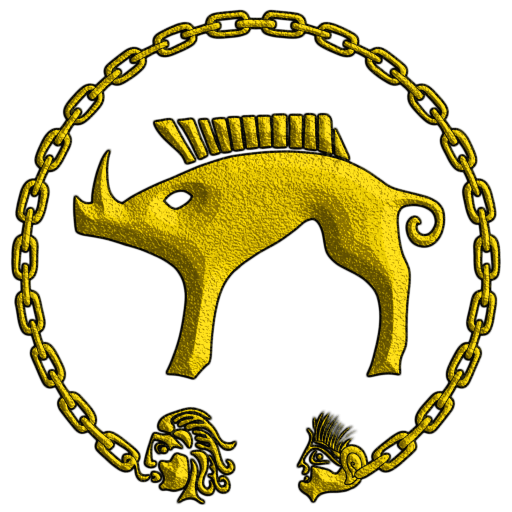
The symbol of Bessus Nouiogalation (BNG) has a few Gaulish elements displayed within it. At the center is a turcos (a boar). The turcos (boar) holds a position of prominence in Gaulish works and displays and is very much associated with them. For us, that means it was important to include it. It is indeed just as common in contemporary works related to the Gauls. The turcos represents galâ (bravery, ferocity in battle) which may explain the widespread prominence and depictions of them from Gaul and beyond.

However, a lonely turcos just wouldn’t do. Our homage to this sacred animal is accompanied by an interesting piece of an account related to Ogmios. Theorized by some scholars such as Ralph Haussler in ‘From Tomb to Temple: the Role of Hero Cults in Local Religion in Gaul and Britain During the Iron Age and Roman Period’ in this entry:

“Indigenous deities like Ogmios appear to be heroes par excellence, comparable to Herakles whose heroic deeds were already known in pre-Roman Gaul. In this view, it should not surprise us that Parthenios of Nikaia considered Hercules to be the ancestor of all Gauls, and that Ogmios could be seen as the god from whom all life originates.”

Ogmios holds a special position in BNG as ancestor of the Gauls. As Galatîs, we too include Him among our diverse ancestors. And so we attempt to reforge this connection in our contemporary environment. For this reason, surrounding the turcos are two heads linked by a golden chain. The head on the left is based on a head found on Gaulish coins that we used in the symbol to represent Ogmios. You can see His tongue being connected to the chain. On the right, you see another stylized head. It is representing a follower of Ogmios, with the chain attached to their ear. This allegory of chains connecting the tongue of Ogmios to the ears of His followers is based on a historical account from Lucian of Samosata. (Full account here.) For the relevant parts:

Our Heracles is known among the Gauls under the local name of Ogmios… [That’s our Ogmios, Lucian!]

This ancient Heracles drags after him a vast crowd of men, all of whom are fastened by the ears with thin chains composed of gold and amber, and looking more like beautiful necklaces than anything else. From this flimsy bondage they make no attempt to escape, though escape must be easy. There is not the slightest show of resistance: instead of planting their heels in the ground and dragging back, they follow with joyful alacrity, singing their captor’s [Hard to say that of the willing, but okay…] praises the while; and from the eagerness with which they hurry after him to prevent the chains from tightening, one would say that release is the last thing they desire.” 

So what we glean here is this: His followers follow Him willingly. They could escape at any time due to the weak bonds but choose not to do so. They follow Him willingly and gladly. This valuable account depicts an important insight into Ogmios and the nature of the followers. Thus we are fortunate to have such a piece of lore preserved.

Like these followers, we Galatîs could choose to break from the bonds of Bessus Nouiogalation (Custom of the New Gauls) if we so chose. These aren’t the chains of force or violence. Sadly far too common in the history and present of our world today. Nor is He guileful or deceitful. His eloquence, His îanolabâ (right speech) is His strength, and so He is followed. Equally so, we try to follow the customs of the Senogalatîs (Ancient Galatîs) in our own time. Freely and willingly. We do our best to make Bessus Nouiogalation available freely and openly to those called to or who desire to be Galatîs. 


Ogmios’s chains bind only the willing who follow Him gladly. However, there are people around the world who do not have such gentle chains. Who are not bound to a Dêuos like Ogmios, but to cruel and barbaric people. As such, if you’d like to help people who have suffered such anuîrolaniâ (injustice), we’d ask you to consider making a datus (donation) here, to the organization ‘Not For Sale’. Which combats human trafficking and provides resources to survivors.