When I first began walking this path — and helping to create it — I remember how overwhelming it felt to look upon the long list of deities within Gaulish Paganism. There were so many names, so many aspects of life represented, that it raised a natural question: how do we decide which deities to incorporate into Bessus Nouiogalation (BNG)?
I myself am a follower of Sucellos and Nantosuelts, another founding member is devoted to Taranis, and another to Carnonos, and so on. It would have been easy to simply include all of our personal favorites and call that our pantheon. But that approach felt too limited. If we were building a new bessus — a new custom, a new toutâ (tribe) — then it needed to be something with deeper meaning, something that reflected not just our individual devotions, but the spirit of the tribe itself.
And then, out of nowhere, Ogmios called to us. He became the voice of our work — the one who guided our words, our inspiration, and our devotion. From there, we began to think of how the ancient tribes may have related to their gods. Each toutâ likely had its own divine patrons: a Toutatis to guard the people, Materês to give life, Regentiâ the ancestors, and others who represented the shared virtues of the community.
It was from that reflection that our core Toutâdêuoi emerged — those who form the heart of our daily rites.
Ogmios, the first ancestor of the Galatîs, the speaker and guide.
Toutatis, the protector of the tribe.
Suleuiâs, the wise guides and keepers of right.
Materês, the life givers and knowers of fate.
Regentiâ, the honored ancestors.
Celtînâ, the mother of virtue.
Carnonos, the guardian between worlds and guide of many ways.
Many of these gods and goddesses were completely new to me, and to us. I didn’t know their stories, their symbols, or how to connect with them. But as time went on, I began to see that these deities are not far from us at all. They are animistic and symbolic, deeply woven into the rhythms of home, self, tribe, and the paths we walk. They are ancestral in a mythological sense, the living currents that have always been. Of course, our devotion doesn’t end with these few. Within our custom, there are many other Deuoi who hold their own sacred places—gods and goddesses who guide us through the seasons, who stand beside us in moments of magic, who embody the virtues we strive for, and who dwell within the natural forces that surround us.
Some Deuoi belong intimately to the tribe (the list above)—they are the core Toutâdêuoi, those whose presence defines and sustains the identity of Bessus Nouiogalation (BNG). Others, while still part of the tribe’s spiritual life, reach beyond it—they are more cosmic, seasonal, personal, or situational, touching wider aspects of life, nature, and spirit that transcend the boundaries of the tribe itself.
Together they form the living web of our devotion, from the hearth to the horizon.
For all initiated members of BNG, these daily rites form a shared rhythm — a way to remain connected with these tribal deities and with each other. It’s important for each of us to know their names and the invocations that call to them, for they represent the common spiritual ground of our community.
That said, your own household devotions may — and should — grow beyond this list. Over time, you might find other deities from the broader Gaulish pantheon, or from your own cultural and ancestral background, who speak to you. That is the natural flowering of practice. But for the tribe as a whole, these rites to the core Toutâdêuoi serve as our foundation — a place where all of us can meet, no matter where our paths lead.
Through these small daily gestures — the offering, the invocation, the quiet moment of reflection — we strengthen our dêuocariâ (piety), nurture Sumatreiâ (good relationship), and keep the flame of Gala alive within ourselves and our community.
At the edge of the village, as dusk drapes the land in violet shadow, a farmer casts a bronze wheel into the spring. His whisper rides the water — a prayer for rain, for fertile soil, for balance — even as the drums of war beat faintly on the horizon, carrying the shadow of Alesia. Behind him, the hearth burns bright; his wife tends the flames, murmuring blessings, while their child fingers a small amber amulet at the neck, a talisman against fate. In the moonlit woods nearby, a healer stoops, cutting herbs with her left hand, honoring the old ways in solemn silence. And on the morrow, a warrior will claim the champion’s cut of meat at the feast, raising his right hand — the sacred hand — in oath before the gods, steel and spirit intertwined, ready to meet the tide of battle at Alesia.
This is a praise story, reflecting the everyday life of the Gaul on the eve of the fall of Alesia — a moment to honor the ordinary acts, the quiet rituals, and the courage woven into daily life. As we move towards October 4th, which is a time to honor those at Alesia, let’s all light a candle to remember and honor those Senistrei.
The Rite: This is using our Molātocridiū and inspiration from our Gaulish brother D’ian.
Cleanse: This prepares you physically and spiritually for ritual.
Wash hands and say: Glanolamâs “Clean hands”
Swipe your forehead and say: Glanobritus “Clean mind”
Swipe down the face with both hands and say: Glananation “Clean soul” (This is based on the idea of the soul residing in the head.)
Light Candles: Light a candle or candles in honor of the ancestors. (if you can keep the candle burning do so (unless you have cats lol)
Turn Left: Begin by turning to the left once. This shifts your orientation toward the ancestral realm.
Invoke the Ancestors (while lighting incense):
Gaulish: Senomaterês etic Senaterês . Senoueniâs
English: Old mothers and old fathers . Old families
Libation: Pour a small amount of your drink onto the ground or in cups as an offering, then take a sip yourself.
Right-Hand Kiss: Kiss your right hand and place it on the ground in honor of your ancestors.
Turn Right: Turn to the right to symbolically leave the otherworld. This ensures a safe return from the ancestral realm.
Sit in silence, allowing a sacred silence to fall. Listen for omens and the voices of the ancestors.
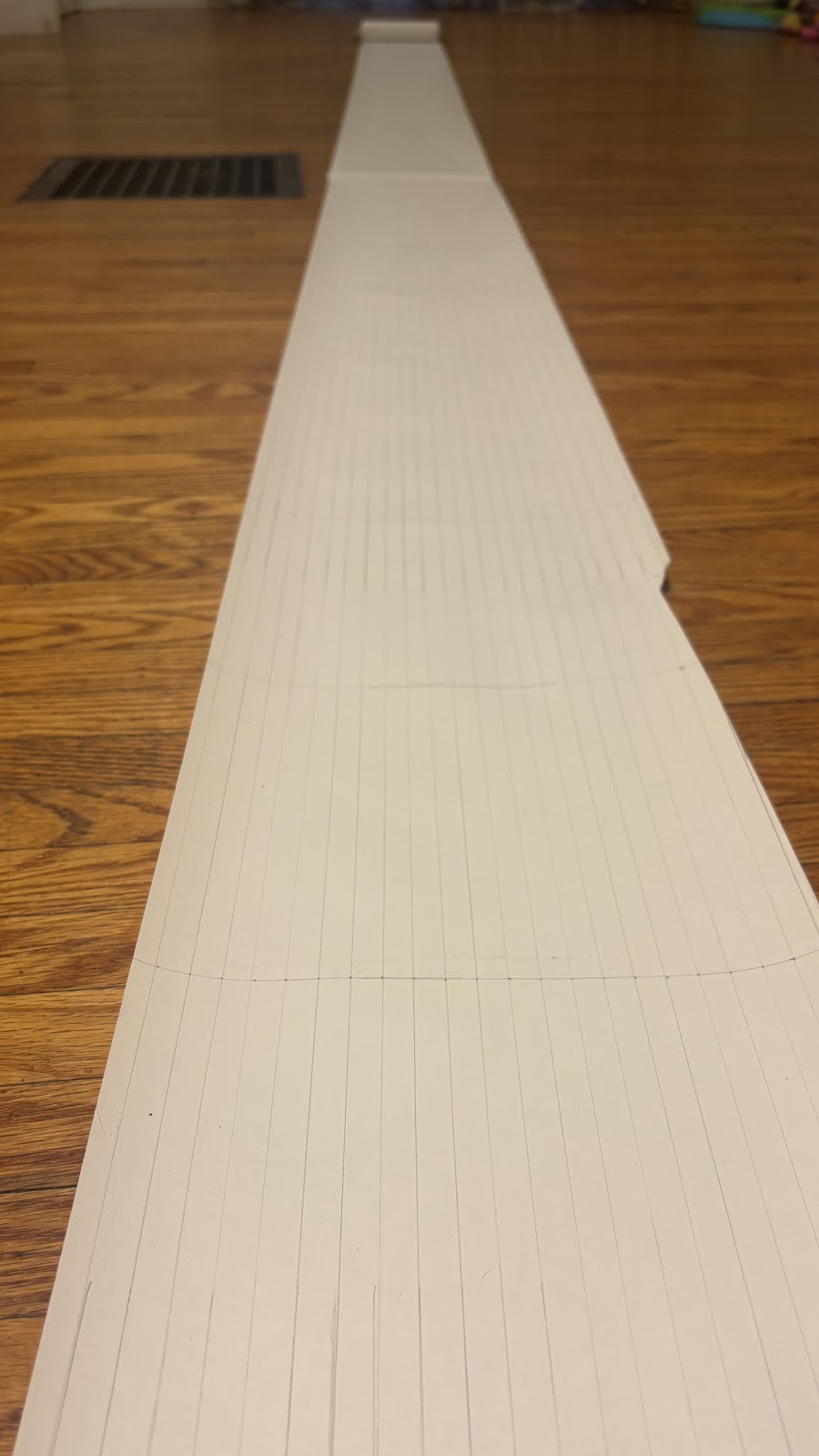
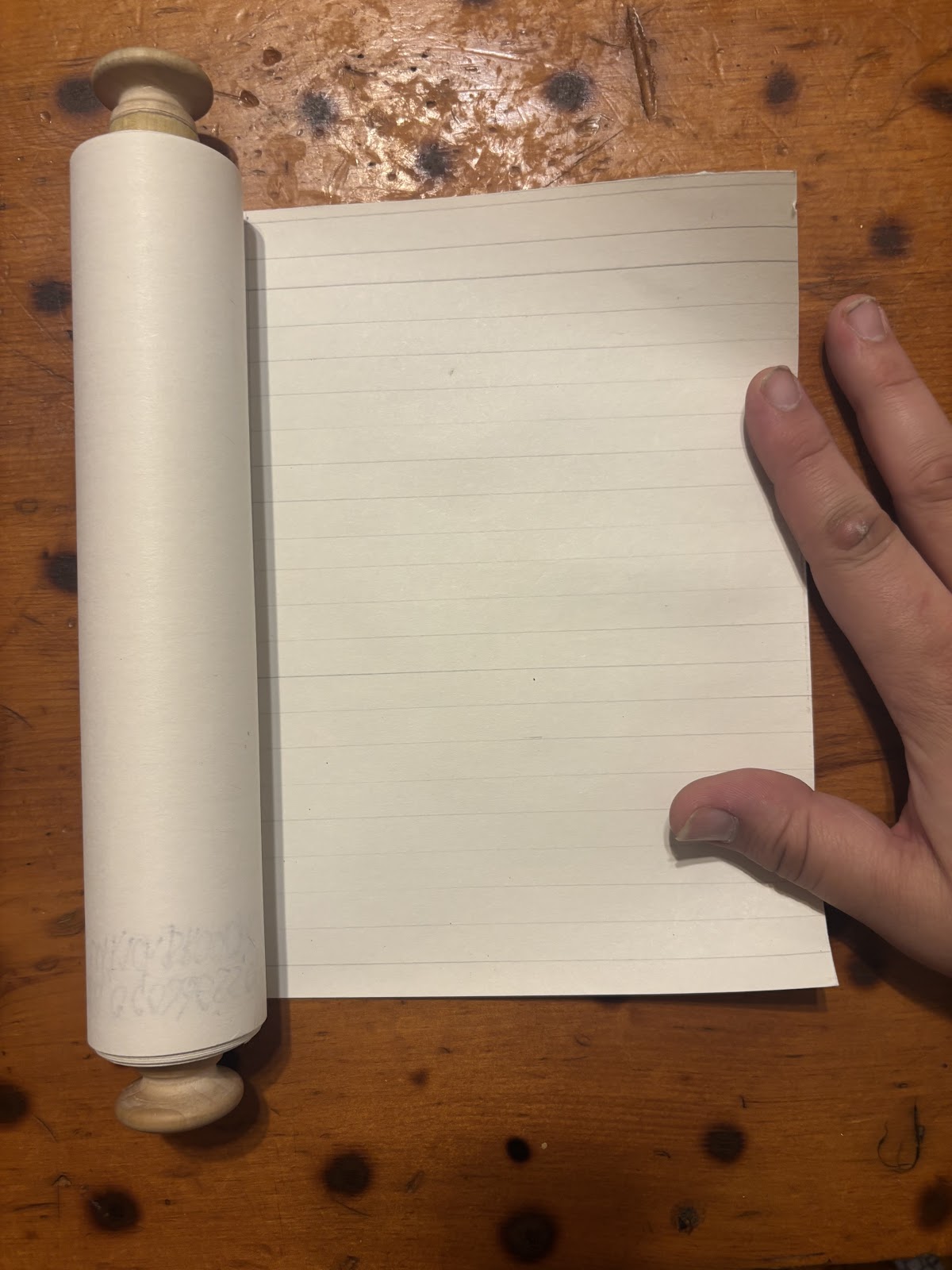
A 20 foot long blank lined scroll, approximately 2/3 of the way unrolled
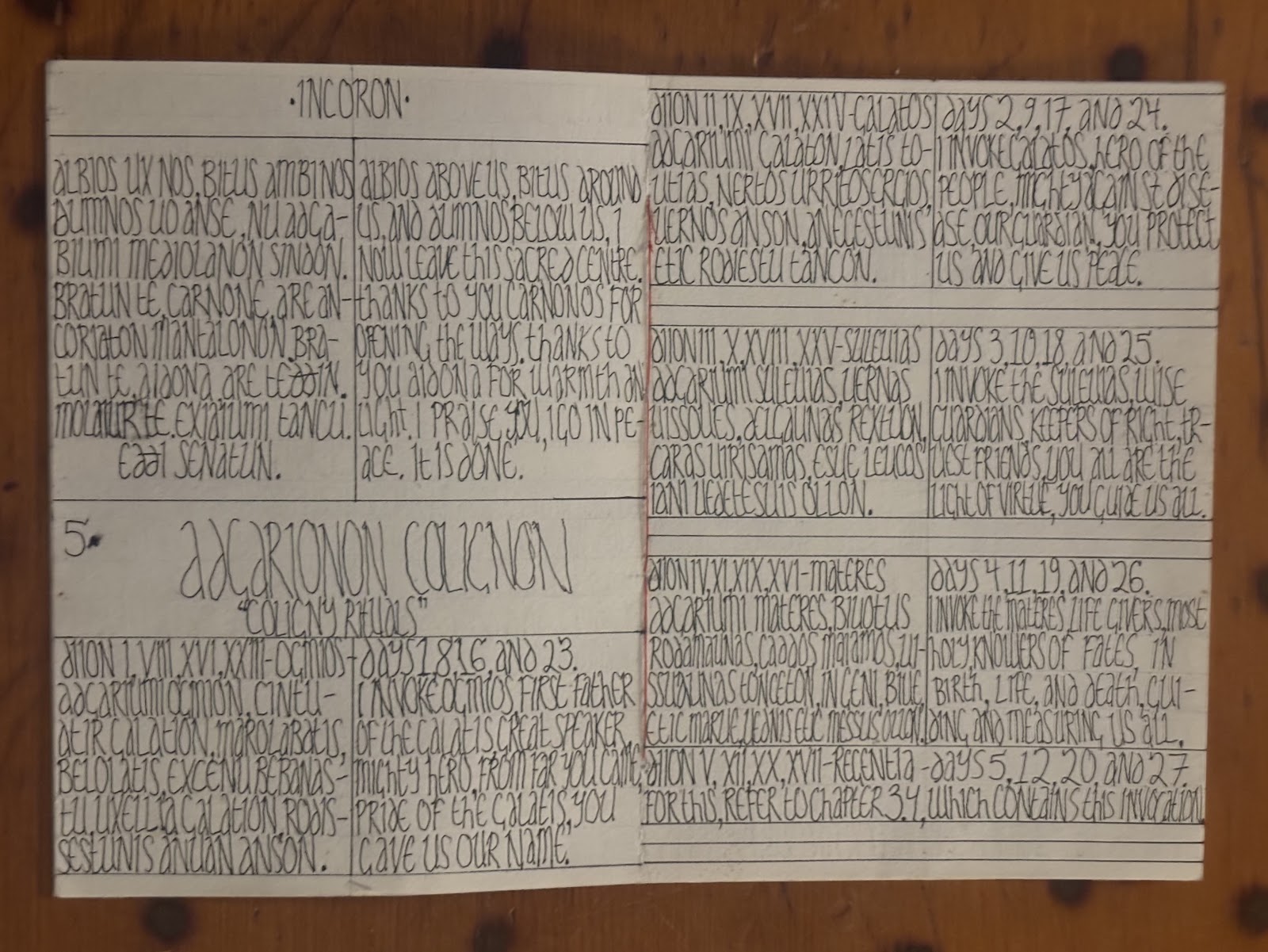
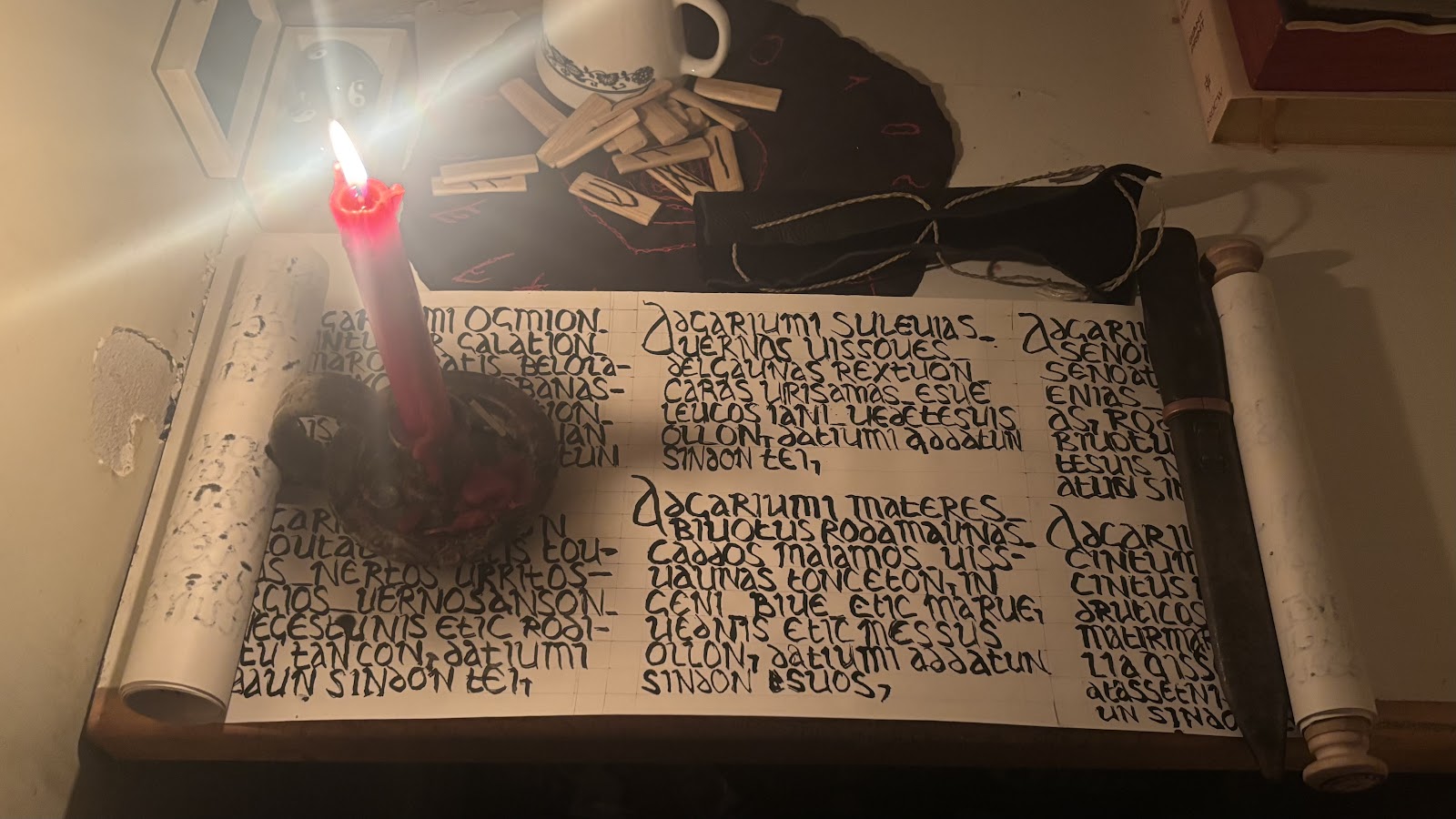
I’ve been practicing calligraphy lately and I really wanted to dig into how I should mix that in with a handmade writing medium, plus I needed a new altar tool for my daily practices anyway, so I decided to put down the entire “run” of daily rites for Bessus Nouiogalation, 1 whole week’s worth with a little personal flair.
The grand sum of Dēuoi, or deities, acknowledged in the daily rites throughout a week is 8, counting (in order of appearance on the scroll) Aidonā, Carnonos, Ogmios, the Toutatis Galatos, the Suleuiās, the Materēs, the Regentiā, and Celtinā. I wanted to do the script fully in the Iextis Nouiogalaticos, or tongue of the new galatis, and so I set out to figure out how in the heck to make that a thing.
An early (scrapped) prototype of a Gaulish book of shadows.
Let’s be real with ourselves, I’m a huge freakin’ history nerd, almost to a fault. I rock around in a belted plaid, I carve little wooden figurines for my kids, I make meals and bread based on historical finds – honestly, if I’m gonna try something new, I look for as old a tutorial as I’m capable of finding. I can confidently say that I enjoy a challenge.
I’ll even carve a rock if I’m sufficiently inspired (or bored).
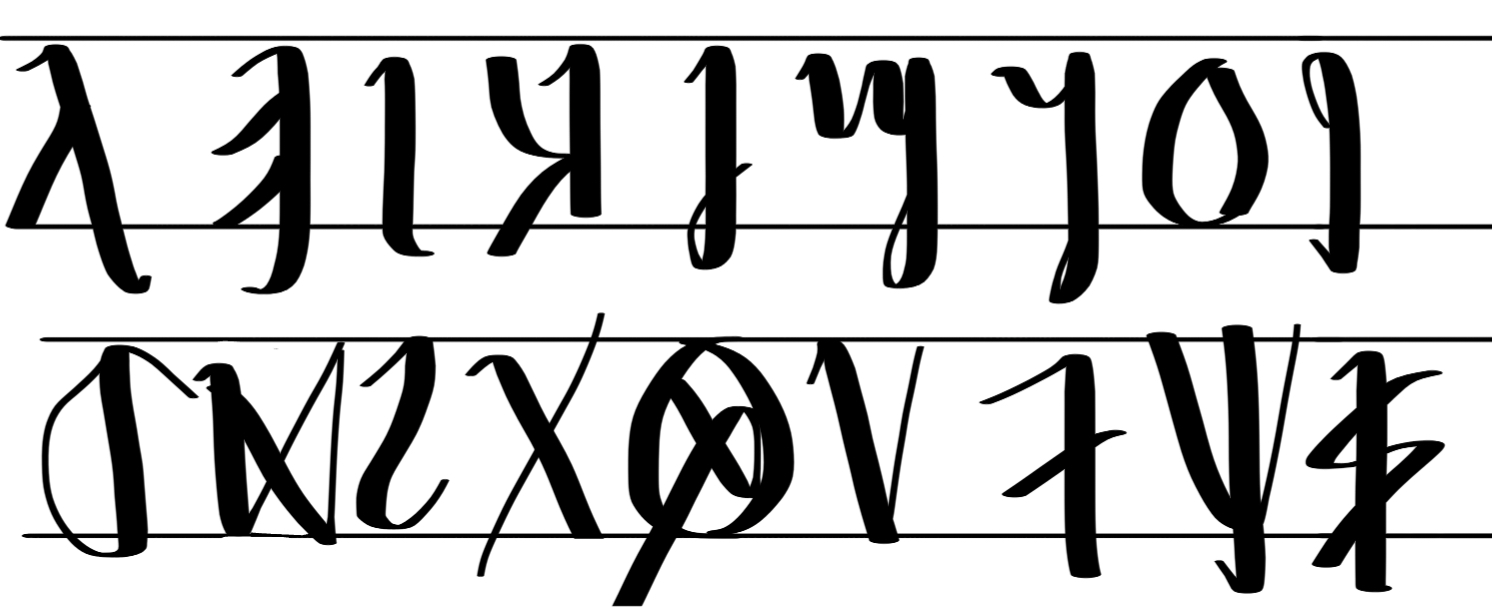
I went as far as to create an entire branch-off from the Lepontic runoi commonly used among Gaulish polytheistic practitioners, and mixed them with uncial calligraphy’s flowing, almost-liquid script. It can even go frontwards and backwards, that’s the sort of rabbit-hole it seems I’ve become used to diving down on a regular weeknight – I don’t mind, honestly! (I’m sure I’ll share this script in a later post, so stay tuned..)
An early work-up of the 18 characters, before I got things dialed in.
I’ll come back from the tangent now, but a challenge is NOT what I would define scrollmaking as!
I see people all over the internet making a Book of Shadows here, a practice journal there, and I must say, it’s always been something that appealed to me, although my practices aren’t quite so complicated as to fill a whole book from cover to cover, and so I wanted to search for other options that resonated with me and reflected the tone of a religion from thousands of years ago. That was when I settled upon scrolls, inspired by the large amount of them scattered across ancient-themed Hollywood sets, and I wanted to know more.
Tough luck, Caromāros, not a snowball’s chance!
The definition of a “scroll” is a riddle, wrapped in a mystery, inside an enigma. Lame try at humor aside, Oxford Languages describes the noun “scroll” in the context of a writing surface as “a roll of parchment or paper for writing or painting on.”. Notice the lack of any form of “thing” to roll that parchment or paper upon? I sure did.
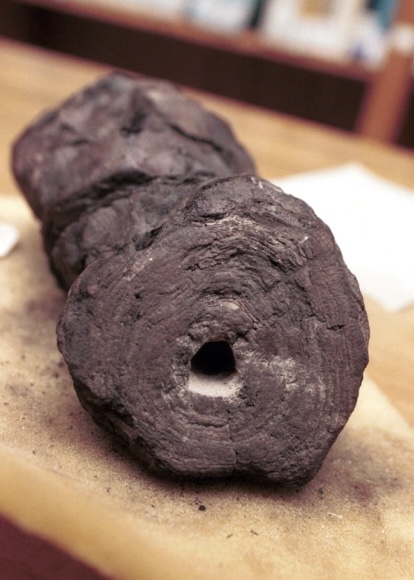
A scroll found at the Villa of Papyri in Herculaneum.
I then had to look into it more, and Carla Hurt, the writer of this blog post on foundinantiquity.com, brought up some very good points when referencing Roman scrolls, found both in-situ as well as in media depictions. From the layers of volcanic ash that covered the Villa of the Papyri in Herculaneum, enough preservation was granted to give us carbonized scrolls that were written “back in the day”, and none of them have wooden bars in them.
Additionally, Carla points to the Roman marble statue of Sophocles, an ancient copy of a Greek statue from the 4th century B.C.E., which depicts Sophocles (surprise!) with a bag of scrolls (also a shock, I know!). One thing noticeable from this statue that pertains to our topic here is that the scrolls all finish in a flat end and are all the same length, insinuating that there was no rod or bar in these scrolls either.
Sophocles’ scrolls, by his feet.
This is all great work, and it’s super helpful for anyone who genuinely wants to create something right out of history, but I wanted to make something that I would be capable of holding in my own hands, pass around to people, put in my bag and bring with me to different places, all without worrying about it being crushed or bent. I think the reason that all these prop-masters have enforced the idea of a scroll with a bar is the durability that it adds – you simply wrap the paper or parchment tight around the bar, tie it off, and now you’re clear of the risk! It also gives you something to help wrap it up with, as you can turn the knobs on the end of the bar as you would a dial, yet the fancy embellishments are unnecessary if you’re just going for something that will keep your work safe.
The actual creation of the scroll, the reason for this whole post, is probably the simplest thing you can do. Like, I wrote this whole wall of text for gluing paper onto a stick, people. There isn’t much to it, I swear!
I got a roll of paper 9 meters (30 feet) long, and then I figure out how wide I want the whole scroll to be – let’s say a standard paper width of 8.5 inches. I then unroll the paper to a manageable length, because it’s DAMNED long, and mark the paper suitably with a pencil and ruler. You just need to measure up from one end to the desired distance, put a dot on the paper, and then once you’ve reached your desired length off of the roll, go back and connect all the dots. Take your ruler again, put something disposable like an old board underneath where you’re going to make your cut, and get a really sharp knife to make the cut.
That’s it. The paper is in a roll, it naturally wants to roll back up on itself, and going off of the way that scrolls were made historically, you can call it done at this point and walk away with something straight out of a monastery. I figured I’d go further though, so get yourself a piece of hardwood dowel from the big box store, cut it down to 25.5 centimeter (10 inch) long, and then pop some cabinet knobs onto the ends of it with superglue.
One rod with the top knob glued on, pre-sanding, next to another that is yet to be finished.
You’ll find that the cabinet knobs don’t quite match the size of the dowel, they’ll be smaller, so that’s why we went longer on the rod – so that we can sand it down to a smooth transition! Just make sure you mark where the paper will be, and don’t go into that zone, or you’ll have some difficulties when it comes to the next part.
Once your ends are sanded, you’ve applied any finishes or stains that you want, and you’re pleased with the result, take the superglue again and glue down one end of the paper onto the rod. Set it all up so that the rod goes in between the part you’re gluing and the rest of the scroll, which will help the scroll want to roll the right way – if you don’t do this, it’s fine, it just takes more effort to roll it until the paper gets used to the new curve! Get it all rolled up, and now you can do whatever else you’d like.
When you go to write on it, if you want it horizontal, just unroll it with the bar on the right and the paper going out towards the left (unless you’re writing in a left-facing script, in which case flip it so the bar is on the left and the paper goes rightwards.). At this point you can go back through the scroll and mark your pages and your lines with ruler and pencil, and once you’ve written with ink you can erase the pencil from the page, or leave it.
Orientation for right-facing writing.Orientation for left-facing writing.
If you’d rather the scroll gets held at the top and goes downward, like the image in the collective mind of what a town crier looked like, then you can forego pages and just mark your lines, the pages are just so you don’t have to unroll 5 feet of paper to finish a single paragraph!
Scroll orientation for top-down writing (can be left-or right-facing).
Now what the heck are you still doing here?! You just read an entire blog post on how to make a scroll, clearly you’re interested! Go roll up some paper and write on it already!
My scroll in use. I’d love to see yours when you finish!
I want to take a moment to share with all of you, whether you’re part of BNG or simply watching our journey unfold.
When BNG was first forming, three of us came together to shape what we hoped would be a living spiritual path rooted in Gaulish polytheism. At that time, we didn’t have a shared framework. Each of us brought our own cosmology, our own devotions, and our own understandings of the Deuoi. We came together with Sucellos, Taranos, Artio—gods who had long stood at the centers of our individual worship. It was a challenge just getting into the same spiritual rhythm.
And then something unexpected happened.
We didn’t summon Ogmios. We weren’t studying him. In fact, none of us had given him much attention at all. But like a quiet figure at the edge of a firelight, he stepped forward. Not loudly. Not in a flash. Just… undeniably. At first, it was disorienting. Ogmios pulled us out of our comfort zones. He demanded precision in speech, integrity in action, and courage in communication. He wasn’t interested in idle devotion or vague platitudes. He wanted us to speak clearly, to live virtuously, and to teach with purpose. And so, without ever formally choosing him, he became the guiding force of BNG. Our symbol became based on him. Our foundational teachings were shaped around his example. And over time, as our prayers took form and our doctrines unfolded, the presence of Ogmios wove itself into every part of what we were becoming. Eventually, the other founders stepped away, each for their own reasons, and I became the last of the original three still walking this path. Others came in to take up the work of the Delgaunoi, the Keepers of the Bessus, but Ogmios remained constant. And somewhere along the way, something even more unexpected happened: he stopped being just the guide of BNG and became the god who reshaped me.
You see, I never loved writing. Language, grammar, the art of shaping thoughts into words—it all felt like a burden to me. I stumbled through it. I avoided it. I didn’t think it mattered as much as action or devotion or feeling. But Ogmios thought otherwise. He became a teacher to me, in the truest sense of the word. Not one who scolded or demanded, but one who held up a mirror and asked, “What do you really mean?” He walked beside me as I tried, failed, rewrote, and slowly—painfully—learned how to find my voice. He didn’t just help me write better. He taught me how to think better. To refine my thoughts, to examine them, and to take responsibility for what I said. Every sentence became an offering. Every carefully chosen word, an act of devotion. Through Ogmios, I came to understand that language is a spiritual tool. It can heal. It can destroy. It can liberate or bind. And the ethics of language—truthfulness, clarity, restraint, kindness—became virtues I had to cultivate. Not just as a writer or a teacher, but as a Druid, as a human being.
In time, Ogmios taught me that the power of speech isn’t about sounding wise or being persuasive. It’s about alignment. It’s about having your words, your actions, and your soul all point in the same direction. He helped me recognize that virtue isn’t just what we do—it’s how we speak, how we teach, how we build and share meaning. And so now, Ogmios stands at the center of BNG—not just as a divine presence, but as the architect of its soul. He shapes our devotion, but also our structure, our ethics, and our discipline. He is the god of the tethered tongue and the unshakable virtue. And he is, without question, my god. I didn’t expect to be his devotee. I didn’t expect him to be mine. But that’s the nature of the gods. We may set out looking for them, but sometimes, they’re the ones who find us.
Through BNG, Ogmios has made me a speaker. Through Ogmios, BNG has become a tradition of voice, virtue, and vision. And through all of it, I have come to realize that we are not just followers of the gods—we are their students.
You may have noticed a flurry of updates and changes on the BNG site — and yes, you’re right! We’ve been hard at work behind the scenes, polishing, expanding, and breathing new life into several areas of the site.
Bessus Nouiogalation is a living tradition. That means our bessus — our custom — is always evolving. As we grow, reflect, and refine, so too does the space that holds our work. This round of updates has brought more cohesion, deeper content, and finally, the completion (well, for now!) of some projects that have been patiently waiting their turn.
Here’s a quick rundown of what’s new:
New and Updated Sections
Bessus (Custom) This section has been reorganized for better clarity and flow.
Tegobessus (House Custom) Intro Now complete (at least until we inevitably add more!). This is a major update that brings the full personal practice section into the light. Full content list
Morisenon A new deity entry has been added, honoring Morisenon and their place in our living pantheon.
Morisenon Uēdiās (Prayers) Along with the deity page, we’ve added a collection of prayers for and to Morisenon.
Caddoi Senuî (Sacred Symbols) This is a new section exploring sacred Gaulish symbols. It’s still in progress, but already has some rich insight to explore.
Tegosnamon – Myth of the Home Added to the Bessus Nouiogalation Myths section, this new entry encourages you to reflect on and build your own house mythology as part of your spiritual practice.
Community Reflections
We’ve also added the Uirā Toutionon section — a place for members of our Touta to share insights, reflections, poems, and thoughts on BNG practice. This is your space to help shape and reflect the living tradition.
New Orders: Slougoi
This one has been in the works since BNG began — and it’s finally happening!
Slougos Uation (Order of the Uatis) – Coming soon.
These Slougoi will allow members to dive deeper into particular paths within BNG, reflecting different roles and areas of focus.
Coming Soon: Tegobessus Booklet
We’re currently preparing an offering for the Gaulish Polytheism website community: a downloadable booklet on Tegobessus — designed to help people create and cultivate their personal house custom. Stay tuned!
BNG continues to grow because of all of you — your passion, your practice, and your presence. Every prayer, every question, every reflection adds to the whole. We’re grateful you’re walking this path with us.
You give so that we may give. And we give so that you may give.
First is Ogmios, whom we honor as the great spiritual ancestor of the community—wise of word, strong of spirit. I see him as a divine father, the one who guides us with the golden chains of eloquence.
Toutatis Galatos is BNG’s guardian, the protector of our people, born of Ogmios. He watches over the tribe with steadfast care, standing at the heart of our shared path.
The Suleuias walk beside us as the seers and soul-guides of the community. They bless the hearth and help steer the course of our decisions with wisdom and grace.
The Materes are the deep forces of fate, weaving the threads of life and time. Yet like Galatos, they, too, are guardians—ever-present among the people and the land.
The Regentia are the honored dead—not just our ancestors, but the noble ones of memory. Their names echo through time, like Ambicatus, whose legacy inspires and shapes our steps.
Celtînâ is the radiant mother of Galatos and the beloved of Ogmios. She stands as the first mother of the Galatis, strong in valor, shining with beauty, a living image of the virtues our people hold most dear.
Carnonos, last in this honored line, is keeper of the threshold and opener of the rift between the worlds. To him, we give respect, for through his ways, we walk from this realm to Antumnos.
Dis Pater, meaning “Rich Father,” is a mysterious and ancestral god mentioned by Julius Caesar, who wrote that “all the Gauls claim descent from Dis Pater.” But Caesar never told us who this god was.
While “Dis Pater” is a Roman term, in BNG we do not equate it with the Roman god of the underworld. Instead, we interpret the phrase as Caesar’s attempt to capture a native concept.
In Roman tradition, Dis Pater is a god of the underworld, wealth, and ancestral lineage — often associated with Pluto or Hades. In the Gaulish context, however, the identity of Dis Pater remains unclear. Scholars and practitioners have linked him to gods like Sucellos, Taranos, Ogmios, Carnonos, or even mythic ancestors like Celtus. Each carries a piece of the mystery.
In Bessus Nouiogalation (BNG), we don’t claim to know exactly who Dis Pater is. Instead, we recognize him as a sacred role, a divine mystery that speaks to ancestry, transition, and cosmic order. Dis Pater is not one god but a function filled by many — or by one whose name has been lost to time.
Ultimately, we believe each soul may come to know their own Dis Pater — the one who walks beside you in silence, who guides your soul between worlds, and who whispers the ancient truths that shape your path.
As mentioned above in Commentarii de Bello Gallico, Julius Caesar wrote that “all the Gauls claim descent from Dis Pater.” It’s a cryptic and powerful statement — one that has echoed down through the centuries and become a source of speculation, reconstruction, and inspiration among modern Gaulish pagans.
Who was this Dis Pater, this “Rich Father” of the Gauls? Is it Ogmios, Celtus, Sucellos, Smertrios, Carnonos, or Taranos?
All these have been discussed as the Dis Caesar may have meant. Why? Because each bears a connection — through iconography, etymology, or mythic function. I won’t dive into the academic weeds here (perhaps on my personal site), but instead offer how Bessus Nouiogalation (BNG) sees it.
In BNG, we choose not to pin down this ancestral god with a single identity. We do not say who the Gaulish Dis Pater is, because we do not believe he can be fully named. To do so would be to close the door to mystery, and in BNG, mystery is part of the sacred order of things.
Instead, we hold space for several figures who might reflect the role or radiance of this hidden Dêuos — not one name, but a constellation of them.
These are not contradictions. They are facets.
Ogmios: The Father of the Gauls
In BNG theology, Ogmios is honored as the Father of the Gauls. He is the god of powerful speech, binding his followers not with chains of iron, but with chains of golden words. A god of wisdom, silence, endurance, and radiant strength — he leads not through fear, but through persuasion and insight. Ogmios is not just a god of eloquence — he is the one who calls the tribes into being. He teaches, names, and guides. He sets the tone for our shared ethos: to live with honor, wisdom, and clarity, even in silence. As the divine father, Ogmios doesn’t thunder — he whispers truths that shape nations.
He may be Dis Pater as the one who calls us into being, who names the tribes, and binds us in golden truths.
Galatos: The Divine Ancestor
We recognize Galatos as a mythic figure central to Gaulish identity — our culture hero and divine ancestor. Galatos, in BNG thought, is not a historical figure. He is a mythic construct, born from multiple streams of lore and gnosis:
From the Greek Celtus myths, in which a legendary son gives rise to the Celts.
From the martial and protective powers of Smertrios, a god of strength and battle.
From the communal, rooted spirit of the Toutatis — the tribal protector and embodiment of the people as one.
He may be Dis Pater as the first of us, born of the land and tribe, carrying the spirit of our people forward.
Sucellos: The First to Enter Dumnos
We also see Sucellos as deeply entwined with this mystery — though in a more veiled and liminal role. In BNG mythopoesis, Sucellos is one of the first to pass into Dumnos, the Deep — and then into Antumnos, the Otherworld, the Ancestral Realm, the place of mystery and return. He is “the Well-Hidden One,” a god of quiet fertility, fermentation, and transformation. While his name may literally mean “the good striker,” we also reflect on kel- as “to hide,” and see in him the Keeper of What is Secret. Sucellos is not the father of the Gauls in a literal sense. He is the first ancestor — the one who precedes descent, who holds the memory of what came before, and who carries the keys to what lies beyond.
He may be Dis Pater as the hidden one, the first to pass into mystery, who waits for us in the deep places beyond life.
Carnonos: The Liminal Lord
We recognize Carnonos as a Dêuos of liminality and movement, one who dwells at the edges — of civilization and wilderness, of life and death, of seen and unseen. He is a guide, a guardian, a traveler. In BNG thought, Carnonos is not merely a forest god, but a keeper of transitions, a psychopomp who can move between this world and Antumnos, the Otherworld. His antlers crown him as one who listens beyond speech, who leads without words. He is flanked by animals, rooted in place, yet always moving through thresholds.
He may be Dis Pater as the one who walks between worlds, helping us cross when we must — and guiding us back when we are lost.
Taranos: Bringer of Virtue and Cosmic Order
Taranos is the great celestial Dêuos in BNG — the one whose thunder reminds us of the power of virtue and the need for cosmic balance. We honor him not only as the god of storm and sky, but as the one who maintains the order of the world through the gift of the Îanoi — the virtues. His mythic triumph over the serpent speaks to his role in shaping and protecting the structure of reality, setting boundaries between Samos and Giamos, between life and death, peace and chaos. The wheel is his symbol — ever-turning, many-spoked, always whole. Through it, Taranos teaches that strength lies in balance, that storm brings both destruction and renewal.
He may be Dis Pater as the giver of law, of structure, of insight — the thunder that wakes the soul.
The Dis Pater as a Sacred Role, Not a Single Being
So who, then, is the Gaulish Dis Pater of our bessus?
In Bessus Nouiogalation, we say this: He is not a Dêuos of one name — he is a sacred role, a sacred function, a mystery.
He may be Ogmios, whose golden chains bind hearts to truth.
He may be Galatos, the first of us, born of strength and tribe.
He may be Sucellos, the smiling god who walks unseen into the Otherworld.
He may be Carnonos, guiding us through the veil.
He may be Taranos, striking thunder into our bones to awaken us.
He may be all of these — or none of them.
Conclusion: In the Silence, the Father Speaks
Each of the Deuoi has a sacred function in the cosmic order of things. For us, it’s about your own relationship to that deeper presence. The Gaulish Dis Pater remains unnamed in our tradition — not out of vagueness, but out of reverence. To name is to limit — and this god is too large, too deep, too intimate to be held in a single form. Each of us may encounter him differently — and that, too, is sacred.
In Bessus Nouiogalation, we also honor that your Dis Pater may not be any of the Deuoi listed above. He/She/They may come to you as another figure entirely — a guardian, a guide, a Deuoi whose name has been lost or never spoken aloud. What matters is not the name, but the role — the sacred presence of a divine ancestor who shapes, shelters, and calls you home.







 Bessus Nouiogalation