Poetic Reflections on the Virtues of BNG — The Îanoi of Bessus Nouiogalation

Branos Carnutodrûidion. Gaulish Polytheism. Gaulish Paganism

Written by Branos Carnutodrûidion/Urādos – Gutuatir of BNG


A short reflection on our virtues.

  • Dêuocariâ – Piety
    It is our sacred breath, offered with every flame.
  • Luxtiâ – Duty
    It is our place on the Wheel — the role we rise to with steady hands.
  • Uissus – Wisdom / Knowledge
    It is the soul’s pursuit, carried through the long journey of becoming..
  • Îanolabâ – Right Speech
    It is the voice that sounds like the Carnux — clear, bold, and meant to be heard with purpose.
  • Doniocariâ – Compassion
    It is the open hand extended in love.
  • Oigetocâriâ – Hospitality
    It is the warm hearth that never turns away a guest.
  • Raton – Generosity
    It is the gift that keeps the wheel unbroken.
  • Uiridios – Truth
    It is the still water that reveals all things, clear and undistorted..
  • Decos – Honor
    It is the quiet torc we wear in the unseen.
  • Uîrolaniâ – Justice
    It is the spear we raise for the silenced.
  • Galâ – Bravery
    It is our inner fire — steady, defiant, and unwavering in the storm.
  • Ûxelliâ – Pride
    It is the banner we carry into the world.

Ogmios Walks Beside Me — How the God of Speech Shaped Bessus Nouiogalation

Branos Carnutodrûidion. Gaulish Polytheism. Gaulish Paganism

Written By Branos Carnutodrûidion/Urādos – Gutuatir of BNG


I want to take a moment to share with all of you, whether you’re part of BNG or simply watching our journey unfold.

When BNG was first forming, three of us came together to shape what we hoped would be a living spiritual path rooted in Gaulish polytheism. At that time, we didn’t have a shared framework. Each of us brought our own cosmology, our own devotions, and our own understandings of the Deuoi. We came together with Sucellos, Taranos, Artio—gods who had long stood at the centers of our individual worship. It was a challenge just getting into the same spiritual rhythm.

And then something unexpected happened.

We didn’t summon Ogmios. We weren’t studying him. In fact, none of us had given him much attention at all. But like a quiet figure at the edge of a firelight, he stepped forward. Not loudly. Not in a flash. Just… undeniably. At first, it was disorienting. Ogmios pulled us out of our comfort zones. He demanded precision in speech, integrity in action, and courage in communication. He wasn’t interested in idle devotion or vague platitudes. He wanted us to speak clearly, to live virtuously, and to teach with purpose. And so, without ever formally choosing him, he became the guiding force of BNG. Our symbol became based on him. Our foundational teachings were shaped around his example. And over time, as our prayers took form and our doctrines unfolded, the presence of Ogmios wove itself into every part of what we were becoming. Eventually, the other founders stepped away, each for their own reasons, and I became the last of the original three still walking this path. Others came in to take up the work of the Delgaunoi, the Keepers of the Bessus, but Ogmios remained constant. And somewhere along the way, something even more unexpected happened: he stopped being just the guide of BNG and became the god who reshaped me.

You see, I never loved writing. Language, grammar, the art of shaping thoughts into words—it all felt like a burden to me. I stumbled through it. I avoided it. I didn’t think it mattered as much as action or devotion or feeling. But Ogmios thought otherwise. He became a teacher to me, in the truest sense of the word. Not one who scolded or demanded, but one who held up a mirror and asked, “What do you really mean?” He walked beside me as I tried, failed, rewrote, and slowly—painfully—learned how to find my voice. He didn’t just help me write better. He taught me how to think better. To refine my thoughts, to examine them, and to take responsibility for what I said. Every sentence became an offering. Every carefully chosen word, an act of devotion. Through Ogmios, I came to understand that language is a spiritual tool. It can heal. It can destroy. It can liberate or bind. And the ethics of language—truthfulness, clarity, restraint, kindness—became virtues I had to cultivate. Not just as a writer or a teacher, but as a Druid, as a human being.

In time, Ogmios taught me that the power of speech isn’t about sounding wise or being persuasive. It’s about alignment. It’s about having your words, your actions, and your soul all point in the same direction. He helped me recognize that virtue isn’t just what we do—it’s how we speak, how we teach, how we build and share meaning. And so now, Ogmios stands at the center of BNG—not just as a divine presence, but as the architect of its soul. He shapes our devotion, but also our structure, our ethics, and our discipline. He is the god of the tethered tongue and the unshakable virtue. And he is, without question, my god. I didn’t expect to be his devotee. I didn’t expect him to be mine. But that’s the nature of the gods. We may set out looking for them, but sometimes, they’re the ones who find us.

Through BNG, Ogmios has made me a speaker. Through Ogmios, BNG has become a tradition of voice, virtue, and vision. And through all of it, I have come to realize that we are not just followers of the gods—we are their students.

Site Updates: 25 Samonios 2607

You may have noticed a flurry of updates and changes on the BNG site — and yes, you’re right! We’ve been hard at work behind the scenes, polishing, expanding, and breathing new life into several areas of the site.

Bessus Nouiogalation is a living tradition. That means our bessus — our custom — is always evolving. As we grow, reflect, and refine, so too does the space that holds our work. This round of updates has brought more cohesion, deeper content, and finally, the completion (well, for now!) of some projects that have been patiently waiting their turn.

Here’s a quick rundown of what’s new:

New and Updated Sections

Community Reflections

We’ve also added the Uirā Toutionon section — a place for members of our Touta to share insights, reflections, poems, and thoughts on BNG practice. This is your space to help shape and reflect the living tradition.

New Orders: Slougoi

This one has been in the works since BNG began — and it’s finally happening!

We’ve launched the first Slougos (Order/Group)

These Slougoi will allow members to dive deeper into particular paths within BNG, reflecting different roles and areas of focus.

Coming Soon: Tegobessus Booklet

We’re currently preparing an offering for the Gaulish Polytheism website community: a downloadable booklet on Tegobessus — designed to help people create and cultivate their personal house custom. Stay tuned!


BNG continues to grow because of all of you — your passion, your practice, and your presence. Every prayer, every question, every reflection adds to the whole. We’re grateful you’re walking this path with us.

You give so that we may give. And we give so that you may give.

Gaulish Polytheism, Gaulish Paganism

— Branos Gutuatir

Tegobessus IV: Adaððus aidoniâs (Hearth Rite)

The Hearth Rite is a central pillar of your Tegobessus. It strengthens many aspects of your custom and serves as a direct line of connection to the sacred. While personalization is welcomed, all members of Bessus Nouiogalation (BNG) are encouraged to know and perform the Adaððus Aidoniâs regularly. In doing so, we tend our relationship with the Dêuoi and reinforce the spiritual bonds that connect our scattered homes into a unified Touta.

Few rites are as foundational as the Adaððus Aidoniâs (Read more in-depth about this rite HERE) — the Hearth Rite. Rooted in the veneration of Aidonâ, the sacred hearth-flame and Deuos of the home, this rite ties our daily and weekly rhythms to the divine center of our lives. Aidonâ is ever-present wherever the flame is lit: whether in a traditional hearth, a candle on your shrine, or a small devotional fire — she is there.

But hearth rites are more than routine. They are an act of cosmogony. Every motion, word, and offering reaffirms your place in the cosmos. Through this rite, we enact the world’s ordering, mirroring creation itself and grounding ourselves in the eternal dance of Samos and Giamos.

To keep this practice accessible to all, BNG follows a simple, meaningful format:

  • Invocation of the Three Realms of Drus — Albios, Bitus, and Dubnos
  • Offering of Ponem (Mugwort), for purification and sacred connection
  • Presence of Carnonos, Deuos of the in-between, as Gatekeeper between realms

What follows is the core version of the BNG Hearth Rite. It can be adapted as your own custom grows, but this form serves as a shared ritual foundation — simple, meaningful, and powerful.

Each Galatis is encouraged to perform this rite at least once a week. It nourishes Dêuocariâ (Piety), Luxtiâ (Duty), and Decos (Honor), anchoring your home within the sacred rhythm of our tradition.


How to Perform the Hearth Rite

This version of the Hearth Rite features an invocation to Galatos, the Toutatis of BNG, but it may be adapted for other deities (Dêuoi), Regentiâ (Ancestors), or Bituatî (Land Spirits). Additional Invocations can be found HERE.

1. Glanosâgon (Purification)

  • Wash hands: Glanolamâs — “Clean hands”
  • Swipe forehead: Glanobritus — “Clean mind”
  • Swipe down face: Glananation — “Clean soul”

This symbolic cleansing prepares us to enter sacred time and space.


2. Louceton (Lighting the Flame)

  • Light your Dagilâ (hearth candle or flame).
  • Say: Dauiûmî aidun sondon Aidoniâs — “I light this flame of Aidonâ”

3. Establishing Sacred Space

  • Circumambulate sunwise (clockwise) around the flame 3x with Ponem (Mugwort), lit from the flame.
  • Visualize Drus: its roots in Dubnos, trunk in Bitus, branches in Albios.

Say:

Gaulish:
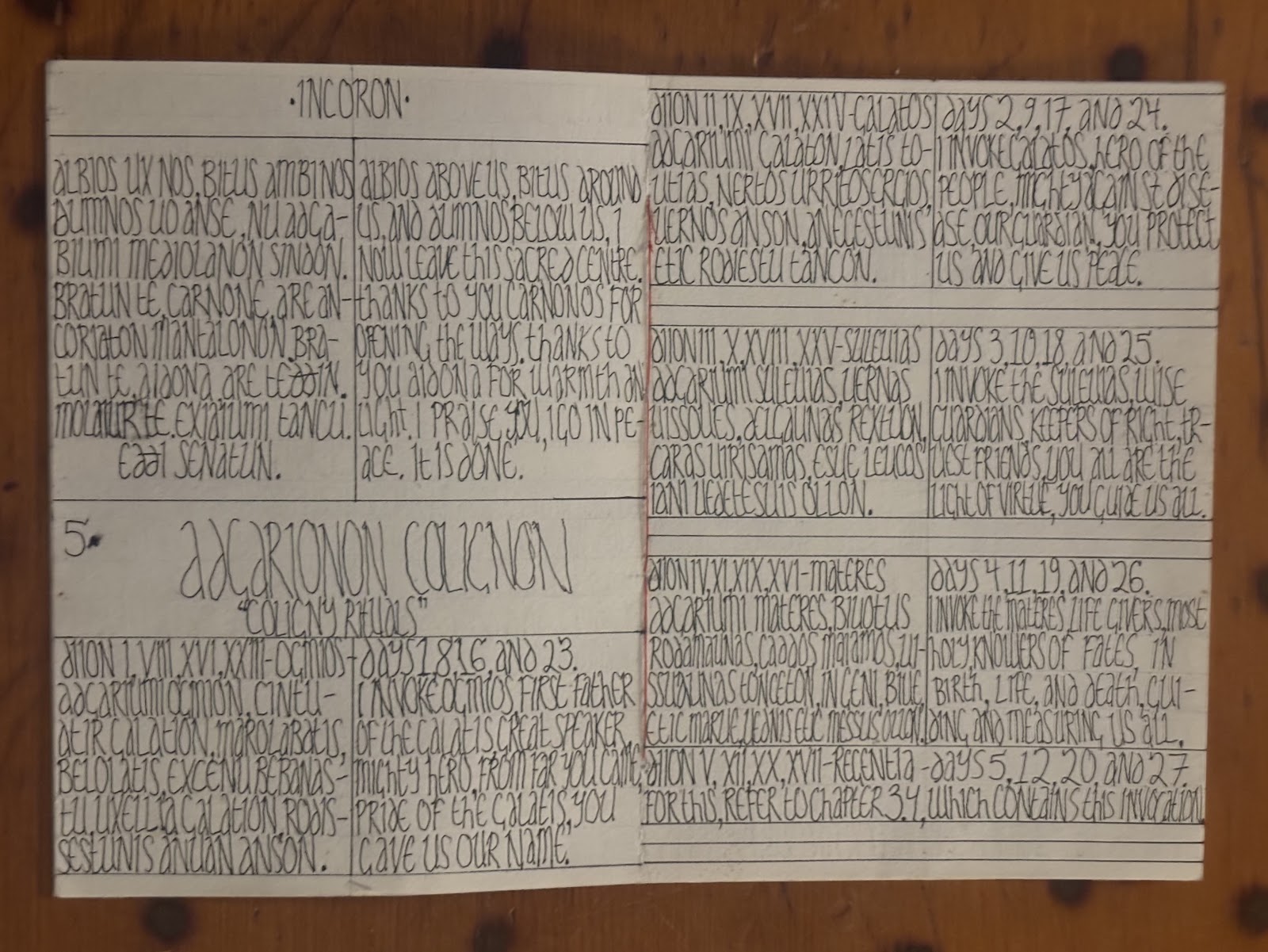
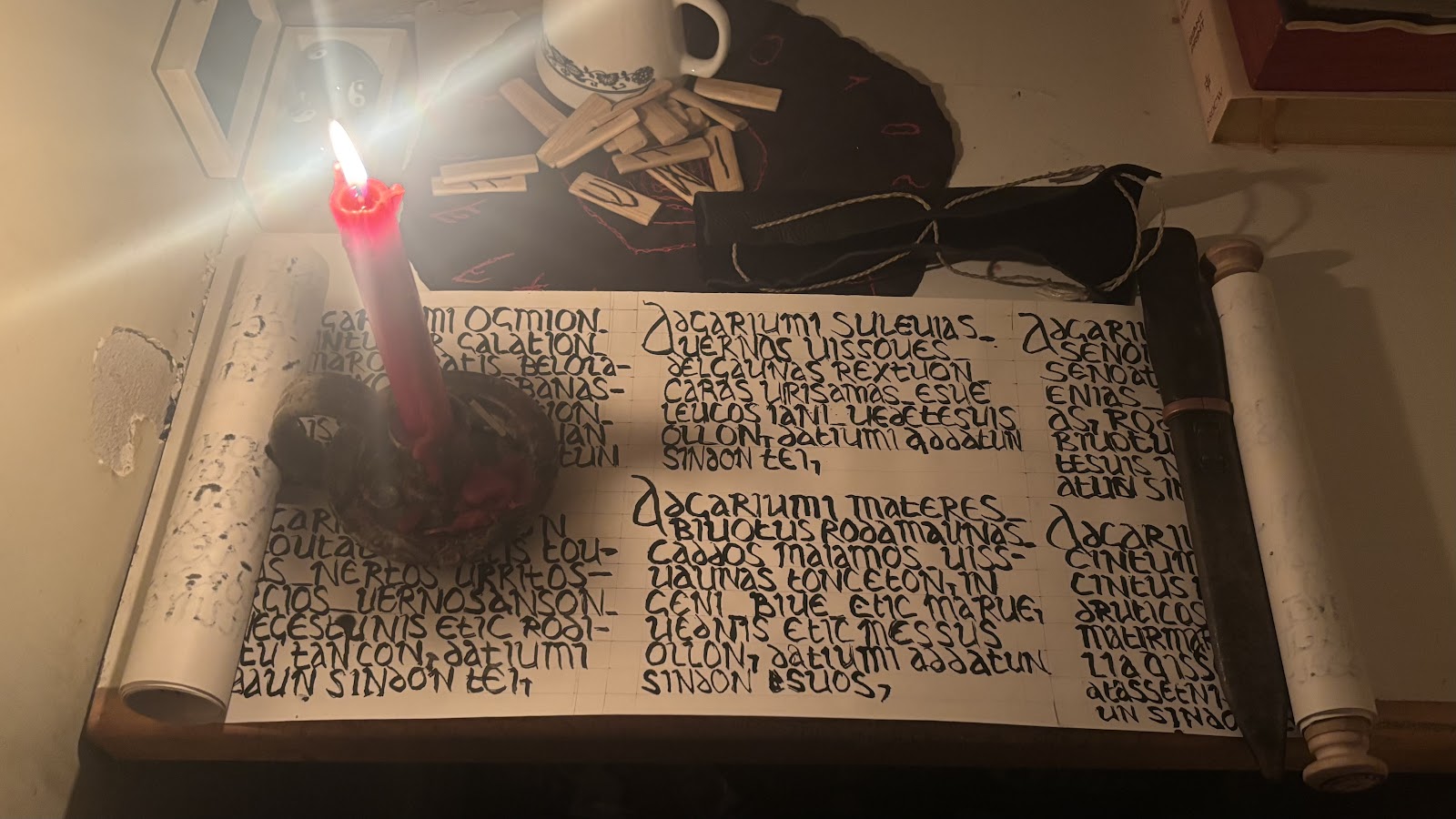
Albios ux nos, Bitus ambi nos, Dumnos uo anse, exugriûmî in sindon mediolanon do legiû nemeti mou. Aidona aidus tou berait teððin eti leucetun, ac cei butâ tou anauâit comadberon anson. Datiûmî addatun sindon tei.

English:
Albios above us, Bitus around us, and Dumnos below us, I enter into this sacred center to establish my nemeton. Aidonâ, may your flame bring warmth and light, and may your presence enrich our communion. I give you this offering.


4. Offering to Aidonâ

  • Offer herbs or incense to the flame.

5. (Optional) Gatekeeper Invocation

Carnonos serves as the Gatekeeper of BNG. His invocation helps open the paths between realms.

Gaulish:
Adgariomos Carnonon, Ancorios mantalon, Agios matos alami, Arxiomos agnî eri adàððun sondon. Uêdiâs anson cluâontor. Rodâmos addatus etic bratun tê.

English:
We call upon Carnonos, Opener of the ways, Wise guide of the herd. We ask for your guidance during this rite. May our prayers be heard. We give offering and thanks to you.


6. Adgarion (Invocation to Deity)

Here we invoke Galatos, our tribal protector.

Gaulish:
Adgariomos Galatû Toutatî, Latis Toutiâs, Nertos urittosergios, Uernos Anson, Anegestûnis etic rodîestû tancon. Rodâmos addatus etic bratun tê.

Optional:
Arcîmî ratobo Galatîs — I ask for blessings to the Galatî.

English:
We invoke Galatos, hero of the people, mighty against disease, our protector. You give us peace and guidance. We offer you our thanks.


7. Silence and Communion

Sit or kneel quietly. Listen, feel, and commune.


8. Incoron (Closing the Rite)

  • Circumambulate sunwise three times.

Gaulish:
Albios ux nos, Bitus ambi nos, Dumnos uo anse, nu adgabiûmî mediolanon sindon. Brâton tei, Aidona, are teððun etic leuceton. Brâton tei, Carnone, are ancoriaton mantalonon. Molâiûr te. Exiâiûmî tancû. Eðði senâtun.

English:
Albios above us, Bitus around us, and Dumnos below us, I now leave this sacred center. Thanks to you, Aidonâ, for warmth and light. Thanks to you, Carnonos, for guiding the paths. I praise you. I go in peace. It is done.


Note: This rite is adaptable and may be expanded as one develops their relationship with Aidonâ or other deities. The important thing is consistency and sincerity. Performing the Hearth Rite regularly becomes a sacred rhythm that deepens one’s spiritual life in BNG.

Circumambulate means to walk in a circle around something, especially in a sacred or ritual way. In BNG, we circumambulate the flame — often with Mugwort — to define sacred space and connect to the realms of Drus. This act is a physical and spiritual boundary-setting, turning an ordinary space into a Nemeton.

Cosmogony refers to the story or act of the world’s creation. In ritual, especially the Hearth Rite, our words and actions symbolically mirror this creation. When we invoke the Three Realms and move in sacred patterns, we’re participating in the ordering of the cosmos — weaving our personal rites into the greater pattern of existence.

Tegobessus IX: Trirextoues (Three Laws) and îanoi (Virtues)

Morality and ethical behavior are essential components of Bessus Nouiogalation (BNG). While ritual, devotion, and cosmology shape our outward practice, it is our behavior and character that demonstrate the depth of our commitment. Within BNG, we honor both the Three Druid Laws (Trirextoues) and the cultivation of virtue (Îanoi) as a dual foundation for ethical and spiritual living.

The Three Laws (Trirextoues)

These are the only moral precepts clearly attributed to the Druids in antiquity. They are simple, powerful, and timeless.

1. To Honor the Gods

Gaulish: Dugion Dēuūs

This law teaches us to live with gratitude and respect toward the Dêuoi (Gods) and all divine beings. In BNG, this includes maintaining Cantos Roti, the Gifting Cycle, in which we engage in reciprocal relationships through offering, praise, and ethical living. Honoring the Gods is not only a ritual act — it’s a way of aligning with the sacred and recognizing the divine in all things.

2. To Do No Misdeed

Gaulish: Ne Urextus Volson

This law calls us to act with integrity and care — to do no harm to others, ourselves, or the spirits. It applies not just to humans but also to the Regentiâ (Ancestors), Bituatîs (Land Spirits), and Tegatis (House Spirits). It fosters Sumatreiâ — good relationship — with all beings, seen and unseen.

3. To Practice Virtue

Gaulish: Etic Deluātus Nertūs

Virtue is not about outward appearances — it is the cultivation of strength and character from within. Rooted in the Gaulish concept of nertūs (power, vigor, virtue), this law encourages courage, wisdom, and self-discipline. Whether in solitude or in public, a Galatis strives to align their being with the sacred order of the cosmos.

The Virtues of BNG (Îanoi)

BNG expands upon the Trirextoues with a set of twelve core virtues, grouped into three sets of four, each connected to one of the Three Laws. These are not commandments, but guiding principles — living tools to shape one’s soul (anatiâ) and life. You can read more about our Îanoi HERE.

BNG Virtues:

  • DêuocariâPiety
    Reverence and love for the Gods, shown through devotion, ritual, and relationship.
  • LuxtiâDuty
    A sense of responsibility toward others, one’s roles, and sacred obligations.
  • UissusWisdom / Knowledge
    Pursuit of truth through study, experience, and discernment.
  • ÎanolabâRight Speech
    Speaking with clarity and integrity. Avoiding gossip or harm through words.
  • DoniocariâCompassion
    Kindness in action. Feeling with others and responding with care.
  • OigetocâriâHospitality
    Welcoming others as sacred guests. Sharing space, food, and safety.
  • RatonGenerosity
    Giving freely of time, blessings, and resources.
  • UiridiosTruth
    Living with honesty and sincerity in all actions and relationships.
  • DecosHonor
    Acting with dignity, keeping one’s word, and cultivating personal worth.
  • UîrolaniâJustice
    Fairness, equity, and protection of those in need.
  • GalâBravery
    Standing firm in difficulty, speaking truth, and facing life with courage.
  • ÛxelliâPride
    Healthy pride in your path, your people, and your values — without arrogance.

These virtues are not static rules, but part of an ongoing practice of self-formation — ways to shape your soul into something worthy of the Dêuoi and future generations. In BNG, morality is not a list of dos and don’ts, but a living relationship with the sacred through thoughtful action, reverence, and personal excellence.

Tegobessus and Your Virtues

The BNG virtues are central to our Touta’s shared practice — all members are encouraged to learn them by heart, as they influence how we relate to the Dêuoi, the Regentiâ, the Bituatîs, and each other. They are the ethical roots that nourish the collective. But your Tegobessus (House Custom) is a deeply personal expression of this tradition. Whether you add to and adopt the full BNG virtue set, build your own, or rely solely on the Trirextoues, what matters most is that you live with intention. Let your values live in your words, actions, and choices. Let them guide who you are becoming — and who you are offering to the world.

Tegobessus X: Anmanātion (Naming)

As part of Tegobessus (House Custom), you may feel called to take on a spiritual name — one that reflects your role, identity, or path as a Galatis. This is not required, but for many, it’s a meaningful act of self-definition and dedication. It can also mark a turning point in your spiritual journey: a rite of passage, a personal transformation, or the founding of your house custom.

This name is a reflection of your soul, your path, and what you are striving to become.

Why Choose a Spiritual Name?

  • To mark your commitment to the path of the Galatîs
  • To express your connection to certain deities, spirits, virtues, or ancestors
  • To symbolize personal transformation, rebirth, or growth
  • To reflect your cosmology, house mythos, or virtues
  • To take on a role (e.g., Uatis, Senodruis, Bituatis-carrier, etc.)

How to Choose or Create One

You can base your name on many things — it’s entirely personal and meaningful to you. Here are some starting points:

  • Deity connection – names that honor or include an aspect of a deity (e.g., Ogmidanos – “one of Ogmios”)
  • Virtues or qualities – draw from the Nauan Nertoi (Nine Virtues), such as Nertomaros (“Great Strength”), Sedulona (“Peaceful One”)
  • Nature-based – trees, animals, rivers, winds, e.g., Dercomaros (“Oak-Great”), Alaunia (“of the flowing one”)
  • Mythical themes – use your own house myths, cosmology, or symbolic roles
  • Ancestral honor – a name that links you to your biological or chosen ancestors
  • Use Your Real Name — and Reimagine It. You can absolutely use your given name. Many Gaulish practitioners do! In fact, you can trace the etymology of your real name and translate or adapt it into a Gaulish style. If you’re not sure where to begin, we can help! We can break down the root meaning of your name and explore how it might be adapted using Gaulish elements and word structure.
  • Profession or Role – Your name can also reflect your craft, trade, or calling — especially when it forms a major part of your identity. A blacksmith might choose a name like Gobannomaros (“Great Smith”) A healer could choose Belenudonna “Woman of Belenus”)

Forming the Name (Linguistic Tips)

BNG uses reconstructed Gaulish to help deepen the spiritual and cultural resonance of names. Here’s a simple structure:

  • [Root Word] + [Suffix]
  • Root words can be nouns or adjectives (e.g., Nertos, Sedû, Litauiâ, Bitu, Drus)
  • Suffixes might include:
    • -maros/-marā – great, large
    • -rix/-rīx – king, ruler, master
    • -gnatos/-gnatā – child of, born of
    • -dūnon – fortress, power
    • -ū (n.) – abstract noun or concept

Examples:

  • Litauimaros – “Great [one] of the Earth”
  • Drusgnata – “Child of the Oak”
  • Sedūrix – “Peace-ruler”
  • Bitugenos – “Born of the Land”

Use your Ueposlougos Nouiogalaticos (BNG Dictionary) to help find the meanings and build names.

Ritual Naming

You may wish to ritualize the naming process. Here are ideas:

  • Speak the name aloud before the Aidû (hearth or altar)
  • Introduce yourself to the Dêuoi, Bituatîs, and Regentiâ with your new name
  • Include the name during an Adgarion (invocation)

Taking on a name is not about claiming power — it is about naming your transformation, your aspiration, and your relationship to the divine and unseen world. Like all things in BNG, it is rooted in intention and Sumatreiâ.

If you’d like help crafting a name — in terms of language, symbolism, or story — members of our Touta are here to help. Reach out. We walk together.

Tegobessus VII: Bituatîs (Land Spirits)

The land is not just the backdrop of our lives—it is an active, living, spiritual reality. Within Bessus Nouiogalation (BNG), we understand the land as inhabited by sacred beings who dwell in fields, forests, rivers, stones, etc. These beings are not always gods in the sense of Dêuoi, but they are spirits worthy of honor and respect. We call them Bituatîs, “Spirits of the Earth” or “Land Spirits,” though this encompasses a wide range of presences—from guardian spirits of local features to more primal or chthonic forces.

This is one of the areas of Gaulish spirituality that is both richly intuitive and under-documented historically. While the ancient Gauls left us few direct records of land spirit veneration, we can infer much from comparative Indo-European practices, archaeological finds such as offerings in bogs and rivers, and the persistent folklore of the Celtic-speaking world.

BNG does not claim an unbroken historical reconstruction, but instead offers a spiritually coherent approach rooted in ancestral reverence, animist understanding, and personal relationship.

Land Spirits in Everyday Practice

In Tegobessus, the honoring of land spirits is both household-based and local. These beings are with us always. They are the subtle presences who remember the ancient paths, who dwell in the roots of trees, who inhabit the glades and streams, and who—sometimes—come to dwell near our homes. You may already know them: the subtle change in air when you enter an old grove, the feeling of being watched while walking a familiar trail, the sense of peace (or unease) in a certain part of your yard. These are signs of presence.

Who Are the Land Spirits?

They go by many names and forms. Some are clearly beings of place—spirits of a specific hill, tree, spring, or stone. Others are more generalized—guardians of a larger land area or valley. In your practice, it is less important to categorize them precisely and more vital to recognize, respect, and reciprocate. In BNG, we refer to them collectively as Bituatîs, though individual names and identities may arise through a long relationship. You may find local names, ancestral titles, or even nicknames that feel appropriate.

Honoring the Spirits of the Land

While not always as formal as rites to the Dêuoi or the Regentiâ, offerings to the Dêuoi Dumnosê are a deeply important part of Tegobessus. They anchor us to the place where we live and form a relationship with the unseen world that supports the visible one.

When to Offer

  • At seasonal transitions (e.g. Equinox, Solstice, Agricultural Holidays)
  • Upon arrival to a new home or area
  • Before taking from the land (harvesting, foraging, building)
  • After significant weather events
  • Anytime you feel prompted by intuition or presence

What to Offer

  • Whole milk, honey, or water poured directly onto the earth
  • Herbs such as mugwort, juniper, or mint
  • Coins (buried or left respectfully)
  • Food offerings, especially local produce or bread
  • Words of respect, song, or silence

How to Offer

  1. Choose a quiet place outside, preferably somewhere you feel the presence of the land.
  2. Purify yourself (Glanosâgon) before beginning.
  3. Light a candle if you wish, or simply place your hand on the ground.
  4. Speak aloud or inwardly the following simple invocation:

Sample Invocation: Adgarion Bituatîs

Gaulish:

Adgariomos/Adgariūmī Bituatîs
Sentoi bitus
Mapatîs Litauiâs
Enogenetiâs etic donon beriâs
Rodâmos/Rodâmî addatus etic brâtun tê
Slanon te
Brâtun te
Molâmos/Molâmî Bituatîs
Iâmos/Iâiumî in tancê

English Translation:

We/I invoke the Spirits of the Land
Ancient ones of the world
Children of Litauiâ (the Earth)
You who bring gifts
We/I give offering and thanks to you
Cheer to you
Thanks to you
We/I praise the Spirits of the Land
We/I go in peace

Building Relationship

The goal of land spirit veneration is not to manipulate or demand—it is to form relationship. This is why regular small offerings and simple, honest words often mean more than elaborate ritual. Leave your offering, speak kindly, and listen. You may be surprised by what you feel—or by how the land itself begins to respond.

In time, some practitioners may come to recognize specific land spirits, or even receive names for them in dreams, divination, or sudden knowing. These experiences are valid and welcomed within BNG, though always interpreted through discernment.

Honoring the land spirits is a vital component of Bessus Nouiogalation. It ties us to the land we walk, grounds our rituals in the living world, and reminds us that we are part of an ecology that is both physical and spiritual. As with all parts of Tegobessus, consistency and sincerity are more important than perfection. Be respectful, be regular, and always remember: you are not alone.

Along with Bituatîs there are other beings/spirits that we call Ueranadoi, Anderoi, and Antumnatîs, which collectively we call Biuiti (Being, Creatures, Entity) you can find more info HERE.

Tegobessus IX: Exbiion Tegos (Banner of the house) and Tegoanman (House Name)

As part of building your Tegobessus — your personal spiritual expression within Bessus Nouiogalation — we invite you to create a House Banner and a House Name. This is purely for fun, but it adds depth, symbolism, and personal meaning to your path. It’s also a time for reflection on what truly matters to you and yours.

Your House Banner can feature anything meaningful:

  • A tree that speaks to your values
  • An animal that feels like your guide
  • An object of spiritual significance
  • A concept or virtue you strive to embody
  • Symbols tied to your ancestry, homeland, or heart

Once you’ve chosen your symbols, give your household a name using the “Tego–” prefix (from tegos, meaning “house/home”). This name should reflect the imagery, spirit, or values of your banner — something that feels right to your soul.

Examples:

  • Tegowidugenos – “House of the Wild Born”
  • Tegonertomagos – “House of Great Strength”
  • Tegolitauiâ – “House of the Earth”
  • Tegouiridios – “House of Justice”

You can display your banner physically (as a flag, painting, carving, digital crest, or altar piece), or keep it in your mind and spirit. It is a sacred representation of your path, your hearth, and your identity.

Need help creating your TegoBessus name or banner?
We’ve got artists and language folks in the community happy to assist. Just reach out — we’d love to help bring your vision to life.

Tegobessus VIII: Îuoi (Holidays)

Holidays are not merely moments of rest or recreation—they are sacred turnings in the spiral of time, where the cosmos opens just a little more clearly to us. We call these days of observance Îuoi, and they help us mark the changes in season, celestial shifts, agricultural patterns, and mythic moments of our tradition. While no single fixed liturgical calendar is required in your house custom, holidays provide an excellent framework for developing both group and house customs. These customs build continuity, deepen familial and spiritual bonds, and allow the development of a unique culturally rooted mythos.

Trinox Samoni: The Festival of Three Nights of Samonios

Trinox Samoni is the only holiday explicitly named in the Coligny Calendar, the lunar-solar-based calendar of the ancient Gauls. The name translates to “Three Nights of Samonios,” and on the Coligny Calendar falls on 17 Samonios, which would be the third quarter moon around the Summer Solstice. Because this is the only explicitly attested holiday by name, Trinox Samoni holds a central place in most Gaulish pagan customs, including BNG. That said, it is understood that many Galatîs will celebrate it in their own way, depending on house tradition, climate, and personal relationship with the spirits and gods. Remember diversity is not a weakness—it is a living testimony to the adaptable, local nature of ancient Gallic religion. In this sense, we are all celebrating Trinox Samoni together, even if it looks different from hearth to hearth. You can read more about Trinox Samoni HERE.

The Coligny Calendar: A Framework, Not a Requirement

The Coligny Calendar gives us a fascinating glimpse into how the Gauls may have seen sacred time—tracking lunar months, intercalary periods, and special notations for mat (good) or anmat (not good) days. However, you do not need to use the Coligny Calendar to practice Gaulish Paganism. It is complex, occasionally obscure, and likely varied regionally even in its own time.

That said, it can be a fun and meaningful tool for those who wish to align their practice with the historical rhythms of the Gauls. Using it can help cultivate a sense of cosmic rhythm, and it invites deeper reflection on how time and sacred observance intertwine. As you have gathered from our site, we in BNG use the Coligny Calendar to mark our days.

Creating House-Based Seasonal Mythology

In BNG, we deeply encourage the creation of household mythology and seasonal storytelling that lives along with the Bessus of BNG. This practice roots your home in sacred time and gives personal meaning to your observances. This isn’t about inventing deities (though you can honor lesser spirits or ancestors this way)—it’s about telling the story of the seasons through the values, land, and spirits that shape your household’s life.

Here are some ways to begin building your house custom:

  • Reflect on your local climate and ecology. When do the trees bloom? When do the birds leave or return? Let the land itself inform your spiritual rhythm.
  • Establish a mythic pattern: is your year shaped by a journey, a sacred marriage, a battle between light and dark, a weaving of the worlds?
  • Use local or ancestral figures. Perhaps an ancestral hero blesses the home each spring, or a house spirit brings the cold in winter only to be banished with warmth in the spring rites.
  • Mark solstices, equinoxes, or cross-quarters with rituals, feasts, and stories that evolve over time.

Over time, these stories can become ritualized, forming the backbone of your household observances. These do not replace the dêuoi or BNG festivals and holidays—but complement them, anchoring the divine into the specific soil of your life.

A Living Calendar for a Living Religion

In total, the calendar of BNG is a fusion of the old and the new. It honors what we know of the past—like Trinox Samoni—while giving space for Uindonnâ (inspiration, Awen) to guide us in forming new expressions. Whether you follow the Coligny Calendar closely, use the solar cycle, or establish your own hybrid, the core of the practice remains: to celebrate the cycles of life, death, and rebirth in harmony with the Dêuoi, Regentiâ, and Dêuoi Dumnosê.

Closing Reflection

To celebrate the Îuoi is to pause and rejoin the sacred web. In Bessus Nouiogalation, this means cultivating rituals that make meaning from season and story alike. You do not need to do it perfectly. What matters is that you do it sincerely. Whether with a fire on the longest night, an offering at first planting, or a tale told every harvest, your holidays help weave your place into the larger song of the cosmos.

On the Toutâdeuoi

Anonymous – Toution

First is Ogmios, whom we honor as the great spiritual ancestor of the community—wise of word, strong of spirit. I see him as a divine father, the one who guides us with the golden chains of eloquence.

Toutatis Galatos is BNG’s guardian, the protector of our people, born of Ogmios. He watches over the tribe with steadfast care, standing at the heart of our shared path.

The Suleuias walk beside us as the seers and soul-guides of the community. They bless the hearth and help steer the course of our decisions with wisdom and grace.

The Materes are the deep forces of fate, weaving the threads of life and time. Yet like Galatos, they, too, are guardians—ever-present among the people and the land.

The Regentia are the honored dead—not just our ancestors, but the noble ones of memory. Their names echo through time, like Ambicatus, whose legacy inspires and shapes our steps.

Celtînâ is the radiant mother of Galatos and the beloved of Ogmios. She stands as the first mother of the Galatis, strong in valor, shining with beauty, a living image of the virtues our people hold most dear.

Carnonos, last in this honored line, is keeper of the threshold and opener of the rift between the worlds. To him, we give respect, for through his ways, we walk from this realm to Antumnos.