First is Ogmios, whom we honor as the great spiritual ancestor of the community—wise of word, strong of spirit. I see him as a divine father, the one who guides us with the golden chains of eloquence.
Toutatis Galatos is BNG’s guardian, the protector of our people, born of Ogmios. He watches over the tribe with steadfast care, standing at the heart of our shared path.
The Suleuias walk beside us as the seers and soul-guides of the community. They bless the hearth and help steer the course of our decisions with wisdom and grace.
The Materes are the deep forces of fate, weaving the threads of life and time. Yet like Galatos, they, too, are guardians—ever-present among the people and the land.
The Regentia are the honored dead—not just our ancestors, but the noble ones of memory. Their names echo through time, like Ambicatus, whose legacy inspires and shapes our steps.
Celtînâ is the radiant mother of Galatos and the beloved of Ogmios. She stands as the first mother of the Galatis, strong in valor, shining with beauty, a living image of the virtues our people hold most dear.
Carnonos, last in this honored line, is keeper of the threshold and opener of the rift between the worlds. To him, we give respect, for through his ways, we walk from this realm to Antumnos.
Dis Pater, meaning “Rich Father,” is a mysterious and ancestral god mentioned by Julius Caesar, who wrote that “all the Gauls claim descent from Dis Pater.” But Caesar never told us who this god was.
While “Dis Pater” is a Roman term, in BNG we do not equate it with the Roman god of the underworld. Instead, we interpret the phrase as Caesar’s attempt to capture a native concept.
In Roman tradition, Dis Pater is a god of the underworld, wealth, and ancestral lineage — often associated with Pluto or Hades. In the Gaulish context, however, the identity of Dis Pater remains unclear. Scholars and practitioners have linked him to gods like Sucellos, Taranos, Ogmios, Carnonos, or even mythic ancestors like Celtus. Each carries a piece of the mystery.
In Bessus Nouiogalation (BNG), we don’t claim to know exactly who Dis Pater is. Instead, we recognize him as a sacred role, a divine mystery that speaks to ancestry, transition, and cosmic order. Dis Pater is not one god but a function filled by many — or by one whose name has been lost to time.
Ultimately, we believe each soul may come to know their own Dis Pater — the one who walks beside you in silence, who guides your soul between worlds, and who whispers the ancient truths that shape your path.
As mentioned above in Commentarii de Bello Gallico, Julius Caesar wrote that “all the Gauls claim descent from Dis Pater.” It’s a cryptic and powerful statement — one that has echoed down through the centuries and become a source of speculation, reconstruction, and inspiration among modern Gaulish pagans.
Who was this Dis Pater, this “Rich Father” of the Gauls? Is it Ogmios, Celtus, Sucellos, Smertrios, Carnonos, or Taranos?
All these have been discussed as the Dis Caesar may have meant. Why? Because each bears a connection — through iconography, etymology, or mythic function. I won’t dive into the academic weeds here (perhaps on my personal site), but instead offer how Bessus Nouiogalation (BNG) sees it.
In BNG, we choose not to pin down this ancestral god with a single identity. We do not say who the Gaulish Dis Pater is, because we do not believe he can be fully named. To do so would be to close the door to mystery, and in BNG, mystery is part of the sacred order of things.
Instead, we hold space for several figures who might reflect the role or radiance of this hidden Dêuos — not one name, but a constellation of them.
These are not contradictions. They are facets.
Ogmios: The Father of the Gauls
In BNG theology, Ogmios is honored as the Father of the Gauls. He is the god of powerful speech, binding his followers not with chains of iron, but with chains of golden words. A god of wisdom, silence, endurance, and radiant strength — he leads not through fear, but through persuasion and insight. Ogmios is not just a god of eloquence — he is the one who calls the tribes into being. He teaches, names, and guides. He sets the tone for our shared ethos: to live with honor, wisdom, and clarity, even in silence. As the divine father, Ogmios doesn’t thunder — he whispers truths that shape nations.
He may be Dis Pater as the one who calls us into being, who names the tribes, and binds us in golden truths.
Galatos: The Divine Ancestor
We recognize Galatos as a mythic figure central to Gaulish identity — our culture hero and divine ancestor. Galatos, in BNG thought, is not a historical figure. He is a mythic construct, born from multiple streams of lore and gnosis:
From the Greek Celtus myths, in which a legendary son gives rise to the Celts.
From the martial and protective powers of Smertrios, a god of strength and battle.
From the communal, rooted spirit of the Toutatis — the tribal protector and embodiment of the people as one.
He may be Dis Pater as the first of us, born of the land and tribe, carrying the spirit of our people forward.
Sucellos: The First to Enter Dumnos
We also see Sucellos as deeply entwined with this mystery — though in a more veiled and liminal role. In BNG mythopoesis, Sucellos is one of the first to pass into Dumnos, the Deep — and then into Antumnos, the Otherworld, the Ancestral Realm, the place of mystery and return. He is “the Well-Hidden One,” a god of quiet fertility, fermentation, and transformation. While his name may literally mean “the good striker,” we also reflect on kel- as “to hide,” and see in him the Keeper of What is Secret. Sucellos is not the father of the Gauls in a literal sense. He is the first ancestor — the one who precedes descent, who holds the memory of what came before, and who carries the keys to what lies beyond.
He may be Dis Pater as the hidden one, the first to pass into mystery, who waits for us in the deep places beyond life.
Carnonos: The Liminal Lord
We recognize Carnonos as a Dêuos of liminality and movement, one who dwells at the edges — of civilization and wilderness, of life and death, of seen and unseen. He is a guide, a guardian, a traveler. In BNG thought, Carnonos is not merely a forest god, but a keeper of transitions, a psychopomp who can move between this world and Antumnos, the Otherworld. His antlers crown him as one who listens beyond speech, who leads without words. He is flanked by animals, rooted in place, yet always moving through thresholds.
He may be Dis Pater as the one who walks between worlds, helping us cross when we must — and guiding us back when we are lost.
Taranos: Bringer of Virtue and Cosmic Order
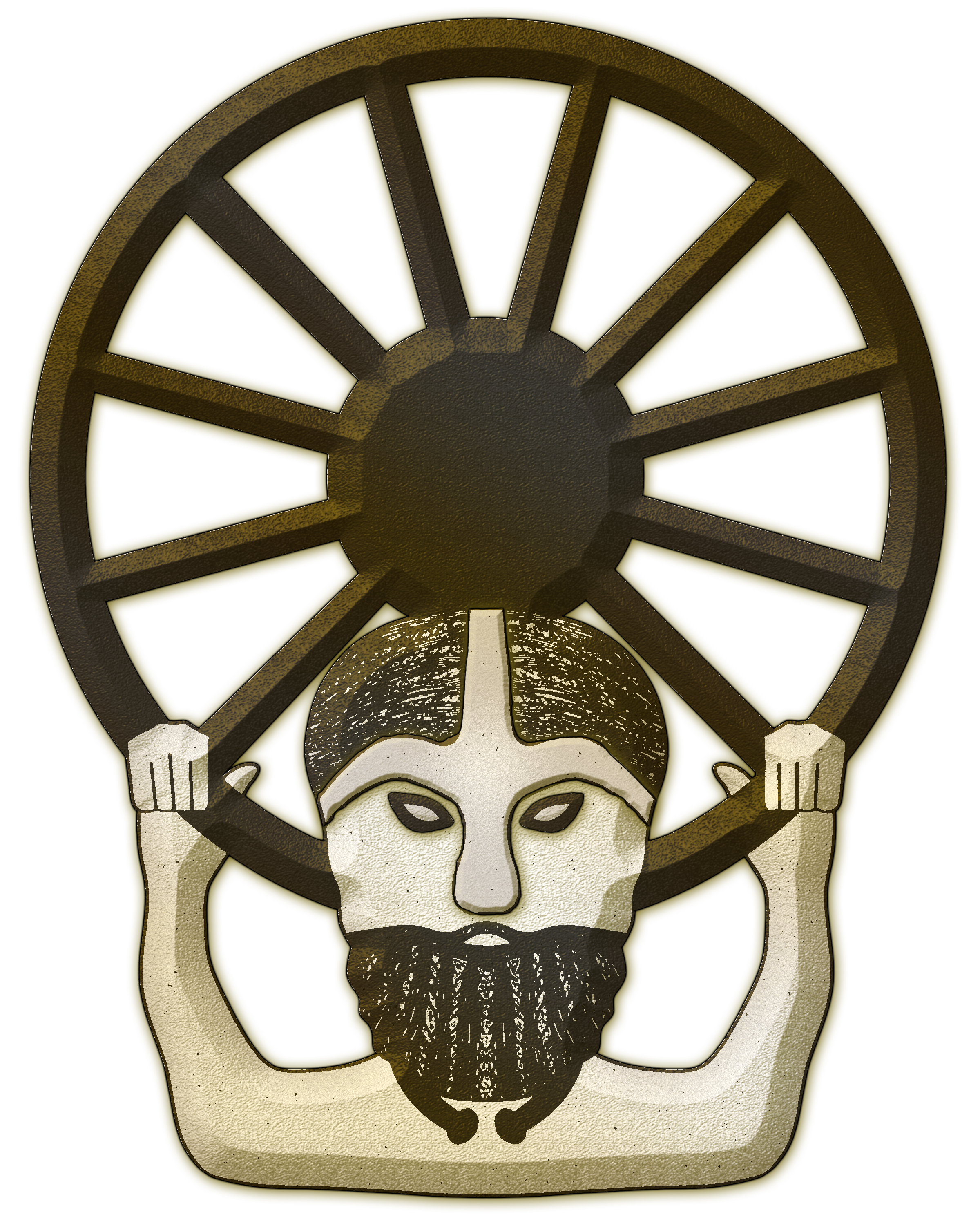
Taranos is the great celestial Dêuos in BNG — the one whose thunder reminds us of the power of virtue and the need for cosmic balance. We honor him not only as the god of storm and sky, but as the one who maintains the order of the world through the gift of the Îanoi — the virtues. His mythic triumph over the serpent speaks to his role in shaping and protecting the structure of reality, setting boundaries between Samos and Giamos, between life and death, peace and chaos. The wheel is his symbol — ever-turning, many-spoked, always whole. Through it, Taranos teaches that strength lies in balance, that storm brings both destruction and renewal.
He may be Dis Pater as the giver of law, of structure, of insight — the thunder that wakes the soul.
The Dis Pater as a Sacred Role, Not a Single Being
So who, then, is the Gaulish Dis Pater of our bessus?
In Bessus Nouiogalation, we say this: He is not a Dêuos of one name — he is a sacred role, a sacred function, a mystery.
He may be Ogmios, whose golden chains bind hearts to truth.
He may be Galatos, the first of us, born of strength and tribe.
He may be Sucellos, the smiling god who walks unseen into the Otherworld.
He may be Carnonos, guiding us through the veil.
He may be Taranos, striking thunder into our bones to awaken us.
He may be all of these — or none of them.
Conclusion: In the Silence, the Father Speaks
Each of the Deuoi has a sacred function in the cosmic order of things. For us, it’s about your own relationship to that deeper presence. The Gaulish Dis Pater remains unnamed in our tradition — not out of vagueness, but out of reverence. To name is to limit — and this god is too large, too deep, too intimate to be held in a single form. Each of us may encounter him differently — and that, too, is sacred.
In Bessus Nouiogalation, we also honor that your Dis Pater may not be any of the Deuoi listed above. He/She/They may come to you as another figure entirely — a guardian, a guide, a Deuoi whose name has been lost or never spoken aloud. What matters is not the name, but the role — the sacred presence of a divine ancestor who shapes, shelters, and calls you home.
This is for the Ambactos Rotî (Ambassador of the Wheel): Followers of the teachings of the Wheel of Îanoi and dedicate themselves to a life guided by these virtues. As our virtues are not just words on a wall they are actions that must be followed. They are spirits themselves.
This is not a rite like setting up a sacred space and all that no candles are needed no offers to give. As the offering is living with the Ianoi.
Stand or sit comfortably in front of the wheel or circle symbol. If you are out and about mark our symbol in the dirt or pour out water from your water bottle in a circle. As you focus on the wheel, visualize it turning slowly, symbolizing the continuous cycle of virtues.
I call upon the Îanoi, invoking the wheel’s eternal motion, that their wisdom and strength may propel me forward on this sacred journey.
Dêuocariâ – Piety, I humbly embrace your presence Luxtiâ – Duty, I embrace your call. Uissus – Wisdom, I yearn for your knowledge. Îanolabâ – Right speech, I honor your truth.
Doniocariâ – Compassion, I open my heart to you. Oigetocâriâ – Hospitality, I welcome you into my life. Raton – Generosity, I share my blessings with others. Uiridios – Truth, I walk in your light.
Decos – Honour, I uphold your integrity. Uîrolaniâ – Justice, I stand for your fairness. Galâ – Bravery, I face life’s challenges with courage. Ûxelliâ – Pride, I take pride in living virtuously.
In the wheel’s embrace, I find harmony and balance. In these virtues, I find my path and purpose.
Thanks to you Îanoi, the eternal spokes in life’s turning wheel.
May I carry the virtues of the Îanoi in my heart. May they guide my actions and lead me towards a virtuous life.
Adgarion “to call to” is the word we use for Invocations. Invocations are a crucial part of our rites. They help aid us in Sumatreiâ (good relationship), which also helps with Cantos Roti (The gifting Cycle) with the Dêuoi (Gods) and Regentiâ (Ancestors). Our invocations are set up in a very simple format meaning short, simple, and powerful words. This is because we have many invocations to learn, and that means much to memorize since our invocations are also in Gaulish. We want to make the learning of the Gaulish simple for the individual to learn and memorize.
What we will do here is break the invocations down. In the first half of the invocation, one, of course, invokes the recipient of the ritual. They then describe the recipient with a few epithets. As well as a statement about them and what they may do in lore. We then give them an offering and thanks.
Then we might request something from them, and the closing of the ritual. As we may ask different things of them, we have prepared several possible requests. This allows you to know what you are asking for if you choose to do so in Gaulish. In any other language, we trust you can find the words.
This is the naming of the God/desses or spirits you are calling on. So one line is calling the name four lines of descriptive words and praise about them.
An offering to the recipient.
Items are given to the deities or spirits for helping you. This is part of the gifting cycle as they give, we give.
Arcimâs (Requests) One does not need to ask anything from them.
Argument – This is the reason you are calling the deities or spirits.
Petition – Asking the deities or spirits to aid you.
Closing
Thanking them
Adgarion Galatû Toutatî
Calling on the recipient Adgariomos/Adgariūmī Toutaton Latis Toutiâs Nertos urittosergios Uernos Anson Anegestûnis etic rodîestû tancon
Rodâmos/Rodâmî addatus etic bratun tê Addatus
Arcimâs Arcîmos/Arcîumî ratobo Galatîs
Closing Slanon te Bratûn te Molâmos/Molâmî Galatû Toutatî Iâmos/Iâiumî in tancê
Invocation for the Toutais Galatos
Calling on the recipient We invoke the Toutatis Galatos Hero of the people Mighty against disease Our guardian You protect us and give us peace
We give offering and thanks to you Offering
Requests We/I ask for blessings to the Galatîs
Closing Cheer to you Thanks to you We/I praise you Toutatis Galatos We/I go in peace
Arcimâs (Requests)
You will notice that in our invocations, you will see Arcimâs (Requests) right after the Offering part. If you have a request during a rite, this is the time to include it. For those doing rituals in a language other than Gaulish, it’s okay to ask in your own words. Though you should develop a formula. Below are some premade requests if you choose to use them.
Arcîmos/Arcîumî _________
(We/I ask for _________)
These requests are in the dative case, meaning an indirect object. In this case, the dative will imply asking for something.
slanû – health
anextlû – protection
calonnî – resolve
gallî – courage, confidence
uiridû – justice
ratû – grace, blessing
ratobo – blessings
sedû – peace
agnê – guidance
nertû – strength
boudê – victory
ianobitoû – prosperity
An example:
Arcîmos/Arcîumî slanû (We/I ask for health)
Now for whom you may ask for blessings. In Gaulish, we will use the accusative case. That means referring to the direct object of a sentence. So, who we are asking the blessing or request to be directed to. If it is for yourself, then the line above is good enough. But what about for someone else?
Some examples of people or groups to ask for in Gaulish are as follows:
uenian – family
carantâs – friends
contreban – city, town, village, community
mapaten anson/imon – child (of ours/mine)
mapatâs anson/imon – children (of ours/mine)
regenion anson/imon – parent (of ours/mine)
regeniâ anson/imon – parents (of ours/mine)
Galatîs – fellow Galatîs
Nouiogalatîs – fellow Nouiogalatîs
ollon – all people
tluxtiûs – the poor, needy
lobrûs – the sick
scasstâ – the hurt, injured
tegesicâ – the workers
bitun – the world
A final example for the full sentence:
Arcîmos/Arcîumî sedû bitun (We/I ask for peace to the world)
There are many things one can offer the Dêuoi. We usually give an alcoholic beverage—wine, cider, mead, or beer—but if you can’t be around alcohol, whether because you’re underage or for personal, health, or recovery reasons, that’s perfectly fine. You can offer juice, sparkling water, non-alcoholic wine, or any other thoughtful beverage.
These are certainly not the only acceptable offerings. Whole milk, bread, or other foodstuffs are often appropriate. Incense and herbs are also important and often overlooked. The key is to be intentional. An offering doesn’t have to be expensive or elaborate—use good sense and offer what is sincere and meaningful.
This practice is not meant to be classist. Offer the best you can within your means. The love and reverence you bring will show. The Dêuoi are not closed off to anyone, regardless of economic condition.
It’s ideal to find something associated with the Dêuos in question, but anything clean, meaningful, and given with respect is acceptable. Remember—it’s the intention that matters most. Offerings are about building a relationship with the Dêuoi, not meeting a requirement. So don’t stress; connect.
After making your offering, take a moment to kneel, bow, or simply sit and commune with the recipient(s).
Datiesti uta dassân, datiûmî uta dassais “You give that I may give. I give that you may give.”
Addatus — offerings — are acts of sacred gifting to the Dêuoi (Gods) and Senoatîs (Ancestors). These gifts are expressions of gratitude, praise, and reverence, rooted in the understanding that all things carry sacred worth and are deserving of honor.
At the heart of this is the principle of Cantos Roti, the Gifting Cycle, which fosters Sumatreiâ — a good and healthy relationship between us and the unseen world. In this cycle, we offer with open hearts, not as a transaction, but as an affirmation of respect and connection. In return, the Dêuoi, Regentiâ, or Bituatîs may offer their own gifts — insight, blessings, strength, or presence.
This is not about bargaining. It is about mutuality. Through Addatus, we participate in the ongoing conversation between our world and the divine, building a living relationship rooted in honor, reciprocity, and shared presence.
Aidonâ is the sacred fire, the hearth personified in your home or wherever a flame is present. She is our Hearth Deuos.
Aidonâ is a reconstructed hearth goddess whose name derives from aidus, meaning flame, fire, or ardor. This rite follows a structure widely attested across Proto-Indo-European religious traditions, adapted here for Bessus Nouiogalation. Your hearth is where your flame resides—whether a fireplace or a single candle—Aidonâ is there with you. Our Adaððus Aidoniâs, is designed to be simple and accessible. Members are encouraged to perform this rite at least once a week, as it strengthens your Dêuocariâ (Piety), Luxtiâ (Duty), Decos (Honor), and helps nurture Sumatreiâ (good relationship) as well as Cantos Roti (Gifting Cycle).
This rite helps your connection within our Touta and with the Dêuoi. Since Aidonâ is present in all homes, she unites us across our Touta.
Below is the Adaððus Aidoniâs with an invocation to Galatos, our Toutatis. You may substitute invocations for other Dêuoi or Regentiâ as you see fit.
Guidance on creating a sacred space and offerings can be found here.
1. Glanosâgon (Purification)
Wash hands and say: Glanolamâs – “Clean hands”
Swipe your forehead and say: Glanobritus – “Clean mind”
Swipe down your face with both hands and say: Glananation – “Clean soul” (Based on the belief that the soul resides in the head.)
2. Louceton (Lighting the Flame)
Light the Dagilâ(s) candle(s).
Gaulish: Dauiûmî aidun sondon Aidoniâs
English: I light this flame of Aidonâ
Demarcate your sacred space:
Demarcation (fixing the boundary) of our space happens with circumambulation (walking a ritual circle) to outline our space. If you have mobility issues or no space, you can use your hand and circle over the flame.
Move sunwise around the flame three times, passing Ponem (Mugwort) lit from the fire. Three represents Drus.
Mugwort is an herb of connection, used for purification, calming the spirit, and aligning oneself with the cycles.
Visualize:
Roots in Dubnos (below)
Trunk in Bitus (middle)
Canopy in Albios (above)
As you move, recite:
Gaulish: Albios ux nos, Bitus ambi nos, Dumnos uo anse, exugriûmî in sindon mediolanon do legiû nemeti mou. Aidona aidus tou berait teððin eti leucetun, ac cei butâ tou anauâit comadberon anson. datiûmî addatun sindon tei
English: Albios above us, Bitus around us, and Dumnos below us. I enter this sacred center to establish my nemeton. Aidonâ, may your flame bring warmth and illumination, enriching our communion. I offer you this gift.
3. Gatekeeper (Optional)
The Gatekeeper mediates between realms. For BNG, Carnonos is our Gatekeeper, a guardian of thresholds and liminal spaces. Carnonos embodies chthonic and intermediary qualities, guiding transitions and ensuring safe passage between realms.
English: We/I call upon Carnonos Opener of the ways Wise guide of the herd We/I ask for your guidance during this rite May our/my prayers be heard We/I give offering and thanks to you
Note: If you invoke Carnonos later in a main invocation, this step can be skipped.
4. Adgarion (Invocation to the Dêuoi)
Prayer Position:
Our words are not the only part of communicating. Our position of how we hold ourselves helps us communicate. It allows us to focus our thoughts.
English: Invocation for the Toutatis Galatos We/I invoke the Toutatis Galatos Hero of the people Mighty against disease Our guardian You protect us and give us peace We/I give offering and thanks to you Offering Requests (Optional) I ask for blessings from Galatîs
Commune:
Kneel, bow, or sit in reflection after the invocation and offerings.
English: Albios above us, Bitus around us, and Dumnos below us. We/I now leave this sacred center. Thanks to you, Aidonâ, for warmth and light. Thanks to you, Carnonos, for opening the ways. We/I praise you. We/I go in peace. It is done.
Circle the flame three times while reciting, then extinguish it by covering or pinching.
Diios Nouiogalation “Day of the New Galatîs” – The Birthday of Bessus Nouiogalation! Obviously this day is not a traditional Îuos day on the Coligny Calendar, as we aren’t nearly as old as it. Though it of course holds significance to us as it is the day we started out. That said, it does, like all BNG îuoi use the Coligny Calendar.
The date of Diios Nouiogalation is 9 Samoni. While BNG was in the works before that, the 9th of Samonios is the day we introduced our Bessus to our community, and the day this site became the vessel for sharing that Bessus with you, dear reader. As such we commemorate that day with celebrations.
Make no mistake however, the day isn’t simply about us. It is a day for honouring the Atebiuos Galaticos (Gaulish revival). After all, Nouiogalation means “New Galatîs”. So we not only celebrate our Bessus, but the revival of Gaulish inspired customs that created the environment for us to exist. In it carries our hopes that Gaulish custom is back (albeit in a different, modernised form) and here to stay.
Associated Deities: In this case, we give offering to our Toutatis and our Materês. Toutatis for our safety and health, and the Materês that They our toncnaman (that which is sworn, fate) be kind to us.
Activities: For us, it’s a party. In whatever reasonable way one chooses to celebrate is fine. Though, we talk about our Bessus, and of the Gaulish revival as a whole. For which we are grateful, and our hopes for the future. Also for remembering the revival’s history. Where we come from, where we are, and where we intend to be. A celebration of the Atebiuos.
Of course, one who isn’t in BNG, or doesn’t associate with us likely won’t observe this day. Which is obviously understandable. To which we say: Find the day you or your group came to Gaulish custom and celebrate that. After all, we’re far from the only ones who serve our fellow Galatîs. Celebrate the day you or your group chose to do that. It matters.
For us and our fellows, this is a day of pride and love for our Bessus, and the Atebiuos as a whole.
Taranis brings us the Îanoi (Virtues). If one is the center of the wheel, and the rim is that which is literally around us (family, community, the world, etc.), the virtues are the spokes. With all spokes present, the wheel can roll forward. The more spokes present, the smoother the ride. Too few, and the wheel breaks apart. Everything is connected in the great cycle of the cosmic order of things,each leading and affecting the other.
Ambactos Rotî (ambassador of the wheel) are those of us that follow the teachings of the wheel of Îanoi. We dedicate ourselves to the ever-spinning motion.
For a reading of this article in English, please click here.)
Îanoi, which in a more literal sense means from Îanos “right, just, correct,” essentially, in this case, “things that are right or correct.” For the purposes of the Bessus Nouiogalation (that is, “Custom of the New Galatîs,” plural form of “Galatis”), it also encompasses the term “virtues.” The understanding of virtues is essential so that we have a guide to live our lives in a way that helps us be better people. In turn, this helps us be better members of our communities.
So why codify something like virtues? The answer to which is simple, they give us something to refer to when we lose our way. The Dêuoi (worshipped beings) fulfill their actions perfectly. But they are Dêuoi. We are Donioi (humans). We aren’t perfect in our actions. No one is, and that’s okay. Every now and again, it doesn’t hurt to remember Nouiogalatis virtues, inspired by those of the ancient Gauls. As they will help us re-center ourselves and keep us in accordance with what is right.
The way we will break this down is by looking at what was thought to be the three laws the Druides (singular: Druið, pronounced “Dru-its”) taught. As you may guess, it translates to Druid. Though with the last law, we’ve been able to apply a more general interpretation to it. As our understanding of that one has changed. You’ll understand when you see it. We will list one law at a time, and there will be four virtues assigned to each to help us live up to each law.
They were originally recorded by Diogenes Laertius’s “Vitæ,” introductory verse 5:
I. The gods must be worshipped.
II. No evil done.
III. Exercise valour.
Now, we must be aware with the third law that there are multiple interpretations of it. And this is but one translation proffered. Another mentioned “manly behavior”, but even to the Gauls, there’s no reason to assume they only attributed these qualities to men. We must remember that these laws were recorded from someone who wasn’t a Gaul. After all, Onomaris was certainly courageous in leading her people to the east. We also must remember that valor doesn’t just apply to warriors. We can all think of people who have done courageous things far outside the field of combat that uphold notions of valor.
As such, in Bessus Nouiogalation — an independent and contemporary Gaulish-inspired custom — we strive to uphold these laws among our community. Developed from our interactions within Galatibessus of which we are a part, and dialogue with members of our specific bessus (custom). They are called the Trirextoues (The Three Laws).
Trirextoues/The Three Laws
Dugie Dêuûs – “Honor the Gods”
Gneie ne drucon – “Do no evil”
Delge āxtam – “Hold your behavior”
With these laws established, there are twelve virtues, and four each helps us align ourselves with these laws. So we will visit each law and discuss relevant virtues that can guide us. It should go without saying that there are more than twelve good qualities that can be exercised as virtues. However, many will relate to the ones discussed.
Let us start with the first law:
Dugie Dêuûs – “Honor the Gods”
Dêuocariâ (piety) Piety is important because by seeking and acting on honoring the Dêuoi, we bring ourselves closer to them. In doing so, it helps us learn all other right actions. Not every pious person is otherwise virtuous. However, they’re arguably not pious. As part of piety is not simply regular worship, but learning the virtues each of the Dêuoi has to teach.
And a peculiar and striking practice is found among the upper Celts, in connection with the sacred precincts of the gods; as for in the temples and precincts made consecrate in their land, a great amount of gold has been deposited as a dedication to the gods, and not a native of the country ever touches it because of religious scruple, although the Celts are an exceedingly covetous people.
Diodorus Siculus, Library of History V.27
All the Gauls are extremely devoted to superstitious rituals.
Caesar, The Gallic Wars VI.16
Luxtiâ (duty) The Dêuoi fulfill their duties perfectly. Of course, we do not always fulfill our duties perfectly. It’s part of being human. Though as donioi (humans), we don’t let imperfection stop us from acting. And so it’s important to remind ourselves to act on the duties we agree to — so long as it was made between two groups or people in equal positions of power. Just as the Dêuoi would.
Uissus (wisdom/knowledge) To be wise is to have knowledge of the teachings of the Dêuoi. As well as how to put them into action. The Druids of the past were exalted for their wisdom, but you don’t have to be one to learn the lessons of the Dêuoi and the world. Nor to act upon them. As wisdom is not passive, but active.
Îanolabâ (right speech) Something particularly relevant to the Gauls. As Ogmios, what the Romans said their northern neighbors called Hercules. However, (and you can read the account here) Ogmios was shown as older, as opposed to the younger Hercules. The reason why is that the Gauls in particular valued eloquence, as speech can bind wills more effectively than strength.
The Gauls are terrifying in aspect and their voices are deep and altogether harsh; when they meet together they converse with few words and in riddles, hinting darkly at things for the most part and using one word when they mean another; and they like to talk in superlatives, to the end that they may extol themselves and depreciate all other men. They are also boasters and threateners and are fond of pompous language, and yet they have sharp wits and are not without cleverness at learning.
Diodorus Siculus, Library of History V.31
Gneie ne drucon – “Do no evil”
Doniocariâ (compassion) Compassion is one of the most essential ways to ensure we do good instead of evil. How we respond to the suffering of others, and that we are aware of their pain is one of the most integral parts of the human condition.
Oigetocâriâ (hospitality) This is a key one. Through being hospitable, we forge connections and bonds with others, strengthening our communities. Both in person and online, as guest and host relations still apply.
“They invite strangers to their feasts, and do not inquire until after the meal who they are and of what things they stand in need.”
Diodorus Siculus, Library of History, 5.28
Raton (generosity) Until recently, people weren’t celebrated for being greedy. As one who is miserly is denying resources to the community. Sharing and generosity remind us that we are all interconnected. Without the goods or services others offer, a society cannot function. By being greedy in our personal lives, we cannot make friends. Generosity goes beyond material wealth, and includes company, kind words, a listening ear. Many qualities we associate with good people even today.
Uiridios (truth) This is a more complex concept than simply “not lying”. As sometimes, in rare cases, lying is a course of action that serves truth. An example would be lying to protect someone from violence and harm if the assailant was looking for them. To live in truth is to be truthful to one’s actions and be authentic. It is to act in a way that fosters honesty, justice, fairness, and virtue.
Delge āxtam – “Hold your behavior”
Decos (honour) We’ll get the obvious out of the way first. Honour ties into many other virtues as it is based on how well you live up to all of the other virtues. Thus, reputation ties directly into this as well. Your honour is measured by your integrity and virtue.
Uîrolaniâ (justice) To be honourable is to also be just. To exercise fairness in our decisions and actions. It also requires the knowledge of making decisions in a just manner. As acting in a fair and just way is important, so is speaking out when justice is being violated. And that takes a little of the next virtue.
Galâ (bravery) To be brave is another thing that isn’t always easily understood. It is not fearlessness. Bravery is doing something in spite of fear. And bravery is living up to the virtues even when it is inconvenient or when everyone around you disregards them. It’s also about having the fortitude to admit a mistake or flaw, as well as face consequences for one’s wrongdoings. Galâ is also ability—the cultivated skill to act with purpose and precision. True courage is not reckless; it is guided by knowledge and refined through practice. Ability transforms passion into action, ensuring that our strength serves wisely rather than blindly. Through ability, we learn to master our impulses, wield our talents for the good of others, and stand ready for whatever trials arise. To live with Galâ is to unite heart, mind, and hand in steadfast harmony. This is our resolve, it’s the inner passion and fire that fuels us. You can read more about the idea of Galâ here.
They reward brave warriors with the choicest portions of the meat, in the same manner as the poet introduces Ajax as honoured by the chiefs after he returned victorious from his single combat with Hector [in Illiad 7.321]: ‘To Ajax then were given of the backbone / Slices, full-length, unto his honour.
Diodorus Siculus, Library of History V.28
But the leader of the Celtic band soberly looked Alexander in the eye and said, “Nothing. We honor the friendship of a man like you more than anything in the world, but we are afraid of nothing at all. Except,” he added with a grin, “that the sky might fall down on our heads!
Ptolemy Soter quoted by Arrian and other historians
Ûxelliâ (pride) In the “over culture” we’re often taught that this is not a virtue. However, pride is not synonymous with arrogance. Being proud of one’s deeds is virtuous and can inspire others to also be virtuous. Whereas arrogance is for the self and doesn’t benefit anyone else. Pride also is about fostering a sense of self worth, and in turn recognising the worth of others. When in line with the other virtues, pride can help foster a sense of community and commitment to the common good.
As all traditions have ethical and moral codes, so do we. We’re confident that these virtues are a reasonable approach to right actions based on what was taught to the people by the Druides. There are many other virtues that could be listed but almost all of them are related to those listed in some way.
When thinking of what to do in a situation, try to remember the Îanoi!
A good practice is to, at the end of your day, take a look at what Îanoi you excelled at and what ones you had trouble with. Make a note of why look back a see what you could have done differently or why to excelled. Our Îanoi is not something talked about but acted on.
Bessus Nouiogalation is a tradition that centers around the historical Gaulish language and material culture from the La Tène archaeological period, roughly spanning 450 BCE to 50 BCE. It also involves the worship of entities known collectively as Dêuoi, with Dêuos being the singular term, and these Dêuoi are named in the Gaulish language itself.
The primary aim of Bessus Nouiogalation is to establish a stable cultural and religious revival, creating a New Galatis tradition that draws lessons from the past while remaining open to influences from various times, cultures, and places to different extents. Though it focuses on a specific historical period, it embraces broader elements. Recognizing that the tradition must be relevant to everyday life, Bessus Nouiogalation places significant emphasis on its Îanoi (virtues) and cultural aspects. Cultural influence has historically been pervasive and touches all aspects of life, and the tradition seeks to honor this connection. We hope to share content to support and inspire those interested in being a part of this tradition.
A major component of our bessu is to live life in accordance with Assus (order, according to ritual, with connotations of sacred or universal law). What this means is to live in a way that is beneficial to the world, our communities, and ourselves. There is no order without Uîrolaniâ (Justice).
There are many different ways to express and live our Bessus, but the emphasis on all of the aforementioned characteristics: culture, ethics, worship, all parts of worldview, factor into it. Certainly, some may be more interested in one of these things more than others, but it is understood that all of them are necessary for a whole and complete bessus.
Comoinicaunos (being alone together)
comoinicaunos ā on
This is a concept rooted in our bessus, that embodies the idea of being alone together while sharing a collective worship experience. This distinctive interpretation of Gaulish Monasticism reimagines solitude as a means of connecting with both oneself and the divine, emphasizing the value of spiritual unity within a community. Comoinicaunos, invites individuals to explore a Gaulish monastic approach that celebrates the beauty of solitary devotion while remaining connected to a larger spiritual Touta. Comoinicaunos blends Gaulish worldview with the modern need for introspection and connection, offering a unique path that encourages both solitude and togetherness. This concept is a testament to the evolving nature of spiritual traditions, adapting to meet the contemporary needs of practitioners.
Comoinicaunos encourages individuals to embrace moments of solitude, whether through meditation, prayer, or contemplation. This solitary time allows practitioners to deepen their personal connections with the Deuoi.
Despite the focus on solitude, Comoinicaunos also highlights the importance of collective worship. Practitioners come together periodically to share their experiences insights, and to partake in communal rituals and celebrations. The concept fosters a strong sense of community support. Practitioners provide assistance, guidance, and mentorship to one another, enhancing the overall spiritual growth of the group.
We can aspire to a vibrant and positive set of customs that are helpful to us today, as opposed to reactionary or romanticist thinking. As tradition is not unmoving or unchanging.
Choose a place in which to do Dugiion, that is worship in your home. If you live in a fancy and/or very rustic establishment, you might already have something like a hearth. Odds are, you don’t. In that case, simply use a good surface as an Uentâ, or place of offering/sacrifice. This place will be the focal point of your Tegobessus (House Custom).
Place relevant stuff on it. At minimum, a candle and a bowl. Images or symbols of Dêuoi are all the better! Added dishes for offerings are fine too. Optimally, you’ll want this to face Ari (East). If not Ari, then try Dexouâ (South). If it has to face Eri (West) or Tutos (North), so be it. While East is optimal, something is better than nothing.
Now, what to put upon this Uentâ? At bare minimum you’ll need a Cumbâ (Bowl, also means “valley”, but is not pertinent to this) and a Dagilâ (candle). Whether or not it’s electric isn’t a big deal. But these are the bare minimums. The Cumbâ to hold the Addatus (offering), the Dagilâ for the Aidû (flame), of course.
Of course, many will want to add Deluâs (images) of various Dêuoi (Worshipped Beings). Or symbols: A Rotos (wheel) for Taranis, an Epos (horse) related symbol for Eponâ, and so on. These certainly add character and help focus attention in a ritual on the deuos in question.
We have the why and how. Now for the when:
Planning rites are essential. Try to do them on a regular basis. The point is not to be perfect but to make an attempt at regularity. Do your best, but don’t beat yourself up over not being perfect. Just make it a goal to do the rites on a regular basis. This will allow for a rhythm to your rituals.
There are plenty of intervals on which one might choose to do rites. They could be done daily, weekly, bi-monthly, but at minimum once a month. Another suggestion is moon phases.
One of the most important things to do before a Rite is that of Glanosâgon (Purification). That means making yourself clean and ritually pure. To do this, you may wish to bathe or shower before ritual. At the least it is important to wash the hands and face. As the Gauls were known for using soap, some kind of bar soap would be a nice continuation of that tradition.
Wash hands and say: Glanolamâs “Clean hands” Swipe your forehead and say: Glanobritus “Clean mind” Swipe down the face with both hands and say: Glananation “Clean soul” (This is based on the idea of the soul residing in the head.)
Purify the sacred space
One must purify the sacred space. To do this, we will invoke Nemetonâ. This is vital to establish your space or making a new one. We will use Juniper as this was used by the Senogalatis to clear away snakes and to help with bits from poisonous creatures. So we will use it to clear away any unwanted energies in our space. You will now need a Dagilâ (Candle) to represent Aidona.
Light your Juniper and walk around your area or make a motion around your area in a sunwise circle three times to represent the three realms of Drus (Albios, Bitus, and Dubnos). As you do this, say the below invocation.
We/I invoke Nemetonâ Lady of the Borders Guardian of the Sacred The Great Keeper You give sacredness to the offering space, and you protect against bad spirits We/I give offering and thanks to you Offering Request We/I ask that this place be made sacred Cheer to you Thanks to you We/I praise Nemetonâ It is done
Welcoming Aidona
Aidonâ is the name we give to the spirit of the fire; basically, the hearth personified. We are introducing Aidonâ into our space for the first time so this is a very important step for us.
After the invocation, say
Oibelumî/Oibelomos sinaidû Aidoniâs.
I/We light this flame of Aidonâ.
Say some words welcoming Aidonâ This is very personal and needs to come from you.
[Addatus – Offering] After the offering, take a few moments to kneel, bow, or sit and commune with the recipient(s)


 Bessus Nouiogalation