There are many things one can offer the Dêuoi. We usually give an alcoholic beverage—wine, cider, mead, or beer—but if you can’t be around alcohol, whether because you’re underage or for personal, health, or recovery reasons, that’s perfectly fine. You can offer juice, sparkling water, non-alcoholic wine, or any other thoughtful beverage.
These are certainly not the only acceptable offerings. Whole milk, bread, or other foodstuffs are often appropriate. Incense and herbs are also important and often overlooked. The key is to be intentional. An offering doesn’t have to be expensive or elaborate—use good sense and offer what is sincere and meaningful.
This practice is not meant to be classist. Offer the best you can within your means. The love and reverence you bring will show. The Dêuoi are not closed off to anyone, regardless of economic condition.
It’s ideal to find something associated with the Dêuos in question, but anything clean, meaningful, and given with respect is acceptable. Remember—it’s the intention that matters most. Offerings are about building a relationship with the Dêuoi, not meeting a requirement. So don’t stress; connect.
After making your offering, take a moment to kneel, bow, or simply sit and commune with the recipient(s).
Datiesti uta dassân, datiûmî uta dassais “You give that I may give. I give that you may give.”
Addatus — offerings — are acts of sacred gifting to the Dêuoi (Gods) and Senoatîs (Ancestors). These gifts are expressions of gratitude, praise, and reverence, rooted in the understanding that all things carry sacred worth and are deserving of honor.
At the heart of this is the principle of Cantos Roti, the Gifting Cycle, which fosters Sumatreiâ — a good and healthy relationship between us and the unseen world. In this cycle, we offer with open hearts, not as a transaction, but as an affirmation of respect and connection. In return, the Dêuoi, Regentiâ, or Bituatîs may offer their own gifts — insight, blessings, strength, or presence.
This is not about bargaining. It is about mutuality. Through Addatus, we participate in the ongoing conversation between our world and the divine, building a living relationship rooted in honor, reciprocity, and shared presence.
It can be a challenge at times to explain the overarching components of bessus (custom). Better said, to explain it in our own way. Consistent with the way in which a bessus articulates itself. Defining things on its own terms instead of those decided by others. The good news is that we are indeed able to do this. In the time that Bessus Nouiogalation has developed, we’ve had an opportunity to find the right words and concepts to piece this perspective together.
The goal of bessus — if it has one at all (or needs one) — is a totally different topic that will be discussed another time. In this treatise, we’ll talk about a concept that helps illuminate specific and essential components of bessus. That which we have termed Tricaddontoi. Perhaps too fittingly, the word has three parts within it. The first is simply tri, meaning “three” (p. 301 Dictionnaire de la Langue Gauloise, by Xavier Delamarre). The second caddos, meaning “holy, sacred” (p. 96, same book as previous). Lastly, ontos, but in plural ontoi, meaning “way, path, road” (p. 173 Les Noms des Gaulois by Xavier Delamarre).
All three parts are words attested in Gaulish. They’re also a part of the developing language Nouiogalaticos, which is a combination of attested Gaulish, reconstructions from various sources, and partially from BNG-developed reconstructions. We have a term Tricaddontoi meaning “Three Sacred Ways”. They are as follows:
Dêuontos – “Way of the Dêuoi”
Anationtos – “Way of Souls”
Biuontos – “Way of Living”
Each one describes a specific aspect of bessus, though the names only really scratch the surface. We’ll go over a synopsis of each, for which we intend to explain with a little more depth at a later time. We will discuss them now:
Dêuontos
Dêuontos “Way of the Dêuoi” comprises a few specific traits. Things related to it often are what draw people to this community. Likely due to the fact that hearing about and being interested in one of the Dêuoi we worship is often the way people find out about us. So what are the components of Dêuontos? The methodologies that allow us to fulfill this way?
Adaððus “toward that which is ordained” = “ritual”
Addatus “toward giving” = “offering”
Uediâs “invocations, prayers”
These things are hardly unheard of. They are acts specifically related to worship of the Dêuoi. The part that Westerners often (incorrectly) assume to be the whole of “religion”. This is why a common adage in Bessus Nouiogalation is that “Much more goes on here than religion, but one can find religion here.” Dêuontos is but one part of bessus (custom). While it is certainly possible to just follow the Dêuontos, a Nouiogalatis it doesn’t alone make. Regardless, the part of Bessus Nouiogalation that is religious is called Dêuontos. A follower of it who is not a Nouiogalatis could then be called a Dêuontios (masc.), Dêuontiâ (fem.), or a Dêuontion (neut.). All Nouiogalatîs are already this, and so this term is redundant for them. This Caddontos also falls under the governance of the first of the Trirextoues Bessous (Three Laws of Custom), which is “Dugiê Dêuoi” or “Honour the Dêuoi.” A few examples of the practice of Dêuontos can be found in the recital of the Uediâs(as previously mentioned), which of course, center our Dêuoi with particular emphasis on our Toutadêuoi. These are, of course, just a few examples. The matter of Tegobessus, of course, straddles this, Dêuontos, and equally well into the next Caddontos.
Anationtos
The second of the Tricaddontoi is Anationtos, “the way of souls/spirits.” Anation means “soul, life force, breath.” Anationtos teaches us that all things possess anation. They have this life force or soul. Anation. Anationtos also often entails interaction with one’s more immediate environment, for which one should take great care in how one relates to it. In essence, one of the significant aspects of Anationtos is how one relates to Bituatîs (spirits/beings of the land). This has to do with both these Bituatîs and the literal care for the land, water, and air itself. This, in part, entails forming a relationship with the beings of one’s local environs, but great care must be taken. Especially in places, one is not indigenous. Be aware of this and engage respectfully, and do not violate or disrespect the wishes of a land’s indigenous peoples, especially if this is in a settler context. (More common for people in the United States, Canada, and Australia. But not limited to those places.) Do not appropriate practices from people who do not consent to it.
Anationtos includes practices centering the tegos (home). It also includes customs surrounding the reverence of one’s ancestors. Without a doubt, including outdoor rites. None of this is to say there isn’t an intersection between this Caddontos and the other two. One will find that they all cross one another at different times. They are not three parallel tracks, so to speak, but complex paths that cross and diverge in a myriad of ways. Through Anationtos, we also explore the nature of the “indestructible soul” that it is said the Druides of the past taught to the Senogalatîs (“Ancient Gauls”). Explained in this quote from Strabo’s Geography (4.4.4)
“Both the Druids and others assert that both the soul and the world are indestructible, but that sometimes fire and sometimes water have overwhelmed them.”
As such, we can attribute to Anationtos both that which is of our immediate surroundings and that which delves into the very nature of the mysteries of life. Some parts of life are not mysteries, however. Those are covered below.
Biuontos
The third and last of these Tricaddontoi is that of Biuontos. That is the “life path.” This Caddontos entails the nature of living, of the conduct of the community and the persons in it. It is most importantly described as a methodology of relation. Where the first two Caddontoi speak more to immaterial relation, Biuontos is more about the preservation of custom and the explanation of moral code. Something of a guide to help us in life. An obvious example of this is found in the Îanoi (virtues). These cover some of the basic moral and ethical precepts of our bessus. Between the Trirextoues Bessous (Three Laws of Custom), and the 12 Îanoi — virtues — they outline a basic code of conduct we strive to fulfill. Through them, we hope to serve both the Nouiogalatis community, as well as society. These also help improve our own lives.
Another facet of Biuontos is, again, the preservation of custom. That is, keeping to them as reasonably as possible and where material circumstances and conditions allow. Examples of that would be things like observing the Îuoi (holidays). Both in celebration, and in community action, including related to the Îuoi, and in general. Biuontos also helps us develop methodologies in order to fulfill duties related to the other two Caddontoi such as using the Coligny Calendar as a guide to rites and prayers.
With Biuontos, as with the other two Caddontoi, there are certainly points where they meet and converge. Each helping the other.
The Tricaddontoi offers us a valuable example of the critical points in our bessus. Hopefully explained in a digestible manner. There is, of course much more that goes into each of the three. Through Dêuontos, Anationtos, and Biuontos we develop our bessus further as we go. This is why we chose the specific triple spiral that we did to represent them.
Three starting points, but each meets somewhere in the intersections. In the middle of them, the place where we all meet. The Medios, the center. Perhaps within it is where that possible, mysterious “goal” of bessus may lie.
Amidst various cultural practices, one custom is the concept of daily offerings. These offerings are typically small and are accompanied by humble prayers or invocations. Engaging in these rituals serves the purpose of ingraining piety as a habitual practice.
Excellence, then, being of these two kinds, intellectual and moral, intellectual excellence owes its birth and growth mainly to instruction, and so requires time and experience, while moral excellence is the result of habit or custom.
Aristotle, ‘Nicomachean Ethics, Book II’
While it wouldn’t be accurate to claim that we derived our idea solely from this quote, it aligns well with our concept and is agreeable. When we turn our (Îanoi) virtues into habits, we are more likely to adhere to them. This is significant as it reflects our commitment to being responsible community members and true to ourselves. Moreover, these actions are pleasing to the Dêuoi we worship. To cultivate the virtue of dêuocariâ (piety) as a habit, we devised a practical system. This approach serves as a means to enhance our connections with the Dêuoi and fortify our adherence to Bessus (customs) along with taking part in Cantos Roti (gifting cycle) which fosters Sumatreiâ (Good Relationship). We pondered, “What kind of daily ritual setup would have been logical for a member of our Toutâ?”
In this pursuit, we turned to the most renowned piece of Gaulish timekeeping — the Coligny Calendar. Drawing inspiration from it, we formulated a methodology for daily adaððoues (rituals). Our intention was to keep the structure straightforward, and coincidentally, it aids in remembering the current Coligny Calendar date.
For members of Bessus Nouiogalation (BNG), consistent adherence is only obligatory for those in the Delgaunos tier. Nevertheless, it is encouraged for Toution to make an attempt. This framework applies to all months, with one distinction between 29 and 30-day months. Given that this is a BNG arrangement, it should be unsurprising that each of our Toutâdeuoi (deities of a group) are represented with a day each.
A simple offering suffices for these daily rituals. A suggested item to consider offering is incense, as it is readily accessible, cost-effective, and generally well-regarded as a suitable offering. Another recommendation is to integrate these adaððoues (rituals) into your everyday schedule. Align them with your waking moments, before sleep, or after bathing. Associating them with other daily activities is notably beneficial.
Common Questions
What about Bituatîs (land beings)? Generally, these adaððoues (rites) are done indoors. Though indeed it could be possible to offer to them indoors, it is generally encouraged to meet them in their domains. This, and taking into account that the Gauls knew of cooler winters, and many places of very cold ones. As such, we didn’t want to put it on anyone to make such a trip in inclement weather when it may be unsafe.
What if one wishes to do more than the amount of offerings in the structure?Or gives worship to more Dêuoi than the structure accommodates? It’s worth mentioning that what we’ve done here is merely provide a baseline. One can always do more. Those who do undoubtedly will easily be able to figure out a pattern that works for them. Whether it be multiple adaððoues in the same day, or simply offering to different Dêuoi on the open day. On the last open day of the seven day structure, one doesn’t have to stick to the same Dêuoi every week. It could be different Dêuoi each time. The free spot allows for either a set-aside space for devotional relations or a chance to build new relationships.
The Breakdown
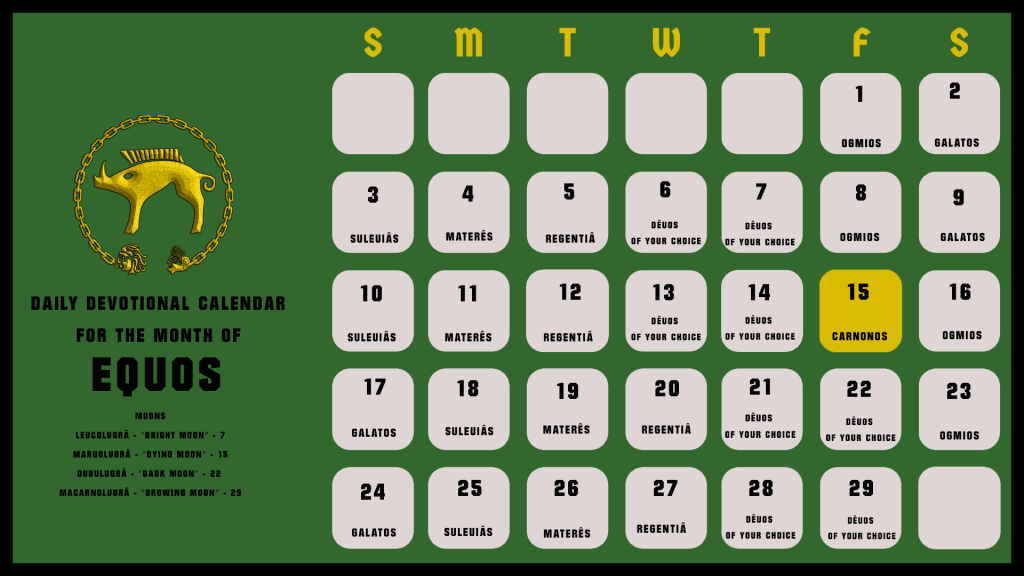
We use our Coligny Calendar app From the beginning of the month, our structure is as follows:
Each First Quarter moon, we will have a new Calendar for you all.
1 – Ogmios (Ancestor of the Gauls)
2 – Toutatis (Guardian of the Toutâ)
3 – Suleuiâs (Good Guides)
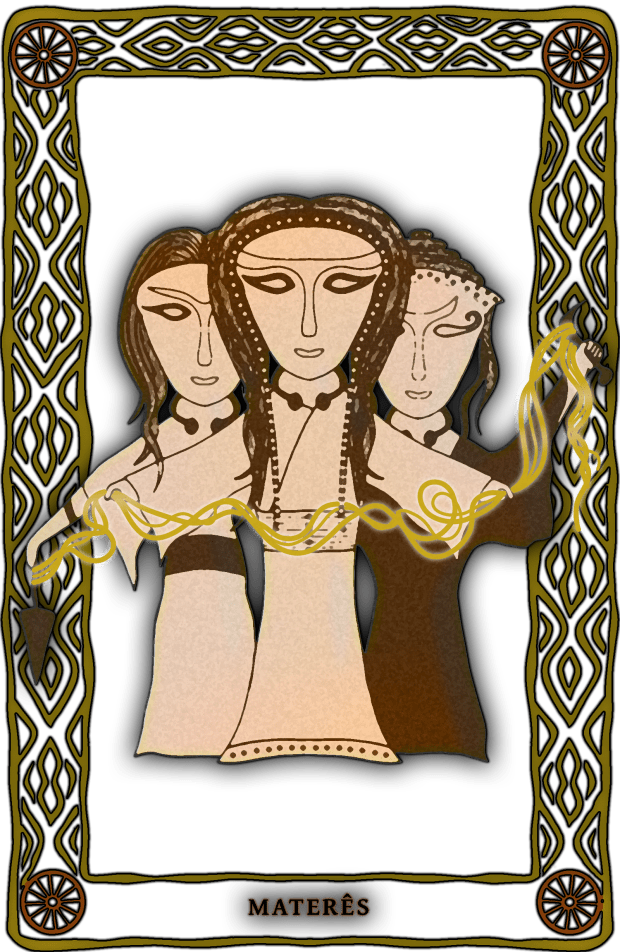
4 – Materês (Knowers of fate, life givers)
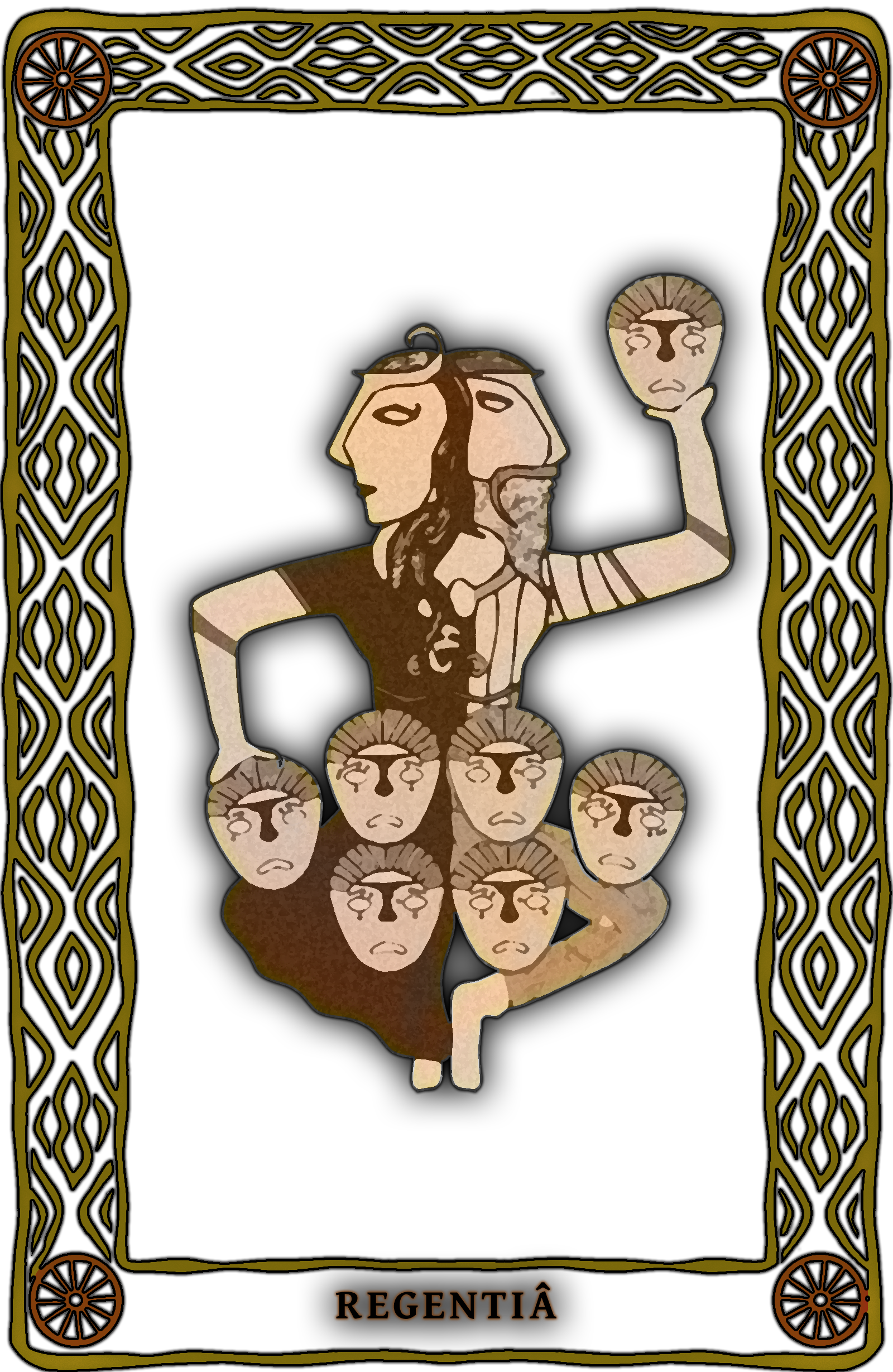
5 – Regentiâ (Ancestors)
6 – Celtînâ (Mother of Virtue)
7 – A “Dêuos of your choice”, or none. Though the former is strongly recommended. Also useful if there is a previous day that one missed. The free spot allows for either a set-aside space for devotional relations or a chance to build new relationships.
This cycle repeats for days 8-14. Thus, we arrive at the middle of the month.
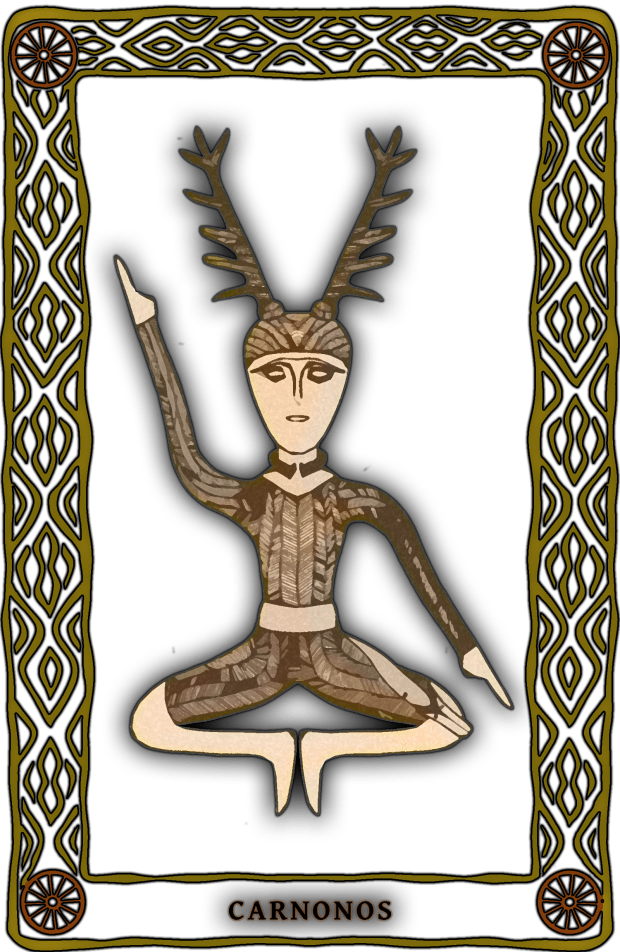
15 – Carnonos (Way opener, guardian between worlds)
After which, the cycle of the first 14 days repeats. Which covers days 16-29.
30 – Carnonos (Way opener, guardian between worlds) Carnonos will only show up again in a month with 30 days. 30-day months are marked matis (good, favorable) 29-day months are marked anmatis (bad, unfavorable)
May the Dêuoi look favorably upon the attempt, and may they give blessings to you all.
Adgariomos/Adgariūmī Ogmion Cintuatîr Galation Mârolabâtis Belolatis Excenu bebanastû, uxelliâ Galation, rodîssestûnis anuan anson Rodîmos/Rodîumî adbertâ etic bratûn tê Addatus Arcimâs Slanon te Bratûn te Molâmos/Molâmî Ogmiû Iâmos/Iâiumî in tancê
Invocation for Ogmios
We/I invoke Ogmios First father of the Galatîs Great speaker Mighty hero From far you came, pride of the Galatîs, you gave us our name We/I give offering and thanks to you Offering Requests Cheer to you Thanks to you We/I praise you Ogmios We/I go in peace
Adgariomos/Adgariūmī Toutaton Latis Toutiâs Nertos urittosergios Uernos Anson Anegestûnis etic rodîestû tancon Rodâmos/Rodâmî addatus etic bratun tê Addatus Arcimâs Slanon te Bratûn te Molâmos/Molâmî Galatû Toutatî Iâmos/Iâiumî in tancê
Invocation for the Toutais Galatos
We invoke the Toutatis Galatos Hero of the people Mighty against disease Our guardian You protect us and give us peace We give offering and thanks to you Offering Requests Cheer to you Thanks to you We/I praise you Toutatis Galatos We/I go in peace
Adgariomos/Adgariūmī Suleuiâs Uernâs uissoues Delgaunâs rextuon Carâs uîrisamâs Esue leucos îani uedetesuîs ollon Rodâmos/Rodâmî addatus etic braton suos Addatus Arcimâs Slanon te Bratûn te Molâmos/Molâmî Suleuiâbo Iâmos/Iâiumî in tancê
Invocation for the Suleuiâs
We/I invoke the Suleuiâs Wise guardians Keepers of right Truest friends You all are the light of virtue, you guide us all We/I give offering and thanks to you all Offering Requests Cheer to you Thanks to you We/I praise you Suleuiâs We/I go in peace
Adgariomos/Adgariūmī Materês Biuotus rodamaunâs Caddos maiamos Uissuaunâs tonceton In geni, biuê, etic maruê, uednis etic messus ollon Rodâmos/Rodâmî addatus etic bratun suos Addatus Arcimâs Slanon te Bratûn te Molâmos/Molâmî Materebo Iâmos/Iâiumî in tancê
Invocation for the Materês
We/I invoke the Materês Life givers Most holy Knowers of fates In birth, life, and death, guiding and measuring us all We/I give offering and thanks to you all Offering Requests Cheer to you Thanks to you We/I praise you Materês We/I go in peace
Adgariomos/Adgariūmī Regentiâ Senomaterês etic Senaterês Senoueniâs Regentiâ coimâs Rodissatesuîs biuotus nîs etic uilietesuîs snî Rodâmos/Rodâmî addatus etic bratun tê Addatus Arcimâs Slanon te Bratûn te Molâmos/Molâmî Regentiobo Iâmos/Iâiumî in tancê
Invocation for the Regentiâ
We/I invoke the Ancestors Old mothers and old fathers Old families Dear Ancestors You gave us life and you watch [over] us We/I give offering and thanks to you Offering Requests Cheer to you Thanks to you We/I praise you Regentiâ We/I go in peace
Adgariomos/Adgariūmī Celtînan Cintumatir Galation Cintus in nertê etic canî Druticos in ollontobi Matirmarâ Galation, uxelliâ aisson, ton boudiâ enatâssetnis Rodâmos/Rodâmî addatus etic bratûn te Addatus Arcimâs Slanon te Bratûn te Molâmos/Molâmî Celtînan Iâmos/Iâiumî in tancê
Invocation for Celtînâ
We/I invoke Celtînâ First mother of the Galatîs First in might and beauty Valourous in all ways Great Mother of the Galatîs, pride of the ages, your glory begat us We/I give offering and thanks to you Offering Requests Cheer to you Thanks to you We/I praise you Celtînâ We/I go in peace
Adgariomos/Adgariūmī Carnonon Uernos mantali Entar bitoues Agetios Ecuoues antê trirîgion sesîi etic ages anatiâ Rodâmos/Rodâmî addatus etic bratûn te Addatus Arcimâs Slanon te Bratûn te Molâmos/Molâmî Carnonû Iâmos/Iâiumî in tancê
Invocation for Carnonos
We/I invoke Carnonos Warden of the roads Between worlds He Who Guides the Herds At the border of the realms, you sit and guide souls We/I give offering and thanks to you Offering Requests Cheer to you Thanks to you We/I praise you Carnonos We/I go in peace
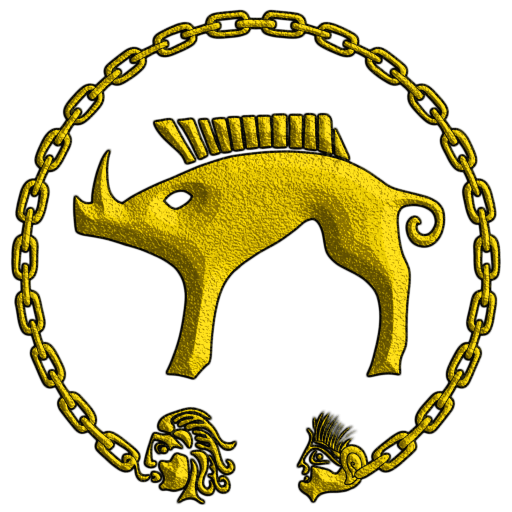
The symbol of Bessus Nouiogalation (BNG) has a few Gaulish elements displayed within it. At the center is a turcos (a boar). The turcos (boar) holds a position of prominence in Gaulish works and displays and is very much associated with them. For us, that means it was important to include it. It is indeed just as common in contemporary works related to the Gauls. The turcos represents galâ (bravery, strength, force, fire, animating vigor.) which may explain the widespread prominence and depictions of them from Gaul and beyond.
“Indigenous deities like Ogmios appear to be heroes par excellence, comparable to Herakles whose heroic deeds were already known in pre-Roman Gaul. In this view, it should not surprise us that Parthenios of Nikaia considered Hercules to be the ancestor of all Gauls, and that Ogmios could be seen as the god from whom all life originates.”
Ogmios holds a special position in BNG as ancestor of the Gauls. As Galatîs, we too include Him among our diverse ancestors. And so we attempt to reforge this connection in our contemporary environment. For this reason, surrounding the turcos are two heads linked by a golden chain. The head on the left is based on a head found on Gaulish coins that we used in the symbol to represent Ogmios. You can see His tongue being connected to the chain. On the right, you see another stylized head. It is representing a follower of Ogmios, with the chain attached to their ear. This allegory of chains connecting the tongue of Ogmios to the ears of His followers is based on a historical account from Lucian of Samosata. (Full account here.) For the relevant parts:
“Our Heracles is known among the Gauls under the local name of Ogmios… [That’s our Ogmios, Lucian!]
This ancient Heracles drags after him a vast crowd of men, all of whom are fastened by the ears with thin chains composed of gold and amber, and looking more like beautiful necklaces than anything else. From this flimsy bondage they make no attempt to escape, though escape must be easy. There is not the slightest show of resistance: instead of planting their heels in the ground and dragging back, they follow with joyful alacrity, singing their captor’s [Hard to say that of the willing, but okay…] praises the while; and from the eagerness with which they hurry after him to prevent the chains from tightening, one would say that release is the last thing they desire.”
So what we glean here is this: His followers follow Him willingly. They could escape at any time due to the weak bonds but choose not to do so. They follow Him willingly and gladly. This valuable account depicts an important insight into Ogmios and the nature of the followers. Thus we are fortunate to have such a piece of lore preserved.
Like these followers, we Galatîs could choose to break from the bonds of Bessus Nouiogalation (Custom of the New Gauls) if we so chose. These aren’t the chains of force or violence. Sadly far too common in the history and present of our world today. Nor is He guileful or deceitful. His eloquence, His îanolabâ (right speech) is His strength, and so He is followed. Equally so, we try to follow the customs of the Senogalatîs (Ancient Galatîs) in our own time. Freely and willingly. We do our best to make Bessus Nouiogalation available freely and openly to those called to or who desire to be Galatîs.
Ogmios’s chains bind only the willing who follow Him gladly. However, there are people around the world who do not have such gentle chains. Who are not bound to a Dêuos like Ogmios, but to cruel and barbaric people. As such, if you’d like to help people who have suffered such anuîrolaniâ (injustice), we’d ask you to consider making a datus (donation) here, to the organization ‘Not For Sale’. Which combats human trafficking and provides resources to survivors.
The Iextis — that is language — is a big part of Bessus Nouiogalation. It informs how we learn and develop custom greatly, as it seeks to develop along the lines of Galatibessus, which centres Gaulish worldview in development. This is why the language is so important, and is privileged over English in our articles and server. After all, English gets plenty of privileges as is.
Without a doubt, learning Gaulish is difficult due to conflicting reconstructions of the tongue, and uncertainties amongst what we do know. As Bessus Nouiogalation means “Custom of the New Galatîs” or “Neo Gaulish Custom”, it is of prime importance that we provide an outlet to help folks who want to put a little more Gaulish in their lives. Whether or not they undergo an in depth study of the language.
The words and phrases provided will be a combination of attested Gaulish. Supplied mostly by Xavier Delamarre’s works ‘Dictionnaire de la Langue Gauloise’ and ‘Les Noms Gaulois’. Along with input from Ranko Matasovic’s ‘Etymological Dictionary of Proto-Celtic’. With reconstructions informed also mainly by Iuomâros Cunouellauni’s Iextis Galation, and buttressed with Olivier Piquerron’s Yextis Keltika (along with the English translation thereof by Tegos Skribbatous). Other sources will be neologisms of attested and reconstructed words that we make ourselves, and pieces of other sources. The idea for this document is based off a previous document with a similar aim written for Toutâ Galation by Selguiros Caranticnos.
While referencing these works it is important to understand that the use of this tanuâ (tongue) is not to academic ends, but instead a key part of Gaulish revival. By using the language we not only remember and honour the Galatîs of the past, but solidify the Nouiogalatis identity of the present and with our greatest hope — the future.
For those not in BNG, especially fellow Galatîs, this document intends to help revive the use of at least a form of Gaulish. We cannot promise complete accuracy, but we’ve given it our best. Hopefully this document provides you with some useful Gaulish or at least Neo-Gaulish words that allow you to bring some of the language into your own life. Also, to understand some of the Gaulish phrases you may see or hear. Peruse at your leisure. All are welcomed and encouraged to participate.
Atelabâmos Iextis Galation! (We speak the Gaulish language again!)
Sounds
Vowels
Vowel are pretty simple. Five vowels each with two sounds. A short and long version.
It should be mentioned that regarding vowels, these are approximations. It is certain that there would have been different accents. As such, think of the vowel pronunciations as more of a guideline than a given. This allows one to see what we figure the sounds would have been. However vowel pronunciation tends to be a marker of accent and it’s okay to be different.
Why the circumflex? The accent marking our long vowels here â, ê, î, ô, and û is called a circumflex. While at first the choice to use these to mark our long vowels as opposed to the usual macron like in: ā, ē, ī, ō, and ū seems a strange one. The reason why it is done here is actually to honour one of the first widespread Gaulish language reconstructions — Labarion, which used the circumflex to mark long vowels. While in Gaulsh writings and inscriptions no such marks exist, we want to honour a dialect that contributed much to the revival of Gaulish usage in the community.
Semi-Vowels
There are two semi-vowels. The letters iand u. Other than their vowel sounds in the above table, they also have consonant sounds.
(For English speakers, the ‘i’makes a ‘y’sound. For Romance language speakers, when used as a consonant, the ‘i’ makes an English ‘y’. For other Germanic language speakers, the ‘u’ is an English ‘w’.)
A general rule for knowing when a semi-vowel is acting as a vowel, and when it is acting as a consonant is this: If there is a vowel after i or u, they are consonants. Example: Iextis, and Uediâ. The first i in iextis is a consonant, as is the u in uediâ.
Why use i and u as semi-vowels when other reconstructions use letters like j, y, and w? This is for two reasons. The first being that those three letters did not exist in Gaulish. The second is that if w or y was used, it would unfairly centre English. Just as one doesn’t change the spelling of say Latin or Greek to suit another language, neither will we.
Diphthongs
Diphthongs are vowel clusters. There are a few of these in Gaulish:
It is worth noting that these do not apply if they are at the conjunction of two words being put together to make one word (E.g. Areuiros, it’s are- then uiros).
Consonants
With the consonants, they’re also quite simple to pronounce. There are a few slight variations that we’ll visit:
For English and Romance language speakers, it’s important to note that the ‘c’ is always “hard”. Always a ‘k’ sound, never an ‘s’ or ‘ç’. The ‘g’ always like (for English speakers) “get”, as it is in Latin (for those who speak Romance languages). Also, for both groups, ‘x’ is like Scottish loch or Welsh bach. It’s called a voiceless velar fricative. For Germanic language and French speakers, the ‘r’ is rolled like in Spanish.
When a consonant doubles (E.g. aballon) pronounce both (abal-lon).
Now… for the fun part!
We have gone over some basics of pronunciation, and now are ready to get into words and phrases. In this document, we aren’t really going to go over grammar as the goal of it is to get you speaking some Gaulish. Stay tuned for more about that in later installments.
There will be a few attested phrases in here, and attested words will be given preference. Neologisms will of course be necessary for words for things that didn’t exist in the time of our ancestors (E.g. Bituuegâ for ‘Internet’). Plus, we’ve made plenty such words by combining whole attested words and using prefixes, suffixes, and infixes. Along with participles and substantives.
Last thing, do not expect a literal one for one exact translation here between Gaulish and any other language. We’ll use Gaulish to convey an idea, but it doesn’t mean each word can be broken down to mean the exact same words in your usual language.
Bisiomos cintus. (We will start.)
[Example there. Cintus means “first” but we’ve worked it to mean “start”.]
For speaking to multiple people, take the word “te” which means “you” in the accusative case (when speaking directly to someone)and replace it with “suos” (the plural form). For ease of use, this pronoun is being separated. But normally, following a verb or preposition, the pronoun would be attached to the word. E.g. uerte instead uer te, or Labâiumite instead of Labâiumi te.
Vocabulary
Greetings and Partings
Subutâ! (“Hello!” or “Goodbye!”)
Rocenon! (“Hello!” but for someone you know well.)
Slanon te! (“Health to you!” as either a toast, or as a more formal greeting.)
Suauelon! (“Bye!” lit. “Good wind!”)
Atepissiumi te! (“I will see you again!”)
Ðironâ nessâtu te. (“Ðironâ approach you.” This can be a morning or evening greeting/blessing.)
Alaunâ nessâtu te. (“Alaunâ approach you.” This is a morning greeting/blessing.)
Suuarin! (“Good morning!”)
Diion dagon! (“Good day!” This can be a usual greeting as well. Perhaps also to send someone off…)
Dercon Grannî uer te. (“Eye of Grannos upon you.” An afternoon greeting/blessing.)
Suarenoxten! (Good evening!)
Noxten dagan! (Good night!)
Text Related Expressions
These expressions are similar to what one sees in text messages and online chats.
Suariumi ueroxos! [suo] (“I laugh on high!” [lol])
Brissumi exsuartû! [bexs] (“I burst from laughing!” [rofl, lmao])
In mon dercû… [imd] (In my eye… [imo])
Incors boccâ iton! [icbi] (“Shut your mouth!” [stfu])
Gniumi. [gm] (“I know.” [ik])
Ne gniumi. [ngm] (“I don’t know.” [idk])
Ne carâiumi. [ncm] (“I don’t care.” [idc])
Sindos. [sin] (“This.”)
Simple Phrases
Lubiumi te! (“I love you!”)
Iâiumi uercon. (“I’m going to work.”)
Biie iaccos disergiosc. (“Be you healthy and removed from sickness/pain.”)
Etic Sucellê boîtu ordon clitân! (“And Sucellos strike hammer to post!” [Don’t let the door hit your behind on the way out!])
Immi rios exuergû. (“I’m free from work.”)
Delge curmi imon… (“Hold my beer…”)
Gentian dagan! (“Happy Birthday!”)
Cobon dagon! (“Good luck!”)
Suuercon! (“Good work!”)
Dêuoi cantite. (“Dêuoi with you.”)
Sagiumi mon uerouos! (“I try my best!”)
Uores mê! (“Help me!”)
Bratun (/Braton) te! (“Thank you!”) [For plural, substitute “te” for “suis” or “suos”.]
Choose a place in which to do Dugiion, that is worship in your home. If you live in a fancy and/or very rustic establishment, you might already have something like a hearth. Odds are, you don’t. In that case, simply use a good surface as an Uentâ, or place of offering/sacrifice. This place will be the focal point of your Tegobessus (House Custom).
Place relevant stuff on it. At minimum, a candle and a bowl. Images or symbols of Dêuoi are all the better! Added dishes for offerings are fine too. Optimally, you’ll want this to face Ari (East). If not Ari, then try Dexouâ (South). If it has to face Eri (West) or Tutos (North), so be it. While East is optimal, something is better than nothing.
Now, what to put upon this Uentâ? At bare minimum you’ll need a Cumbâ (Bowl, also means “valley”, but is not pertinent to this) and a Dagilâ (candle). Whether or not it’s electric isn’t a big deal. But these are the bare minimums. The Cumbâ to hold the Addatus (offering), the Dagilâ for the Aidû (flame), of course.
Of course, many will want to add Deluâs (images) of various Dêuoi (Worshipped Beings). Or symbols: A Rotos (wheel) for Taranis, an Epos (horse) related symbol for Eponâ, and so on. These certainly add character and help focus attention in a ritual on the deuos in question.
We have the why and how. Now for the when:
Planning rites are essential. Try to do them on a regular basis. The point is not to be perfect but to make an attempt at regularity. Do your best, but don’t beat yourself up over not being perfect. Just make it a goal to do the rites on a regular basis. This will allow for a rhythm to your rituals.
There are plenty of intervals on which one might choose to do rites. They could be done daily, weekly, bi-monthly, but at minimum once a month. Another suggestion is moon phases.
One of the most important things to do before a Rite is that of Glanosâgon (Purification). That means making yourself clean and ritually pure. To do this, you may wish to bathe or shower before ritual. At the least it is important to wash the hands and face. As the Gauls were known for using soap, some kind of bar soap would be a nice continuation of that tradition.
Wash hands and say: Glanolamâs “Clean hands” Swipe your forehead and say: Glanobritus “Clean mind” Swipe down the face with both hands and say: Glananation “Clean soul” (This is based on the idea of the soul residing in the head.)
Purify the sacred space
One must purify the sacred space. To do this, we will invoke Nemetonâ. This is vital to establish your space or making a new one. We will use Juniper as this was used by the Senogalatis to clear away snakes and to help with bits from poisonous creatures. So we will use it to clear away any unwanted energies in our space. You will now need a Dagilâ (Candle) to represent Aidona.
Light your Juniper and walk around your area or make a motion around your area in a sunwise circle three times to represent the three realms of Drus (Albios, Bitus, and Dubnos). As you do this, say the below invocation.
We/I invoke Nemetonâ Lady of the Borders Guardian of the Sacred The Great Keeper You give sacredness to the offering space, and you protect against bad spirits We/I give offering and thanks to you Offering Request We/I ask that this place be made sacred Cheer to you Thanks to you We/I praise Nemetonâ It is done
Welcoming Aidona
Aidonâ is the name we give to the spirit of the fire; basically, the hearth personified. We are introducing Aidonâ into our space for the first time so this is a very important step for us.
After the invocation, say
Oibelumî/Oibelomos sinaidû Aidoniâs.
I/We light this flame of Aidonâ.
Say some words welcoming Aidonâ This is very personal and needs to come from you.
[Addatus – Offering] After the offering, take a few moments to kneel, bow, or sit and commune with the recipient(s)
As with any other custom, a Gaulish custom one needs holidays. Those special times of year where we come together to observe specific Dêuoi for specific reasons. As well as attuning ourselves to the cycle of the seasons and what that means for us. Bessus Nouiogalation is no exception.
In a previous article, we talked about the Sequanni / Coligny Calendar. The IVOS clusters on the calendar are thought to denote holidays. That being the case, it gives us an idea of where to put at least some holidays. Therefore, it’s fitting to use those clusters to put forth a kind of list of holidays. Along with that, using their placements in the year, we’ll try to use that as a guide to figure out both what to call these holidays and what they may be about. In this way, even if we don’t know the original traditions, we can be inspired to develop some of our own. For reference sake, we use the BNG Coligny Calendar.
In the history of the calendar, the length of an age, or where the calendar completed its cycle, went from 30 to 25 years as time went by. As the Metonic cycle is the most accurate as far as lunisolar timekeeping goes, as without it, there is quite an eventual drift. It seems to be a good borrowing. This puts the calendar’s full cycle at 19 years. Remembering that the calendar was originally in a temple to Apollo, who was said to make a journey to the land of the Hyperboreans (a mythic people who lived “beyond the lands of the Celts”) every 19 years. So, it’s far from the least plausible leap. By retaining the names of the months and being able to keep up with the same methodology of a lunisolar calendar, we see a synthesis of retaining the old while being able to adapt and borrow as the Gauls themselves did.
So, with that reference noted, we should also say that even without the Metonic adaptation, the holidays are still in the same time range. Though the purpose of this article is not to discuss the calendar, we wanted to give some background into the frame of reference we use for the holidays. What we see when looking at the calendar is that there are several points in the year where the notation ‘IVOS’ is attached to several days in a row. As Iuos notations cluster around certain times of the year, it can be assumed that they are likely holidays. It cannot be said for sure how long a given holiday was observed. As the clusters may point to a range of time in which it was acceptable to observe a given holiday. The pain with the Iuos clusters is that though they are consistent, they still show up in different months on the calendar throughout the years.
Though intercalations are involved with that slight distortion, the timing of the holidays themselves are actually completely consistent. So, on the calendar, the clusters will show up in one month or another, at most two. However, it is still consistent because these clusters are marked by one specific moon. In other words, an Iuos cluster may show up around 1 Simiuisonna one year, and near 1 Equos the next, but it will be the same moon in the lunar cycle. The months start at the first quarter moon, in line with Pliny the Elder’s statement that the Gauls started their months six days after the new moon. This assumes a first-quarter start, and a first-quarter moon is easily visible. If this sounds confusing —and it did to us at first —it will be made clear in this list of holidays.
Remember that the moon (Lugra) is your friend.
A side note: not all of our holidays fall within the calendar clusters. But most do.
Our wheel of the year.
Sonnocingos Nouios“New Year” – This one needs the calendar linked above for reference. As it’s the first day on the calendar itself. 1 Samonios is the date most years. Whenever there is an intercalary month of Quimonios, it is 1 Quimonios.
Diios Nouiogalation “Day of the New Galatîs” – The Birthday of Bessus Nouiogalation always falls on 9 Samoni.
Cintusamos “Start of Summer” Also called Îuos Nantosueltiâs etic Sucelli. Always two first-quarter moons before the summer solstice.
Samolitus “Summer Feast” Also called Îuos Taranes. Always the first quarter moon before the summer solstice.
Trinox Samoni “Three nights of Samonios” – This one also requires the app linked above. Starts on 17 Samonios. Usually, the third quarter moon closest to the summer solstice. However, it can be on or just after it. No more than a week after.
Cerdolitus “Crafting Feast” Also called ÎuosGobanon. Third quarter moon before Cintumessus below.
Cintumessus “First Harvest” Also called Îuos Lugous Always two first-quarter moons after the summer solstice.
Noxsās Decan Grannī The second first-quarter moon before the autumn equinox.
Catus Alisiâs “Battle of Alessia” – Third quarter moon closest to the autumn equinox. Always 17 Ogronios.
Cintugiamos “Start of Winter” Also called Îuos Ogmi. Two first-quarter moons before the winter solstice.
Giamolitus “Winter Feast” Also called Îuos Eponiâs. The full moon closest to the winter solstice.
Adbiuos “To Life, Quickening” Also called Îuos Suleuiânon. Two first-quarter moons after the winter solstice.
Ducospia Carnuton “Rebellion of the Carnutians” – Closest to the full moon before the Spring Equinox. Always 9 Elembi.
Uisonnalitus “Spring Feast” Also called Îuos Sironiâs. Just after the new moon closest to the spring equinox.




 Bessus Nouiogalation